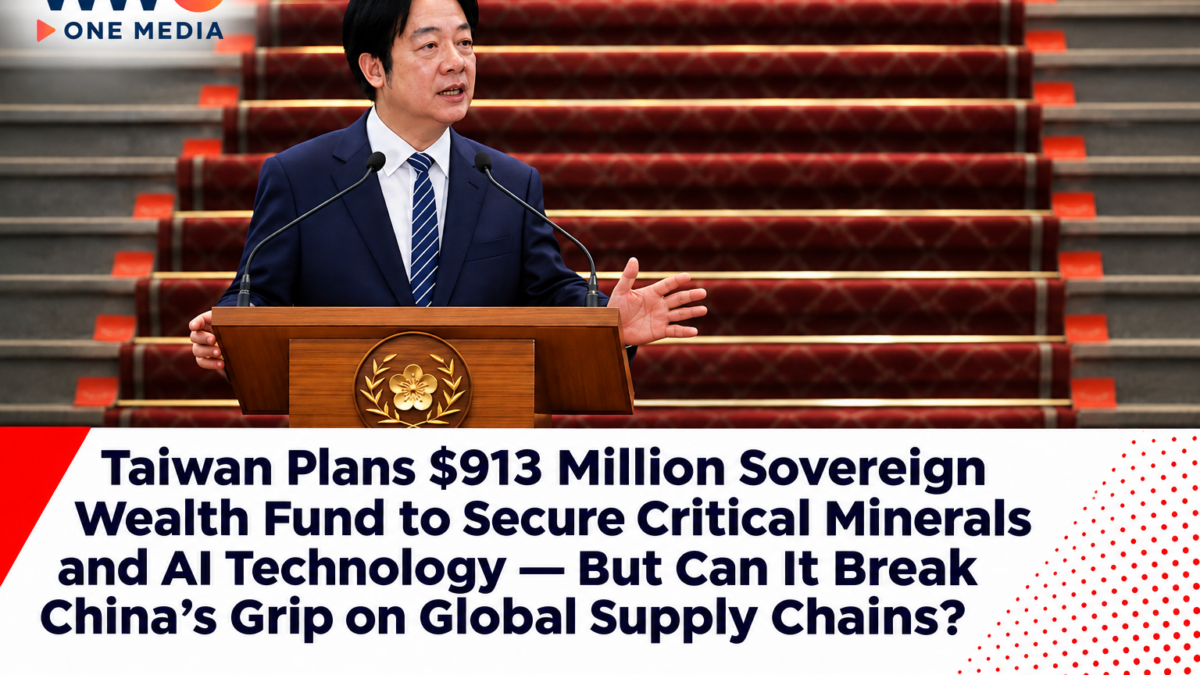
TAIPEI, TAIWAN / MANILA, PHILIPPINES — November 12, 2026 — Taiwan is moving closer to establishing a national sovereign wealth fund, with officials preparing legislation for a new investment vehicle that could begin with approximately NT$30 billion (US$913 million) and target overseas technology, strategic raw materials and international business networks.
The proposed fund represents a major step in President Lai Ching-te’s ambition to strengthen Taiwan’s position in the global economy and help domestic companies expand beyond the island.
According to Bloomberg’s November 12 report, Taiwan is drafting plans for the investment platform and targeting progress on the legislation before the end of the year.
The initiative took shape during a November 11 legislative hearing, when National Development Council Chairman Yeh Jiunn-shyan disclosed that officials were preparing the provisions of a dedicated law.
The council hopes to complete an internal draft before the end of 2026.
The proposed legislation would then undergo discussions with other agencies, including the Ministry of Finance, the central bank and the Financial Supervisory Commission.
Officials are working toward the possibility of submitting the bill to the Legislative Yuan during the first half of 2027.
But the plan faces difficult questions.
Should Taiwan draw on its foreign-exchange reserves to finance investments overseas?
Can a government-backed investment institution compete internationally while protecting public resources?
And could strategic investments help Taiwan reduce its exposure to disruptions in the global supply chains supporting its world-leading semiconductor industry?
The biggest question is whether Taiwan’s proposed wealth fund can become a powerful tool for economic security—or whether disagreements over financing, governance and investment risks will slow the project before it launches.
Taiwan Targets NT$30 Billion for New Sovereign Wealth Fund
Taiwan’s National Development Council has proposed using approximately NT$30 billion as an initial planning benchmark for the new sovereign wealth fund.
The amount is equivalent to roughly US$913 million at the exchange rate used in contemporary local reporting.
It would provide a relatively modest starting point compared with some of the world’s largest sovereign investment institutions.
However, the figure remains preliminary.
Yeh told lawmakers that officials were continuing to examine the amount of capital required, and the eventual figure could change.
The fund has not yet been established.
No final capital appropriation, investment mandate or management structure has been approved.
The government’s immediate priority is to develop a legal framework capable of defining how the fund would operate.
That framework could determine the institution’s objectives, oversight arrangements, investment authority and funding mechanisms.
For international investors, the announcement signals Taiwan’s intention to play a more direct role in overseas strategic investment.
For domestic businesses, it raises the possibility of a government-backed partner able to participate in international expansion.
Lai Ching-te’s Global Investment Ambition Moves Forward
President Lai Ching-te first announced the sovereign wealth fund proposal on May 20, 2025, during a speech marking his first year in office.
His objective was to establish a national investment platform that would combine government resources with private-sector expertise.
The initiative was designed to help Taiwanese companies expand internationally while strengthening the island’s economic competitiveness.
Taiwan has already developed globally influential businesses in semiconductors, electronics manufacturing, computing hardware and advanced technology.
However, its companies operate within supply chains extending across the United States, Asia and Europe.
Expanding internationally can give Taiwanese businesses access to customers, production facilities, technology and specialized materials.
A sovereign wealth fund could potentially support selected strategic transactions that might be difficult for individual companies to finance independently.
But the initiative is not intended to replace private investment.
The proposed approach emphasizes cooperation between government institutions and businesses.
That means the fund’s effectiveness would depend on the quality of investment decisions and the strength of its partnerships.
Why Taiwan Wants to Invest Overseas Instead of Focusing at Home
One important feature distinguishes the proposed sovereign wealth fund from Taiwan’s existing public investment institutions.
Officials say the new fund would concentrate primarily on overseas strategic investments.
Taiwan already has the National Development Fund, which supports domestic industrial development, innovation and investment activity.
Creating another institution with an identical mandate could produce unnecessary duplication.
The government therefore wants to define a separate role.
Yeh identified potential opportunities involving international distribution channels, critical raw materials and important technologies.
The proposed fund could help Taiwanese businesses gain access to markets or resources that are strategically important but difficult to secure through ordinary commercial arrangements.
Financial returns would remain part of investment evaluation.
However, maximizing short-term profit would not necessarily be the fund’s sole objective.
The government is considering a structure that weighs national economic interests alongside financial performance.
That approach introduces a central challenge: determining how to measure success when strategic benefits may be difficult to quantify.
Critical Minerals Could Become a Major Investment Priority
Taiwan’s semiconductor industry depends on an international network of suppliers providing advanced materials, chemicals, precision equipment and specialized components.
Some of those resources are concentrated in a limited number of countries.
China is particularly influential in the processing and supply of several strategically important minerals.
That creates potential vulnerabilities when export restrictions, geopolitical disputes or logistical problems affect availability.
As WWC ONE MEDIA reported in its investigation into China’s reported slowdown in critical-metal shipments to Taiwan, companies have faced concerns about delays and uncertainty in obtaining some specialized materials.
The report examined potential implications for semiconductors, optics and advanced manufacturing.
A sovereign wealth fund could eventually help Taiwan participate in overseas projects involving raw-material production, processing or distribution.
Such investments might support diversification and reduce reliance on particular suppliers.
However, officials have not announced specific mining investments, mineral acquisitions or supply agreements under the proposed fund.
The strategic-materials mandate remains at the planning stage.
Taiwan’s Semiconductor Industry Gives the Fund a Global Mission
Taiwan occupies a central position in the world’s semiconductor supply chain.
Its manufacturers supply advanced components used in artificial intelligence, smartphones, data centers, telecommunications and industrial equipment.
The growth of AI infrastructure has increased demand for advanced chips and related manufacturing capacity.
As WWC ONE MEDIA examined in its coverage of Taiwan’s cleanroom engineering companies benefiting from the AI factory boom, the expansion is creating business for equipment suppliers and specialized factory-engineering contractors.
Those companies participate in a complex ecosystem that extends far beyond semiconductor designers and manufacturers.
Taiwanese firms are also expanding internationally to remain close to major customers.
A strategic investment fund could potentially support that process by helping businesses establish relationships with overseas manufacturers, technology providers and supply-chain partners.
But participating in international ventures would carry risks.
A project may face construction delays, regulatory changes, cost increases or weaker-than-expected demand.
The existence of a sovereign investor does not guarantee commercial success.
Where Will the Money Come From?
The financing structure is among the biggest unresolved questions.
Taiwan’s National Development Council is considering several possible funding sources.
These include paid allocations from the central bank’s foreign-exchange reserves, special government bonds, debt issued by the future fund company and participation by private investors.
Insurance companies and four major public funds could also be invited to participate in selected investments.
The proposed approach would allow Taiwan to draw from multiple sources rather than depend entirely on direct budget appropriations.
However, each financing mechanism creates different obligations.
Government bonds require interest payments and eventual repayment.
Corporate bonds issued by the investment vehicle would also create financing costs.
Participation by insurance companies or public funds would require agreement on financial terms and risk-sharing arrangements.
The National Development Council has indicated that ordinary fiscal surpluses are not currently included in the financing plan.
Officials must still determine how the final structure would operate.
Central Bank Foreign-Exchange Reserves Become a Major Political Question
The possible use of central bank reserves has attracted particular attention.
Foreign-exchange reserves support a country’s ability to manage external financial obligations and respond to currency-market disruptions.
They are generally invested with considerable attention to liquidity, safety and appropriate returns.
Sovereign wealth funds often pursue longer-term investment opportunities, some of which may involve greater risk or reduced liquidity.
Combining these objectives can create tension.
Taiwan’s central bank governor, Yang Chin-long, has emphasized that reserve assets should not simply be transferred to the proposed fund without compensation.
Yeh told lawmakers that any arrangement involving reserve resources would be structured on a paid basis rather than a free transfer.
That distinction matters because the central bank would need to preserve the financial integrity of its reserve-management operations.
Any future arrangement would require clear rules governing compensation, risk and the ownership of the underlying resources.
The plan has not established that Taiwan will transfer a specific amount of foreign-exchange reserves to the fund.
Could Special Government Bonds Finance the Expansion?
The Ministry of Finance could potentially issue special bonds to raise capital.
Another option would involve bonds issued by the company established to manage the sovereign fund.
Borrowing can help finance investments without requiring the entire initial amount to be supplied through an immediate budget transfer.
However, debt financing introduces obligations that must be met regardless of investment performance.
If overseas investments produce lower returns than expected, borrowing costs could reduce the fund’s financial results.
If investments suffer substantial losses, public institutions may face pressure to provide additional support.
That makes conservative leverage policies and transparent reporting particularly important.
Officials have not finalized how much borrowing, if any, the investment vehicle would undertake.
Nor have they announced the interest rates, maturities or guarantees that would apply to future bonds.
The proposals remain options under consideration.
Singapore and South Korea Offer Models — But Taiwan May Choose a Different Path
Taiwanese officials have examined international sovereign investment institutions, particularly those operating in Singapore and South Korea.
Singapore has developed globally influential investment organizations, including GIC and Temasek.
South Korea operates the Korea Investment Corporation under a dedicated legal framework.
These institutions demonstrate different approaches to public investment management.
Some focus heavily on long-term financial returns.
Others combine commercial objectives with broader strategic considerations.
Taiwan’s government has indicated that it may draw lessons from overseas experience without copying another country’s governance model.
Yeh told lawmakers that Taiwan’s legal and institutional circumstances differ from those of Singapore and South Korea.
The proposed fund would therefore require a structure suited to Taiwan’s existing public institutions.
Important decisions remain unresolved, including whether investment management would be conducted directly by a public entity, through a separate company or with external professional managers.
The governance arrangements could prove as important as the fund’s initial capital.
Indonesia Shows How Sovereign Wealth Funds Can Attract Private Capital
Sovereign investment institutions are becoming increasingly active across Southeast Asia.
Indonesia Investment Authority has pursued partnerships intended to attract institutional capital into major investment projects.
As WWC ONE MEDIA reported in its November 11 coverage of the Indonesian sovereign fund’s investment in Vena Group’s 2.8-gigawatt renewable energy portfolio, sovereign investors can participate alongside private institutions in long-term infrastructure development.
The partnership gives Indonesia’s investment authority exposure to renewable energy projects across the Philippines and Indonesia.
However, the transaction’s financial terms and precise project-level allocations were not fully disclosed.
The example illustrates both the opportunities and limitations of sovereign investment partnerships.
A public investment platform can help attract additional investors.
But financial transparency, contractual safeguards and realistic return expectations remain essential.
Taiwan’s proposed fund could eventually explore similar partnership structures.
That does not mean it will pursue the same industries or investment strategy as Indonesia.
Taiwan’s Existing National Development Fund Faces Scrutiny
The legislative discussion also highlighted questions about Taiwan’s existing public investment programs.
Lawmakers reviewed performance and oversight issues involving the National Development Fund’s angel investment initiative.
According to a Ministry of Audit review cited during the discussions, 71 of 245 companies receiving investment had unrealized losses exceeding one-third of their investment costs.
Those losses totaled approximately NT$930 million.
The initiative was nevertheless reported to have an overall portfolio gain of around NT$37 million.
The figures demonstrate why individual investment losses should be assessed in the context of the overall portfolio.
Startup investing carries considerable risk, and some companies may fail even when the investment program as a whole produces positive returns.
However, the findings also raised concerns about monitoring, oversight and the quality of investment supervision.
Yeh acknowledged the need for improvements and outlined plans for further review.
For the proposed sovereign wealth fund, the debate provides a warning.
A new investment institution will require clear decision-making procedures, conflict-of-interest safeguards and meaningful accountability.
The Biggest Risk May Be Governance, Not Capital
Raising NT$30 billion could be a substantial undertaking.
But managing that capital responsibly may be an even greater challenge.
A sovereign wealth fund makes decisions involving public resources or assets connected to public institutions.
That creates responsibilities beyond those of an ordinary private investment company.
Its investment managers may face pressure to support politically attractive projects even when commercial prospects are weak.
They may also encounter conflicts involving companies, financial institutions or officials connected to proposed investments.
Transparent governance can help reduce those risks.
Important safeguards may include independent investment assessments, clear mandates, professional management and regular financial reporting.
Authorities must also decide how investment performance will be measured.
If the fund is designed partly to improve Taiwan’s access to critical technologies or strategic materials, conventional annual returns may not capture all of its objectives.
But strategic benefits must still be evaluated using credible standards.
Otherwise, public investment decisions could become difficult to scrutinize.
Taiwan’s Overseas Investments Could Extend Into Southeast Asia
Taiwanese businesses are already expanding their industrial presence across Southeast Asia.
The Philippines is one example.
As WWC ONE MEDIA reported in its coverage of a Taiwanese company’s proposed US$1-billion manufacturing project at New Clark City, Taiwanese investment is contributing to plans for advanced manufacturing and industrial development in the Philippines.
The project highlights the potential for commercial cooperation involving technology transfer, manufacturing facilities and skilled workers.
However, that private-sector project has not been identified as a prospective investment of Taiwan’s proposed sovereign wealth fund.
Any future fund participation in the Philippines would require a separate announcement and agreement.
Nevertheless, Southeast Asia offers potential opportunities in manufacturing, logistics, infrastructure and emerging technologies.
The region’s growing industrial base could make it relevant to Taiwan’s wider international investment strategy.
What Does This Mean for the Philippines?
The establishment of a Taiwanese sovereign wealth fund could eventually create additional opportunities for regional investment.
But those possibilities remain speculative until the fund is approved and begins operations.
Taiwanese companies already participate in international electronics and manufacturing supply chains, including those connected to Southeast Asia.
A government-backed investment platform focused on overseas strategy could potentially support projects involving industrial development, distribution networks and specialized technology.
For the Philippines, the most relevant opportunities would be in sectors that align with Taiwanese industrial expertise and local investment priorities.
These could include advanced manufacturing, electronics, logistics and selected infrastructure projects.
However, no verified announcement currently establishes that Taiwan plans to allocate part of the proposed NT$30 billion specifically to Philippine investments.
The country should therefore be viewed as a possible regional partner, not an announced beneficiary.
Why Taiwan’s Proposal Matters to Global Investors
The sovereign wealth fund would give Taiwan another potential instrument for international economic engagement.
Taiwanese companies already have major positions in technology supply chains.
The proposed institution could provide capital for partnerships extending beyond the operations of individual businesses.
For investors, the initiative may eventually create opportunities involving co-investment, infrastructure financing and strategic industrial assets.
But the fund’s modest proposed starting size is important.
At approximately US$913 million, its initial capital would be much smaller than that of established global sovereign wealth funds.
It would not automatically become a major force in global financial markets.
Its significance would depend on how effectively it deploys capital and attracts partners.
A smaller fund with disciplined investment criteria could potentially deliver meaningful strategic benefits.
A larger institution with weak governance could create substantial financial risks.
The government must decide how to balance those considerations.
Can Taiwan Complete the Legislation by December?
The National Development Council hopes to complete its internal legislative draft before the end of 2026.
Officials then intend to consult the Ministry of Finance, the central bank and the Financial Supervisory Commission.
The objective is to reach a framework suitable for submission to the Legislative Yuan.
Lawmakers have urged the government to pursue progress while ensuring that the legislation is comprehensive.
Yeh said officials would work toward submission during the first half of 2027.
However, he did not guarantee that timeline.
Issues involving financing, governance and the treatment of reserve assets could require additional discussions.
Even after a bill is submitted, it would need to proceed through the relevant legislative process before the fund could be formally established.
Completing an internal draft is therefore only one stage.
The fund will not exist as an operational institution merely because officials finish preparing proposed legislation.
What Happens Next?
Several decisions will determine the future of the sovereign wealth fund.
The first is the amount of initial capital.
The second is the funding arrangement involving central bank reserves, bonds and potential institutional partners.
The third is the investment mandate, including the balance between financial returns and strategic national objectives.
The fourth is the governance structure.
The fifth is the legislative timetable.
Once those issues are resolved, the government would still need to establish the institution, appoint management and develop investment procedures.
Only then could it begin making investments.
Until that happens, specific project announcements should not be attributed to the sovereign wealth fund without supporting evidence.
The Bottom Line: Taiwan Wants a New Financial Tool for a More Uncertain World
Taiwan is taking an important step toward establishing a sovereign wealth fund intended to strengthen its position in global technology and industrial supply chains.
The government is considering an initial capital base of approximately NT$30 billion and a mandate focused primarily on overseas investments.
Its priorities could include distribution networks, strategically important raw materials and critical technologies.
The proposal reflects President Lai Ching-te’s wider ambition to connect Taiwanese businesses more closely with international markets.
But major questions remain.
The fund’s financing has not been finalized.
Its governance structure is still under discussion.
The use of foreign-exchange reserves requires careful safeguards.
And the legislation has not yet been enacted.
Taiwan’s challenge is not simply creating a new pool of investment capital. It is building an institution capable of strengthening economic resilience while protecting the public resources used to finance it.
As Taiwan prepares a year-end draft law for its proposed US$913-million sovereign wealth fund, could overseas investments help secure the technologies and resources that power its semiconductor economy—or will financing disputes, governance risks and geopolitical pressures prevent the fund from achieving its ambitions?