JAKARTA, Indonesia — November 12, 2026 — Indonesia’s political establishment is facing mounting pressure after allegations emerged that senior police officials illegally monitored President Prabowo Subianto and other influential figures, triggering arrests, parliamentary scrutiny and growing tensions involving former president Joko Widodo.
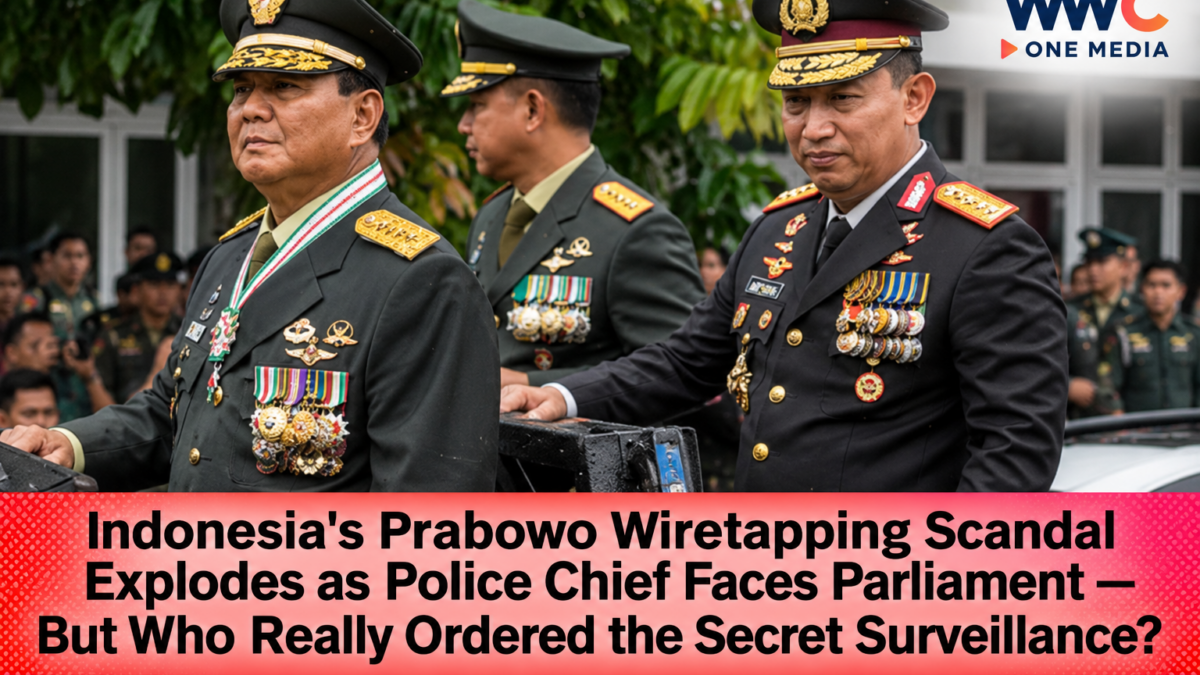
The scandal is entering another critical phase as National Police Chief Gen. Suyudi Ario Seto prepares to face lawmakers on Thursday, November 12, to answer questions about the alleged surveillance operation.
At the center of the controversy is former police chief Gen. Listyo Sigit Prabowo, who was recently appointed presidential chief of staff before being detained in connection with the investigation.
Three senior police generals have been detained, while a fourth high-ranking police official has also been implicated.
Investigators are examining allegations that communications belonging to the president, government officials, politicians, journalists, civil society representatives and business executives were intercepted without proper authorization between 2025 and 2026.
But one critical question remains unanswered: Who ordered the operation, and was it an isolated abuse of police authority or part of a much wider surveillance network?
The Associated Press reported that lawmakers want the police chief to explain the suspected operation, determine whether additional individuals were involved and establish the motive behind the alleged wiretapping.
The investigation has also intensified scrutiny of Prabowo’s relationship with his predecessor, Widodo, popularly known as Jokowi.
Police Chief Faces Parliament as Indonesia Demands Answers
The parliamentary questioning comes as Indonesia’s House of Representatives intensifies its examination of the allegations.
Commission III, which oversees legal affairs, human rights and security matters, is expected to question Suyudi about the investigation and the possible involvement of other officials.
Lawmakers are particularly interested in determining who authorized the suspected surveillance and whether the operation extended beyond the individuals already identified by investigators.
Commission III Chairman Habiburokhman said the inquiry would continue until the facts were fully established and anyone found responsible was held legally accountable.
The investigation is especially sensitive because the alleged surveillance involved the country’s highest political office.
Authorities have suggested that the monitoring may have exposed confidential government communications and threatened national interests.
However, investigators have not publicly established the full motive or identified everyone who may have participated.
The parliamentary inquiry could therefore become an important test of accountability within Indonesia’s law-enforcement institutions.
Three Senior Police Generals Detained Over Alleged Spying on Prabowo
The controversy erupted after Indonesian police announced the detention of three senior officers suspected of participating in an illegal wiretapping operation.
They include:
- Gen. Listyo Sigit Prabowo – Former National Police chief and recently appointed presidential chief of staff.
- Insp. Gen. Ahrie Sonta Nasution – Head of the National Police Legal Division.
- Insp. Gen. Eko Hadi Santoso – A senior police officer associated with the National Police Education and Training Institute.
A fourth senior police official has also been implicated in the developing investigation.
Police allege that the unauthorized surveillance took place between 2025 and 2026, when Listyo was still leading the National Police.
Investigators are examining possible unlawful interception of communications, unauthorized access to electronic systems and the deletion of electronic information.
The alleged targets reportedly included President Prabowo, Cabinet members, politicians, journalists, community leaders, nongovernmental organization representatives and businesspeople.
According to the Associated Press, investigators seized 11 mobile phones, one iPad and four USB flash drives while examining the suspected operation.
Police also questioned witnesses and technical experts as part of the investigation.
The suspects have not been convicted, and their alleged involvement must still be established through proper legal proceedings.
Deleted Recordings Could Become a Major Breakthrough in the Investigation
One of the most disturbing aspects of the case involves allegations that recordings of Prabowo’s telephone conversations were deliberately deleted.
According to the AP report, police said Ahrie Sonta Nasution allegedly requested permission from Inspector General Slamet Uliandi to delete recordings of the president’s calls.
Investigators allege that Uliandi approved the request and the files were subsequently removed.
This development has raised questions about whether the suspected surveillance operation involved attempts to conceal evidence.
Digital records could be crucial in determining who authorized the interceptions, which telephone numbers were monitored and whether the information was shared with other individuals.
The investigation must also establish whether the deleted material can be recovered and whether other copies remain available.
Nasution’s lawyer, Krisna Murti, did not directly address the allegations but said his client would cooperate with investigators.
The alleged deletion is particularly significant because it could provide investigators with evidence about how the surveillance system was accessed and controlled.
However, the accusations still require verification through digital forensic examination and legal proceedings.
Why Is Jokowi Being Dragged Into the Wiretapping Scandal?
The investigation has become politically explosive because of Listyo’s longstanding relationship with former president Joko Widodo.
Listyo became national police chief in 2021 under Jokowi and remained in the position during the early part of Prabowo’s administration.
He was widely regarded as a close associate of the former president.
That connection has intensified speculation about the political implications of his detention.
Prabowo and Jokowi were once presidential rivals, competing against each other in the 2014 and 2019 elections.
Their political relationship changed dramatically ahead of the 2024 presidential election, when Jokowi supported Prabowo’s presidential campaign.
The alliance also brought Jokowi’s son, Gibran Rakabuming Raka, into the national leadership as vice president.
However, analysts have increasingly questioned whether the political partnership between the two camps is beginning to weaken.
The reassignment of Listyo from national police chief to presidential chief of staff, followed by his detention, has added another layer of uncertainty.
According to analysis published by the Lowy Institute, the wiretapping allegations have revived the political rivalry between Prabowo and Jokowi and could threaten the alliance that helped bring them together.
The Financial Times has also reported that the controversy risks escalating into a wider confrontation among Indonesia’s political elite.
Nevertheless, there is no established evidence that Jokowi ordered, approved or knew about the alleged surveillance operation.
His political relationship with the suspects should not be treated as proof of involvement.
Prabowo’s Government Raises the Possibility of Treason
The presidential administration has treated the alleged surveillance as a serious national-security concern.
Government spokesperson Prasetyo Hadi previously suggested that the suspected actions could fall within conduct associated with treason because of the potential threat to the president and state interests.
The possibility of treason has significantly raised the political stakes.
If the alleged operation was intended to undermine the president’s ability to exercise executive authority, the consequences could extend beyond ordinary violations of surveillance procedures.
However, Indonesia’s Coordinating Minister for Law, Human Rights, Immigration and Corrections, Yusril Ihza Mahendra, previously said investigators had found no indication of treason in the case involving the detained officers.
These differing official assessments highlight why the investigation remains important.
An unauthorized surveillance operation, even one targeting the president, does not automatically establish a coup attempt or treason.
Authorities must prove the actual conduct, motive and involvement of each individual before criminal responsibility can be determined.
For now, the central questions remain unresolved.
Nearly 21,000 Military Personnel Placed on Alert in Jakarta
The wiretapping controversy has also attracted international attention because of heightened military readiness in the Indonesian capital.
The Associated Press reported that approximately 20,980 military personnel were assigned to Jakarta, with another 13,140 personnel available on standby if additional forces were needed.
The mobilization occurred as the surveillance investigation intensified.
The timing has raised speculation about whether the government anticipates a wider security threat.
However, officials have not confirmed that the military preparations were specifically ordered in response to the wiretapping arrests.
The military has described its readiness in terms of protecting national sovereignty and responding to potential threats.
It would therefore be inaccurate to claim that Indonesia is facing a confirmed coup attempt or that the military has been deployed to confront a proven political conspiracy.
Still, the combination of a major security investigation, political tensions and heightened military readiness has placed Jakarta under international scrutiny.
For additional background, read WWC One Media’s report on Indonesia’s nearly 21,000 military personnel placed on alert in Jakarta amid the wiretapping scandal.
Amnesty International Raises Concerns Over Civil Liberties
The alleged monitoring of journalists, activists and other civil society figures has raised concerns beyond the immediate political dispute.
Amnesty International has called for a comprehensive investigation, warning that unauthorized surveillance could be used to intimidate critics and undermine fundamental freedoms.
The issue extends beyond the privacy of political leaders.
Journalists depend on confidential communications to protect sources and investigate matters involving public interest.
Activists and nongovernmental organizations also need secure communication channels to organize their activities and engage with communities.
If surveillance powers were used without proper legal authorization, the consequences could affect public confidence in Indonesia’s democratic institutions.
The investigation must therefore establish whether the alleged operation targeted individuals because of legitimate criminal investigations or whether the surveillance was used for improper purposes.
Authorities have not yet disclosed the complete list of alleged targets or established the full extent of the monitoring.
Indonesia’s Political Crisis Is Growing Beyond the Wiretapping Allegations
The controversy is unfolding alongside other political challenges facing Prabowo’s administration.
Vice President Gibran has faced scrutiny over his educational credentials, while political groups have debated possible parliamentary action concerning his eligibility for office.
The dispute has added pressure to the relationship between Prabowo and Jokowi, who remains an influential political figure.
Gibran’s position is particularly sensitive because he is Jokowi’s son and became vice president through the political alliance that helped Prabowo win the 2024 election.
The wiretapping investigation and Gibran’s education controversy are separate matters, but both have intensified attention on Indonesia’s political leadership.
WWC One Media previously examined the growing controversy in its report on 120 lawmakers pushing an impeachment challenge against Vice President Gibran.
Another report explored how the Prabowo-Jokowi political rift could deepen amid parliamentary scrutiny of Gibran.
The simultaneous developments have created a difficult political environment for the administration.
However, there is no established evidence that the wiretapping allegations and the dispute surrounding Gibran are parts of a single coordinated operation.
What Happens Next? Four Questions That Could Change the Investigation
The parliamentary questioning of the police chief could help clarify several unresolved issues.
1. Who ordered the alleged surveillance?
Investigators must determine whether the operation originated with the detained officials or whether additional individuals gave instructions.
2. Who received the intercepted information?
Authorities have not established whether the recordings were used for political, personal or other purposes, or whether they were shared with anyone outside the suspected operation.
3. Can investigators recover the deleted recordings?
Digital forensic evidence could help reconstruct the alleged surveillance operation and establish whether records were deliberately destroyed.
4. How many other people were monitored?
The reported targets include several categories of influential figures, but authorities have not disclosed the complete list or the total number of affected individuals.
The answers could determine whether the investigation remains focused on a small group of senior officers or expands into a much wider examination of Indonesia’s security institutions.
Indonesia Faces a Defining Test of Political Accountability
The alleged wiretapping scandal has become one of the most serious political and security controversies facing Prabowo’s administration.
A former national police chief and other senior officers have been detained, electronic evidence has been seized, and lawmakers are preparing to question the current police chief.
At the same time, the investigation has revived questions about the relationship between Prabowo and Jokowi, the independence of law-enforcement institutions and the protection of civil liberties.
For Prabowo, the challenge is to demonstrate that even the country’s most powerful officials are not above the law.
For Indonesia, the stakes are much broader.
The investigation could expose weaknesses in the country’s surveillance safeguards and force the government to reconsider how sensitive communications are monitored and protected.
But the most important question remains unanswered: Was the alleged wiretapping an isolated abuse of authority, or will investigators uncover a much wider network operating inside Indonesia’s security establishment?
As the police chief faces parliament and investigators continue examining the deleted recordings, Indonesia’s political establishment may be approaching a moment that could redefine the relationship between its president, former leader and powerful security institutions.