
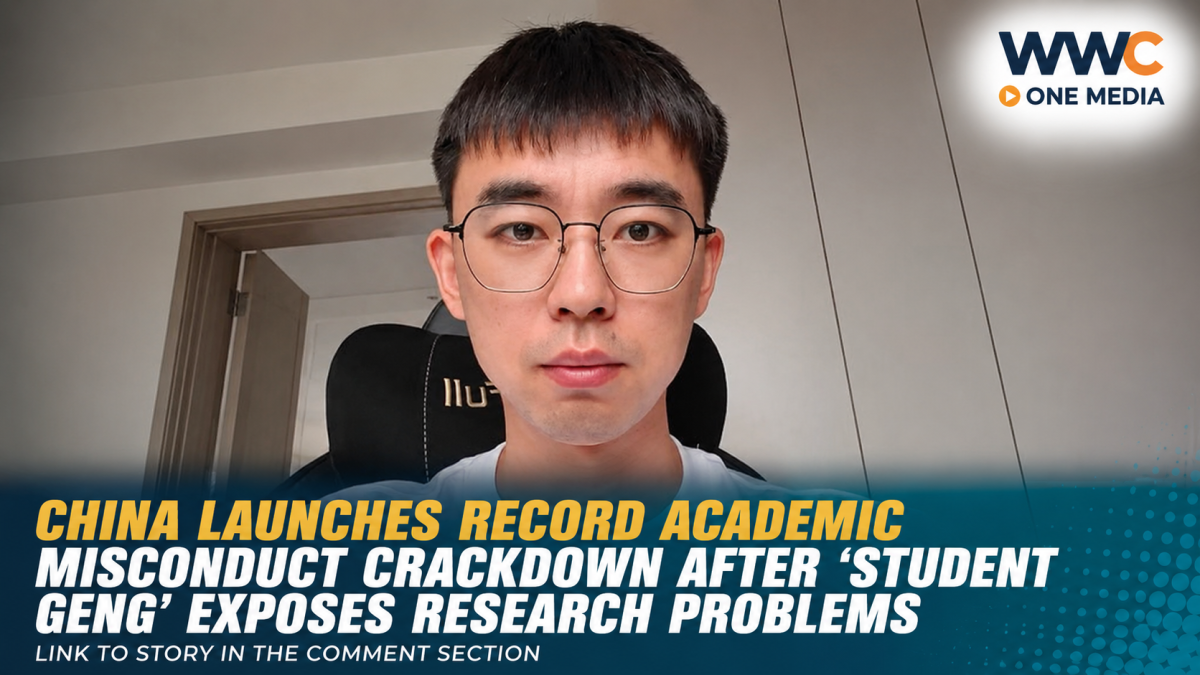
China has escalated its fight against academic misconduct after a viral whistleblower’s allegations against prominent researchers triggered a wave of university investigations — culminating in what the country’s top basic-research funding agency describes as its largest public disclosure of misconduct cases to date.
The National Natural Science Foundation of China (NSFC) published details on August 28 covering 31 cases involving more than 40 researchers at universities and hospitals across the country. The cases include allegations or findings involving fabricated or manipulated data, plagiarism, improper authorship, buying or selling research data, and other violations.
The announcement has drawn particular attention because four prominent academics previously flagged by a blogger known as “Student Geng” were included in the NSFC action.
The whistleblower who put China’s research system under the spotlight
The controversy erupted in April, when Geng Hongwei, a former PhD student and online science blogger known as “Student Geng,” began publicly questioning research papers by senior Chinese academics.
His scrutiny focused heavily on unusual data patterns and questionable images in papers published in prestigious international journals, including Nature and its specialist titles. Nature reported in June that four senior Chinese academics had already faced disciplinary action following his allegations.
The episode quickly became much bigger than a dispute over individual papers. Universities began launching investigations, while several senior academics lost administrative positions after institutional reviews confirmed problems with specific research work.
Four high-profile academics now face NSFC sanctions
The latest NSFC disclosure includes four researchers who had previously been publicly identified by Geng.
All four had received recognition under China’s National Science Fund for Distinguished Young Scholars, while three had held dean or associate-dean positions, according to the South China Morning Post.
The NSFC says sanctions include revoking relevant research projects, recovering previously allocated funding and suspending eligibility to apply for NSFC funding for periods ranging from three to seven years, depending on the case.
For the four cases connected to the controversy:
- Wang Ping, formerly of Tongji University, was sanctioned over research-data fabrication or manipulation. The NSFC revoked three related projects and ordered funding to be recovered, while barring him from applying or participating in applications for five years.
- Chen Quan, formerly dean of Nankai University’s School of Life Sciences, was sanctioned after an investigation found that portions of data had been estimated and that other data had been reused or incorrectly pasted. Two related projects were revoked and funding was ordered recovered, with a five-year application restriction.
- Su Jiaqian, formerly head of Shanghai University’s Institute of Translational Medicine, was sanctioned in a case involving fabricated data. His related project application was withdrawn and he received a five-year restriction on NSFC applications.
- Kuang Dongming, formerly associate dean of Sun Yat-sen University’s School of Life Sciences, was sanctioned over data adjustments and problems involving the use of images. Four related projects were revoked, funding was ordered recovered and a three-year application restriction was imposed.
These NSFC decisions follow disciplinary actions already announced by the universities involved. For example, Tongji University previously removed Wang from his dean position and reduced his professional rank, while Nankai and Sun Yat-sen universities also announced disciplinary measures involving senior academics.
But the crackdown goes far beyond the “Student Geng” cases
One important point is that the 31-case NSFC announcement is not limited to Geng’s allegations.
The official NSFC notice covers a much broader range of misconduct and regulatory violations. Among the cases are plagiarism, fabrication or manipulation of research data, buying experimental data, unauthorized use of another person’s name, third-party submission of papers or grant applications, and attempts to obtain confidential information about project reviews.
The NSFC has also warned research institutions that they must take responsibility for maintaining research integrity and properly supervising projects and publications. It said serious cases can result in inclusion in China’s database of serious research-integrity violations and other joint sanctions.
That makes the latest announcement significant beyond the four high-profile professors: Beijing is signaling that research institutions themselves are expected to take greater responsibility for preventing and detecting misconduct.
Why this matters for China’s scientific ambitions
The controversy comes at a sensitive moment for China, which has invested heavily in becoming a global leader in science and technology.
China’s universities and research institutions now produce enormous volumes of scientific research, while Chinese scientists have become major contributors to leading international journals. That makes confidence in the reliability of published research increasingly important to China’s scientific reputation.
Nature described the Geng episode as a rapidly developing research-integrity controversy, noting that his viral accusations prompted unusually swift investigations and disciplinary responses.
The episode also exposes a difficult question for the scientific system: How should institutions balance rapid action against allegations with the need for careful, evidence-based investigations?
An online accusation is not itself proof of misconduct. In the cases discussed above, the relevant universities and the NSFC subsequently conducted their own investigations and issued formal decisions. Those official findings — rather than the original social-media allegations alone — are the basis for the sanctions reported here.
A warning to China’s research establishment
The NSFC’s latest announcement sends a much broader message: academic prestige, major grants and senior university positions do not shield researchers from scrutiny.
The foundation’s own records show that its enforcement system is targeting misconduct ranging from manipulated images and fabricated data to plagiarism, data trading and improper grant practices.
And with more than 40 researchers across 31 institutions named in the latest disclosure, the scale of the announcement suggests China’s effort to strengthen research integrity is moving well beyond one viral whistleblower.
“Student Geng” may have triggered the latest wave of attention — but the crackdown is now being carried out through China’s formal research-funding and university disciplinary systems.
Accuracy note
The phrase “largest-ever crackdown” should be understood carefully. The NSFC’s August 28 announcement is described as its largest public disclosure of research-misconduct cases to date. It does not mean that every academic-misconduct investigation in China is part of one single nationwide operation.
WWC ONE MEDIA J.M.D



Leave a Reply