
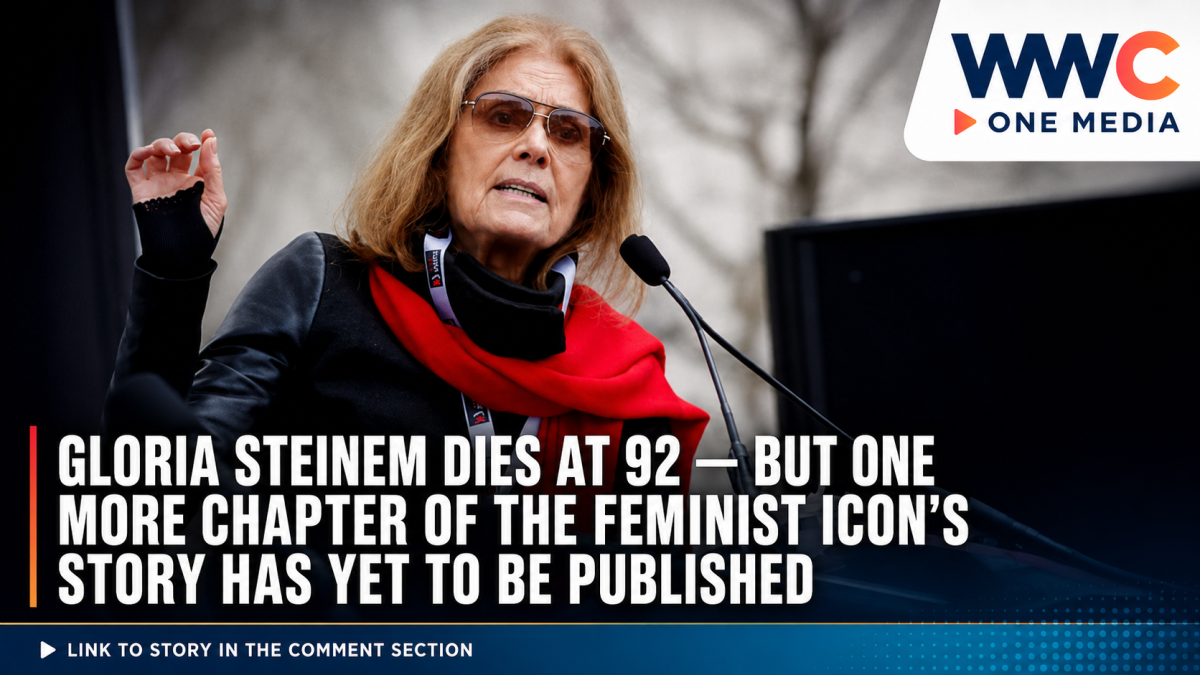
NEW YORK — Gloria Steinem, the journalist, organizer and activist who became one of the most recognizable figures in the modern women’s rights movement, has died at the age of 92 — ending a public life that stretched across more than six decades of political battles, cultural upheaval and changing ideas about women’s place in society.
Steinem died peacefully at her New York City home on September 2, surrounded by people close to her, according to an announcement from her foundation. The organization did not disclose a cause of death. Reuters and the Associated Press independently reported her death Thursday.
But Steinem’s public story is not quite finished.
A new memoir she completed before her death, An Unexpected Life, is scheduled to be published by Random House on September 22, 2026 — less than three weeks after her passing. The 256-page book revisits the experiences that shaped her political thinking and reflects on more than 60 years of activism.
That timing is likely to turn the book from an anticipated memoir into something more significant: one of Steinem’s last opportunities to speak directly to the generations that will inherit the political battles she helped bring into the American mainstream.
From undercover reporter to feminist symbol
Long before she was one of America’s most famous activists, Steinem was building her reputation as a journalist.
One of the defining moments of her early career came in 1963, when she went undercover as a Playboy Bunny for an investigative story about working conditions inside New York’s Playboy Club. The assignment exposed the treatment and demands faced by women employed there and gave Steinem national attention, although she later said the notoriety of the assignment sometimes made it more difficult for her to be taken seriously as a journalist.
Her transformation into a major feminist organizer accelerated later in the decade.
The AP reports that covering a 1969 abortion-rights hearing became a crucial political awakening for Steinem, who had herself undergone an abortion when the procedure was illegal. She subsequently became an outspoken advocate for reproductive freedom and women’s political and economic equality.
By the early 1970s, she had become one of the most visible representatives of what came to be known as second-wave feminism, a movement that expanded the fight for women’s rights into employment, education, reproductive freedom, family life, political representation and equality under the law.
Ms. magazine gave the movement a national platform
Perhaps no media project became more closely associated with Steinem than Ms. magazine.
Ms. began with a sample issue published as an insert in New York magazine in December 1971. Its first regular issue followed in July 1972.
The experiment immediately demonstrated that there was a large audience for journalism centered on women’s lives and political concerns. According to Ms. magazine’s own history, the 300,000 copies of its preview edition sold out nationwide in just eight days and generated roughly 26,000 subscription orders.
That mattered because mainstream women’s magazines of the period were still heavily focused on homemaking, marriage, fashion and beauty. Ms. instead tackled subjects including abortion, domestic violence, sexual harassment, workplace discrimination and political representation.
The magazine became both a publication and an institution of the women’s movement — allowing feminist arguments that had often been dismissed or confined to activist circles to reach a mass audience.
Her activism went far beyond publishing
Steinem’s influence did not stop with journalism.
She helped establish the National Women’s Political Caucus, alongside figures including Bella Abzug, Betty Friedan and Shirley Chisholm, with the aim of expanding women’s role in elected and appointed office. She later helped establish or support organizations including the Women’s Media Center and other groups focused on political participation and equality.
She also became a prominent supporter of the proposed Equal Rights Amendment, reproductive rights and economic equality.
Her activism continued long after the era in which she first became famous. Steinem remained a presence at political gatherings and women’s rights events well into old age, including the Women’s March in Washington in 2017.
President Barack Obama awarded her the Presidential Medal of Freedom in 2013, one of the United States’ highest civilian honors.
A celebrated figure — and a complicated symbol
Steinem’s extraordinary visibility also meant that debates about feminism were frequently projected onto her personally.
Supporters viewed her as an unusually effective communicator who could bring complicated questions about gender and power into mainstream political conversation. Critics within and outside the feminist movement challenged different aspects of her politics, her celebrity and the degree to which the women’s movement represented women across racial and economic lines.
Over time, Steinem increasingly emphasized connections between gender inequality, race, economic power and other forms of discrimination.
Her historical importance therefore rests not on having represented every strand of feminism, but on helping turn women’s equality from an issue that could easily be pushed to the margins into a permanent part of American political debate.
Her last memoir now carries a different weight
Steinem had continued writing almost until the end of her life.
Random House announced An Unexpected Life on her 92nd birthday in March, describing the book as a look back at the people, experiences and movements that shaped her.
The memoir discusses her unconventional childhood, years spent in India, political awakening and decades of activism, while also considering what future generations may face in the continuing fight for equality.
Its September 22 publication date now gives the book an unexpected historical significance.
Readers will encounter Steinem reflecting on her own life after that life has ended.
A movement larger than one person
Steinem repeatedly resisted the idea that one leader should carry an entire political movement. Her approach emphasized organizing, conversation and giving other people the confidence to act.
That may ultimately be the most important part of her legacy.
The battles that defined her career — reproductive rights, political representation, workplace equality, gender violence and women’s economic independence — did not disappear as she grew older. In several cases, they again became major political flashpoints in the United States.
Her death therefore closes the life of one of feminism’s most recognizable figures without closing the arguments she spent decades pursuing.
And on September 22, readers will get one final opportunity to hear how Gloria Steinem herself understood the unexpected life behind that legacy.
What happens next
Steinem’s foundation is expected to continue its work, while her longtime New York home is being preserved through Gloria’s Foundation as a gathering place connected to feminist organizing and dialogue. Her memoir, An Unexpected Life, remains scheduled for U.S. publication on September 22.
WWC ONE MEDIA MJE




Leave a Reply