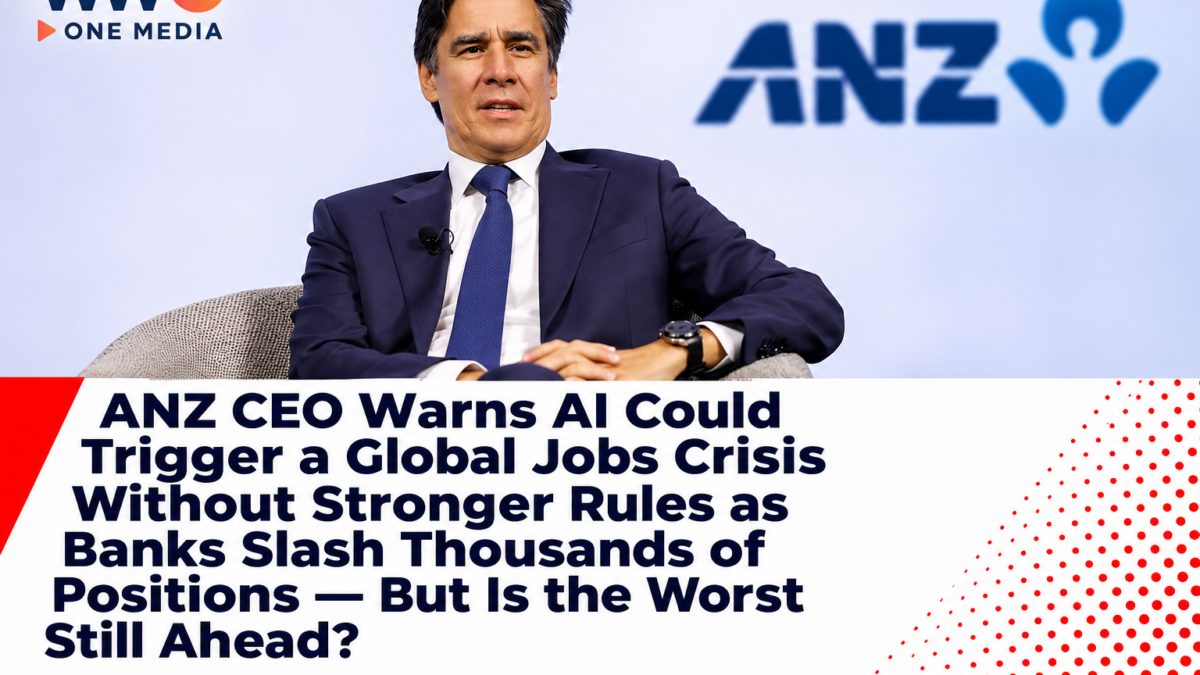
SYDNEY, AUSTRALIA / MANILA, PHILIPPINES — November 12, 2026 — Artificial intelligence could become one of the biggest threats to global employment if governments and businesses fail to establish effective safeguards, according to warnings from ANZ Group Holdings Chief Executive Officer Nuno Matos, whose bank is already undergoing a major workforce transformation.
The warning comes as Australia’s largest banks face intensifying scrutiny over thousands of job reductions, offshoring arrangements and growing investments in artificial intelligence.
ANZ reported A$7.6 billion in annual cash profit for its 2026 financial year, an increase of 31%, while cutting approximately 3,500 jobs over the year to September.
Across Australia’s four largest banks, roughly 6,000 positions have reportedly been eliminated or earmarked for elimination since September 2025.
The developments have raised questions about how financial institutions should balance technological efficiency, shareholder returns and the livelihoods of employees.
But the issue extends far beyond Australia.
From banking and telecommunications to healthcare and professional services, companies worldwide are deploying artificial intelligence to perform tasks previously handled by human workers.
The technology promises greater productivity, faster services and lower costs. Yet its growing capabilities have also raised concerns about job displacement, widening inequality and inadequate regulation.
The central question is whether governments can establish rules that protect workers before AI changes employment faster than economies can create replacement opportunities.
ANZ CEO Warns That AI’s Risks Are Growing Faster Than Expected
Matos has repeatedly expressed concern about the speed at which artificial intelligence is developing.
In September, Bloomberg reported that the ANZ chief executive warned that AI was creating risks faster than even its developers had anticipated.
During an Australian Financial Review summit in Sydney, Matos referred to concerns expressed by prominent technology executives, including Elon Musk, Dario Amodei and Sam Altman.
He warned that the potential consequences of increasingly powerful AI systems extend beyond productivity improvements.
Those risks include threats to critical infrastructure, unpredictable technological behavior and the possibility of widespread employment disruption.
Matos also declined to rule out significant future workforce reductions at ANZ connected with AI adoption.
However, he did not provide a forecast specifying how many ANZ employees would eventually lose their jobs because of artificial intelligence.
That distinction is important.
His comments represent a warning about potential risks, not confirmation that widespread AI-driven unemployment is inevitable.
The challenge for policymakers is determining how to encourage useful technological innovation while reducing the danger of economic and social disruption.
ANZ Cuts 3,500 Jobs Despite Reporting A$7.6 Billion Profit
The concern about employment is particularly relevant because ANZ has already implemented significant restructuring.
The bank reported full-year cash profit of A$7.6 billion for the financial year ended September 30, 2026.
That represented an increase of approximately 31% from the previous year.
At the same time, Australian Associated Press reporting indicated that ANZ had eliminated approximately 3,500 positions during the year.
The contrast has attracted attention from lawmakers and employee representatives.
A profitable financial institution reducing thousands of jobs raises questions about how the benefits of productivity improvements are distributed.
However, it would be inaccurate to describe all 3,500 job reductions as AI replacements.
ANZ’s restructuring also involves business simplification, cost reductions, organizational changes and the reallocation of operations.
Some positions have been affected by offshoring and changes to the bank’s technology organization.
Artificial intelligence is one component of the wider transformation, rather than the independently established cause of every dismissal.
The distinction matters because understanding the actual drivers of job losses is essential to designing effective employment protections.
Australia’s Biggest Banks Face Parliamentary Scrutiny
The controversy intensified on November 12 as executives from Australia’s four largest banks faced questioning by a parliamentary committee.
Lawmakers are examining bank profitability, staffing reductions, outsourcing and the use of artificial intelligence.
The banking industry’s workforce changes are substantial.
According to Australian Associated Press reporting, approximately 6,000 positions have been eliminated or scheduled for elimination across ANZ, Commonwealth Bank, National Australia Bank and Westpac since September 2025.
The Financial Services Union estimates that more than 10,000 Australian banking jobs have disappeared over the past two years.
Those figures reflect different reporting periods and categories and should not be added together.
The parliamentary investigation is also examining whether companies are using AI-related explanations to justify decisions driven by more traditional cost-cutting objectives.
Bank executives argue that technology investments are necessary to improve customer service, remain competitive and manage operational risks.
Employee representatives, meanwhile, are calling for greater transparency about the consequences for workers.
The dispute reflects a wider economic challenge: Companies may become more profitable and efficient even as demand for certain categories of employment declines.
Reuters Raises Concerns About ‘AI Washing’
A November 11 Reuters investigation identified growing accusations of what critics describe as “AI washing” among Australian companies.
The term refers to situations in which businesses emphasize artificial intelligence as a reason for restructuring even though cost reductions, outsourcing or other conventional business decisions may be responsible for much of the change.
Reuters examined workforce reductions and offshoring announcements involving companies such as Qantas, Telstra, Atlassian and WiseTech.
The report highlighted concerns from labor representatives and researchers that AI is sometimes presented as the justification for reducing domestic employment while work is transferred to lower-cost locations.
This does not establish that every company making an AI-related restructuring announcement is misleading employees.
But it demonstrates why regulators and investors should demand evidence when businesses attribute job losses to automation.
A company replacing manual work with an operational AI system represents a different situation from transferring existing work to another country.
Both can affect employment, but their causes and policy implications differ.
The distinction is also relevant to the Philippines, where business-process outsourcing has become a major source of jobs and export revenue.
ANZ Is Already Using AI to Transform Banking Operations
Despite his warnings, Matos is not advocating that ANZ abandon artificial intelligence.
The bank considers AI an important part of its ANZ 2030 business strategy.
During its November 9 full-year results briefing, management outlined three central areas for AI investment:
- Improving customer experiences and providing more effective tools for employees.
- Simplifying business processes and increasing organizational productivity.
- Strengthening fraud prevention, risk management and operational controls.
ANZ has already introduced AI-supported customer relationship management capabilities and is using artificial intelligence to improve contact-center operations.
The bank also reported that AI-assisted software engineering had doubled its capacity to deliver coding for its Single Customer Front-End project.
This does not necessarily mean the bank has halved its software engineering workforce.
Rather, the company says AI has increased its ability to complete software development work.
Such improvements demonstrate why businesses are investing heavily in automation.
The same employees may be able to produce more output, while some routine responsibilities become less labor-intensive.
The employment consequences depend on how companies use the additional capacity.
They may expand services, redeploy workers, reduce staffing or combine these approaches.
ANZ Introduces New Controls to Keep AI Under Human Oversight
ANZ has also acknowledged that AI adoption requires stronger internal governance.
The company is developing an Enterprise AI Control Plane designed to monitor and control how AI systems operate within the bank.
The framework is intended to provide visibility across AI users, models, agents, tools and technology platforms.
Management says it will establish limits on what autonomous AI agents can do and prevent activity outside authorized boundaries.
The initiative reflects concern that increasingly capable AI systems could introduce operational, security and compliance risks.
In banking, these risks can affect sensitive customer information, financial transactions, fraud detection and regulatory obligations.
ANZ also plans to establish an AI Academy to improve employee understanding and build the skills needed to work with the technology.
These measures demonstrate that the bank recognizes both the business opportunities and the potential dangers associated with AI.
However, internal safeguards do not automatically resolve broader questions about employment security.
A system can operate safely from a technical perspective while still changing how many workers a business needs.
AI Is Already Changing Jobs Beyond the Banking Industry
The employment debate extends across multiple sectors.
Financial services companies are automating document processing, customer support, reporting and administrative functions.
Healthcare organizations are introducing more centralized digital systems and automated business processes.
Technology and telecommunications companies are redesigning operations to reduce repetitive work.
As WWC ONE MEDIA reported on Galapagos Capital’s reduction of 9% of its global workforce, financial institutions are increasingly combining automation investments with traditional restructuring.
Galapagos Capital’s reported elimination of 45 positions illustrates how technology adoption can coincide with workforce reductions.
In healthcare, WWC ONE MEDIA examined IHH Healthcare’s restructuring affecting approximately 380 employees across Singapore, Malaysia and Hong Kong.
IHH’s changes involve a broader organizational transformation, and the company has not established that AI alone caused the departures.
Comcast is also investing in automation and creating new positions, illustrating how employment can shift rather than decline uniformly.
Together, these examples show why it is misleading to classify every technology-era job reduction as a direct result of artificial intelligence.
Could AI Also Create New Employment Opportunities?
The risks of displacement are significant, but the economic outlook is not uniformly negative.
Artificial intelligence can also create demand for new skills and occupations.
Businesses may need employees specializing in AI systems integration, cybersecurity, data governance, compliance and human oversight.
Existing workers may also become more productive when AI handles repetitive responsibilities.
A July 2026 European Parliament research briefing concluded that generative AI is likely to transform many occupations rather than simply eliminate them.
The research also identified concerns about entry-level employment, particularly in white-collar occupations where routine cognitive tasks can be automated.
This creates an important challenge for younger workers.
If companies automate responsibilities traditionally assigned to junior employees, graduates may find fewer opportunities to gain practical experience.
But productivity gains can also support expansion and create demand for new services.
As WWC ONE MEDIA reported on approximately 26,000 additional U.S. information-technology workers in October, AI investment has also been associated with demand for technical workers.
That example does not establish that AI caused every new position.
It does show why employment outcomes are more complicated than predictions of universal job destruction.
Why the Philippines Should Pay Attention
The warning from ANZ has direct relevance to the Philippine economy.
The country has developed a major business-process outsourcing industry serving international companies in customer service, banking support, financial processing and administrative operations.
Many of these activities involve tasks that AI can increasingly assist with or automate.
For Philippine workers, the immediate challenge may involve changing job descriptions, new performance expectations and growing demand for digital skills.
Some routine roles could become less important, while more complex technical and service-related positions expand.
The impact will depend on how employers integrate technology and whether employees receive opportunities to retrain.
The Philippines is already discussing possible legislative safeguards.
In November, Senator Erwin Tulfo proposed stronger protections for workers facing AI-related dismissals, including advance notice and increased separation compensation.
The proposal remains legislation under consideration and is not an enacted nationwide requirement.
As WWC ONE MEDIA reported in its coverage of Tulfo’s AI-related labor protection bill, the measure would attempt to balance businesses’ ability to adopt new technology with employees’ need for financial security and transition assistance.
Matos’s warnings reinforce why these questions are becoming increasingly urgent.
Governments Face Pressure to Establish Stronger AI Rules
The international debate over AI regulation is no longer limited to data privacy or the technical safety of advanced models.
It increasingly includes employment rights, economic inequality and corporate accountability.
Governments face several difficult decisions.
Should businesses be required to disclose how many jobs are eliminated because of AI?
Should employers demonstrate that automated systems are operational before attributing layoffs to them?
Should workers receive more notice, retraining assistance or financial protection when technology replaces existing responsibilities?
And who should be responsible when autonomous AI systems make decisions that harm customers or employees?
These questions have no universally accepted answers.
The United Kingdom’s parliamentary Joint Committee on Human Rights called in September for stronger AI legislation and regulatory oversight.
Its recommendations emphasized gaps in accountability and the need for meaningful protection against harmful AI applications.
However, different jurisdictions are adopting different approaches.
The challenge is creating safeguards that protect people without unnecessarily preventing beneficial innovation.
Could a Global Employment Crisis Actually Happen?
Predictions of mass unemployment caused by artificial intelligence remain highly uncertain.
Some jobs may disappear, others may be redesigned, and entirely new occupations may emerge.
The outcome will depend on the technology’s actual capabilities, business investment, economic demand, workforce training and government policy.
There are also differences between what AI systems can technically perform and what companies can deploy reliably, securely and economically.
A task that can be automated in a demonstration may still require human supervision in a regulated workplace.
In banking, for example, decisions involving lending, fraud investigations and sensitive personal information often require carefully controlled processes.
That creates opportunities for AI to assist workers rather than replace them completely.
Nevertheless, companies may reduce staffing when automated systems lower the amount of labor required.
This makes workforce planning and transparent reporting particularly important.
Without reliable information, policymakers risk either underestimating genuine disruption or overstating job losses caused by AI.
The Bottom Line: ANZ’s Warning Is About More Than Banking
ANZ CEO Nuno Matos is highlighting a fundamental tension in the global AI economy.
Artificial intelligence promises higher productivity, improved services and new business opportunities.
But the technology is also changing the relationship between corporate growth and employment.
ANZ’s own experience illustrates that tension.
The bank reported A$7.6 billion in annual cash profit while undertaking substantial restructuring and expanding its use of AI.
Australia’s other major banks are also facing scrutiny over job cuts and offshoring arrangements.
Meanwhile, governments are confronting pressure to establish clearer rules for the responsible adoption of increasingly autonomous technologies.
For workers, the concern is whether existing employment protections and retraining systems can keep pace.
For employers, the challenge is using AI productively without undermining customer trust, employee confidence or social stability.
And for policymakers, the most important question may be how to distribute the benefits of technological progress while protecting people from sudden disruption.
Matos’s warnings do not prove that a global employment crisis is inevitable. But they underline the growing concern that AI adoption could outpace the institutions responsible for managing its consequences.
As banks cut jobs, businesses automate more responsibilities and governments debate stronger safeguards, will artificial intelligence create a more productive global economy—or trigger an employment shock that arrives before workers and regulators are ready?