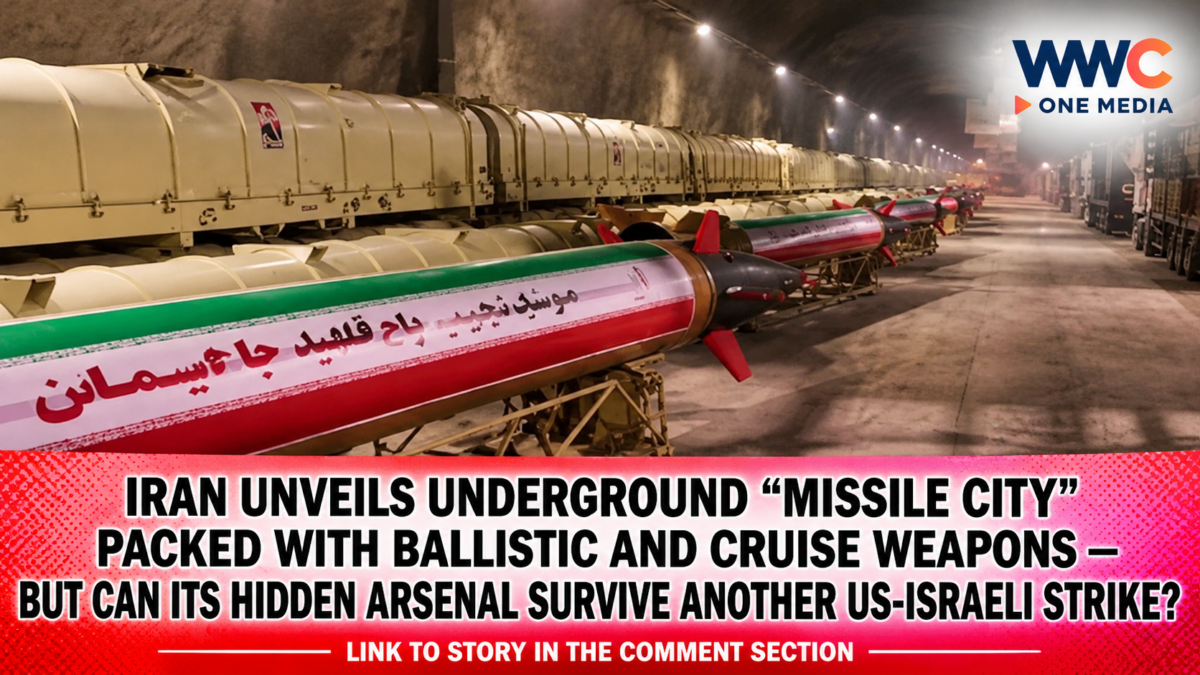
TEHRAN, Iran — Iran’s Islamic Revolutionary Guard Corps (IRGC) has unveiled a new underground missile complex displaying an array of ballistic missiles, cruise missiles and launch systems, sending a fresh warning to the United States and Israel as tensions over the Middle East conflict remain unresolved.
The facility, described by Iranian authorities as an underground “missile city,” was showcased on November 10, 2026, during the IRGC Aerospace Force’s military activities marking its Aerospace Week.
Footage released through Iranian state and semi-official media showed senior military commanders inspecting underground passages lined with missiles, transport vehicles and launch equipment.
The announcement is more than a military publicity exercise. Tehran is attempting to demonstrate that its missile infrastructure remains operational despite months of American and Israeli attacks against Iranian military targets.
But there is an important unanswered question: how much of the facility’s actual capability can be independently verified?
Iran has not disclosed the complex’s exact location, size, missile inventory or operational capacity. The released footage was also edited and partially blurred, making it difficult for outside observers to independently identify every weapon on display.
The unveiling nevertheless sends a clear strategic message. Iran wants its adversaries to believe that destroying exposed military installations will not necessarily eliminate its ability to produce, store and deploy missiles.
IRGC Shows Off Underground Missile Complex
The unveiling was reported by Iran’s semi-official Tasnim News Agency on November 10.
The ceremony was attended by Major General Ali Abdollahi, chief of staff of Iran’s armed forces, and Brigadier General Majid Mousavi, commander of the IRGC Aerospace Force.
The facility reportedly contains different categories of ballistic and cruise missiles, together with their associated launch systems.
Iranian media also highlighted both solid-fuel and liquid-fuel missile systems.
The IRGC described the installation as a new underground missile city, part of a broader effort to protect strategic weapons infrastructure from potential airstrikes.
Unlike conventional military storage facilities, the concept promoted by Iranian officials goes beyond simply keeping weapons underground.
IRGC spokesman Brigadier General Hossein Mohebbi said the force had moved missile and drone production lines from surface facilities into underground complexes.
He described these facilities as missile production cities, arguing that Iran could continue manufacturing weapons even during sustained bombardment.
However, the IRGC has not released independently verifiable technical documentation demonstrating the full production capacity of the complex.
The distinction between displaying missiles in an underground facility and proving that the site can sustain large-scale weapons manufacturing is important.
Iran Says Its Missile Production Can Continue Even Under Heavy Bombardment
The unveiling followed comments by Mohebbi on November 7, when he discussed the IRGC’s efforts to relocate military manufacturing infrastructure underground.
According to Al Jazeera, Mohebbi said the relocation was intended to ensure that missile and drone production could continue despite attacks on exposed facilities.
The announcement reflects a central concern for Iran’s military planners: protecting weapons production and storage from an adversary with advanced aircraft, surveillance systems and precision-guided weapons.
Underground facilities can make it more difficult for an opponent to identify, access and destroy military equipment.
However, they are not invulnerable.
Entrances, ventilation systems, transport connections, electrical infrastructure and other supporting facilities may remain vulnerable to attacks. The effectiveness of an underground complex also depends on its depth, construction, protection systems and ability to maintain operations.
The IRGC has not disclosed enough information about its latest facility to establish how resistant it would be to sustained attacks.
Still, Iran’s decision to publicly showcase the complex suggests that underground military infrastructure is becoming a central part of its deterrence strategy.
What Weapons Were Actually Seen Inside the Missile City?
Iranian state media described the installation as containing ballistic and cruise missiles, but the footage did not provide a complete inventory.
Military analysts examining the released images have identified several missile systems that may be present.
Reporting by South Korea’s ChosunBiz, which cited analysts who examined the footage, identified possible examples of:
- Fattah-1: An Iranian medium-range ballistic missile that Tehran describes as hypersonic.
- Emad: A ballistic missile developed by Iran, with a reported range of approximately 1,700 kilometres.
- Khorramshahr: A family of Iranian ballistic missiles.
- Kheibar Shekan: A solid-fuel ballistic missile associated with a manoeuvrable re-entry vehicle.
- Paveh: A ground-launched cruise missile belonging to Iran’s Soumar family.
These identifications are based on visual analysis, not an official weapon-by-weapon confirmation from the IRGC.
Janes, a defence intelligence publication, separately noted that the footage showed a possible new cruise missile design alongside several established Iranian missile systems.
Its analysts pointed to differences in the apparent shape of some cruise missiles and the possibility that Iran may be developing systems intended to reduce radar visibility.
However, the appearance of a weapon in a promotional video does not establish its operational performance.
Iran’s claims about the Fattah-1’s hypersonic capabilities, for example, should also be distinguished from independently verified assessments of its speed, manoeuvrability and ability to evade modern air-defence systems.
The exact missile inventory inside the newly unveiled complex remains unconfirmed.
Iran Says It Has Lifted Restrictions on Missile Range
One of the most consequential claims accompanying the unveiling concerns Iran’s missile-range policy.
IRGC spokesman Mohebbi reportedly said that restrictions on the range of Iranian missiles had been lifted.
For years, Iranian officials had publicly maintained a self-imposed limit of approximately 2,000 kilometres for their ballistic missile programme.
That limit had been presented as a policy decision rather than an internationally binding restriction.
If Iran is moving away from that policy, the potential implications could extend beyond the immediate Middle East.
However, Tehran has not provided a detailed technical explanation of what the policy change means for its current missile inventory.
It is also important to distinguish a declaration about missile-range policy from proof that Iran has deployed operational missiles capable of striking specific distant targets.
The announcement does not, by itself, establish that Iran has successfully fielded a new intercontinental ballistic missile.
The range, accuracy, payload and operational readiness of any newly developed system would require independent verification.
Iran’s Military Commanders Issue a Warning to Washington and Tel Aviv
The unveiling also carried a political and military message.
Ali Abdollahi said Iran’s armed forces would make decisions based on their own capabilities rather than the strength or resources of their adversaries.
IRGC Aerospace Force commander Majid Mousavi warned Iran’s enemies against underestimating the country, saying that any mistake would trigger a response they would regret.
The statements were reinforced by Iranian Parliament Speaker Mohammad Bagher Ghalibaf.
On November 10, Ghalibaf described the missile facility as a clear message to Iran’s adversaries.
He warned that Iran would respond swiftly if its opponents made what he called a military miscalculation.
He also said Iran’s armed forces would determine the geographical scope of any future confrontation.
The remarks are significant because they suggest Tehran wants its adversaries to consider the possibility that a renewed attack could lead to retaliation beyond the immediate battlefield.
Iranian officials have repeatedly warned that US military installations and allied interests could become targets if another major confrontation begins.
But these statements remain warnings, not evidence that a wider military campaign has already been launched.
Why Iran Is Building More Underground Military Facilities
Iran’s emphasis on underground weapons infrastructure is not new.
For decades, the country has developed underground facilities to protect missile storage, military equipment and strategic infrastructure.
The strategy is particularly important because Iran faces adversaries with advanced air forces, intelligence capabilities and precision-strike weapons.
Underground storage can complicate efforts to identify exactly where missiles are located and how many remain operational.
It can also help protect equipment from attacks targeting exposed military installations.
The latest unveiling comes after months of military confrontation involving the United States, Israel and Iran.
On February 28, American and Israeli forces launched joint attacks against Tehran and other Iranian targets. Iran subsequently responded with missile and drone attacks against Israel and US-linked assets in the region.
The confrontation also affected shipping and energy security around the Strait of Hormuz.
The wider conflict has placed considerable pressure on Iran’s military infrastructure, making the survival of its missile production capabilities a major strategic issue.
Al Jazeera reported that Iran’s military leadership had increasingly emphasised underground production and storage as a way to maintain its weapons capabilities during sustained attacks.
Can US and Israeli Airstrikes Destroy Iran’s Missile Network?
The unveiling raises a difficult question for Washington and Tel Aviv.
Even if airstrikes destroy missile launchers, storage facilities and production sites, can they eliminate an arsenal that is distributed across underground complexes and mobile launch platforms?
There is no simple answer.
Underground facilities can make military infrastructure harder to destroy, but they do not guarantee that weapons remain accessible or operational.
A missile complex may survive an initial strike while losing the ability to move equipment, communicate with command centres or transport missiles to launch positions.
The distinction between destroying a facility and disabling its military function is therefore important.
Recent satellite imagery and reporting have also raised questions about Iran’s efforts to rebuild or expand damaged military infrastructure.
A November 6 report by the New York Post, citing satellite-image analysis, described construction and repair activity at several Iranian military locations, including areas associated with missile infrastructure.
Such activity does not necessarily prove that all damaged facilities have been restored, but it suggests that Iran may be attempting to rebuild capabilities despite the damage caused by previous attacks.
For a wider look at Iran’s missile programme and its implications for American naval forces, read WWC ONE MEDIA’s report:
That report examined Iran’s claims about its Qasem Basir ballistic missile and the uncertainty surrounding its reported use against US naval vessels.
The Strait of Hormuz Remains a Major Strategic Pressure Point
The missile-base announcement is unfolding against the backdrop of continuing tensions around the Strait of Hormuz.
The narrow maritime passage connects the Persian Gulf to the Gulf of Oman and the wider Indian Ocean.
It is one of the world’s most important energy shipping routes, carrying a substantial share of internationally traded oil and liquefied natural gas.
Any disruption can affect tanker movements, insurance costs, shipping schedules and global energy prices.
Iran has repeatedly used its geographical position near the strait as a source of strategic leverage.
The United States, meanwhile, has sought to protect maritime traffic and maintain pressure on Tehran.
The confrontation has already involved attacks and threats affecting commercial vessels, military ships and energy infrastructure.
WWC ONE MEDIA previously examined how the maritime conflict has raised the risk of a wider confrontation:
The report highlights why an escalation involving the Strait of Hormuz could have consequences far beyond the countries directly involved.
For energy-importing economies, the risk is particularly serious because higher shipping costs and supply disruptions can eventually feed into fuel prices and inflation.
The New Missile Base Comes as Washington and Tehran Explore Diplomacy
Despite the military warnings, diplomatic efforts have continued.
Regional governments, including Qatar, have been involved in efforts to reduce tensions between Washington and Tehran.
US President Donald Trump said on November 8 that renewed American airstrikes were highly unlikely if progress continued in negotiations.
The comments suggested that Washington was still considering a diplomatic route, even as military pressure remained part of its broader strategy.
The United States also carried out limited strikes on Iran’s Qeshm Island earlier in November, with American officials describing the operation as defensive.
The latest missile-base unveiling therefore comes at an unusual moment: both sides are signalling military readiness while also leaving room for negotiations.
That combination makes the situation particularly difficult to interpret.
Iran may be using the facility to strengthen its negotiating position by demonstrating that its military capabilities have not been eliminated.
Washington, meanwhile, is maintaining pressure while signalling that it does not necessarily want another major round of fighting.
WWC ONE MEDIA examined the diplomatic uncertainty in its report:
The report explains why limited military action can continue even when senior officials are publicly discussing a possible settlement.
Iran’s Missile Strategy Also Has an Economic Cost
Maintaining a large missile programme and building protected underground infrastructure require substantial financial and industrial resources.
Iran is already dealing with economic pressure from international sanctions, damaged infrastructure, reduced trade and the costs associated with the prolonged conflict.
The government must balance military spending with domestic priorities, including energy, employment, public services and economic recovery.
The unveiling has also prompted criticism inside Iran.
Iran International reported on November 11 that some citizens questioned the government’s military spending amid poverty, energy shortages and a lack of civilian shelters.
That reaction highlights a domestic dilemma for the Iranian leadership.
The government presents underground missile facilities as essential to national defence, but ordinary citizens are also facing the consequences of prolonged economic and security pressure.
The question is whether the military investment will strengthen Iran’s long-term security or deepen the economic difficulties confronting its population.
WWC ONE MEDIA has previously examined the economic pressure facing Tehran:
What the Missile City Unveiling Really Tells the World
The IRGC’s latest announcement demonstrates that Iran wants to project resilience and preserve uncertainty about the condition of its missile programme.
The underground facility may contain significant weapons stocks, but the available footage does not establish its full inventory, exact location or operational capacity.
It also does not prove that every missile displayed is fully operational or that Iran can continue producing weapons at the scale claimed by its military officials.
Nevertheless, the unveiling sends several messages:
- Iran wants to demonstrate military survival: Tehran is showing that its missile infrastructure remains part of its defence strategy despite previous attacks.
- Underground production is a priority: The IRGC says it is relocating manufacturing facilities to protected locations.
- Missile deterrence remains central: Iran is attempting to convince its adversaries that another attack could trigger serious retaliation.
- The Strait of Hormuz remains strategically important: Any renewed conflict could affect global energy supplies and international shipping.
- Diplomacy remains uncertain: Military demonstrations and negotiations are continuing at the same time.
The Bigger Question: Is Iran Preparing for Another War?
Iran’s underground missile city is not simply a display of military hardware. It is part of a broader effort to convince Washington and Tel Aviv that Iran can absorb attacks and retain the ability to retaliate.
But the claims surrounding the facility must be treated carefully.
Its exact location remains undisclosed. Its operational capacity has not been independently established. The identities and performance of some missiles shown in the footage remain uncertain.
The unveiling does not prove that Iran has become immune to airstrikes, nor does it establish that a new confrontation is inevitable.
What it does show is that Tehran wants its opponents to believe that the destruction of visible military targets will not necessarily end its ability to fight.
The IRGC has opened the doors of another underground missile city, but the real test will come if Washington or Israel launches another major attack. Will Iran’s hidden arsenal provide the deterrence Tehran promises — or will the next confrontation expose the limits of its underground military strategy?