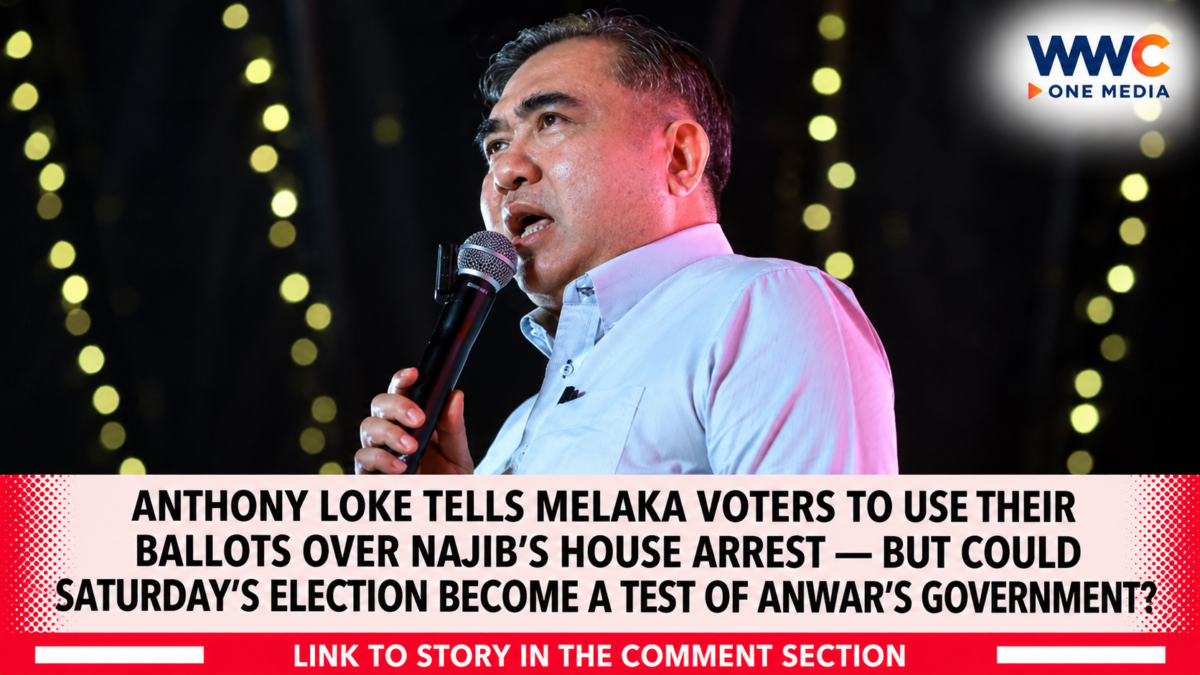
Malaysia’s controversy over former prime minister Najib Razak’s house arrest is now spilling directly into the final stretch of the Melaka state election, with Democratic Action Party (DAP) secretary-general Anthony Loke urging voters to make their feelings known at the ballot box.
Speaking at a Pakatan Harapan (PH) campaign rally in Ayer Keroh on November 10, Loke acknowledged that many Malaysians remain unhappy with the decision allowing Najib to serve the remainder of his prison sentence in his residence.
But rather than encouraging voters to reject the court ruling or challenge the constitutional authority behind it, Loke pointed to the democratic process as the appropriate way to express their dissatisfaction.
“Whether or not we accept that decision, we can express our views through the ballot box,” he said, according to reports by Free Malaysia Today and Malay Mail.
His message came at a particularly sensitive moment: Loke had just resigned as transport minister following the Kuala Lumpur High Court’s decision allowing Najib to serve the remainder of his sentence in the SRC International case under house arrest.
With Melaka voters scheduled to head to the polls on November 14, the controversy has become another major issue confronting the governing coalition.
The question now is whether voters will treat Najib’s house-arrest arrangement as a reason to reassess their political support—or focus on the state government’s performance, economic opportunities and the candidates seeking to represent their communities.
Loke Says Voters Can Express Their Disagreement Through Elections
Loke’s remarks reflect the difficult political position facing DAP and its partners in Prime Minister Anwar Ibrahim’s unity government.
On one hand, DAP has consistently taken a critical position on Najib’s corruption convictions and the wider 1Malaysia Development Berhad (1MDB) scandal. On the other, the party remains part of a federal administration that includes UMNO, the political party historically associated with Najib.
At the Ayer Keroh rally, Loke acknowledged that the house-arrest decision was difficult for many members of the public to accept. However, he also stressed that the constitutional powers of the King, the Federal Constitution and the rule of law must be respected.
His comments were significant because they sought to distinguish disagreement with a decision from rejection of the constitutional process behind it.
Loke also cautioned against reducing the Melaka election to a single national controversy.
He reminded voters that the state election was not simply about Najib. It was also about the quality of elected representatives, local development and the welfare of ordinary residents.
That distinction could prove important for PH, which must defend its political position while campaigning against Barisan Nasional (BN), its partner in the federal unity government.
Najib’s House Arrest Triggered Loke’s Cabinet Resignation
Loke’s appeal to Melaka voters followed one of the most significant Cabinet developments in Malaysia’s recent political dispute.
On November 10, Loke announced that his resignation as transport minister would take effect immediately after the Kuala Lumpur High Court issued a new order allowing Najib to serve the remainder of his SRC International sentence under house arrest.
The resignation fulfilled a condition Loke had previously attached to his planned departure.
He had first offered to resign in September after the conditional royal pardon granted to Najib became public. However, Anwar asked him to remain temporarily to ensure continuity at the Transport Ministry.
Loke subsequently made clear that he would leave once Najib actually began serving his sentence at home.
The High Court’s November 10 order provided the trigger.
As reported by CNA and The Straits Times, the resignation exposed a major disagreement within Anwar’s governing coalition over how the Najib controversy should be handled.
Loke’s departure, however, did not mean DAP had withdrawn from the federal government.
DAP’s position was that the resignation concerned Loke’s ministerial role, rather than a decision to pull the party out of the governing coalition.
WWC ONE MEDIA previously examined the political consequences in its report, Anthony Loke Resigns as Malaysia’s Transport Minister After Court Allows Najib Razak to Serve Sentence Under House Arrest.
Why Najib’s Return Home Has Become a Political Flashpoint
Najib’s house arrest follows a complicated legal and constitutional process involving his conditional royal pardon.
The former prime minister was convicted in the SRC International case and began serving his prison sentence in August 2022. The pardon reduced his original 12-year sentence to six years and included conditions allowing him to serve the remaining period under house arrest.
A RM50 million fine was also part of the conditions associated with the pardon. UMNO subsequently paid the amount on Najib’s behalf.
The implementation of the house-arrest arrangement became contentious after the Attorney-General’s Chambers intervened on November 6, temporarily suspending the transfer while seeking clarification over the legal interpretation of the royal pardon and the court order.
The palace publicly expressed displeasure over the handling of the matter and stressed that the King’s constitutional authority must be respected.
The dispute was subsequently addressed through a new High Court order on November 10, which cleared the way for Najib to serve the remainder of his SRC International sentence at his residence.
Reuters and the Associated Press reported on the legal dispute, including the disagreement over how the pardon and court orders should be implemented.
It is important to distinguish house arrest from an unconditional release. Najib remains subject to the sentence in the SRC International case.
He also faces a separate 15-year prison sentence imposed in another 1MDB-related case in December 2025, which he is appealing. The separate case remains a significant part of the wider legal picture and should not be confused with the sentence covered by the house-arrest arrangement.
For further context, WWC ONE MEDIA examined the royal pardon dispute and the legal questions surrounding Najib’s release in Malaysia’s King Rebukes Attorney-General as Najib’s RM50-Million House Arrest Deal Is Blocked — But Could a Second 15-Year Sentence Keep Him Behind Bars?.
Melaka Election: 28 Seats, 79 Candidates and a Test for Political Alliances
The timing of Loke’s remarks makes the controversy especially significant.
Melaka’s 16th state election is scheduled for November 14, with 79 candidates contesting 28 state assembly seats, according to AsiaOne’s election coverage.
The contest is also testing the ability of political parties to maintain support across newly arranged alliances.
BN and Perikatan Nasional (PN) are campaigning through their Muafakat Melaka arrangement, while PH is seeking to challenge the incumbent state administration.
PH faces a complicated task. It is competing against BN in the state election even though both coalitions are partners in the federal unity government.
That arrangement creates a difficult political balance: PH must explain why voters should support its candidates over BN’s while maintaining cooperation with BN at the national level.
The election is therefore about more than party loyalty.
Campaign issues include economic opportunities, jobs, household welfare, tourism, traffic conditions and the delivery of development projects.
AsiaOne’s election analysis also highlighted the importance of whether voters will support candidates from coalition partners when their preferred political party is not directly contesting a particular seat.
The Najib controversy adds another national issue to that already complicated decision.
WWC ONE MEDIA has also examined the changing political relationships surrounding Malaysia’s upcoming elections in UMNO Wants GE16 Sooner After Johor and Negeri Sembilan Gains — But Zahid Says It Will Stay in Anwar’s Government Until the End.
Loke’s Message Comes as Questions About Anwar’s Government Grow
Beyond Melaka, the controversy has raised questions about the durability of Anwar’s multi-party administration.
Loke has defended the decision to resign from the Cabinet while maintaining that DAP will continue supporting the prime minister.
He has also challenged Barisan Nasional lawmakers who disagree with Anwar’s leadership to leave the government rather than continue criticising the administration while retaining Cabinet positions.
That position underscores the tensions within the unity government.
The coalition includes parties with different political histories, voter bases and positions on Najib’s treatment. Their continued cooperation depends on balancing those differences without undermining the government’s ability to function.
Anwar has also played down immediate speculation about a wider Cabinet reshuffle, saying it was too early to discuss changes after Loke’s departure.
WWC ONE MEDIA reported on that uncertainty in Anwar Says Cabinet Reshuffle Is “Too Early” as Anthony Loke’s Resignation Creates Vacancy in Malaysia’s Government.
Meanwhile, broader political disagreements have continued to attract attention, including tensions involving UMNO and the administration’s handling of government policy and spending.
In a separate report, WWC ONE MEDIA examined those questions in Anwar Denies Government Split as Budget Dispute Between Finance Ministry and Zahid’s Department Raises Questions Over RM6.1 Billion in Rural Road Spending.
These developments do not establish that the government is about to collapse. DAP has maintained its support for Anwar, and a minister’s resignation alone does not demonstrate that the administration has lost its parliamentary majority.
Nevertheless, the controversy has exposed how difficult it can be for coalition partners to maintain a common political position when a highly sensitive national issue divides their supporters.
Could Najib’s House Arrest Influence the Melaka Vote?
The answer will depend on how voters weigh the controversy against the issues affecting their daily lives.
For some, Najib’s house arrest may be a question of accountability, fairness and the credibility of Malaysia’s anti-corruption commitments.
For others, the election may be determined more by local development, employment, living costs, candidate performance and the stability of the state government.
There is also a distinction between expressing dissatisfaction with a federal decision and choosing a state assembly representative.
The Melaka election does not directly decide Najib’s legal status, reverse the High Court order or determine whether Anwar remains prime minister. It determines who will represent the state’s 28 constituencies and which political bloc will govern Melaka.
Still, the political consequences could extend beyond the state.
A strong result for one coalition could influence how national leaders assess voter sentiment, coalition cooperation and their strategies ahead of Malaysia’s next general election.
That is why Loke’s remarks carry significance beyond the campaign rally where they were delivered.
He is effectively telling voters that they can disagree with the house-arrest decision while respecting the constitutional process—and that the ballot box remains an avenue for expressing their political judgment.
The Bigger Question: Will Voters Separate Local Issues From National Anger?
As Melaka approaches polling day on November 14, political parties face a difficult challenge: convincing voters that their candidates deserve support despite the national controversy surrounding Najib.
Loke has urged voters to consider the broader responsibilities of state representatives rather than allowing one issue to define the entire election.
But whether that message resonates is something only the voters can determine.
The outcome could reveal how much the house-arrest controversy has affected PH’s support, whether BN can maintain its advantage as the incumbent state coalition, and how effectively the parties can persuade voters to accept their changing political alliances.
For Anwar, the result may offer another indication of how his government is being judged amid growing coalition tensions.
For Loke, the message is clear: voters have a democratic avenue to express their disagreement.
But when Melaka voters finally cast their ballots on Saturday, will their decision remain a verdict on state leadership—or become a much wider political warning to the leaders in Putrajaya?