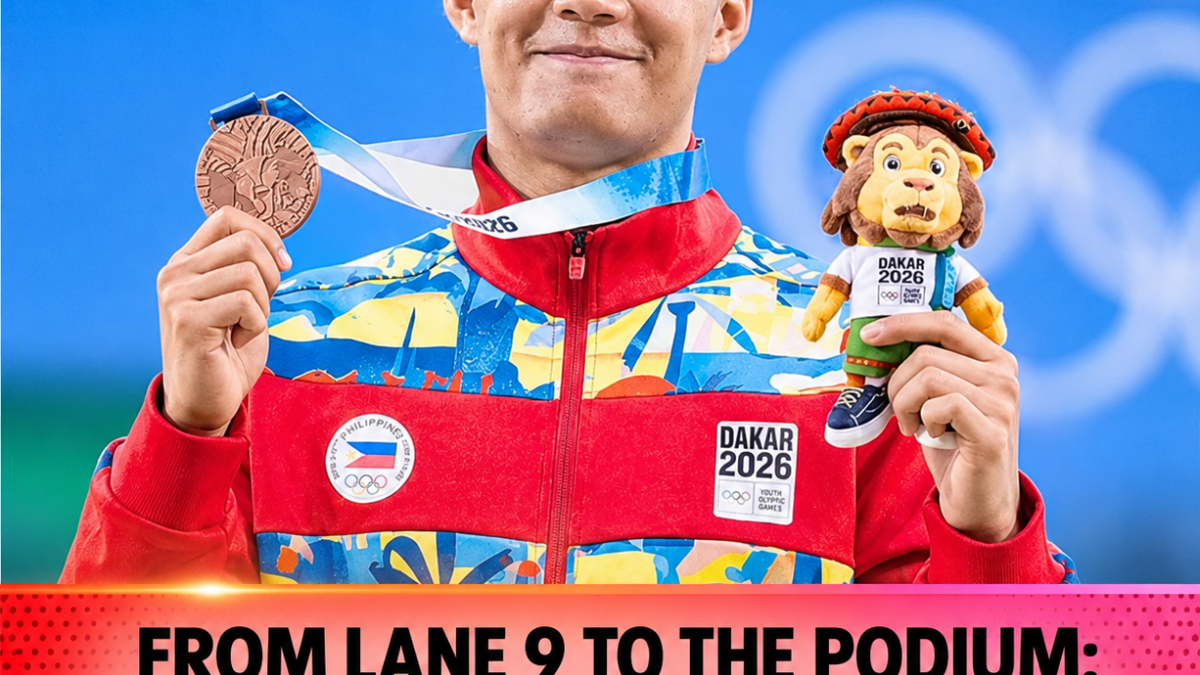
DAKAR, Senegal — Filipino sprinter Pi Durden Wangkay delivered one of the Philippines’ biggest sporting moments at the 2026 Youth Olympic Games, capturing bronze in the men’s 200-meter final after a dramatic photo finish that separated him from silver by just four-thousandths of a second.
The 17-year-old clocked a personal-best 21.355 seconds in the final, finishing behind Zimbabwe’s Ropafadzo Mzondo, who won gold in 21.04 seconds, and Guyana’s Deuquan’ Farrell, whose 21.359-second finish secured silver.
Wangkay’s bronze became the Philippines’ second medal at the Dakar Games, following Naomi Marjorie Cesar’s silver in the women’s 800 meters. Together, their performances gave the country its best overall showing in four editions of the Youth Olympic Games.
But what makes Wangkay’s achievement even more remarkable is how unlikely the podium finish appeared before the race.
A Difficult Lane Assignment, an Unexpected Medal
Wangkay entered the final after recording a fifth-best time in the earlier rounds. He was assigned Lane 9, the outermost lane, which made it difficult to see where his competitors were positioned during the race.
Rather than allowing the disadvantage to affect his performance, the Filipino sprinter focused on executing his own race.
“I ran blind,” Wangkay said, describing the challenge of competing from the outside lane.
He also admitted that he had not expected to win a medal, especially after entering the final with a slower time than several of his rivals.
His mother and coach, Jonah Genilza, helped develop the strategy: concentrate on his own race instead of trying to follow competitors he could barely see.
The approach paid off.
Wangkay produced a personal-best performance and surged into third place, turning what looked like a difficult medal challenge into a historic result for Philippine athletics.
Just 0.004 Seconds Away From Silver
The final became a battle between Wangkay and Farrell for second place.
Both athletes were officially recorded at approximately 21.36 seconds, but the photo-finish reading gave Farrell the advantage.
Farrell registered 21.359 seconds, while Wangkay crossed at 21.355 seconds.
The difference was only 0.004 seconds.
Although the Filipino narrowly missed silver, his performance demonstrated how competitive the final was and how little separated the medalists.
Zimbabwe’s Mzondo secured gold in 21.04 seconds, finishing ahead of the two athletes involved in the close fight for second.
Wangkay expressed satisfaction with his bronze, recognizing the difficulty of the competition and the narrow margin separating the medal positions.
The Philippine News Agency and GMA News independently reported the close finish, while BusinessMirror also highlighted the four-thousandths-of-a-second difference.
Wangkay Also Breaks His Own Philippine Age-Group Records
The medal was not the only achievement from Wangkay’s performance.
According to Panay News, his 21.36-second performance erased his previous Philippine under-18 and under-20 records of 21.40 seconds.
He had established those previous marks during the Philippine Athletics Track and Field Association (PATAFA) Weekly Relays in Pasig City on October 25, 2026.
That means his Youth Olympic bronze came with another important milestone: a new personal best and improved national age-group records.
It is a significant achievement for a young athlete who is still developing and gaining experience against international competition.
His previous accomplishments also show that the Dakar performance was not an isolated breakthrough. GMA News reported that Wangkay had already won gold medals at the Asian Youth Games and the Indonesian U18 Championships in 2025.
He also captured two gold medals in the secondary boys’ 100-meter and 200-meter events at the 2025 Palarong Pambansa.
Naomi Cesar and Wangkay Give the Philippines Its Best YOG Campaign
Wangkay’s bronze followed another major achievement by fellow Filipino track athlete Naomi Marjorie Cesar.
Cesar won silver in the women’s 800-meter final, clocking 2:09.34 to finish behind Ethiopia’s Netsanet Selemon, who took gold in 2:04.43.
Morocco’s Khadija Elmostaqim claimed bronze in 2:10.05.
The two medals marked a breakthrough for the Philippine delegation.
Before Dakar 2026, the Philippines had secured a Youth Olympic medal through Christian Tio, who won silver in men’s IKA twin-tip racing at the 2018 Buenos Aires Games.
The two medals won by Cesar and Wangkay in Dakar surpassed that previous campaign and established the country’s best medal haul across its four Youth Olympic Games appearances, according to Philstar and other Philippine media reports.
GMA News also reported that both young athletes come from families with strong athletics backgrounds.
Wangkay’s mother, Jonah Genilza, previously represented the Philippines in international competitions and was a Palarong Pambansa standout. Cesar’s father, Ben, was also a former national team sprinter.
Their achievements highlight how athletic experience, family support and structured coaching can help young Filipino competitors reach the international stage.
Why Dakar 2026 Matters for Philippine Athletics
The Youth Olympic Games are designed to give young athletes international competition experience while helping them prepare for higher levels of sport.
For the Philippines, Wangkay and Cesar’s performances offer encouraging signs for the future of track and field.
Their medals show that Filipino athletes can compete against international rivals in events where fractions of a second can determine the final standings.
However, a successful youth competition is only one step in an athlete’s development. Maintaining progress requires consistent coaching, access to quality facilities, sports science support, regular international exposure and sustained investment.
The challenge is to help promising athletes transition from youth competitions to senior-level events, where the competition becomes even tougher.
WWC One Media has also examined the development of young Filipino athletes through its coverage of Angel Polo’s Youth Olympic experience in Dakar. Although Polo did not secure a medal, her campaign highlighted the value of international exposure and the lessons young athletes can bring home.
The wider significance of the competition is explored in Dakar 2026’s historic role as the first Olympic sporting event hosted in Africa.
Philippine athletics has also seen other international breakthroughs, including King James Reyes’ bronze medal at the 2026 Asian Para Games, another example of Filipino athletes reaching the podium through determination and preparation.
What Comes Next for Pi Durden Wangkay?
Wangkay’s next challenge is to build on his Youth Olympic success.
Philstar reported that he is expected to return to competition for De La Salle in the UAAP beginning November 29, 2026.
That gives the young sprinter another opportunity to develop his speed, improve his competitive experience and carry his international momentum into collegiate athletics.
His Dakar performance also gives him a new personal benchmark to chase. Having broken his own age-group records, the next targets will be improving his times further and continuing to compete against stronger fields.
For Philippine athletics, the bigger priority is ensuring that young talents like Wangkay and Cesar receive the support needed to sustain their progress beyond one major competition.
A Bronze Medal That Could Mark the Beginning of Something Bigger
Pi Durden Wangkay did not leave Dakar with gold, and the silver medal slipped away by an almost invisible margin.
But his bronze carries a different kind of significance.
He overcame a difficult lane assignment, competed against a strong international field, recorded a personal best and improved his Philippine age-group records—all while helping the country achieve its best Youth Olympic Games medal campaign.
At just 17, Wangkay has already given Filipino sports fans a performance worth remembering.
The question now is whether this historic bronze will become the foundation for even bigger achievements in the years ahead.