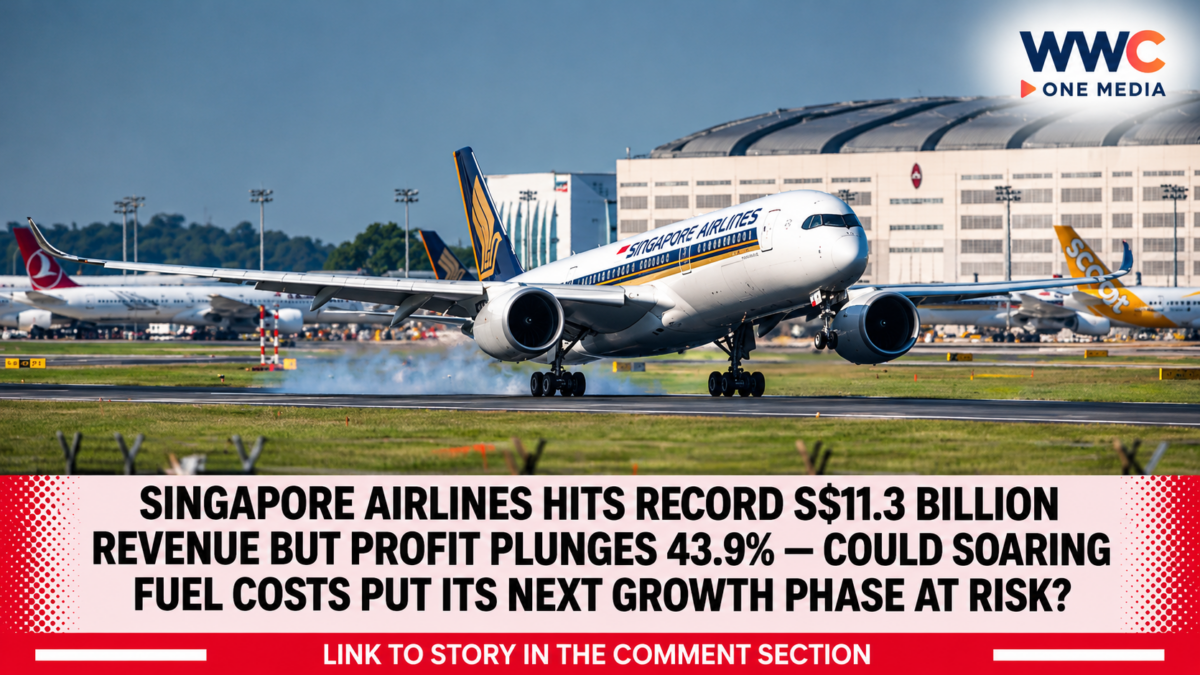
SINGAPORE — Singapore Airlines (SIA) is carrying more passengers, generating record revenue and benefiting from stronger cargo demand. Yet its latest financial results reveal a problem that even a booming travel market cannot easily overcome: the soaring cost of jet fuel.
For the first half of its 2026/27 financial year, Singapore Airlines Group reported record revenue of S$11.3 billion, up 16.8 per cent from S$9.67 billion a year earlier.
But net profit fell 43.9 per cent to S$133.9 million, compared with S$238.5 million in the corresponding period last year.
The main pressure came from fuel. The group’s fuel expenditure before hedging surged 90.3 per cent to approximately S$4.7 billion, as average jet fuel prices climbed sharply amid the continuing conflict in the Middle East.
The results, released on November 11, 2026, expose a difficult contradiction for the national carrier: demand is strong, passenger numbers are at record levels and cargo is generating more revenue, but the cost of operating flights is consuming a much larger share of those gains.
There was some relief in the second quarter, when profits recovered significantly from the previous quarter and improved against the same period last year.
However, the half-year figures tell a more complicated story.
SIA is selling more travel than ever, but can it protect its earnings if fuel prices remain elevated?
Record S$11.3 Billion Revenue Fails to Protect SIA’s Bottom Line
The headline revenue figure is impressive.
SIA Group generated S$11.297 billion in revenue during the six months ended September 30, 2026, representing a 16.8 per cent increase year on year.
The growth was supported by stronger passenger and cargo performance across Singapore Airlines and its low-cost subsidiary, Scoot.
Passenger-flown revenue increased 16.8 per cent to approximately S$9.10 billion. The group carried a record 21.8 million passengers, 5 per cent more than in the same period last year.
Passenger yields also improved by 12.1 per cent to 11.1 Singapore cents per revenue passenger-kilometre.
Cargo was another bright spot.
Cargo revenue rose 30.2 per cent to approximately S$1.39 billion, supported by stronger cargo yields and higher demand for air freight.
The cargo yield increased 25.4 per cent, while the cargo load factor improved to 58.5 per cent.
These results show that SIA is benefiting from demand across two important parts of its business: passenger travel and air freight.
Yet stronger sales did not translate into higher overall earnings.
The group’s total expenditure increased 20.9 per cent to S$10.73 billion, outpacing the 16.8 per cent revenue growth.
That difference explains why record revenue did not prevent the sharp decline in first-half profit.
Jet Fuel Costs Surge More Than 90% as Middle East Conflict Weighs on Airlines
Fuel was the biggest pressure point in the results.
SIA’s fuel cost before hedging increased by approximately S$2.23 billion, or 90.3 per cent, to around S$4.7 billion.
Average jet fuel prices for the six-month period reached US$171 per barrel, an increase of 86.7 per cent from a year earlier.
The airline attributed the sharp increase to elevated fuel prices amid the continuing conflict in the Middle East.
Fuel is one of the most significant operating expenses for airlines. When prices rise sharply, carriers face a difficult decision: absorb the additional expense, increase fares, adjust capacity or combine several measures.
SIA has adjusted airfares and cargo rates, but the company acknowledged that these measures have not fully offset the impact of higher fuel prices.
Fuel hedging helped soften the blow.
The group recorded fuel hedging gains of approximately S$806 million, partly cushioning the increase in fuel expenditure.
After accounting for hedging, net fuel costs rose 56 per cent to approximately S$3.97 billion.
Even with those gains, the increase was substantial enough to weigh heavily on operating profit.
Reuters reported that the airline’s earnings remained under pressure because higher fuel costs could not be fully passed on to customers, despite higher passenger fares and cargo rates.
The wider concern is that a prolonged Middle East conflict could create additional inflationary pressure, affecting both airline operating expenses and demand for passenger travel and air freight.
For SIA, that means the fuel challenge is not simply about the price paid at the pump. It could also influence how much customers are willing or able to pay for flights.
Second-Quarter Profit Rebounds — But the First Quarter Still Hurts
There is a more encouraging side to the financial report.
SIA delivered a significantly stronger second quarter compared with the same period last year.
For the quarter, group revenue increased 14.3 per cent to approximately S$5.58 billion.
Operating profit rose 16.3 per cent to S$463.7 million, while net profit climbed to approximately S$209.7 million, compared with S$52.4 million in the corresponding quarter a year earlier.
That is a substantial improvement.
However, the first-quarter performance explains why the half-year result remained weak.
SIA recorded a net loss of approximately S$75.8 million in the April-to-June quarter, as elevated fuel costs and its share of losses from associated companies weighed on earnings.
The second-quarter recovery helped offset that loss, but it was not enough to restore the previous year’s half-year profit.
For the full first half, operating profit fell 29.1 per cent to S$569.2 million.
The distinction matters: SIA is not reporting a uniformly deteriorating business. Its second-quarter figures show an improvement, but the overall six-month performance continues to reflect the impact of the earlier downturn and high fuel expenses.
Air India Losses Still Weigh on SIA — Although the Impact Has Narrowed
Another important factor in SIA’s financial performance is its investment in Air India.
Singapore Airlines owns a 25.1 per cent stake in the Indian carrier, and its share of Air India’s financial results affects SIA’s reported earnings.
For the first half of FY2026/27, SIA’s share of losses from associated companies, mainly Air India, narrowed to S$361.7 million, compared with S$429.5 million a year earlier.
That improvement helped partially offset the decline in operating profit.
It is important to separate this from the direct cost of operating SIA’s own flights. Air India’s losses are reflected through SIA’s share of results from associated companies, rather than being part of the group’s fuel expenditure.
The investment remains strategically significant because India is a major aviation market with substantial long-term growth potential.
But the financial pressure has prompted questions about how much more support the turnaround may require and when the investment can deliver stronger returns.
WWC ONE MEDIA previously examined the debate surrounding Singapore Airlines’ Air India investment and the financial questions raised in Parliament.
The debate is not simply whether Air India can become profitable. It is also about how SIA balances the long-term strategic value of its Indian investment against the financial impact of supporting a major airline transformation.
SIA has continued to describe the Air India partnership as a long-term strategic investment.
For now, the latest half-year results show that losses from associates remain significant, even though the year-on-year contribution has improved.
SIA Declares Seven Cents in Dividends Despite Lower Profit
Despite the decline in earnings, SIA announced a total first-half dividend of S$0.07 per share.
The payout comprises:
- S$0.02 per share in interim ordinary dividends.
- S$0.05 per share in interim special dividends.
The dividends are scheduled to be paid on December 11, 2026.
The total is lower than the S$0.08 per share distributed for the corresponding period a year earlier, which comprised a S$0.05 ordinary dividend and a S$0.03 special dividend.
The decision to maintain a special dividend despite weaker profits is notable, particularly as the airline continues to face high fuel expenses and substantial investment requirements.
However, dividend payments should be considered alongside the group’s cash position, capital expenditure, debt obligations and future operating needs.
The company reported cash and bank balances of approximately S$8.12 billion at the end of September.
Its total cash and liquidity stood at approximately S$8.98 billion, including fixed deposits classified as other short-term assets.
SIA also had access to S$3.23 billion in committed but undrawn credit facilities.
These figures indicate that the group retains substantial financial resources to support its operations and investments.
New Aircraft and Expansion Continue Despite the Cost Pressures
SIA is not abandoning its growth plans.
During the second quarter, Singapore Airlines and Scoot each took delivery of two aircraft.
This brought the group’s operating fleet to 224 passenger and freighter aircraft, with another 58 aircraft on order.
The fleet expansion forms part of the group’s broader strategy to strengthen its network, improve its travel experience and maintain its competitive position in international aviation.
SIA is also investing in cabin improvements, onboard dining and other passenger-facing upgrades.
In September, WWC ONE MEDIA reported on Singapore Airlines’ major in-flight dining upgrade, featuring more than 100 refreshed and new dishes across its cabin classes.
The airline’s investment in the passenger experience is part of a wider effort to compete for travellers in the premium and long-haul markets.
Its network expansion is also continuing. SIA’s planned return to Madrid after more than 20 years, alongside additional European capacity, reflects its confidence in demand across key international routes.
Read more: Singapore Airlines’ return to Madrid and its wider European expansion plans.
But aircraft deliveries and cabin upgrades require substantial capital.
The challenge is to keep investing in long-term competitiveness while managing expenses that are already rising faster than revenue.
Cargo Demand Offers Another Source of Strength
Passenger travel is not the only area supporting SIA’s business.
Cargo revenue rose 30.2 per cent in the first half, reaching approximately S$1.39 billion.
The group benefited from stronger cargo yields, while demand remained firm for shipments associated with semiconductors and cloud-computing-related activity.
Geopolitical and weather-related disruptions to sea freight also encouraged some shippers to consider air freight as an alternative.
The cargo business therefore provides another source of revenue beyond passenger tickets.
However, cargo operations are not immune to the same cost pressures.
Higher fuel prices can reduce margins, while prolonged geopolitical disruptions can affect supply chains, shipping schedules and the broader economic environment.
SIA’s cargo performance is encouraging, but it does not eliminate the risks posed by an extended period of elevated operating costs.
What SIA Says About the Outlook
SIA described the airline industry as operating in an uncertain environment, with geopolitical developments adding complexity to operations and supply chains.
The group said passenger demand remained healthy, supported by seasonal travel flows.
Cargo demand was also firm, particularly for semiconductor and cloud-computing-related shipments.
However, the airline warned that an extended conflict in the Middle East could create broader inflationary pressures and affect demand for passenger travel and air freight.
The company said it would maintain disciplined cost management to reinforce its long-term competitive position.
That cautious assessment reflects the difficult balance facing airlines.
Strong travel demand can support revenue, but it cannot fully protect profitability when fuel prices rise sharply and other operating expenses continue to increase.
The next few quarters will therefore be important in determining whether SIA can convert its record passenger numbers and cargo growth into stronger earnings.
The Bigger Question: Can SIA Turn Record Demand Into Sustainable Profit?
Singapore Airlines’ latest results reveal a business with two very different stories.
On one side, the group is carrying a record number of passengers, reporting record half-year revenue and benefiting from stronger cargo yields.
Its second-quarter performance also shows that earnings can recover even while fuel costs remain elevated.
On the other side, the first-half profit decline demonstrates how quickly rising fuel expenses can erode the benefits of higher fares, increased passenger volumes and stronger cargo demand.
The airline still has substantial cash resources, a global network and a significant order book of aircraft.
But its ability to sustain growth will depend on several factors: fuel prices, geopolitical developments, passenger demand, cargo performance and the financial progress of its associated companies.
For travellers, the immediate concern may be whether higher operating costs eventually translate into more expensive tickets.
For investors, the more important question is whether SIA can restore stronger profitability without sacrificing its growth strategy or financial flexibility.
Singapore Airlines has proved it can fill more seats and generate record revenue. But with fuel costs soaring and profits falling, can the national carrier turn its passenger boom into lasting financial strength—or is the most difficult part of the journey still ahead?