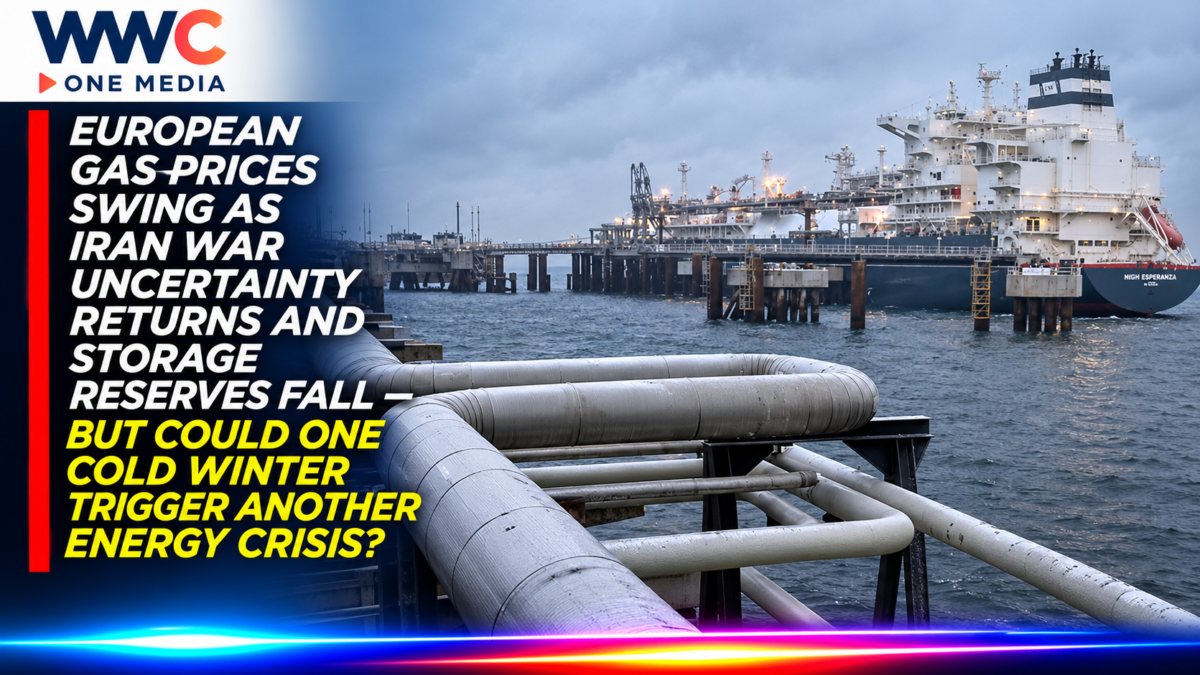
AMSTERDAM / BRUSSELS — November 11, 2026 — Europe’s natural gas market is facing another difficult winter as uncertainty surrounding the US-Iran conflict collides with unusually low storage reserves, rising seasonal demand and continued disruption to liquefied natural gas (LNG) shipments from the Middle East.
The latest warning is coming from Europe’s benchmark gas market, where prices have been moving in both directions as traders weigh hopes for a diplomatic resolution against the risk of another supply shock.
According to Bloomberg reporting published November 10, European natural gas futures fluctuated after declining for two consecutive sessions. The market was responding to US President Donald Trump’s suggestion that further military strikes against Iran might not be necessary, raising hopes that the conflict could eventually wind down.
But the improvement in geopolitical sentiment is competing with a much less reassuring supply picture.
Europe has started withdrawing gas from storage more rapidly as colder weather increases heating demand. Net withdrawals during the previous week jumped nearly sixfold compared with the week before, according to the Bloomberg report.
At the same time, average gas storage across the European Union had fallen to approximately 72%, compared with a five-year seasonal average of 89%. Germany’s reserves were lower, at around 59%.
The result is a market caught between two opposing forces: hopes that peace could restore disrupted LNG supplies and fears that Europe may not have enough gas reserves if the winter becomes unusually cold.
The biggest question is whether Europe’s falling gas prices represent a genuine improvement in energy security—or simply a temporary pause before another major winter supply shock.
European Gas Prices Fall More Than 20% in November—but the Market Remains Unstable
The latest movement in European gas prices highlights how quickly geopolitical developments can influence energy markets.
After surging to levels last seen during the 2022 energy crisis in October, European gas prices had fallen by more than 20% during November, according to Bloomberg.
The decline reflected improving expectations that the US-Iran conflict could eventually move toward negotiations rather than further military escalation.
Trump’s comments suggesting additional strikes against Iran may not be necessary helped reduce the geopolitical risk premium previously built into energy prices.
However, the decline does not mean Europe’s underlying supply problems have disappeared.
Traders are still monitoring the Strait of Hormuz, the recovery of Qatari LNG exports, winter temperatures and the speed at which European countries are consuming their stored gas.
Bloomberg reported that the Dutch Title Transfer Facility (TTF), Europe’s benchmark natural gas contract, was fluctuating as traders assessed these competing developments.
The TTF price is especially important because it provides a major reference point for wholesale natural gas trading across Europe.
A change in the benchmark can influence the cost of gas purchased by utilities, energy suppliers and industrial consumers.
But wholesale benchmark prices are not the same as household electricity or heating bills, which also depend on contracts, taxes, network charges and other costs.
The recent market decline therefore offers some relief, but it does not guarantee that European consumers will immediately experience lower energy bills.
Trump’s Iran Comments Ease Market Fears—but the Supply Risk Has Not Disappeared
The latest optimism in the gas market followed Trump’s comments suggesting that additional military action against Iran might not be necessary.
The US political situation has also become relevant to the conflict.
Following his party’s losses in the recent midterm elections, the administration faces growing political pressure over the war.
Bloomberg reported that congressional Democrats were considering whether to use the December 11 government shutdown deadline as leverage to pressure Trump to end the conflict.
The possibility of renewed negotiations has encouraged traders to reduce some of the geopolitical premium attached to oil and gas prices.
But a political statement is not the same as a final peace agreement.
The market still needs evidence that energy production, exports and shipping can return to normal.
Even if diplomatic negotiations advance, damaged infrastructure, shipping restrictions and commercial disruptions may take time to resolve.
For Europe, the most important question is not simply whether military activity declines. It is whether reliable LNG shipments can return to the international market quickly enough to support winter demand.
Europe’s Gas Storage Is Falling Faster as Cold Weather Arrives
The biggest immediate concern is the condition of Europe’s gas reserves.
Gas storage is essential because demand increases significantly during the winter heating season.
Countries typically inject gas into underground storage facilities during warmer months and withdraw it when households, businesses and power stations need additional supplies.
But Europe’s storage position is already weaker than normal.
Bloomberg reported on November 10 that EU storage levels had fallen to approximately 72%, compared with a five-year seasonal average of 89%.
The difference is significant because the region is entering the period when gas consumption normally increases.
The recent cold spell has accelerated withdrawals.
Net withdrawals during the previous week jumped almost sixfold from the previous week, highlighting the pressure that sudden changes in temperature can place on the energy system.
Germany, Europe’s largest economy and one of its most important gas consumers, is in a particularly difficult position.
Bloomberg placed German storage levels at around 59% in its November 10 report.
A separate Reuters report published November 3 put Germany’s gas storage at 61.05% on November 2, compared with an EU average of 74.56%.
These figures refer to different reporting dates and should not be treated as simultaneous readings.
Reuters also reported that Germany had entered winter with its lowest gas stocks on record, raising concerns about how much fuel could remain by the end of the heating season.
The lower storage position makes Germany particularly sensitive to a prolonged cold spell or another interruption to international supplies.
Germany Faces a Warning Over Its Winter Gas Security
Germany’s storage problem has become one of the clearest examples of Europe’s wider energy vulnerability.
The country holds more than one-fifth of the European Union’s gas storage capacity, making its reserves particularly important to the regional market.
But its storage facilities entered November below the country’s approximately 70% target.
Reuters reported that analysts were concerned Germany could finish winter with only around 20% to 25% of storage capacity remaining.
That estimate is an analyst assessment, not a confirmed forecast.
The outcome will depend on winter temperatures, industrial consumption, imports and the availability of additional LNG cargoes.
Germany’s experience also reflects the consequences of Europe’s changing energy supply structure.
After Russia’s invasion of Ukraine in 2022, European countries rapidly reduced their dependence on Russian pipeline gas and increased purchases of LNG from other suppliers.
That strategy improved diversification, but it also increased exposure to international LNG market conditions.
The Iran conflict has now demonstrated how a disruption in the Persian Gulf can affect European energy security even though the region is not directly dependent on Middle Eastern gas for most of its total supply.
Strait of Hormuz Remains the Biggest Geopolitical Risk for LNG Supplies
The Strait of Hormuz is one of the world’s most important energy shipping routes.
Before the conflict, approximately one-fifth of global LNG flows passed through the waterway, with Qatar playing a particularly important role.
Disruptions to shipping and damage to energy infrastructure have restricted the ability of major Gulf exporters to deliver contracted supplies.
The International Energy Agency (IEA) said in its November 3 Global Gas Security Review that the effective halt of LNG flows through the Strait of Hormuz reduced loadings from Qatar and the United Arab Emirates by more than 60 billion cubic metres between March and October 2026.
The agency also projected that global LNG supply would decline by approximately 3%, or nearly 20 billion cubic metres, during 2026.
That is a significant development because LNG has become increasingly important to both European and Asian energy markets.
Unlike pipeline gas, LNG can be transported by specialized tankers and redirected toward different destinations, depending on contractual arrangements and market conditions.
This flexibility helps countries diversify their supply.
But during a major international shortage, buyers can end up competing for the same available cargoes.
Europe and Asia are therefore exposed to a shared supply problem.
If European buyers need more gas during a cold winter, they may have to compete with Asian importers for replacement LNG shipments.
That competition could keep international prices elevated even if the immediate military situation improves.
Qatar’s LNG Exports Are Recovering—but Normal Supply Has Not Returned
There are some encouraging signs.
Bloomberg reported that LNG loadings onto tankers from Qatar had increased over the preceding weeks.
That suggests the major exporter is attempting to restore shipments despite ongoing disruptions in the Strait of Hormuz.
However, an increase in tanker loadings does not mean the entire export system has returned to normal.
The IEA’s November assessment highlighted the scale of the supply shock and the difficulty of quickly replacing lost Middle Eastern LNG.
Qatar’s export infrastructure, shipping availability and access to international routes remain central to the recovery.
Europe is particularly exposed because it needs to replenish reserves while simultaneously meeting winter consumption.
The European Union has already increased its reliance on American LNG.
According to the European Union Agency for the Cooperation of Energy Regulators (ACER), US LNG accounted for approximately 30% of total EU gas supply during the 2026 summer season.
The same report said no significant volumes of Qatari LNG reached the EU during that period.
That shift demonstrates how the crisis is changing Europe’s supplier mix.
But replacing one major supplier with another does not eliminate the risk of global price volatility.
The IEA Warns Europe’s Gas Problems Could Continue Into 2027
The International Energy Agency has warned that Europe’s low storage buffers could prolong tight conditions in global gas markets well into 2027.
Its November 3 Global Gas Security Review found that Europe entered the 2026–2027 heating season with its lowest natural gas storage levels in more than a decade.
The agency also highlighted the growing importance of flexible LNG trading arrangements and additional supplies from North America.
But the global supply shock remains serious.
The IEA estimated that the disruption to LNG flows through the Strait of Hormuz had reduced Qatar and UAE loadings by more than 60 billion cubic metres between March and October.
It expects global LNG supply to decline by around 3% in 2026, even as international buyers seek alternatives.
The implications extend beyond the winter months.
If Europe ends the heating season with depleted storage, it will need to purchase large volumes of gas during the following summer to prepare for winter 2027–2028.
That could sustain demand for LNG and keep the international market tight even after temperatures rise.
In other words, Europe’s energy challenge may not end when winter does.
Lower Wind Generation Adds More Pressure to Europe’s Gas Market
Natural gas is not only used for heating and industrial production.
It also plays an important role in electricity generation.
When wind generation falls, gas-fired power stations can help compensate for reduced renewable electricity output.
Bloomberg reported that lower wind generation in parts of Europe had added further pressure to gas inventories.
The relationship is important because renewable electricity output can vary depending on weather conditions.
Wind and solar power reduce the amount of fossil fuel needed when generation is strong.
But when wind speeds fall and solar output is limited, power systems may need more flexible generation sources.
Natural gas is one of the fuels frequently used to provide that flexibility.
This creates a difficult situation when gas storage is already low and international LNG supplies remain uncertain.
A cold spell can increase heating demand at the same time that weak wind generation raises the need for gas-fired electricity.
The combination can accelerate gas withdrawals and increase pressure on wholesale prices.
Much of Europe was expected to experience above-average temperatures during the week following Bloomberg’s November 10 report, potentially providing some near-term relief.
But meteorologists have warned that colder periods could still develop later in the heating season.
German Gas Storage Group Warns Extreme Cold Could Threaten Supply Security
Germany’s low reserves have prompted concern from INES, the country’s gas storage industry association.
According to Bloomberg, INES warned that Germany’s gas supply could not be fully guaranteed during the winter if extremely cold temperatures occur.
That warning should not be interpreted as confirmation that Germany is about to run out of gas.
It highlights the reduced margin of safety under an extreme-weather scenario.
Germany is currently expected to experience a mild to average winter, according to the market outlook cited by Bloomberg.
But an extended cold spell could increase withdrawals faster than expected.
The country’s supply position would then depend on whether additional imports can arrive in time.
This is why storage levels, pipeline flows, LNG deliveries and weather forecasts are being closely monitored by energy traders.
The more limited the available reserves, the more important reliable imports become.
High Gas Prices Are Already Hurting European Industry
The consequences of Europe’s gas market problems extend far beyond energy traders.
High wholesale prices increase operating costs for manufacturers, particularly businesses that depend heavily on natural gas and electricity.
Chemical producers, fertilizer manufacturers, glassmakers, steel companies and other energy-intensive industries can be especially vulnerable.
Reuters reported on November 5 that French utility Engie’s Chief Financial Officer Pierre-François Riolacci expected higher energy prices to reduce European consumption during winter.
He said gas demand was already under pressure during the third quarter, including among large industrial customers.
European chemicals companies have been among the earliest businesses affected by higher energy and raw-material costs.
The industry is facing a particularly difficult combination of weak demand, high operating costs and regulatory pressure.
The concern is that expensive energy could encourage factories to reduce production, delay investment or move some operations to lower-cost regions.
That would create economic consequences beyond the energy sector itself.
Europe’s energy crisis is therefore also becoming a competitiveness problem.
Why Europe’s Gas Crisis Matters to Asian Countries and the Philippines
Although Europe is geographically distant from the Persian Gulf, its energy market is closely connected to Asia.
LNG is traded internationally, and cargoes can be directed toward markets where buyers are willing and able to pay competitive prices.
When Europe needs additional supplies, Asian buyers may face stronger competition for available shipments.
That can increase procurement costs and create uncertainty for countries that depend heavily on imported gas.
The Philippines is also exposed to international energy-market volatility.
The country increasingly uses imported LNG to supplement domestic natural gas supplies for electricity generation.
A prolonged disruption affecting major LNG exporters could therefore influence the cost of fuel available to Philippine power producers.
However, European wholesale gas prices do not directly determine Philippine electricity bills.
Local electricity rates also depend on generation contracts, fuel procurement, exchange rates, transmission costs, distribution charges and regulatory decisions.
The broader concern is the international cost of obtaining replacement fuel.
WWC ONE MEDIA previously examined how the Iran conflict is pushing Filipinos toward rooftop solar as households and businesses seek protection against volatile imported energy prices.
Read: Iran War Sends Filipinos Racing Into Solar as Power Bills Surge
The Philippines is not alone in seeking alternatives.
Bangladesh has also been pursuing additional American LNG supplies as disruptions to Qatari deliveries threaten its energy security.
Read: Bangladesh Seeks More US LNG as Qatar Supply Crisis Deepens
These developments demonstrate how the same geopolitical shock can affect countries with very different energy systems.
Poland’s Qatar LNG Contract Cancellation Shows How Serious the Supply Disruption Has Become
Another important development occurred on November 10, when Polish energy company Orlen moved to terminate one of its long-term LNG supply agreements with QatarEnergy.
The contract covered approximately one million metric tons of LNG annually and was scheduled to remain in force until 2034.
Orlen cited prolonged force majeure conditions that prevented QatarEnergy from fulfilling deliveries.
The company said the termination would not threaten Poland’s supply security because it had access to domestic production and other long-term suppliers, including Norway and the United States.
The decision is particularly significant because it illustrates how prolonged supply interruptions can affect even long-term commercial relationships.
A contract may provide a framework for future deliveries, but it cannot guarantee that gas will physically reach its destination during a major geopolitical disruption.
WWC ONE MEDIA examined the financial and strategic implications of the Polish decision in its report on the €570-million Qatar LNG agreement.
Read: Poland Cancels €570-Million Qatar LNG Deal After War Disrupts Gas Deliveries
The development also shows why Europe is increasingly looking toward the United States and other suppliers to diversify its energy sources.
Europe’s Energy Crisis Is Returning Despite Years of Diversification
Europe has spent years reducing its dependence on Russian pipeline gas following the 2022 energy crisis.
Governments invested in LNG terminals, expanded import capacity and sought new supply agreements with producers outside Russia.
Those measures helped the continent diversify its energy system.
But the latest crisis demonstrates that diversification does not mean complete protection from international shocks.
Europe is now dealing with a different geopolitical problem involving the Middle East and the Strait of Hormuz.
The supply disruption has exposed the importance of reliable shipping routes, flexible import arrangements and adequate storage.
WWC ONE MEDIA recently reported on Europe’s wider energy crisis, including unusually low gas inventories and wholesale electricity prices that surged above €600 per megawatt-hour during selected trading intervals in Germany.
Read: Europe’s Energy Crisis Returns as Power Prices Surge Above €600 and Gas Reserves Run Low
The electricity price spike and the gas storage situation are connected, but they are not identical market indicators.
The €600 figure refers to selected wholesale electricity trading intervals, not the average household electricity price.
Together, however, the developments show how weather, fuel availability and international conflict can combine to create sudden energy-market pressure.
Five Factors That Could Determine Whether European Gas Prices Rise Again
The direction of Europe’s gas market will depend on several developments over the coming weeks.
1. Progress in US-Iran negotiations
A credible agreement that restores safe shipping and energy exports could reduce the geopolitical risk premium in gas prices.
2. Qatar’s LNG export recovery
More reliable deliveries from Qatar would improve international supply and reduce pressure on buyers competing for replacement cargoes.
3. Winter temperatures
A prolonged cold spell could accelerate storage withdrawals and increase heating demand.
4. Wind and renewable electricity generation
Weak wind generation could increase the need for gas-fired electricity, putting additional pressure on inventories.
5. Europe’s ability to secure replacement imports
Additional American and other international LNG supplies could help offset the loss of Middle Eastern shipments, although competition with Asian buyers may keep prices elevated.
These factors will determine whether the recent price decline develops into a sustained recovery or proves temporary.
The Bottom Line: Europe’s Gas Market Is Caught Between Peace Hopes and Winter Supply Fears
European natural gas prices have fallen more than 20% so far in November after reaching levels associated with the 2022 energy crisis in October.
But the market remains unstable.
Trump’s comments about potentially ending further strikes against Iran have encouraged optimism, while Qatar’s increased tanker loadings suggest some improvement in export activity.
Yet Europe is entering winter with gas storage below normal seasonal levels.
The EU’s reserves were around 72% in Bloomberg’s November 10 report, compared with a five-year seasonal average of 89%.
Germany’s storage was even lower, at approximately 59%.
The IEA has warned that the disruption to LNG flows through the Strait of Hormuz could prolong tight global gas market conditions into 2027.
Meanwhile, Reuters reports that high energy prices are already affecting industrial consumption, particularly among European manufacturers with limited profit margins.
There are reasons for cautious optimism.
Warmer weather, stronger LNG shipments and diplomatic progress could ease market pressure.
But the risks remain significant.
Europe’s energy security will depend on whether its suppliers can restore reliable deliveries before winter demand reaches its peak.