SINGAPORE / NEW YORK / MANILA — November 11, 2026 | WWC ONE MEDIA | Global Oil Markets, US-Iran Relations, Energy Prices and Financial Markets
The global oil market is entering a dangerous period of uncertainty as crude prices experience one of their sharpest reversals of 2026, driven by growing expectations that the United States and Iran may avoid another major round of military attacks.
But there is a serious problem with the apparent improvement.
The war has not produced a lasting peace agreement, shipping remains dangerous in the Strait of Hormuz, and the restrictions affecting Iranian oil exports have not been fully resolved.
In a November 11 Bloomberg Opinion column, energy commentator Javier Blas argued that oil traders are not necessarily forecasting peace. Rather, the dramatic selloff reflects reduced expectations of an immediate third round of major US-Iran hostilities.
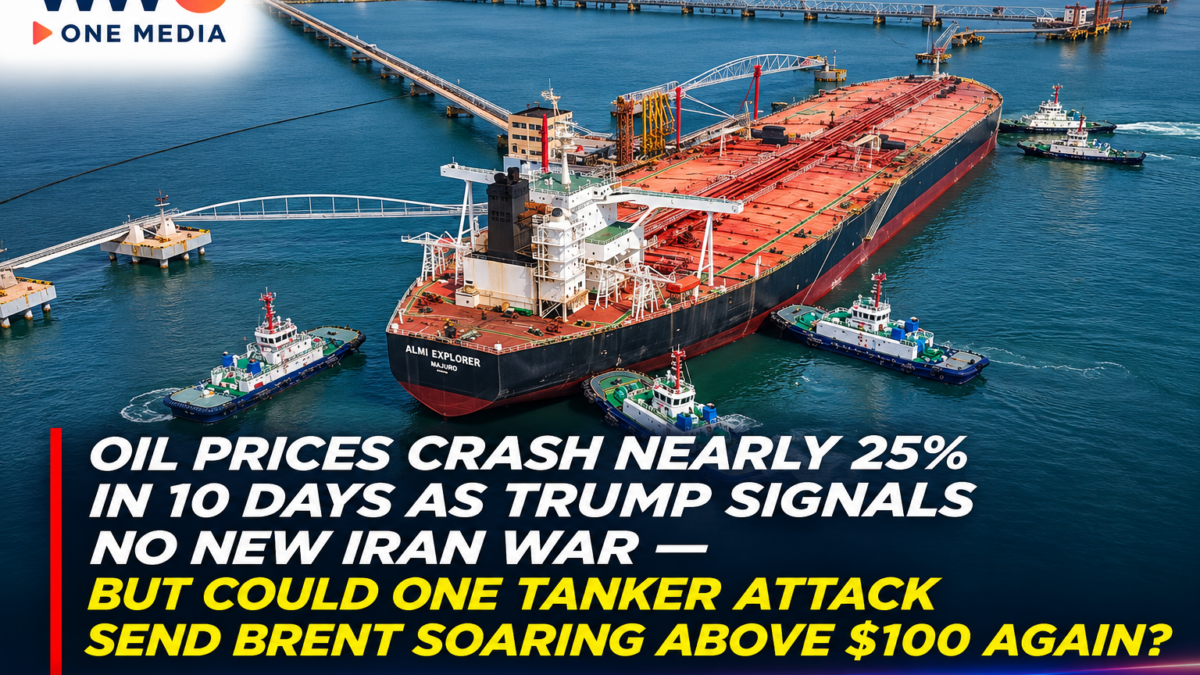
Brent crude has declined nearly 25% over approximately ten days, according to the columnist’s market assessment.
But prices remain highly sensitive to events in the Persian Gulf.
On Wednesday, November 11, Brent futures rebounded to approximately $92.53 per barrel, while US West Texas Intermediate rose to $86.71, according to Reuters.
The recovery followed reports of renewed attacks on commercial vessels near the Strait of Hormuz, one of the world’s most important energy transportation routes.
The conflicting signals have created an extraordinary situation.
Investors are selling oil because they believe another major escalation may be less likely.
Yet shipowners, insurers and energy traders continue confronting threats that could disrupt the movement of millions of barrels of petroleum.
Could the market be mistaking a temporary reduction in fighting for the beginning of peace—or is the latest oil-price collapse finally signaling the end of the Middle East energy crisis?
Oil Prices Collapse as Trump Signals Restraint Toward Iran
International oil prices have fallen sharply since late October as investors reassessed the likelihood of renewed American military operations against Iran.
The decline accelerated after the November 3 US midterm elections, in which Republicans suffered major political losses.
The results increased expectations that President Donald Trump might seek a diplomatic exit from the conflict rather than intensify military operations.
Trump subsequently suggested that additional extensive attacks against Iran were unlikely, although he made that position conditional on Tehran reaching an acceptable agreement.
Oil markets reacted immediately.
On November 9, Brent crude fell approximately 5.9% to settle at $92.57 per barrel.
The selloff extended one of the market’s most volatile stretches since the COVID-19 pandemic.
In related reporting, WWC ONE MEDIA examined Brent’s nearly 6% decline to approximately $92 after Trump signaled a pause in further strikes against Iran.
The decline reflected a reduction in the geopolitical risk premium embedded in crude prices.
But a lower risk premium does not mean the underlying conflict has been settled.
That distinction is central to understanding why prices can fall dramatically one day and rebound the next.
Bloomberg Opinion: The Market Is Pricing Less War, Not Peace
Bloomberg Opinion columnist Javier Blas raised an important interpretation of the recent selloff.
A nearly 25% decline in Brent over ten days could suggest investors believe a lasting peace agreement is approaching.
But the columnist’s argument is more cautious.
Markets may instead be responding to a narrower possibility: the United States and Iran might avoid another immediate round of major attacks.
That is not the same as a comprehensive diplomatic settlement.
A lasting agreement would likely need to address the American naval blockade, international sanctions, Iranian nuclear activities and restrictions on commercial shipping.
Without progress on those questions, the energy market remains exposed to disruptions.
The distinction helps explain why Brent can trade around $90 a barrel even after a substantial decline.
Oil prices reflect not only present supply and demand but also the probability of future disruptions.
When the perceived likelihood of military escalation falls, futures prices may decline.
When fresh attacks occur, traders can quickly reassess that probability.
Strait of Hormuz Attacks Continue Despite Peace Hopes
The biggest immediate obstacle to a lasting oil-market recovery is the Strait of Hormuz.
The narrow waterway connects the Persian Gulf with the Gulf of Oman and international shipping routes.
Before the conflict, approximately one-fifth of global petroleum liquids consumption passed through the strait.
Oil and gas shipments from major Middle Eastern producers depend heavily on safe navigation through the region.
But maritime security remains fragile.
Reuters reported that 37 vessels were attacked in the Strait of Hormuz and surrounding waters during October, the highest monthly total since the current Middle East war began.
Another ten attacks had been recorded in November as of the latest reporting.
Several incidents involved tankers operating near Oman.
Reuters verified footage showing a commercial tanker on fire after one of the attacks.
British maritime security authorities also reported another vessel being struck near the Omani coast.
These incidents illustrate why traders cannot assume that reduced military rhetoric has restored normal commercial conditions.
In related coverage, WWC ONE MEDIA examined Iran’s November 9 claim that no unauthorized vessels crossed the Strait of Hormuz after navigational aid systems were destroyed.
That Iranian statement did not establish that all shipping had stopped.
It nevertheless highlighted the continuing uncertainty surrounding maritime access.
A Peace Agreement Would Not Automatically Reopen the Strait
Even if Washington and Tehran announce a diplomatic breakthrough, commercial shipping may not immediately return to normal.
According to analysts at LSEG, a restoration of oil flows would depend on several additional conditions.
These include mine clearance, insurance availability and the willingness of shipowners to resume transit.
A tanker operator must consider the safety of its crew, vessel and cargo.
Marine insurance companies must assess whether the risk can be covered at commercially acceptable rates.
Ports and terminals must also be operational.
Damaged navigational infrastructure may require repairs.
These practical requirements can delay recovery even after political leaders announce an agreement.
Consequently, the market could face an extended period in which military tensions are lower but shipping costs remain elevated.
That uncertainty helps explain the gap between political optimism and actual conditions at sea.
Iran’s Oil Exports Have Been Severely Restricted
Another major unresolved problem is the US naval blockade affecting Iranian petroleum exports.
Iran has historically depended heavily on oil sales for government revenue and access to foreign currency.
But the conflict and American restrictions have sharply reduced the country’s ability to sell crude internationally.
Bloomberg reported on November 6 that Iranian oil exports had dwindled to extremely low levels.
Energy consultancy FGE NexantECA said the blockade had effectively halted most normal exports.
Chairman emeritus Fereidun Fesharaki estimated that approximately 200,000 to 300,000 barrels per day were still reaching markets through Iraq.
That estimate was attributed to the analyst and should not be treated as independently verified official production data.
Bloomberg’s tanker-tracking analysis also indicated that Iran had loaded no crude onto export tankers during September and October.
The blockade increases pressure on Tehran.
But economic pressure does not guarantee a diplomatic concession.
Iranian authorities continue demanding sanctions relief and changes to the blockade before accepting a broader settlement.
Washington and Tehran Remain Divided Over the Conditions for Peace
Diplomatic efforts have intensified through regional intermediaries, particularly Qatar.
But the key disagreements remain substantial.
Iran has demanded the lifting of the American naval blockade, sanctions relief and access to frozen financial assets.
It has also raised demands involving compensation and the cessation of military operations.
Washington continues pressing for restrictions and verification arrangements involving Iran’s nuclear program.
Associated Press reporting described proposals under discussion that could involve a phased process.
One stage would address the blockade and access to international nuclear inspections.
Another would seek to establish temporary arrangements for restoring navigation through the Strait of Hormuz.
But the proposals have not produced a confirmed comprehensive agreement.
The distinction matters for financial markets.
A proposal under discussion is not the same as a legally or politically binding settlement.
Nor does it guarantee that each side will fulfill the required conditions.
In related coverage, WWC ONE MEDIA examined the continuing disagreements between Washington and Tehran over sanctions, the naval blockade and further military action.
The unresolved issues explain why oil prices can remain volatile despite repeated diplomatic announcements.
Why Oil Rebounded on November 11
After falling to a two-month low on November 10, crude prices rebounded during Wednesday’s Asian trading session.
Reuters reported Brent futures rising approximately 1.1% to $92.53 per barrel at 04:20 GMT.
WTI increased roughly 0.8% to $86.71.
The recovery followed fresh reports of attacks on ships near the Strait of Hormuz.
Investors also reconsidered whether diplomacy would progress as quickly as markets had recently assumed.
In the previous session, prices had initially declined following statements suggesting that additional American strikes were unlikely.
But part of those losses was reversed after an Iranian security official said no talks were taking place between the two sides.
The developments illustrate an increasingly headline-sensitive market.
Traders are responding to political statements, maritime incidents and changes in expectations rather than a confirmed resolution of the conflict.
The result is a market that can produce sharp price movements in either direction.
Tanker Freight Costs Remain a Major Risk
The oil market’s problems extend beyond crude production.
Shipping costs have also become an important source of volatility.
When a major transportation route becomes dangerous, shipowners may demand higher freight rates.
Insurance premiums can rise.
Some vessels may seek alternative routes, while others remain idle awaiting safer conditions.
These changes can increase the cost of moving crude even when the underlying oil price is falling.
In related reporting, WWC ONE MEDIA examined a dispute over the Baltic Exchange’s TD3C benchmark, which tracks the cost of transporting crude from Saudi Arabia to China aboard very large tankers.
The dispute highlighted how extraordinary wartime shipping conditions have complicated the assessment of tanker transportation costs.
For buyers and sellers, reliable freight pricing is important because shipping expenses affect the final delivered cost of petroleum.
A decline in Brent futures does not automatically translate into a proportional reduction in delivered fuel costs.
Asian Fuel Oil Markets Are Also Reacting to Peace Expectations
The changing outlook has affected petroleum products used in shipping and industry.
In early November, Asian fuel oil prices and refining margins declined as traders anticipated that a potential diplomatic settlement might restore Middle Eastern supplies.
Singapore’s fuel oil market is particularly important because the city-state is a major international trading and bunkering center.
According to Reuters, the benchmark refining margin for 380-centistoke high-sulfur fuel oil swung from a premium of $5.34 per barrel early in the week to a discount of $2.29 on November 5.
In related reporting, WWC ONE MEDIA examined the decline in Asian fuel oil prices and the risk that high tanker costs could offset some benefits from cheaper crude.
These developments show how the impact of the Iran conflict extends beyond crude-oil futures.
Refiners, shipping operators and industrial consumers are also adjusting to rapidly changing market conditions.
US Oil Inventories Add Another Source of Pressure
Geopolitical developments are not the only influence on crude prices.
American inventory data also affect market expectations.
Reuters reported that US crude inventories increased by approximately nine million barrels during the week ended November 6, according to market sources citing American Petroleum Institute figures.
A large inventory build can suggest that available supply exceeded refinery demand or other withdrawals during the reporting period.
That can exert downward pressure on prices.
However, preliminary industry inventory estimates may differ from subsequent official government figures.
The increase should not be interpreted as proof that the entire global oil market is oversupplied.
International oil prices depend on a combination of global production, consumption, inventories, transportation costs and geopolitical risks.
For the moment, these competing forces are pulling prices in different directions.
Russia’s Oil Infrastructure Adds Another Layer of Uncertainty
While traders focus on Iran, the Russia-Ukraine conflict continues affecting petroleum infrastructure.
Reuters reported that renewed Ukrainian drone attacks had reduced approximately 30% of Russia’s oil refining capacity since late October, according to industry sources.
On November 11, a drone strike also caused a fire at the Russian Baltic Sea port of Ust-Luga, according to regional authorities.
The governor reported three injured workers.
The extent of any disruption to the port’s oil-export operations had not been independently established.
These developments add another potential source of supply uncertainty.
However, refinery outages and crude-export disruptions are not identical.
A refinery processes crude into petroleum products, while an export terminal handles shipments.
The effect on international prices depends on which facilities are affected and how long operations are interrupted.
What the Oil Market Means for Philippine Fuel Prices
The Philippines imports substantial quantities of petroleum products.
That makes domestic fuel prices sensitive to international market conditions.
A sustained decline in crude and refined-product prices could eventually provide relief to motorists and businesses.
But the relationship is not immediate.
Philippine pump prices depend on regional product benchmarks, exchange rates, transportation costs, taxes and local operating expenses.
The timing of price adjustments also matters.
In September, industry estimates warned of a possible increase of as much as ₱5 per liter as the Middle East conflict intensified.
That historical estimate should not be treated as a forecast for November.
No verified November 11 figure establishes the exact amount by which Philippine pump prices will increase or decrease during the next adjustment cycle.
The more important consideration is whether lower international oil prices can be sustained long enough to reduce the cost of imported fuel.
Could Oil Fall Further if Peace Is Reached?
A credible diplomatic agreement could remove some of the geopolitical risk premium currently embedded in crude prices.
The lifting of restrictions on Iranian exports could potentially increase available supply.
Safer maritime conditions could also reduce transportation and insurance costs.
But the scale and timing of any decline would depend on the agreement’s terms.
Sanctions relief could occur gradually.
Iranian production and exports might require operational adjustments.
Shipowners would still need confidence that the Strait of Hormuz was safe.
Global demand and production decisions by other oil suppliers would also influence prices.
Therefore, a completed agreement could push crude lower without guaranteeing a particular price.
Forecasts involving $80, $70 or other benchmarks should be identified as scenarios unless supported by a specific, attributable market assessment.
Could One Attack Push Brent Above $100 Again?
The opposite risk remains significant.
A major attack on an oil tanker, export terminal or energy-processing facility could quickly change market expectations.
If shipping companies suspend operations or insurers withdraw coverage, buyers may face delays and higher transportation costs.
An escalation could also affect the likelihood of a diplomatic settlement.
Brent has recently traded above $100 per barrel, demonstrating that the market can support significantly higher prices when supply concerns intensify.
However, a return above $100 is a possible scenario, not a forecast guaranteed by the latest attacks.
The size of any price movement would depend on the severity of disruption, available inventories and the response of other producers.
The market remains vulnerable precisely because neither a lasting peace nor a return to full-scale war has been established.
Five Developments Oil Traders Should Watch
1. US-Iran diplomatic negotiations
A credible agreement would be more significant than another statement expressing willingness to talk.
2. Strait of Hormuz shipping security
The number and severity of attacks will influence shipowners’ willingness to continue transit.
3. American sanctions and naval restrictions
Changes to the blockade could influence the availability of Iranian exports.
4. Maritime insurance and freight rates
Lower crude prices may not translate into cheaper delivered fuel if shipping remains expensive.
5. Global inventories and demand
Oil stockpiles, refinery activity and economic conditions will continue influencing prices independently of geopolitics.
The Bottom Line: Oil Markets Are Betting Against Another War, Not Celebrating Peace
The dramatic decline in crude prices reflects a major shift in expectations.
Traders increasingly believe that Washington and Tehran may avoid another immediate round of large-scale military escalation.
But that belief is not the same as confidence in a durable peace.
The US naval blockade remains a major issue.
Iranian oil exports are severely restricted.
The Strait of Hormuz remains dangerous for commercial shipping.
And the terms of any future agreement are still unresolved.
These conditions explain why Brent has fallen sharply while remaining vulnerable to sudden rebounds.
For consumers, the selloff offers the possibility of cheaper fuel.
For shipping companies, the risks have not disappeared.
For oil producers and investors, the challenge is determining whether the market is adjusting to a genuine improvement in supply conditions or simply reacting to a temporary decline in military threats.
Oil prices have fallen nearly 25% in roughly ten days as traders bet that another US-Iran military escalation is less likely. But with ships still being attacked, Iranian exports constrained and no lasting peace agreement signed, is the market finally approaching stability—or could one more incident in the Strait of Hormuz reverse the entire selloff?