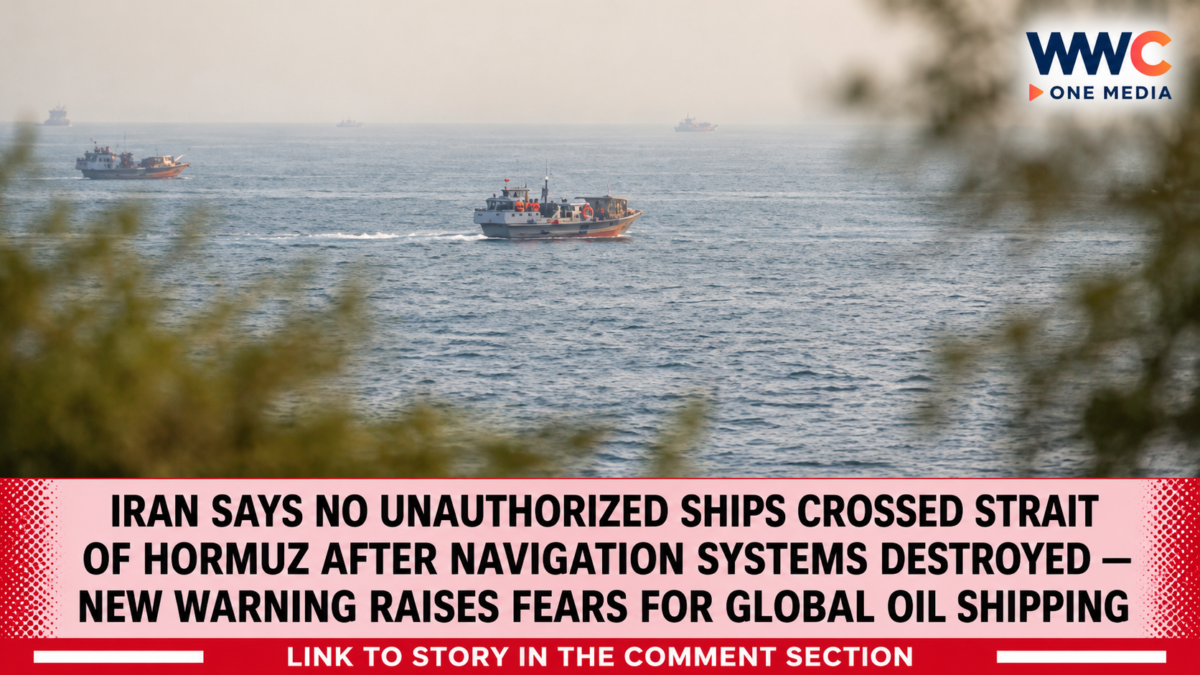
Iran has announced that no unauthorised vessels managed to pass through the Strait of Hormuz overnight after navigational aid systems in the southern section of the strategic waterway were destroyed, raising fresh concerns about maritime safety, international shipping and the future of global energy supplies.
An unnamed official from Iran’s Islamic Revolutionary Guard Corps (IRGC) Navy made the announcement on Monday, November 9, 2026, through Iranian state media.
The statement comes amid an intensifying confrontation involving Iran and the United States, with commercial vessels facing growing risks from military operations, maritime restrictions and threats to shipping routes.
The Strait of Hormuz is one of the world’s most important energy corridors. Before the current conflict, approximately one-fifth of global oil consumption passed through the narrow maritime passage connecting the Persian Gulf to the Gulf of Oman.
Any disruption to shipping through the strait could have consequences far beyond the Middle East, particularly for major Asian energy importers such as China, Japan, South Korea and India.
However, Iran’s latest announcement does not establish that all shipping through the waterway has stopped. The official specifically said that no unauthorised vessels had transited overnight. The statement did not provide details about authorised movements or independently verified shipping activity.
Iran Says Navigation Systems in Strait of Hormuz Were Destroyed
According to the IRGC Navy official quoted by Iranian state media, navigational aid systems in the southern part of the Strait of Hormuz had been destroyed.
The official said the destruction prevented unauthorised vessels from using the maritime route overnight.
But several important details remain unclear.
Iran has not publicly explained exactly when the navigational systems were destroyed, who was responsible for their destruction or what specific equipment was affected.
It has also not provided independently verifiable information about how many vessels attempted to cross the waterway during the period in question.
Navigational aids are important for helping ships determine their position, follow designated routes and avoid dangerous waters. Depending on the equipment involved, damage to these systems could make navigation more difficult, particularly in a narrow and heavily trafficked shipping corridor.
The announcement therefore raises concerns beyond the immediate military confrontation: commercial vessels also need reliable navigational information to operate safely.
Reuters reported the statement but did not independently verify the destruction of the systems or the IRGC’s account of overnight vessel movements.
Strait of Hormuz Becomes a Dangerous Maritime Flashpoint
The latest announcement comes as the Strait of Hormuz remains at the centre of the escalating conflict between Tehran and Washington.
Iran has increasingly used restrictions on maritime access as leverage, while the United States maintains a naval blockade aimed at restricting Iranian shipping activity.
The competing restrictions have created an increasingly complicated situation for commercial shipping companies.
Vessel operators must consider whether they can safely enter the waterway, whether their movements could violate restrictions imposed by either side and whether insurance providers will cover voyages through the conflict zone.
The consequences are already visible in maritime activity.
The Wall Street Journal has reported a growing number of attacks on commercial shipping in the region, including incidents involving mines, drones and small boats.
The latest developments suggest that the maritime confrontation is no longer limited to military vessels. Commercial shipping and energy transportation are increasingly caught in the middle.
Four Tankers Reportedly Halted in the Strait
Iranian state broadcaster IRIB also reported that four tankers had been halted and brought to a standstill in the Strait of Hormuz over the preceding 24 hours.
However, the broadcaster did not provide enough independently verified information to establish the vessels’ identities, ownership, destinations or the precise circumstances behind their stoppage.
The reports add to concerns that shipping restrictions are becoming more difficult to navigate as military activity intensifies.
Another significant development involved a St Kitts-flagged commercial vessel in the Gulf of Oman.
The Associated Press reported that US Central Command said American forces disabled the vessel after it ignored repeated warnings and attempted to leave the region following a visit to an Iranian port, in violation of the US naval blockade.
The incident demonstrates how enforcement of maritime restrictions is increasingly involving direct military action against commercial vessels.
For shipping companies, the risks are becoming more complicated: a vessel may face danger not only from attacks but also from enforcement operations and competing claims over which routes are legally permitted.
Why the Strait of Hormuz Is So Important to the Global Economy
The Strait of Hormuz is a narrow passage between Iran and Oman that connects the Persian Gulf with the Gulf of Oman and the wider Arabian Sea.
Its strategic importance comes from the enormous volume of oil and gas transported through the route.
Major energy exporters, including Saudi Arabia, Iraq, Kuwait, the United Arab Emirates, Qatar and Iran, depend on shipping routes connected to the strait.
Before the conflict, roughly one-fifth of global petroleum consumption moved through this maritime chokepoint.
That makes the waterway particularly important to Asian economies, which rely heavily on Middle Eastern energy imports.
A prolonged disruption could affect:
- Crude oil and refined petroleum supplies.
- Liquefied natural gas shipments.
- International shipping schedules.
- Marine insurance premiums.
- Transportation and manufacturing costs.
- Electricity and fuel prices in importing countries.
Even when oil production continues, the inability to transport cargo safely can create shortages and increase prices in international markets.
For a deeper look at the consequences for energy shipments, WWC ONE MEDIA previously reported on Saudi Arabia’s efforts to supply more oil to Asia through Oman while navigating the Strait of Hormuz crisis.
US and Iran Continue Exchanging Military Pressure
The maritime crisis is unfolding alongside continuing military and diplomatic confrontation between Iran and the United States.
Washington has maintained its naval blockade while warning that it is prepared to respond to threats against American forces and commercial shipping.
Tehran, meanwhile, has continued asserting its ability to restrict access to the Strait of Hormuz.
The latest US military announcement involving the disabled commercial vessel highlights the risks facing ships attempting to move through waters affected by the blockade.
The Associated Press has also reported on Iranian claims involving tanker attacks and mines in the strait, although some details remain independently unverified.
These developments have created a dangerous cycle in which military operations, shipping restrictions and retaliation threats reinforce one another.
WWC ONE MEDIA previously examined the escalation in Iran’s reported attack on an oil tanker in the Strait of Hormuz and the growing danger to international shipping.
The publication also reported on Iran’s proposed exclusion zone near the Strait of Hormuz and what it could mean for vessels entering the restricted area.
Oil Prices Fall as Diplomatic Hopes Offer Temporary Relief
Despite the continuing maritime tensions, international oil prices moved lower on November 9 as investors reacted to renewed diplomatic activity.
Brent crude fell by more than 5 per cent at one point, while US West Texas Intermediate also recorded a significant decline.
The market reaction followed indications that diplomatic discussions involving Washington and regional leaders could help prevent another major escalation.
US President Donald Trump said he was holding off on further strikes against Iran for the time being after discussions with Qatar’s prime minister.
Qatar has played an important mediating role in efforts to reduce tensions and explore a possible agreement.
However, lower oil prices do not necessarily mean the maritime crisis is over.
Shipping security remains uncertain, and the United States has maintained its naval blockade. Iran has also continued demanding changes to Washington’s approach before agreeing to further negotiations.
The difference between market expectations and conditions at sea is important: traders may respond positively to diplomatic signals even while shipping companies continue facing substantial operational risks.
Why Asia Could Be Among the Hardest Hit
The consequences of a prolonged Strait of Hormuz disruption could be particularly serious for Asian economies.
Countries such as China, India, Japan and South Korea are major importers of Middle Eastern oil and gas.
The Philippines could also feel the effects through higher imported fuel costs, transportation expenses and pressure on electricity generation and consumer prices.
For countries dependent on imported petroleum, rising oil prices can quickly affect businesses and household budgets.
Higher fuel costs can increase the price of transporting food, operating factories, delivering goods and providing public transportation.
The disruption also creates additional challenges for shipping companies operating between Asia, the Middle East and Europe.
WWC ONE MEDIA has previously examined the danger to Filipino workers in the region in its coverage of 14 Filipino seafarers who returned home after surviving a tanker attack in the Strait of Hormuz.
The incident illustrates that the crisis is not simply about oil prices or geopolitical competition. Filipino maritime workers and other international crews can face direct physical danger when commercial vessels operate in conflict-affected waters.
What Happens If Navigation Aids Remain Damaged?
The destruction of navigational systems could create additional challenges if commercial vessels are forced to rely on alternative navigation arrangements.
Ships operating in the Strait of Hormuz must navigate a geographically sensitive waterway with heavy commercial traffic and limited room for manoeuvring.
Reliable navigation information is essential for avoiding collisions, grounding and other maritime accidents.
If important aids are unavailable, operators may need additional safety procedures, alternative routing information or guidance from maritime authorities.
However, the precise impact of the reported destruction cannot yet be established because Iran has not identified the affected systems or provided technical details.
It is also unclear whether the damage has affected all commercial traffic or only particular routes.
The International Maritime Organization’s role in promoting safe navigation and freedom of international shipping could become increasingly important as the situation develops.
Four Critical Questions Remain Unanswered
Iran’s announcement has raised several important questions that could determine what happens next.
Who destroyed the navigational aid systems?
Iranian officials have confirmed that the systems were destroyed but have not publicly identified who was responsible.
Which vessels are considered unauthorised?
Tehran has not provided a complete explanation of the rules governing permitted and prohibited crossings under the current restrictions.
How many commercial ships can still safely transit the strait?
Iran’s statement only addressed unauthorised vessels during an overnight period. Independent shipping data will be necessary to establish actual traffic levels.
Could the damaged navigation systems increase the danger of maritime accidents?
If important equipment remains unavailable, vessels could face additional navigational challenges in an already volatile shipping corridor.
These questions will be important for shipping companies, insurers, energy traders and governments monitoring the crisis.
The Strait of Hormuz Crisis Could Trigger Another Global Energy Shock
Iran’s latest announcement underscores how quickly the security situation in the Strait of Hormuz can change.
The destruction of navigational aid systems, reports of halted tankers, US enforcement of its naval blockade and continuing diplomatic tensions have created an increasingly uncertain environment for international shipping.
The most immediate concern is the safety of vessels and their crews.
The broader economic concern is whether the disruption will continue long enough to affect global oil and gas supplies, increase transportation costs and place additional pressure on economies already dealing with energy-market instability.
For now, Iran says no unauthorised vessels crossed the waterway overnight. But the announcement does not establish that the strait is completely closed or that all shipping has stopped.
What happens next will depend on the condition of maritime infrastructure, the actions of Iranian and American forces, and whether diplomatic negotiations can produce an arrangement that restores predictable and safe passage.
If navigation systems remain damaged and Iran and the United States continue tightening their control over the waterway, could the Strait of Hormuz become the next major trigger for a global oil and shipping crisis?