HANOI, VIETNAM — November 11, 2026 | WWC ONE MEDIA | World News, Southeast Asia, Corporate Fraud, Corruption and Public Safety
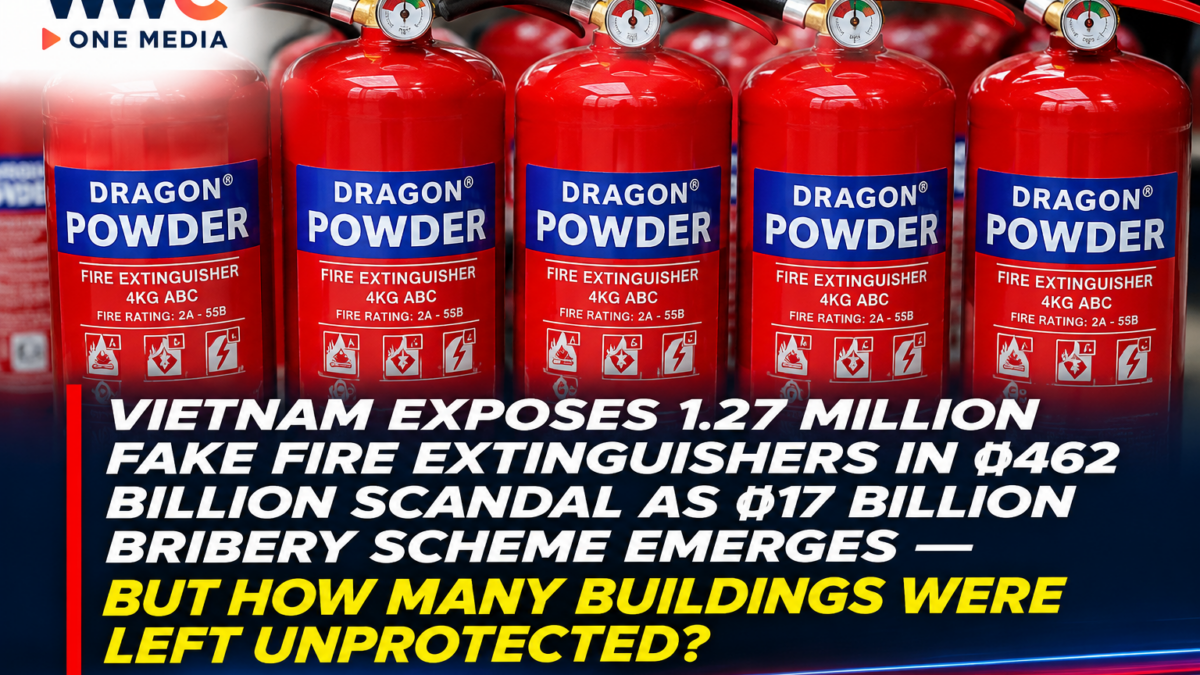
A massive counterfeit fire extinguisher scandal is shaking Vietnam after investigators uncovered an alleged criminal network that sold more than 1.27 million fake fire extinguishers, generated over 462 billion Vietnamese dong in revenue and allegedly paid more than 17 billion dong in bribes to obtain fraudulent safety certifications.
The case has raised serious questions about corruption, product inspections and the reliability of equipment purchased to protect homes, offices, factories and other buildings from fires.
Nine defendants appeared before the Hanoi People’s Court on November 11 in connection with charges involving counterfeit goods, bribery and falsification of official records.
However, the court postponed proceedings until November 30 because of the absence of a defense lawyer and several individuals involved in the case.
The case began with a single customer who reported that 180 fire extinguishers he purchased were unable to put out flames.
Police investigations subsequently exposed what prosecutors describe as a large-scale manufacturing and distribution operation involving Vietnamese businesses, a Chinese national and people connected with product-testing organizations.
Some tested extinguishers reportedly contained only 2% to 6% of the required firefighting chemical composition, compared with an applicable minimum standard of approximately 90%.
The allegations extend beyond the sale of defective products.
Prosecutors say bribes were used to obtain safety certifications, while other defendants allegedly falsified documents relating to testing-equipment calibration.
As Vietnam intensifies its nationwide crackdown on counterfeit products and commercial fraud, could the fire extinguisher case expose deeper weaknesses in the country’s product-safety inspection system—and how many dangerously ineffective devices might still be in use?
One Customer’s Complaint Exposed a Nationwide Counterfeit Operation
The investigation began in September 2025.
A Hanoi resident, identified in Vietnamese reporting as Bui Duy Long, contacted authorities after purchasing 180 Dragon-branded fire extinguishers for more than 63 million dong.
The customer discovered that the products failed to extinguish flames as expected.
He reported the problem to police, triggering an investigation into the manufacturer and distributors.
Initial examinations raised concerns about the chemical composition of the extinguishers.
Investigators subsequently searched factories, warehouses and related facilities in Hanoi, Ho Chi Minh City and Tay Ninh province.
They seized firefighting equipment, raw materials, machinery and labels.
What initially appeared to be a complaint involving a limited batch of defective goods developed into an investigation covering more than one million products.
The episode illustrates the importance of consumer complaints in identifying potentially widespread product-safety failures.
However, the prosecution must still prove each defendant’s alleged criminal responsibility through the judicial process.
Prosecutors Identify More Than 1.27 Million Allegedly Fake Extinguishers
According to the indictment, the alleged operation involved two Vietnamese companies.
The first was Vietlink Service Trading Production Joint Stock Company.
Prosecutors say the company manufactured and sold approximately 1,049,875 Dragon-branded powder fire extinguishers through its distribution network.
The business allegedly generated more than 344 billion dong in sales revenue from these products.
In late December 2024, the manufacturing operation was transferred to An Phu Electrical and Lighting Joint Stock Company.
The prosecution alleges that An Phu subsequently produced and distributed another 226,568 Dragon-branded extinguishers, generating more than 117 billion dong in revenue.
It also produced extinguishers under the 990 brand, selling 1,392 units for approximately 561 million dong.
Together, these figures account for approximately 1.278 million extinguishers allegedly sold through the two operations.
The reported 462-billion-dong amount represents total sales revenue associated with the alleged counterfeit business.
It should not be interpreted as the defendants’ confirmed personal profit.
Nor does the number of extinguishers establish how many individual buildings, households or businesses purchased the products.
Investigators have not published a complete, independently verified accounting of their final destinations.
What Was Wrong With the Fire Extinguishers?
The allegations concern the actual firefighting substances inside the devices.
A fire extinguisher may look genuine from the outside.
Its cylinder, handle, labeling and packaging can resemble those of a properly manufactured product.
But its effectiveness depends on the type and amount of extinguishing agent, pressure, mechanical condition and suitability for the type of fire.
According to Vietnamese court reporting, laboratory examinations found that certain suspected counterfeit extinguishers contained firefighting chemical components far below applicable requirements.
Some reported samples contained only 2% to 6% of the specified active composition, compared with a minimum standard of approximately 90%.
Investigators also identified examples with even lower concentrations.
These deficiencies could seriously undermine the equipment’s ability to suppress a fire.
However, test findings from the examined samples should not be generalized into a claim that every one of the 1.27 million devices was tested individually.
The indictment alleges a broader production and distribution scheme supported by the investigation.
The central public-safety concern is that customers may have purchased equipment they believed would work during emergencies.
The Alleged ₫17 Billion Bribery Scheme
The investigation also uncovered allegations that ineffective firefighting equipment was able to obtain official-looking certification documents.
According to prosecutors, Nguyen Thi Kim Ngan, who was associated with Vietlink, arranged payments to individuals connected with firefighting-equipment testing.
The alleged payments totaled more than 17 billion dong.
Investigators say the payments were made to obtain favorable certification results despite products failing to meet required standards.
The alleged arrangement included payments of approximately 8,000 to 10,000 dong for each powder fire extinguisher, with separate smaller payments involving certain accessories.
Three defendants face bribery-related charges.
They include Pham Duc Canh, Pham Thi Huong and Dang Kim Tuu.
The prosecution alleges that the arrangement involved improper sample collection, falsified testing results and the issuance of certifications that should not have been granted.
These are accusations contained in the prosecution’s case.
They are not final judicial findings of guilt.
The distinction is essential because criminal responsibility must be determined through evidence presented and examined in court.
Investigators Uncover 302 Allegedly False Calibration Certificates
Another part of the investigation concerns equipment used in the testing process.
Firefighting equipment laboratories rely on properly calibrated machinery to produce reliable test results.
Calibration helps establish whether measuring instruments are functioning within accepted tolerances.
If calibration records are falsified, the credibility of subsequent testing can be compromised.
Prosecutors allege that individuals associated with TechBoss and a Vietnamese measurement institution prepared 302 false calibration certificates between late 2022 and 2024.
The documents reportedly covered equipment at Phuong Nam, the testing company implicated in the case.
Investigators allege that certifications were issued without the required physical checks.
The associated fees totaled approximately 353 million dong.
Three defendants face charges involving falsification of official records.
The alleged misconduct highlights a potentially serious weakness: product safety depends not only on manufacturers but also on the integrity of the institutions responsible for verifying compliance.
Nine Defendants Face Three Categories of Criminal Charges
Vietnamese prosecutors have brought the case against nine defendants in three groups.
The first group, accused of manufacturing and trading counterfeit goods, includes:
- Dang Quoc Hoang, associated with Vietlink.
- Phung Huu Loi, associated with An Phu.
- Dong Liang, a Chinese national associated with the production operation.
The second group includes three defendants accused of accepting bribes in connection with the certification process.
The third group includes three individuals accused of falsifying records relating to equipment calibration.
Nguyen Thi Kim Ngan, whom investigators identify as a significant figure in the alleged arrangement, remains wanted.
Authorities separated aspects of her alleged involvement for further investigation.
The court has not completed its examination of the case.
It would therefore be inaccurate to report the nine defendants as already convicted or sentenced.
Court Postpones Trial Until November 30
The Hanoi People’s Court opened the first-instance proceedings on November 11.
The hearing was expected to examine the counterfeit-production allegations, financial transactions and the role of testing and calibration companies.
But the proceedings encountered a procedural obstacle.
One defendant and more than ten individuals with relevant rights or obligations were absent.
A defense lawyer representing a foreign defendant had also requested postponement.
After considering the potential impact on the defendants’ rights and the fairness of the proceedings, the court decided to postpone the trial.
The hearing is now scheduled to resume on November 30, 2026.
The postponement is not an acquittal.
It is also not confirmation of the prosecution’s allegations.
The case remains pending before the court.
Vietnam’s Counterfeit Goods Crackdown Is Expanding
The fire extinguisher case comes amid a wider effort by Vietnamese authorities to combat counterfeiting, commercial fraud and violations of intellectual-property protections.
Earlier in 2026, the government ordered stronger inspections and enforcement against counterfeit merchandise.
The Ministry of Industry and Trade reported increased monitoring and enforcement activities, including cases involving online marketplaces and cross-border shipments.
In related coverage, WWC ONE MEDIA examined Vietnam’s expanded customs powers to intercept counterfeit and intellectual-property-infringing goods, including shipments passing through the country.
The customs reforms focus heavily on intellectual-property enforcement.
The fake extinguisher case involves additional public-safety and alleged corruption issues.
Although the legal frameworks are not identical, both developments demonstrate the government’s growing focus on the manufacture and sale of products that do not meet relevant requirements.
Nearly 68,000 Trade and Counterfeit Violations Detected in Six Months
Vietnamese authorities reported substantial enforcement activity during the first half of 2026.
According to the National Steering Committee for Anti-Smuggling, Trade Fraud and Counterfeit Goods, authorities handled approximately 67,937 violations involving smuggling, commercial fraud and counterfeit goods.
That represented an increase of about 36% from the comparable period in 2025.
Authorities also reported collecting more than 9.6 trillion dong in state-budget revenue through enforcement-related measures.
The figures illustrate the scale of the government’s enforcement campaign.
However, they cover several categories of violations.
They should not be presented as the number of fake fire extinguisher cases.
Likewise, increased enforcement detections may reflect stronger policing, changes in offending or a combination of factors.
The figures alone do not establish that counterfeiting has increased by exactly the same percentage.
Fraudulent Product Certifications Can Be More Dangerous Than Ordinary Counterfeiting
Counterfeit merchandise creates different levels of risk depending on the product.
A fake branded accessory may primarily cause financial losses and trademark violations.
A counterfeit fire extinguisher introduces a potentially life-threatening failure.
People purchase firefighting equipment specifically because they expect it to perform during an emergency.
When a device carries what appears to be an official safety certification, customers may reasonably assume that it has undergone appropriate testing.
The alleged bribery and falsification scheme therefore raises concerns beyond ordinary misleading labels.
It questions whether certification systems can reliably distinguish safe equipment from ineffective products.
If prosecutors prove that officials or testing personnel knowingly approved dangerous equipment, the case could reveal weaknesses in institutional oversight.
But reforms will require more than identifying individual defendants.
Authorities may also need to examine testing procedures, certification records, inspection controls and product traceability.
Similar Fake Product Scandals Are Emerging Across Southeast Asia
The issue of counterfeit products and fraudulent valuations is not unique to Vietnam.
In Malaysia, police recently investigated an alleged pawnshop fraud involving imitation jewelry and a reported RM28.4-million incident in Johor.
The Malaysian investigation is unrelated to Vietnam’s extinguisher case.
However, both demonstrate the potential consequences when fraudulent products or documents enter commercial transactions.
They also show why internal controls, inspections and credible records are necessary.
In both cases, the allegations remain subject to their respective legal processes.
Online Marketplaces Face Growing Pressure Over Counterfeit Goods
Counterfeiting has also become a major concern for e-commerce platforms.
Consumers increasingly purchase goods online, often without physically inspecting the products.
That creates challenges in identifying misleading listings, unsafe equipment and counterfeit merchandise before delivery.
In the Philippines, TikTok Shop and the Department of Trade and Industry recently promoted stronger consumer awareness during the year-end shopping season.
The reported listing figure covers multiple categories of platform violations.
It is not a count of counterfeit fire extinguishers or confirmed criminal offenses.
Nevertheless, it illustrates why digital platforms, regulators and consumers are paying closer attention to product authenticity.
For life-safety equipment, legitimate certification and proper testing are especially important.
The Case Raises Broader Questions About Institutional Fraud
Investigators in Vietnam are examining how an alleged network could distribute more than one million questionable firefighting devices while obtaining documents suggesting the products met safety requirements.
The issue involves manufacturing, distribution, inspections and alleged bribery.
Similar questions about the use of false authority have emerged in other Southeast Asian fraud cases.
In the Philippines, police raided an alleged international scam operation in Pasay City where investigators recovered equipment used to imitate official law-enforcement settings.
That incident involved a separate suspected online fraud scheme.
It did not involve Vietnam’s fire extinguisher manufacturers.
The common concern is that false symbols of authority can make deception more convincing.
For Vietnam, the alleged misuse of product certifications is particularly serious because customers may rely on those documents when purchasing emergency safety equipment.
What Businesses and Consumers Should Do
Businesses that purchase firefighting equipment should review their inventories and documentation.
Useful precautions include checking manufacturer and distributor information, verifying applicable certifications and ensuring equipment is inspected and maintained according to local fire-safety requirements.
A certificate should be checked through a legitimate issuing authority where such verification is available.
Purchasers should be cautious about suspiciously low prices or sellers unable to provide reliable documentation.
However, the appearance of a particular brand name alone is not sufficient to determine whether a specific extinguisher is counterfeit.
People should not attempt risky fire tests or deliberately discharge equipment simply to check whether it works.
Where there are concerns about authenticity or effectiveness, the safer course is to seek assessment by qualified fire-safety personnel and follow instructions from the relevant fire authority.
Businesses should also preserve purchase records and report suspected fraudulent products through official channels.
Five Questions Vietnam’s Investigation Must Answer
1. Where did the extinguishers end up?
Investigators identified extensive distribution, but the full end-user locations have not been publicly established.
2. How many dangerous devices remain in use?
The prosecution’s sales figures do not provide a verified count of products still installed in buildings.
3. How were allegedly defective extinguishers certified?
The trial is expected to examine bribery allegations and irregularities in testing procedures.
4. Will the investigation expand to other individuals?
Authorities are continuing separate inquiries involving a wanted suspect and other possible misconduct.
5. Can Vietnam strengthen inspection systems?
The ultimate test will be whether enforcement action reduces the risk of unsafe products reaching consumers.
The Bottom Line: Vietnam’s Fake Fire Extinguisher Case Is a Public-Safety Warning
The alleged production and sale of more than 1.27 million counterfeit fire extinguishers represents a major test of Vietnam’s consumer-protection and criminal-justice systems.
Investigators say the operation generated over 462 billion dong in sales revenue.
They also allege that more than 17 billion dong in bribes helped secure improper product certifications.
Nine defendants face charges relating to counterfeit goods, bribery and falsification of records.
The trial opened on November 11 but has been postponed until November 30.
The outcome remains uncertain.
But the central public-safety concern is already clear: firefighting equipment that does not meet required standards can leave people exposed during emergencies.
For Vietnam, the case raises questions about the effectiveness of product inspections, the integrity of certification procedures and the ability of consumers to identify dangerous goods.
A complaint involving just 180 fire extinguishers helped expose an alleged 1.27-million-unit counterfeit operation and a bribery scheme worth more than 17 billion dong. But as Vietnam prepares to resume the trial and expand its campaign against fraudulent products, will investigators discover how many dangerous extinguishers remain in circulation—or is the biggest threat still hidden inside equipment that looks perfectly safe?