BANGKOK, THAILAND / CHIANG RAI / NAY PYI TAW, MYANMAR — November 11, 2026 | WWC ONE MEDIA | World News, Environmental Crisis, Southeast Asia and Public Health
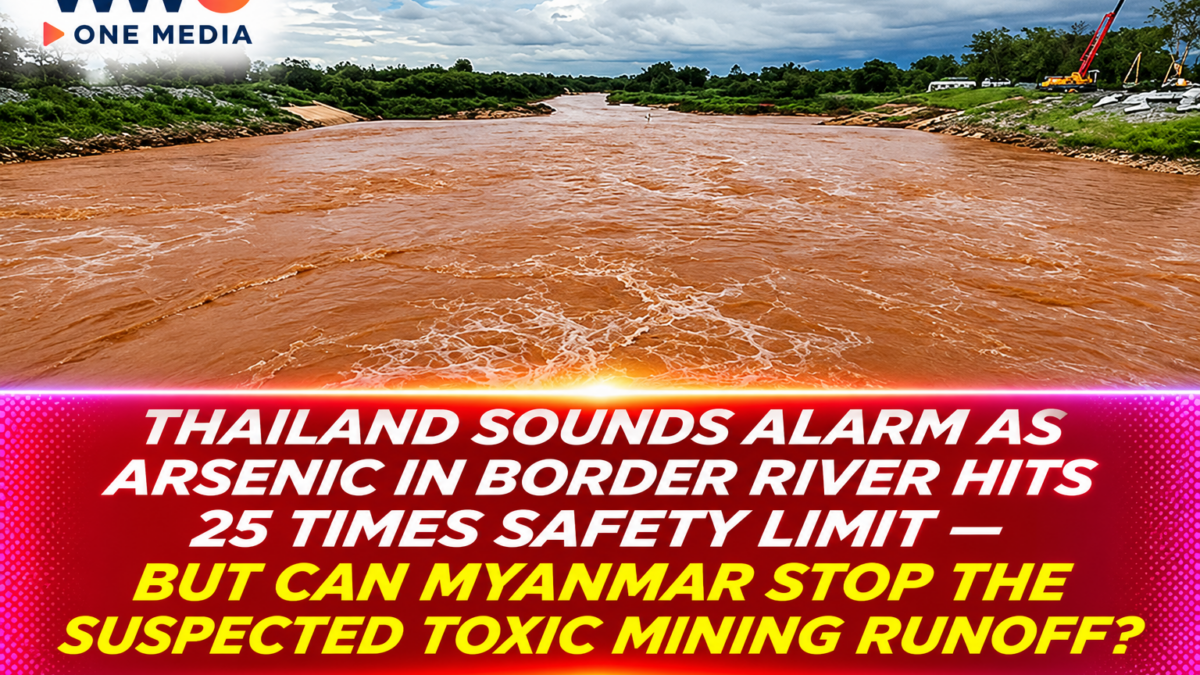
Thailand is escalating a growing environmental dispute with Myanmar after tests revealed dangerous arsenic contamination in waterways shared by the two countries, raising fears over drinking-water supplies, farming, fisheries and the health of communities along the border.
Thai Foreign Minister Sihasak Phuangketkeow is scheduled to travel to Myanmar on November 12 to demand stronger action on pollution affecting the Kok and Sai rivers, which flow from Myanmar’s Shan State into northern Thailand.
The diplomatic intervention follows new evidence of serious water-quality deterioration in Chiang Rai province.
According to Thai PBS World, arsenic concentrations in the Sai River recently reached 0.25 milligrams per liter at a monitored location—25 times Thailand’s 0.01 mg/L surface-water benchmark.
The pollution has also affected the treatment of water for households in Mae Sai, where unusually muddy river conditions have strained the local waterworks system.
Thai officials suspect that mining activities across the border, including gold and other mineral extraction operations in Myanmar’s Shan State, are contributing to the contamination.
However, the precise sources and relative contribution of individual mines still require investigation.
The crisis is no longer simply a local water-quality concern.
It is becoming a major diplomatic, environmental and economic challenge involving two neighboring countries, cross-border commerce and the wider Mekong River system.
With toxic metals detected in rivers supporting communities on both sides of the border, can Thailand and Myanmar stop the contamination at its source—or will another round of diplomatic negotiations leave families facing unsafe water?
Thailand to Confront Myanmar Over Toxic River Pollution
Thailand’s Ministry of Foreign Affairs has placed cross-border water contamination on the agenda for Foreign Minister Sihasak’s November 12 visit to Myanmar.
The minister is expected to raise the deterioration of the Kok and Sai rivers with Myanmar officials.
According to The Nation Thailand, the agenda will also include border security, political developments and trade barriers.
Sihasak said the latest environmental information presented to the Thai government indicated serious pollution in waterways connected to Myanmar.
He identified mining activity across the border as a matter requiring investigation and action.
Thailand wants cooperation that goes beyond exchanging diplomatic statements.
Officials are seeking a coordinated response involving water testing, technical information, possible pollution controls and measures to protect affected communities.
The discussions are expected to involve the Myanmar government, even though conditions within Shan State create significant difficulties for regulatory enforcement.
The November 12 meeting is scheduled to take place after this article’s publication date.
Its outcome should not be described as a completed agreement.
Arsenic in the Sai River Reaches 0.25 Milligrams Per Liter
One of the most alarming developments concerns the Sai River, which flows through the Thailand–Myanmar border region.
Thai PBS World reported on November 9 that the Pollution Control Department detected an arsenic concentration of approximately 0.25 mg/L.
The relevant surface-water quality benchmark cited in Thailand’s monitoring reports is 0.01 mg/L.
That means the reported concentration was approximately 25 times the benchmark.
The result is serious, but it requires careful interpretation.
It represents a particular measurement, not proof that every section of the Sai River contains the same concentration.
Arsenic readings can vary depending on location, rainfall, sediment movement and the timing of testing.
Earlier tests have shown lower concentrations.
In May 2026, Thailand’s Pollution Control Department reported approximately 0.016 mg/L at several Sai River monitoring stations.
The differences demonstrate why repeated sampling is necessary.
A single high reading can identify a significant problem, but investigators need consistent monitoring to determine the full extent and duration of contamination.
Mae Sai Water Supply Faces Disruption
The contamination has created immediate practical difficulties for water treatment in Mae Sai district of Chiang Rai.
According to Thai PBS World, river turbidity reached approximately 14,000 nephelometric turbidity units, or NTU, on November 5.
The local Provincial Waterworks Authority reportedly operates treatment equipment capable of handling raw-water turbidity up to approximately 6,000 NTU.
As a result, unusually muddy water exceeded the treatment system’s stated operating capacity, forcing a reduction in water production.
Turbidity measures how cloudy water becomes because of suspended particles.
It is not itself a measurement of arsenic concentration.
However, heavy sediment loads can complicate water treatment, while separate arsenic contamination requires appropriate testing and removal measures.
The waterworks authority is assessing alternative raw-water sources and treatment arrangements.
Thai officials have emphasized that residents must have access to water meeting applicable safety requirements.
The reported reduction in water production does not establish that every household tap is delivering arsenic-contaminated drinking water.
Authorities must test treated drinking water separately before making that determination.
Myanmar Mining Operations Are Under Suspicion
Mining activities in Myanmar’s Shan State are a central focus of the investigation.
Researchers, environmental organizations and Thai border officials have raised concerns about gold mining and the extraction of other minerals, including rare earth elements.
Some operations are located close to waterways that flow into Thailand.
Mining can disturb mineral-bearing rock and sediment and, depending on extraction methods, contribute contaminants to surrounding water systems.
But identifying a particular contaminant in a river does not by itself establish which company or mining site released it.
Investigators need upstream and downstream sampling, information about mine operations and appropriate chemical analysis to establish the sources.
Thai PBS reported allegations involving Chinese-funded or managed mining operations around Tachileik.
Those reports warrant investigation but should not be treated as a court finding that every Chinese-associated operator committed an environmental offense.
The more defensible conclusion is that mining activities in Shan State are strongly suspected contributors, while site-specific responsibility remains to be determined.
Kok, Sai and Ruak Rivers Connect the Crisis to the Mekong Basin
The concern extends beyond the Sai River.
Thailand’s environmental authorities have monitored the Kok, Sai, Ruak and Mekong rivers for heavy-metal contamination.
These waterways form part of a connected river system supporting communities across northern mainland Southeast Asia.
The Mekong River Commission reported in April 2026 that monitoring had identified arsenic concerns in parts of the river network.
Water samples showed concentrations exceeding the relevant benchmark at certain locations.
Sediment samples raised additional concerns, with some locations recording elevated contamination.
The distinction between water and sediment matters.
Pollutants can accumulate in riverbed material even when the concentration measured in flowing water changes.
Flooding and other disturbances can move contaminated sediment downstream.
However, it would be inaccurate to claim that every section of the Mekong River is equally contaminated.
Monitoring results vary substantially among locations.
A later Thai survey, conducted from late April to early May, found some Kok and Sai River sampling points above the arsenic benchmark while the monitored Ruak and Mekong water samples were within that standard during that survey.
The situation therefore requires continuous, location-specific assessment.
Families, Farmers and Fishermen Face Growing Uncertainty
The consequences extend beyond water treatment.
Residents use these rivers for farming, fishing and other livelihood activities.
Concern about contaminated water can affect agricultural decisions even before a specific crop or food product is confirmed unsafe.
Farmers may hesitate to irrigate crops.
Fishermen may find it harder to sell their catch.
Families may incur extra expenses purchasing or transporting alternative water supplies.
Channel NewsAsia’s June investigation documented fears among northern Thai communities about contaminated rivers, food safety and declining livelihoods.
The report included independent water and sediment testing that identified elevated arsenic at selected locations.
The Associated Press has also examined the wider threats posed by mining-related runoff to communities in the Mekong basin.
However, consumers should not assume that all fish or crops from northern Thailand are contaminated.
Food safety must be established through appropriate testing of the particular products and locations concerned.
Thai authorities have instructed the Department of Fisheries to investigate aquatic organisms and the Land Development Department to examine agricultural soils.
Those investigations will be important for determining where restrictions or other safeguards may be necessary.
Thailand and Myanmar Already Signed a Cooperation Framework
The November talks are not the first attempt to resolve the dispute.
In August 2026, Thailand and Myanmar signed terms of reference to establish a joint working group for managing water quality in shared and transboundary rivers.
Thai PBS World reported that the framework covers water-quality monitoring, information sharing and technical cooperation.
The arrangement is intended to provide a basis for coordinated environmental action.
But signing a cooperation document does not mean contamination has been resolved.
Officials now plan to move the working group forward through technical discussions in late November.
The next stage could include agreeing on sampling locations, exchanging monitoring information and examining possible pollution sources.
For Thailand, practical cooperation inside Myanmar is particularly important because downstream treatment alone cannot permanently resolve ongoing upstream releases.
Myanmar’s Conflict Makes Environmental Enforcement Difficult
The political situation in Myanmar creates an additional obstacle.
Shan State includes territories affected by longstanding armed conflict and competing centers of authority.
The Myanmar military government does not exercise the same degree of practical control over every part of the state.
That complicates access to mines and the enforcement of environmental rules.
Thai PBS has identified this fragmented political environment as a challenge facing the joint water-quality initiative.
Even if national authorities agree to investigate contamination, collecting samples and inspecting mining operations may require cooperation with local power holders.
That makes the diplomatic problem considerably more complex than a conventional dispute between two countries with effective control over all their territory.
The immediate priority is to establish reliable monitoring and protect affected communities while addressing the obstacles to inspecting suspected sources.
Regional Investigation Raises Questions About Mining Accountability
The Thailand–Myanmar dispute reflects a larger challenge for Southeast Asia.
Mineral extraction can support industrial development, government revenue and international supply chains.
Rare earth elements, for example, are important in technologies used in electric vehicles, electronics and industrial equipment.
But poorly managed extraction can place communities and ecosystems at risk.
Reuters reported in November 2025 on research identifying thousands of mining sites across mainland Southeast Asia, including potentially polluting operations.
Mongabay has also investigated mineral trading networks linking mines in Myanmar with businesses in Thailand and regional buyers.
These findings raise questions about environmental oversight and the traceability of mineral supply chains.
However, the existence of a trading relationship does not automatically establish that a particular importer or buyer knowingly purchased minerals from a polluting operation.
Accountability requires evidence about the source of materials, relevant legal requirements and the actions of individual companies.
The Crisis Offers a Warning for Philippine Mining Policy
The Philippine mining sector faces similar questions about balancing economic development with environmental protection and community rights.
The Bataan controversy is unrelated to the contamination in Thailand.
No evidence establishes that the Philippine project caused the same kind of arsenic pollution.
Nevertheless, both stories underline the importance of credible environmental assessment and transparent monitoring before damage becomes difficult to reverse.
The Philippines also has major proposed mining developments involving significant investment.
Tampakan is a separate commercial development, not an identified source of Thailand’s river pollution.
The comparison concerns the need for responsible resource development and effective oversight.
Water Security Is Becoming a Major Regional Economic Issue
Access to reliable water supplies is increasingly important for households, agriculture, industry and local economies.
Water contamination can create additional costs for treatment facilities and businesses dependent on the affected source.
These problems are different from water shortages caused by drought, but both can undermine water security.
In related environmental coverage, WWC ONE MEDIA examined the Philippines’ development of a national climate-related loss-and-damage strategy, including the economic consequences of disasters and disruption to essential services such as water supply.
The Thai river contamination should not automatically be attributed to climate change.
The primary concern in this case involves potentially mining-related pollutants and their movement through shared waterways.
Nevertheless, the financial and social consequences of losing access to safe water illustrate why environmental risks can become major economic problems.
River Pollution Also Threatens Restoration Efforts Elsewhere
The environmental costs of contaminated rivers can persist long after a particular industrial activity has ended.
Sediment removal, ecological rehabilitation and restoring public confidence may require extensive work.
The Sydney case involves different activities and environmental circumstances.
It does not establish that data centers and mines produce the same pollutants.
But both stories demonstrate why communities place high importance on protecting waterways from additional industrial pressure.
Environmental management becomes more difficult when damage has already accumulated over many years.
Public Monitoring and Cleanup Must Work Together
Thailand has already expanded water-quality monitoring.
The Pollution Control Department established seven monitoring stations during 2026 and has been exploring the creation of a local laboratory to provide faster testing.
Government agencies are also investigating soil and aquatic organisms.
These steps are important because communities need timely, reliable information about their exposure risks.
Public communication should distinguish between unsafe raw river water and treated drinking water that has passed the relevant tests.
The long-term solution will also require identifying and controlling upstream pollution sources.
Local cleanup activities can help address some forms of environmental damage, but they cannot substitute for stopping continuing toxic discharges.
Those campaigns addressed physical waste rather than Myanmar-related arsenic contamination.
Removing visible litter is different from treating dissolved heavy metals or contaminated sediment.
The comparison highlights why different pollution problems require different technical responses.
What Thailand Wants From the Myanmar Talks
The November 12 discussions may become an important test of bilateral environmental cooperation.
Thailand wants Myanmar to engage with suspected mining-related pollution sources and support a coordinated response.
The two countries will need to consider how to share reliable environmental information.
They must also address practical challenges involving access to affected locations and technical investigations.
The joint working group planned for late November could help establish a more systematic response.
But an agreement to meet does not guarantee a solution.
The key indicators will be whether authorities can identify significant sources, obtain reliable samples, introduce effective controls and demonstrate improvements through repeated monitoring.
For affected communities, the most important outcome will be consistent access to water that meets relevant safety standards.
Five Questions That Could Determine the Outcome
1. Will Myanmar permit effective investigations of suspected upstream mining sites?
Access and regulatory enforcement will be essential to establishing responsibility.
2. Can Thailand secure safe alternative water sources?
Mae Sai’s water-treatment difficulties make reliable household supply a priority.
3. Will the joint working group publish transparent testing results?
Public access to credible data can help communities make informed decisions.
4. Are fish and agricultural products affected?
Authorities are conducting further testing; contamination cannot be presumed uniformly across all food products.
5. Can pollution be controlled before it spreads further?
Preventing continuing releases is likely to be more effective than relying exclusively on downstream treatment.
The Bottom Line: Thailand’s Toxic River Crisis Is Becoming a Diplomatic Test
Thailand’s decision to raise arsenic contamination directly with Myanmar marks a significant escalation in its efforts to protect communities along their shared rivers.
The latest reports identify a serious problem in the Sai River, where one reported arsenic reading reached 0.25 mg/L.
The contamination has coincided with unusually muddy water that disrupted treatment operations in Mae Sai.
Thai authorities suspect mining operations in Myanmar’s Shan State, but definitive attribution to individual sites remains unresolved.
The countries have already established a framework for water-quality cooperation.
Now they face the more difficult task of turning diplomatic commitments into measurable environmental improvements.
The stakes include public health, farming livelihoods, fisheries and confidence in the region’s water supplies.
Thailand is preparing to confront Myanmar over arsenic contamination affecting shared rivers, with water tests raising serious concerns for communities near the border. But as suspected upstream mining operations continue drawing scrutiny and the two governments prepare for another round of talks, can they finally stop toxic pollution from reaching Thai communities—or will the crisis keep flowing downstream?