SEOUL, SOUTH KOREA / MANILA, PHILIPPINES — November 11, 2026 | WWC ONE MEDIA | Global Business, Banking, Financial Markets and Asian Economy
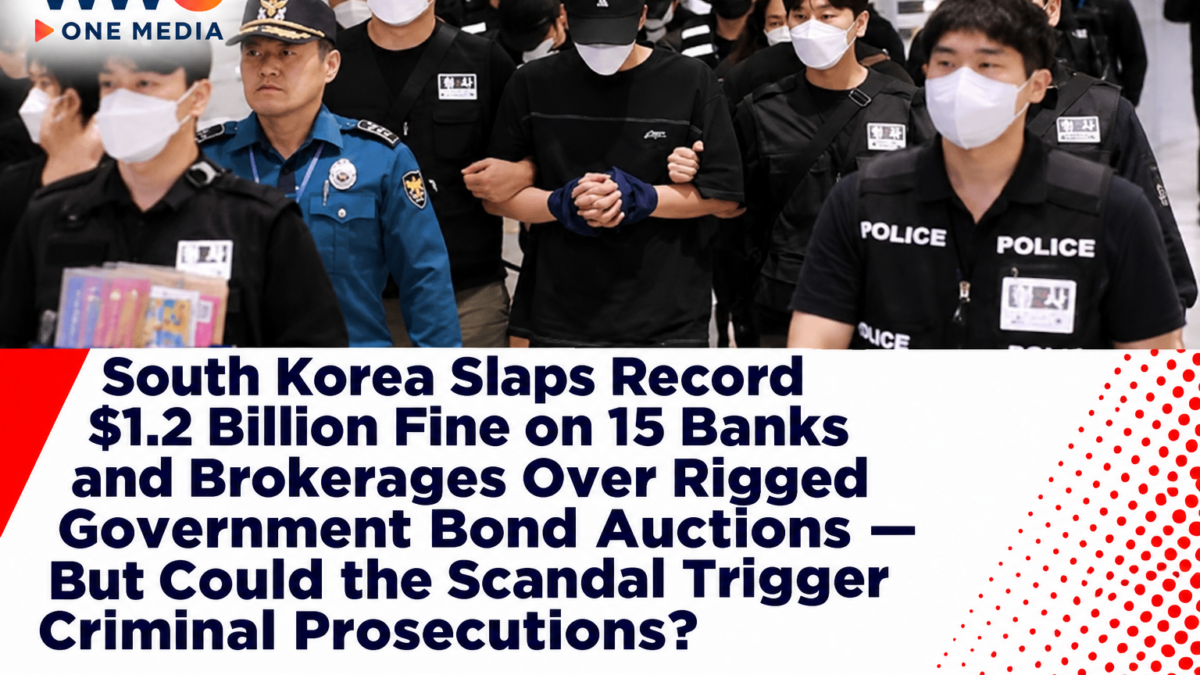
South Korea has delivered one of the biggest financial regulatory punishments in its history, imposing approximately 1.6266 trillion won (US$1.2 billion) in fines on 15 major banks and securities companies after discovering widespread collusion in government bond auctions.
The landmark decision exposes a years-long scheme in which financial institutions allegedly worked together to influence interest rates on government borrowing instead of competing independently.
According to Bloomberg, Reuters and South Korean financial media, the Korea Fair Trade Commission (KFTC) determined that participating institutions coordinated bidding yields, exchanged sensitive pricing information and agreed on auction volumes during 150 government bond auctions between January 2020 and June 2023.
The investigation found that dealers reached direct agreements over bidding yields or volumes in 145 of those auctions.
The regulator concluded that the conduct undermined competition and helped prevent government borrowing rates from falling to levels that might have resulted from genuinely competitive bidding.
The consequences could extend far beyond financial penalties.
Seven institutions have been referred for criminal investigation, while the government is considering additional measures to strengthen transparency in its sovereign bond market.
The case raises a serious question about the integrity of one of Asia’s most important financial systems.
If some of South Korea’s biggest financial institutions were coordinating government bond auctions for more than three years, how much did taxpayers ultimately pay for the lack of competition—and could the scandal extend further?
South Korea Orders Record 1.6266 Trillion Won Penalty
On November 11, South Korea’s Fair Trade Commission announced sanctions against 15 financial institutions for anticompetitive conduct in government bond auctions.
The combined penalties totaled approximately 1.626575 trillion won, rounded to 1.6266 trillion won.
According to South Korean financial publication Edaily, it was the largest single-case fine imposed by the country’s antitrust authority.
The decision surpassed the previous record of approximately 1.03 trillion won imposed in the Qualcomm competition-law case in 2016.
The penalties followed an extensive investigation into how authorized government bond dealers communicated before submitting bids.
The regulator determined that the firms exchanged competitively sensitive information instead of independently deciding the interest rates and quantities they would bid.
Investigators found that some dealers contacted one another immediately before auction deadlines.
The conduct allegedly reduced the uncertainty that would normally encourage bidders to compete.
For the South Korean government, the potential consequence was higher financing costs.
For investors, the case raises concerns about transparency in a market that plays a central role in government financing and the wider banking system.
However, the regulator has not established an exact monetary figure for the government’s losses.
The US$1.2 billion fine represents penalties imposed on the institutions, not a confirmed calculation of the financial harm suffered by taxpayers.
The 15 Financial Institutions Penalized
The sanctions cover ten securities companies and five banks.
The ten securities firms are:
- KB Securities
- NH Investment & Securities
- Mirae Asset Securities
- Shinhan Securities
- Samsung Securities
- Daishin Securities
- Korea Investment & Securities
- Kiwoom Securities
- Kyobo Securities
- Meritz Securities
The five banks are KB Kookmin Bank, NH NongHyup Bank, Industrial Bank of Korea, Hana Bank and Korea Development Bank.
These institutions participated in South Korea’s government bond market as authorized primary dealers.
Primary dealers are financial institutions permitted to participate directly in government securities auctions.
They also perform important market-making functions that help maintain trading activity and liquidity.
Because these institutions serve as intermediaries between governments and investors, their conduct can influence the cost and efficiency of public borrowing.
The investigation therefore concerns an essential part of South Korea’s financial infrastructure rather than an isolated private-sector transaction.
How the Government Bond Collusion Worked
The alleged scheme centered on the bidding process used when South Korea issued government bonds.
In a competitive auction, participating institutions independently determine how much debt they want to purchase and the yield they are willing to accept.
Government borrowing generally becomes cheaper when investors compete to accept lower yields.
But according to the KFTC, dealers shared information that should have remained confidential until the auctions were completed.
Investigators found that participants exchanged intended bidding yields and volumes through telephone conversations and Telegram messages.
Some communications reportedly occurred just one or two minutes before bidding deadlines.
The regulator also found that when trading personnel changed positions, information about contacts at competing institutions and established communication practices was sometimes passed to successors.
That indicated a recurring pattern rather than an isolated exchange.
Across the January 2020 to June 2023 investigation period, regulators examined 345 auctions.
They identified collusive conduct involving 150 auctions.
In 145 cases, the regulator found direct agreements on bidding rates or quantities.
The remaining cases involved exchanges of competitively sensitive information.
The KFTC concluded that these practices reduced competition and tended to keep successful auction yields higher than they otherwise might have been.
Why Even a Small Change in Bond Yields Matters
Government bonds are one of the main instruments countries use to finance public spending and refinance existing debt.
When a government issues bonds, investors effectively lend money to the state in exchange for future payments.
The interest rate, or yield, determines part of the government’s borrowing cost.
Higher yields generally mean more expensive financing.
Consider a simplified example.
If a government borrowed the equivalent of US$1 billion at an annual interest rate of 3%, the annual interest cost would be approximately US$30 million.
At 3.1%, the annual interest cost would increase to approximately US$31 million.
That difference would represent US$1 million in additional annual interest on the same principal, assuming a conventional fixed-rate structure.
Across repeated large bond auctions, even relatively small changes in yields can become financially significant.
This is why governments rely on competition among primary dealers.
The KFTC’s findings suggest that coordinated bidding may have prevented the Korean government from obtaining more favorable financing terms.
However, regulators acknowledged that determining the exact amount of damage is difficult because market yields change continuously.
The commission did not publish a definitive calculation of taxpayer losses.
KB Securities Faces the Largest Individual Fine
Among the penalized institutions, KB Securities received the largest reported penalty.
According to Edaily, the firm was fined approximately 332.18 billion won.
Other major penalties included:
| Financial institution | Reported fine |
|---|---|
| KB Securities | ₩332.18 billion |
| NH Investment & Securities | ₩242.79 billion |
| Mirae Asset Securities | ₩214.83 billion |
| Shinhan Securities | ₩147.31 billion |
| Industrial Bank of Korea | ₩135.85 billion |
| Daishin Securities | ₩120.05 billion |
| Samsung Securities | ₩118.86 billion |
The fines differ because regulators assessed factors including the institutions’ involvement, applicable transactions and other relevant circumstances.
The commission also considered the structure of the bond market when determining penalties.
The size of the sanctions demonstrates the government’s intention to impose a substantial financial consequence for the conduct it identified.
But the institutions may challenge the penalties through legal proceedings.
Final amounts and accounting impacts could therefore change if courts modify or overturn parts of the regulatory decision.
Seven Firms Referred for Criminal Investigation
The KFTC also decided to refer seven institutions for criminal investigation because of their reported extent of participation.
The seven are Mirae Asset Securities, NH Investment & Securities, KB Securities, Kiwoom Securities, Korea Investment & Securities, Industrial Bank of Korea and Korea Development Bank.
The referrals introduce a separate legal dimension to the case.
Administrative fines and criminal liability are not interchangeable.
The regulatory decision establishes the commission’s findings and sanctions.
Any criminal prosecution would require additional proceedings under the applicable laws.
The referral does not mean the firms or their executives have already been convicted of criminal offenses.
Nevertheless, the development increases the potential consequences for the institutions involved.
Investigators may examine communications, trading records and decision-making procedures to establish individual and organizational responsibilities.
Further developments will depend on the investigative authorities and any subsequent judicial proceedings.
Why Banks Dispute the Regulator’s Findings
The accused institutions have challenged important elements of the case.
Earlier reporting by The Korea Times and ChosunBiz described the firms’ argument that communication among primary dealers was part of ordinary market activity.
Bond dealers routinely monitor interest-rate expectations, demand conditions and market liquidity.
The institutions argued that some information exchanges served those functions rather than constituting unlawful price fixing.
They also disputed how regulators calculated the financial penalties.
The KFTC treated the value of certain awarded bond transactions as the relevant base for calculating fines.
The financial institutions argued that a government bond purchase is not equivalent to ordinary business revenue.
They maintained that the earnings generated by trading and holding bonds, rather than the gross amount purchased, should be considered.
This distinction could substantially affect the amount of any penalty.
The regulator nevertheless concluded that the information exchange went beyond legitimate market communication and involved coordination of future bids.
The legal debate may now shift to the courts.
The Investigation Took Years to Reach a Final Regulatory Decision
The conduct under investigation occurred between January 2020 and June 2023.
Regulators spent years reviewing trading information, communications and the structure of South Korea’s sovereign debt auctions.
In August 2026, the KFTC publicly outlined the allegations and prepared to conclude proceedings involving the 15 firms.
At the time, financial-industry participants expressed concern that potential penalties could reach several trillion won.
Some early estimates suggested sanctions far exceeding the amount ultimately imposed.
Following detailed deliberations, the regulator announced the approximately 1.6266 trillion-won total on November 11.
The commission said it considered the market’s structural characteristics and the financial circumstances of the institutions.
It also applied reductions when determining the penalties.
The result was still a record single-case sanction.
The process underscores the complexity of investigating collusion in financial markets, where prices move rapidly and institutions regularly communicate about economic conditions.
The central regulatory challenge is distinguishing legitimate market information from coordination designed to reduce competition.
South Korea’s Government Bond Market Faces a Credibility Test
Government bond markets are essential to financial stability.
Banks, insurance companies, pension funds and institutional investors hold government securities for investment, liquidity and risk-management purposes.
Bond yields also influence pricing throughout the financial system.
If investors lose confidence in the fairness of auctions, they may demand stronger oversight or more transparent procedures.
However, the KFTC’s findings do not establish that every Korean government bond auction was manipulated or that the entire market is unreliable.
The investigation identified specific conduct during a defined period.
The government must now address the weaknesses that allowed those practices to occur.
South Korea’s finance authorities are considering additional guidelines to distinguish permissible market communication from prohibited information sharing.
They will also need to consider whether the institutions involved should retain their primary-dealer privileges.
The government’s response may affect future auction procedures and compliance requirements.
Could the Fines Disrupt South Korea’s Bond Market?
The large penalties have created concern within the financial industry.
Primary dealers perform an important role in underwriting government debt and providing liquidity in secondary markets.
If penalties weaken their ability or willingness to participate, the government may need to consider the consequences for bond issuance.
South Korean financial authorities raised those concerns during the regulatory proceedings.
The finance ministry has indicated that it will consider broader changes to the primary-dealer system carefully, taking account of potential litigation and market stability.
The ministry also plans to establish guidance on what information dealers may exchange during auctions.
The challenge is balancing two objectives.
The government needs strong enforcement against anticompetitive behavior.
But it also needs a functioning and competitive sovereign debt market.
These goals are not necessarily contradictory.
Clearer rules and stronger compliance mechanisms could improve market integrity while preserving legitimate trading activities.
The Scandal Comes Amid Wider Scrutiny of Korean Banks
The bond-auction penalties are not the only recent regulatory action affecting South Korea’s financial institutions.
Earlier in 2026, the Fair Trade Commission fined four major commercial banks approximately 272 billion won over findings involving coordination of mortgage loan-to-value ratios.
Separately, financial regulators imposed penalties on banks and securities companies over the mis-selling of financial products linked to Hong Kong’s H-share index.
These cases involve different products, laws and conduct.
They should not be presented as a single coordinated scheme.
Nevertheless, they illustrate the broader scrutiny facing financial institutions over competition, sales practices and consumer protection.
Other Korean banking controversies have focused on cybersecurity and information security.
In related coverage, WWC ONE MEDIA reported on South Korea’s financial fraud alert following data breaches affecting several financial institutions.
Those incidents are separate from government bond collusion but reinforce the importance of effective oversight across financial markets.
How Bond-Market Integrity Affects the Global Economy
South Korea is one of Asia’s major economies and an important participant in global financial markets.
Its banks and securities companies help connect domestic borrowers with international investors.
The reliability of its government securities market matters to foreign asset managers, pension funds and institutions holding Korean debt.
At the same time, the country has been introducing reforms intended to improve access to Korean financial markets.
The initiative illustrates Seoul’s efforts to modernize its financial infrastructure and attract international participation.
The latest bond scandal creates an additional reason to strengthen confidence in market practices.
However, regulatory enforcement can also demonstrate that authorities are capable of detecting and addressing misconduct.
The longer-term impact on investor confidence will depend on how transparently the penalties, legal proceedings and subsequent reforms are handled.
What This Means for Philippine Investors and Government Bonds
The Korean bond scandal provides a relevant lesson for other Asian economies, including the Philippines.
Government bond auctions are important instruments for financing public expenditures.
In the Philippines, the Bureau of the Treasury conducts auctions involving Treasury bills and bonds.
Banks and investment institutions participate in these markets, helping determine the yields offered on government securities.
Fair competition matters because borrowing costs ultimately influence government finances.
In related reporting, WWC ONE MEDIA covered the Philippine government’s plan to raise at least ₱30 billion through a retail Treasury bond offering while managing domestic financing requirements.
Although retail bond offerings differ from competitive institutional auctions, both are part of the broader sovereign debt market.
The Philippine government must also consider how interest rates and market conditions affect financing costs.
The Korean case does not establish wrongdoing in Philippine bond auctions.
Instead, it demonstrates why independent bidding, transparent procedures and effective market surveillance are important across government securities markets.
For investors, confidence in the auction process is part of confidence in the financial system.
Why Global Bond Investors Are Paying Attention
The case also arrives during a period of heightened sensitivity to government borrowing costs worldwide.
Bond yields fluctuate in response to inflation, central-bank policy, fiscal conditions and investor expectations.
When yields rise, governments may face higher costs on new borrowing.
That can increase pressure on public budgets.
The Korean investigation demonstrates that borrowing costs can also be affected by the behavior of the institutions participating in auctions.
However, no direct causal link has been established between the Korean penalties and changes in US Treasury yields or international bond prices.
The wider lesson concerns market integrity.
Governments rely on competitive auctions to obtain financing at prices that reflect genuine market demand.
Five Questions South Korea Must Answer Next
1. How much did taxpayers actually lose?
The regulator found that coordinated bidding could increase borrowing costs, but it has not established a definitive financial loss.
2. Will the penalized firms challenge the decision?
Legal proceedings could affect the final sanctions and interpretation of the relevant competition rules.
3. Will criminal investigations result in charges?
Seven firms have been referred, but referrals are not convictions.
4. Could some firms lose primary-dealer privileges?
That decision belongs to the relevant government authorities and has not been finalized.
5. Will bond-auction rules change?
The government plans clearer guidance on permissible information sharing, but the final scope of reforms remains uncertain.
The Bottom Line: South Korea’s Bond Scandal Raises a Billion-Dollar Question
South Korea’s decision to fine 15 major financial institutions approximately US$1.2 billion represents a landmark enforcement action against anticompetitive conduct in government bond auctions.
The regulator found that dealers shared sensitive bidding information and coordinated interest rates or volumes during a substantial number of auctions over more than three years.
The penalties are the largest imposed in a single case by the country’s antitrust authority.
Seven firms also face referrals for further investigation.
But the most important question remains unresolved.
How much did the alleged manipulation ultimately cost the South Korean government and its taxpayers?
Regulators have concluded that the conduct weakened competition, but they have not quantified a definitive monetary loss.
The financial institutions may continue challenging the decision, potentially extending the legal controversy.
For South Korea, the priority will be restoring confidence in its sovereign debt market without undermining legitimate bond trading and government financing.
For international investors, the case demonstrates why even sophisticated financial markets require effective competition enforcement.
South Korea has imposed a record US$1.2 billion fine after uncovering coordinated bidding across 150 government bond auctions. But as seven financial institutions face criminal referrals and regulators prepare tighter market rules, could the biggest revelation still be ahead—how much the alleged collusion really cost the public?