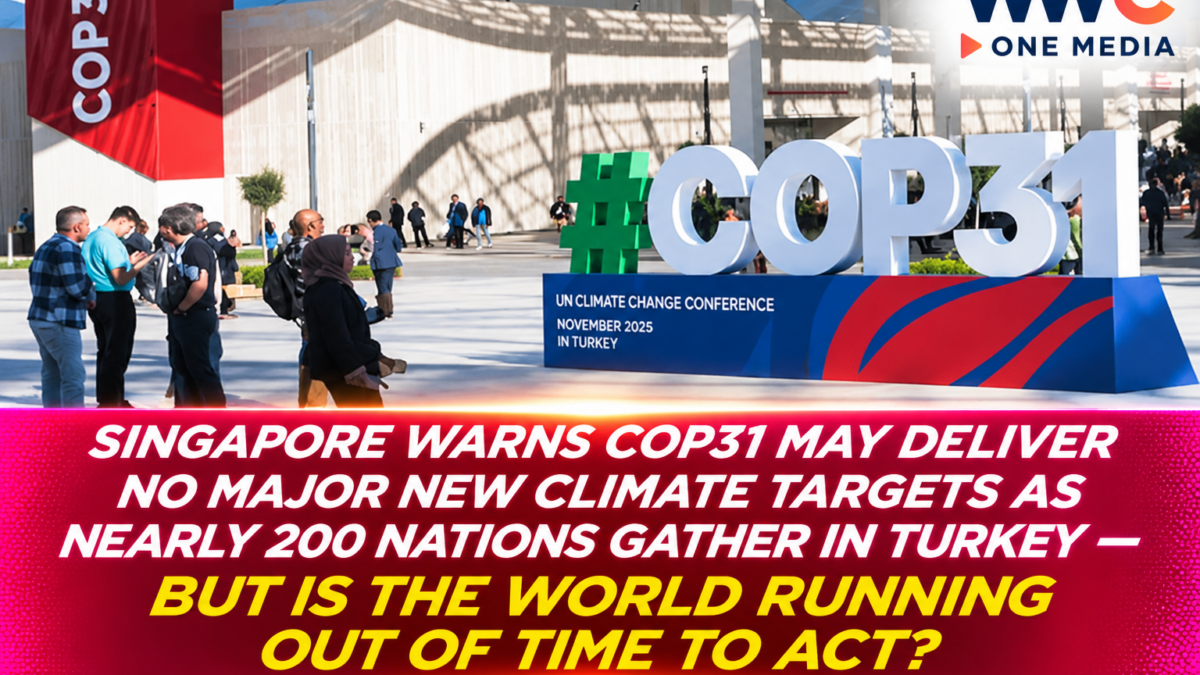
SINGAPORE / ANTALYA, TÜRKIYE — November 10, 2026 — As nearly 200 countries gather for the United Nations’ COP31 climate summit, Singapore has delivered a warning that challenges the way world leaders approach the climate crisis: The world may not need another round of ambitious promises as urgently as it needs governments to fulfill the commitments they have already made.
Singapore’s Minister for Sustainability and the Environment, Grace Fu, warned that negotiations in Antalya, Türkiye, are unlikely to produce a major strengthening of national greenhouse-gas reduction targets.
Instead, she called for greater attention to implementation, climate financing, adaptation and practical measures that can deliver measurable results.
Her warning comes as global climate diplomacy faces mounting political pressure from international conflicts, energy shortages, inflation and disagreements over who should pay for the transition to a low-carbon economy.
The COP31 conference, which began November 9 and runs through November 20, is expected to address emissions reductions, electrification, climate adaptation and international financing.
But with countries increasingly divided over energy security and economic priorities, reaching meaningful agreements could prove more difficult than in previous years.
The question now confronting global leaders is whether the world can turn existing climate promises into measurable action—or whether another international summit will end with ambitious declarations and limited progress.
Singapore’s Grace Fu Says Existing Climate Agreements Offer Enough Work
Speaking ahead of COP31, Fu said negotiators should not expect major new emissions-reduction commitments to emerge from this year’s conference.
She argued that the Paris Agreement already provides countries with a substantial framework for action.
The challenge is translating that framework into actual policies, investments and emissions reductions.
The Paris Agreement, adopted in 2015, aims to keep the increase in global average temperatures well below 2 degrees Celsius above pre-industrial levels while pursuing efforts to limit warming to 1.5 degrees.
Countries are expected to establish and update national climate commitments, known as nationally determined contributions, or NDCs.
However, commitments alone cannot reduce emissions.
Governments must introduce policies, develop infrastructure, mobilize investment and track progress.
Fu’s position reflects growing frustration over the gap between internationally agreed objectives and implementation at the national level.
Her remarks do not suggest that Singapore has abandoned the pursuit of stronger climate ambition.
Instead, they emphasize that existing commitments require urgent implementation.
COP31 Opens in Turkey as UN Warns Climate Action Remains Too Slow
The annual UN climate conference opened in Antalya on November 9 amid warnings that global progress remains insufficient.
UN Climate Change Executive Secretary Simon Stiell urged governments to accelerate implementation as rising temperatures and extreme weather continue threatening communities worldwide.
The conference brings together representatives of nearly 200 countries, alongside businesses, scientists, civil-society organizations and other stakeholders.
Türkiye is hosting the summit, with Turkish Environment Minister Murat Kurum serving as COP31 president and Australia’s Chris Bowen leading negotiations.
The UN climate process has emphasized the importance of transforming national commitments into measurable outcomes.
Related WWC ONE MEDIA report: COP31 Opens in Turkey With Urgent Warning to World: Climate Action Is Falling Far Behind as Extreme Weather Intensifies
The summit comes at a critical moment.
United Nations assessments indicate that current climate action remains insufficient to keep long-term warming within the Paris Agreement’s most ambitious temperature limit.
This creates a difficult challenge for negotiators.
They must maintain international cooperation while confronting growing disagreements over energy costs, national security and economic development.
For climate-vulnerable countries, the consequences of delayed action are already visible through destructive floods, dangerous heat and other extreme-weather risks.
Why Global Climate Negotiations Are Becoming More Divided
Fu warned that the international climate negotiation process has become increasingly fragmented.
Governments are confronting competing priorities, including geopolitical conflict, inflation, energy security, employment and domestic political pressure.
The ongoing Middle East conflict has created additional uncertainty around oil supplies and international energy markets.
Some countries have responded to energy shortages by increasing their reliance on conventional fuels.
Others have accelerated renewable-energy investment to reduce exposure to volatile fossil-fuel prices.
These different responses make it more difficult to establish a common approach to the global energy transition.
Fu also pointed to the United States’ withdrawal from the Paris Agreement, which took effect on January 27, 2026, as an additional challenge for international cooperation.
The absence of full American participation in the agreement complicates efforts to coordinate climate policies among major economies.
However, it does not mean that international negotiations have stopped.
Other countries continue participating in the UN climate process, and some American officials and stakeholders remain involved in climate-related discussions.
The larger concern is whether governments can maintain the political commitment necessary to move forward.
Turkey Wants to Turn Climate Promises Into Real Projects
COP31’s host country has also placed implementation at the center of its agenda.
Türkiye is promoting initiatives involving clean energy, electrification, climate finance and resilience.
One major proposal is a global electrification initiative that would increase electricity’s share of total final energy consumption to 35% by 2035.
Electrification can reduce dependence on fossil fuels in transportation, buildings and certain industrial processes.
However, the climate benefits depend on how the additional electricity is generated.
Switching from gasoline-powered vehicles to electric vehicles, for example, can help reduce emissions, particularly when the electricity supply becomes cleaner.
But expanding electricity consumption without reducing the carbon intensity of power generation would limit the climate benefits.
Related WWC ONE MEDIA report: Turkey Sets COP31 Agenda Around Clean Energy, Climate Finance and Turning Pledges Into Action
Singapore has identified electrification as one area where COP31 could deliver practical progress.
However, Fu said Singapore was still studying whether to support the proposed global electrification pledge.
No final Singaporean endorsement of that initiative was confirmed in the reviewed November 9 reporting.
Singapore’s Own Energy Dependence Shows Why Climate Action Is Difficult
Singapore’s call for practical solutions reflects challenges within its own energy system.
The city-state relies on natural gas for approximately 95% of its electricity generation.
Its limited land area constrains opportunities for large-scale domestic renewable-energy development.
As a result, Singapore is exploring a combination of solar power, energy storage, imported low-carbon electricity and other emerging technologies.
The country also faces the challenge of maintaining affordable and reliable electricity while pursuing decarbonization.
Fu acknowledged that Singapore must account for present energy-security requirements while investing in future low-carbon systems.
This creates a balancing act.
Governments cannot abruptly eliminate existing power infrastructure without ensuring that alternative supplies can maintain reliability.
At the same time, continued dependence on fossil fuels can complicate long-term emissions-reduction goals.
Singapore’s approach reflects the practical challenge of transitioning an energy system while protecting households and businesses against supply disruptions.
Climate Finance Could Become COP31’s Biggest Political Battle
One of the most contentious issues at COP31 is the question of who should finance climate action.
Developing countries argue that they need greater access to funding to reduce emissions, protect communities and respond to climate-related disasters.
Many vulnerable countries contribute relatively little to historical global greenhouse-gas emissions but face substantial environmental damage.
They are seeking financial support to strengthen infrastructure, improve disaster preparedness and develop cleaner energy systems.
However, negotiations remain difficult.
Some governments have called for reforms to the international climate-finance system, including broader contributions from economically powerful countries that retain developing-country classifications under existing arrangements.
The debate also involves whether assistance should be delivered through grants, loans, private investment or other financing structures.
For vulnerable countries, the availability and affordability of funding can determine whether adaptation projects proceed.
A financial pledge does not automatically translate into money reaching affected communities.
Funds must be mobilized, projects evaluated and programs implemented.
That is why Singapore’s emphasis on implementation has particular significance for countries facing immediate climate risks.
Philippines Faces Its Own Climate Financing Challenge
The Philippines is among the countries with a strong interest in the outcome of international climate-finance negotiations.
Its exposure to tropical cyclones, flooding, extreme heat and other climate hazards creates a continuing need for adaptation and disaster-risk reduction.
On November 7, the Department of Environment and Natural Resources, the Climate Change Commission and the United Nations Development Programme Philippines announced work on a National Climate-related Loss and Damage Framework and Strategy.
The initiative aims to strengthen coordination, improve access to climate financing and address losses associated with climate-related disasters.
Related WWC ONE MEDIA report: Philippines Moves to Seek Global Climate Funding as DENR, UNDP Launch Disaster-Loss Strategy — But Will Billions Reach Families Before the Next Catastrophe?
The Philippine initiative illustrates the difference between international climate commitments and domestic implementation.
Governments must translate broad agreements into policies and projects that protect people.
These may include flood protection, early-warning systems, resilient infrastructure, agricultural adaptation and assistance for communities recovering from disasters.
But the success of such programs depends on funding, implementation capacity and accountability.
An international agreement alone cannot guarantee immediate financial assistance.
For the Philippines, a productive COP31 would help improve the systems needed to deliver climate-related support.
Singapore’s Dangerous Haze Crisis Adds Urgency to Environmental Enforcement
Singapore’s climate diplomacy is also taking place against the backdrop of a severe regional haze episode.
During October, smoke from extensive wildfires in Indonesia affected Singapore’s air quality.
The fires raised concerns about environmental damage, cross-border pollution and the responsibilities of businesses operating in affected areas.
Singapore recently strengthened its transboundary haze legislation to improve its ability to hold responsible parties accountable.
Fu explained that the amendments are intended to influence corporate behavior and deter activities that cause harmful pollution.
The objective is not necessarily to maximize prosecutions.
Rather, the government wants businesses to understand the consequences of environmental violations and take preventive action.
The crisis illustrates how environmental problems can cross national boundaries.
Activities in one country can affect air quality, public health and economic activity in neighboring states.
That makes regional cooperation and effective enforcement essential.
Rising Temperatures Are Already Testing Singapore’s Resilience
Beyond haze, Singapore faces increasing exposure to extreme heat.
As a densely populated tropical city, the country must prepare for higher temperatures and greater cooling demand.
In September 2026, Fu highlighted the need to expand access to cooling without allowing additional electricity consumption to undermine climate goals.
Singapore has been preparing more than 300 cooling centres as part of its response to heat-related risks.
Related WWC ONE MEDIA report: Singapore Is Preparing 300+ Cooling Centres for Heatwaves — But Global Cooling Demand Could Triple by 2050
The issue demonstrates why climate adaptation and emissions reduction must advance together.
Communities need protection against increasingly dangerous heat.
But expanding conventional air-conditioning without improving efficiency and electricity generation can increase energy demand and associated emissions.
The challenge is finding solutions that protect people while supporting long-term decarbonization.
Singapore’s emphasis on implementation therefore extends beyond international negotiations.
It also applies to local infrastructure, building design, public health and energy planning.
Global Emissions Remain a Major Concern Despite Renewable-Energy Growth
The rapid expansion of renewable electricity has created opportunities to reduce emissions.
Solar and wind technologies have become increasingly competitive, while electric-vehicle deployment continues in many markets.
However, global climate outcomes depend on the total amount of greenhouse gases entering the atmosphere.
A reduction in emissions from one sector does not necessarily mean that overall global emissions are declining.
WWC ONE MEDIA recently examined findings indicating that fossil-fuel carbon dioxide emissions could decline by approximately 0.4% in 2026 while total carbon pollution continues rising.
Related WWC ONE MEDIA report: Global Fossil Fuel Emissions Set to Fall 0.4% After Iran War Triggers Oil Shock — But Why Is Earth’s Total Carbon Pollution Still Rising?
The distinction matters.
Emissions from fossil fuels, emissions from land-use changes and total atmospheric greenhouse-gas concentrations measure different aspects of the climate problem.
Even if annual emissions decline, additional carbon dioxide can continue accumulating in the atmosphere.
This is why sustained reductions across major emitting sectors are necessary.
Singapore’s demand for implementation is therefore consistent with the broader scientific concern that climate policies must produce measurable outcomes.
Could COP31 Succeed Without Announcing Major New Targets?
A central question emerging from Fu’s remarks is how success should be measured.
Climate summits frequently attract attention when governments announce new emissions targets or major financing commitments.
But a conference can also make progress by improving implementation mechanisms.
For example, negotiations could advance arrangements for climate adaptation, technical cooperation, financing access and emissions reporting.
Governments could also establish practical partnerships supporting clean-energy infrastructure and environmental protection.
Those outcomes may not generate the same headlines as major new targets.
Nevertheless, they can contribute to the longer-term effectiveness of international climate action.
The challenge is ensuring that implementation commitments are measurable and accountable.
Without clear milestones, financing arrangements and reporting systems, even implementation-focused agreements risk becoming another collection of unfulfilled promises.
What Happens Next at COP31?
The conference continues through November 20, with negotiations expected to focus on several difficult areas.
Climate financing remains a central issue, particularly for developing countries seeking support for adaptation and disaster recovery.
Electrification and clean-energy expansion are also important priorities.
Negotiators must additionally consider how to strengthen cooperation despite geopolitical tensions and competing national interests.
Singapore has indicated that maintaining meaningful participation in the process is itself an important objective.
Fu warned that one of the biggest dangers would be governments abandoning serious climate engagement because of other political and economic pressures.
But participation alone is not sufficient.
For COP31 to deliver meaningful progress, governments must move toward agreements that translate into policies, investments and measurable climate outcomes.
The final results will not be known until negotiations conclude.
The Bigger Picture: The World Has Made Climate Promises — Now It Must Deliver
Singapore’s message at COP31 is both practical and politically significant.
Countries have spent years establishing climate commitments, setting emissions targets and negotiating international frameworks.
The Paris Agreement provides a foundation for global cooperation.
Yet emissions remain a major concern, and vulnerable communities continue facing increasingly severe climate risks.
The challenge is no longer limited to identifying what needs to be done.
It is finding the financing, political commitment and institutional capacity to accomplish it.
Singapore is urging governments to focus on that implementation gap.
Its position does not mean stronger climate targets are unnecessary.
Instead, it recognizes that announcements without execution cannot provide the protections communities need.
For countries such as the Philippines, where storms, floods and rising temperatures can threaten lives and livelihoods, the distinction is particularly important.
COP31 may not deliver a dramatic new round of climate targets, but it still has an opportunity to advance the policies and investments needed to fulfill existing commitments.
The world’s governments now face a fundamental test.
Will leaders finally turn years of climate promises into real-world results—or will COP31 become another summit remembered more for its speeches than the action that followed?