
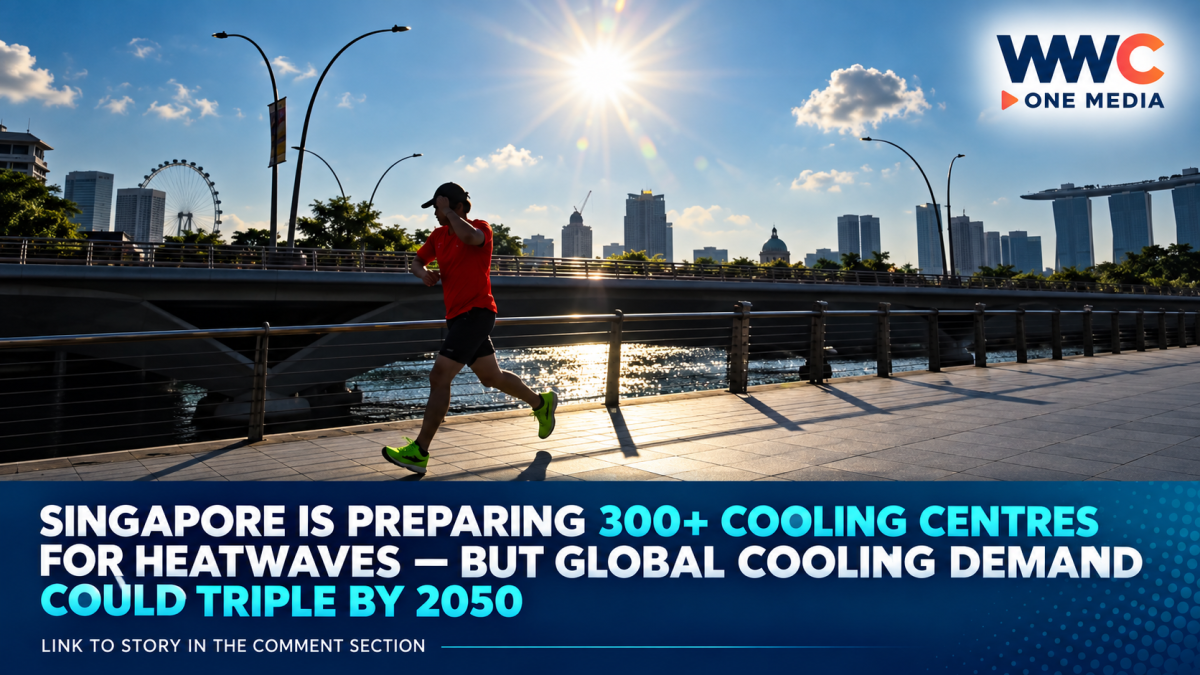
SINGAPORE — As rising temperatures make air-conditioning increasingly essential across Asia, Singapore is confronting an uncomfortable climate paradox: the world needs far more cooling to protect people from extreme heat, but providing it the conventional way could consume enormous amounts of electricity and generate even more greenhouse-gas emissions.
Speaking at the inaugural Global Cooling Pledge Assembly in Singapore on Thursday, September 17, Minister for Sustainability and the Environment Grace Fu said countries must expand access to cooling without allowing the response itself to accelerate climate change.
Her warning comes as Asia is warming rapidly and Singapore prepares for a future with more hot days, warmer nights and prolonged periods of dangerous heat stress. More than 230 representatives from government, academia and business across over 60 countries are attending the four-day meeting, according to CNA.
The challenge can be summed up in one number: cooling already accounts for about one-fifth of global electricity use, and demand could more than triple by 2050 as temperatures, populations, urbanisation and incomes rise.
So while the instinctive response to a hotter world may be to install more air-conditioners, Singapore and other countries are increasingly asking a different question:
How do you keep billions more people cool without making the planet even hotter?
Asia’s heat problem is accelerating
Fu told delegates that Asia is warming nearly twice as fast as the global average, a finding also highlighted by the World Meteorological Organization.
The WMO’s State of the Climate in Asia reports have documented rapid regional warming alongside worsening heatwaves, floods, droughts, glacier loss and record ocean temperatures. Its 2024 assessment said Asia was warming at nearly twice the global average, while its latest 2025 report found that the regional warming trend remained significantly stronger than in previous decades.
Extreme heat was particularly notable in 2025: Japan, China and South Korea all recorded their hottest summers on record, according to the WMO.
For Singapore, the concern is not abstract.
The government’s latest climate planning says daily maximum temperatures could increase by as much as 5.3°C by the end of the century, depending on the global emissions pathway. High heat stress and warm nights are expected to become substantially more common.
Singapore’s annual mean temperature has already risen by about 0.24°C per decade since 1984, according to the Meteorological Service Singapore. Despite La Niña’s cooling influence, 2025 was still among the country’s 10 warmest years on record.
That is why Singapore has designated 2026 as its Year of Climate Adaptation and is preparing its first National Adaptation Plan for publication in 2027, covering heat, floods, coastal protection and food and water resilience.
Singapore’s immediate answer: more than 300 cooling centres
One of the most tangible elements of the country’s heat response will appear when a heatwave is declared.
Singapore plans to activate more than 300 air-conditioned cooling centres islandwide, using facilities including community centres, selected Residents’ Committee and Residents’ Network centres and some indoor sports halls.
They are intended to provide temporary relief, particularly for people who may be more vulnerable to extreme heat.
The public would receive advance warnings through the myENV app, while vulnerable residents such as seniors would receive priority if cooling centres approach capacity, according to details given by the Ministry of Sustainability and the Environment to The Straits Times.
Under Singapore’s current heatwave definition cited by the newspaper, a heatwave occurs when the daily maximum temperature averages at least 35°C for three consecutive days, combined with a daily mean temperature of at least 29°C.
CNA reported Thursday that Fu cited those cooling centres as an example of keeping cooling accessible while Singapore develops longer-term heat-resilience measures.
But emergency cooling centres address only one part of the problem.
Singapore is also trying to reduce how much mechanical cooling buildings need in the first place.
Singapore’s strategy is not simply “turn up the air-con”
Fu outlined three broad priorities for sustainable cooling: planning, policy and partnerships.
Planning includes urban design and research into solutions such as natural ventilation, shade, greenery, passive cooling and hybrid systems combining lower-energy approaches with mechanical cooling.
Singapore has announced a S$40 million “Adapting to Heat Impacts” initiative under its Research, Innovation and Enterprise 2030 programme. The research will examine issues including the health, social and economic consequences of heat and how vulnerable communities can be better protected.
The government has also created a dedicated Heat Resilience Policy Office, tasked with coordinating heat adaptation across infrastructure, health, economic and social policy.
The policy side includes energy-efficiency requirements.
Fu pointed to Singapore’s Minimum Energy Performance Standards for common household appliances as an example of reducing the electricity required for cooling.
Singapore has also been testing approaches that reduce heat before air-conditioning becomes necessary.
At Sentosa, for example, cooling measures under development include shade and misting systems aimed at lowering temperatures in selected visitor areas. Delegates attending the Global Cooling Pledge Assembly have been visiting sites around Singapore to examine such solutions in practice.
Why more conventional air-conditioning creates another climate problem
Air-conditioning saves lives during extreme heat, but conventional cooling has two major environmental costs.
First, air-conditioners and refrigeration systems consume electricity. Where electricity still comes partly from fossil fuels, that produces carbon emissions.
Second, many cooling appliances use refrigerants. Some hydrofluorocarbons, or HFCs, have a warming effect many times stronger than carbon dioxide if they leak into the atmosphere.
The result is a feedback loop:
Higher temperatures create more demand for cooling. More inefficient cooling increases electricity consumption and emissions. Those emissions contribute to further warming, which creates still more cooling demand.
UN Environment Programme modelling shows how large that risk could become.
Under a business-as-usual trajectory, global cooling capacity could rise from roughly 22 terawatts in 2022 to 68 terawatts by 2050. Cooling-related greenhouse-gas emissions could rise from approximately 4.1 billion tonnes of CO₂ equivalent to 7.2 billion tonnes over the same period.
That would leave cooling responsible for a significant share of future global emissions while creating huge peaks in electricity demand.
The Global Cooling Pledge is trying to break that cycle
The Global Cooling Pledge was launched at COP28 in Dubai in 2023 as the first international commitment specifically focused on reducing emissions from cooling while expanding access to it.
Its central target is to reduce cooling-related emissions by at least 68% by 2050 compared with 2022 levels, while also making sustainable cooling more widely available.
By late 2025, 72 countries had joined the pledge, according to UNEP.
Singapore is a signatory and is co-hosting this week’s first Global Cooling Pledge Assembly with UNEP and the Cool Coalition. The meeting runs from September 15 to 18 and is intended to move the initiative from international commitments toward implementation, financing and specific projects.
It also includes the first meeting of the Intergovernmental Committee on Cooling, which is intended to help track implementation and coordinate work among countries.
The numbers show why efficiency matters
UNEP’s latest Global Cooling Watch analysis argues that the world can meet much more of its cooling needs without allowing energy demand to rise at the same rate.
Its proposed Sustainable Cooling Pathway combines passive building design, natural and low-energy cooling, high-efficiency equipment and faster reductions in climate-warming refrigerants.
UNEP estimates that following such a pathway could cut expected cooling-sector emissions by 64% by 2050 compared with business as usual, leaving emissions around 2.6 billion tonnes of CO₂ equivalent rather than 7.2 billion tonnes.
If electricity systems are also rapidly decarbonised, cooling-related emissions could fall by as much as 97% below the business-as-usual scenario, according to UNEP.
There is an economic argument as well.
UNEP estimates sustainable cooling could generate roughly US$17 trillion in cumulative energy savings and avoid as much as US$26 trillion in additional electricity-grid investment by 2050.
Those are modelling estimates rather than guaranteed savings, but they illustrate why governments increasingly view cooling as both an energy and infrastructure issue.
Passive cooling may be the less visible part of the solution
Much of the public debate around heat centres on air-conditioning.
UNEP’s research, however, places substantial emphasis on measures that prevent buildings and cities from heating up as much in the first place.
Those include:
- shading and trees;
- reflective roofs and surfaces;
- improved insulation;
- natural ventilation and airflow;
- building orientation;
- more efficient fans and hybrid fan-air-conditioning systems;
- urban designs that reduce heat accumulation.
UNEP estimates passive measures can lower indoor temperatures by roughly 0.5°C to 8°C, depending on location and design, and could substantially reduce the amount of mechanical cooling required.
That approach is particularly relevant to dense tropical cities such as Singapore, where both humidity and the urban heat-island effect make thermal comfort challenging.
Cooling is also an inequality issue
The global cooling challenge is not simply about keeping offices and homes comfortable.
Cooling affects hospitals, vaccine storage, schools, food supply chains, industrial production and worker safety.
UNEP estimates more than 1 billion people currently lack adequate access to cooling, with low-income households, elderly people, outdoor workers and people living in poorly designed housing among those most exposed.
As extreme heat becomes more common, access to safe indoor temperatures increasingly becomes a public-health issue rather than a luxury.
That is the tension Fu highlighted in Singapore: countries need to expand access, but cannot rely exclusively on increasingly large fleets of inefficient air-conditioners.
Singapore has already recorded signs of growing heat stress
Recent local data underline why the issue is gaining urgency.
Singapore recorded 29 days of high heat stress in 2025, according to the Meteorological Service Singapore. The country’s highest recorded Wet Bulb Globe Temperature reading reached 35.0°C at Palawan Green in Sentosa on October 31, 2025.
The Straits Times, citing NEA data from a comparable set of monitoring stations, reported 17 high-heat-stress days in 2026 by August, compared with five over the corresponding period in 2025.
Those counts should be interpreted carefully because Singapore has expanded its heat-stress monitoring network, improving its ability to detect such conditions. The Meteorological Service said it added seven stations during 2025 and another five in January 2026, taking the network to 20 operational sites.
The next climate battle may be fought over electricity demand
The significance of the Global Cooling Pledge extends beyond temperature.
Air-conditioning is often switched on at the same time by millions of people during extreme heat, creating large spikes in electricity demand.
UNEP warns that unmanaged cooling growth could force countries to spend heavily on new power plants, transmission lines and distribution networks designed partly to cope with those peak periods.
That makes cooling policy inseparable from energy security.
For fast-growing parts of Asia and Africa, the challenge is especially complicated: millions of households are becoming able to afford their first air-conditioners at precisely the same time that extreme heat is making those appliances more necessary.
Restricting access is neither practical nor equitable.
The alternative being promoted in Singapore this week is to make every new unit, building and neighbourhood require less power for the same degree of protection from heat.
Singapore’s 300 cooling centres are only the visible part of a much larger shift
For residents, the most immediate change may be easy to understand: if Singapore crosses its heatwave threshold, hundreds of public spaces could become temporary air-conditioned refuges.
But the more consequential transition is happening much earlier — in building codes, appliance efficiency, research, urban design and infrastructure planning.
Singapore’s Heat Resilience Policy Office is developing a wider action plan across health, infrastructure, economic and social sectors, while the country intends to publish its first comprehensive National Adaptation Plan in 2027.
At the international level, governments meeting in Singapore now face the same calculation on a much larger scale.
The world needs dramatically more cooling.
According to UNEP, demand could more than triple by 2050.
But if that demand is met primarily with inefficient equipment powered by carbon-intensive grids, solving the immediate heat problem could worsen the forces driving it.
That is why the most important message from the Singapore assembly is not simply that people need more air-conditioning.
It is that the next generation of cities will have to provide far more cooling while using far less energy for every degree of relief.




Leave a Reply