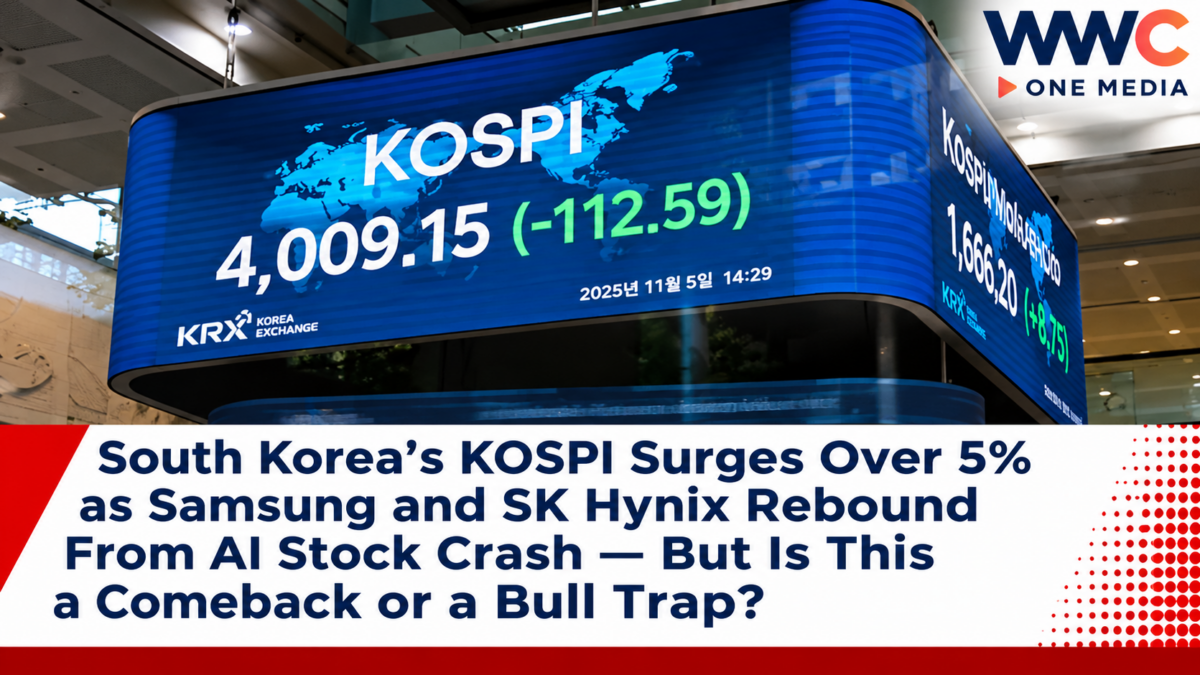
SEOUL, SOUTH KOREA — November 10, 2026 — South Korea’s stock market staged a powerful rebound on Tuesday as bargain hunters rushed back into battered semiconductor shares, sending the benchmark KOSPI up more than 5% during early trading after a devastating selloff driven by fears surrounding the global artificial intelligence boom.
The rally was led by Samsung Electronics and SK Hynix, two of the world’s most important memory-chip manufacturers, as investors reconsidered whether recent losses had pushed technology valuations too far below their underlying earnings prospects.
According to Bloomberg, both semiconductor giants climbed more than 5% during morning trading, helping lift Korean equities after a period of intense volatility.
The recovery followed a strong overnight rebound on Wall Street, where American semiconductor shares surged despite continuing uncertainty surrounding Nvidia and its chief executive, Jensen Huang.
Falling international oil prices also improved market sentiment after US President Donald Trump indicated that further military strikes against Iran might not be necessary.
But the recovery comes with a major warning.
South Korea’s stock market remains sharply below its summer peak, and international investors are still assessing whether the massive global investment in AI infrastructure can be sustained.
Could Tuesday’s buying frenzy mark the beginning of a lasting recovery—or is Wall Street witnessing another temporary rally before the next semiconductor selloff?
KOSPI Jumps More Than 5% as Investors Return to Chip Stocks
South Korean equities opened sharply higher on November 10, reversing some of the damage from the previous week’s market rout.
The KOSPI opened at 5,247.22 points, up 228.37 points, or 4.55%, from its previous closing level.
Buying intensified shortly after the opening bell.
According to Seoul Economic Daily, the market’s rapid advance triggered a buy-side sidecar mechanism on the KOSPI at approximately 9:06 a.m. local time.
A similar mechanism was activated on the technology-heavy KOSDAQ market a few minutes later.
These measures temporarily restrict certain automated trading activity when futures markets experience unusually sharp price movements.
Buy-side sidecars differ from the more severe market-wide trading halts that can occur during major crashes.
Their activation on Tuesday reflected the extraordinary speed of the rebound.
Bloomberg reported that the KOSPI rose more than 5% in early trading, while local financial reporting documented similarly strong gains in the country’s leading technology companies.
The developments represent a striking reversal from the previous week, when investors aggressively sold Korean stocks amid growing doubts about the future of artificial intelligence spending.
Samsung Electronics and SK Hynix Lead the Recovery
South Korea’s two largest semiconductor manufacturers were at the center of the rally.
At approximately 9:01 a.m., Samsung Electronics traded at 199,400 won, up 5%, according to Seoul Economic Daily.
SK Hynix advanced approximately 7.04% to 1,216,000 won.
Later in the morning, Yonhap News Agency reported Samsung shares up 5.11%, while SK Hynix had gained 6.78%.
These figures are intraday observations and can change throughout the session.
The strong gains reflect investors’ willingness to return to companies that remain essential suppliers to the global technology industry.
Samsung and SK Hynix produce memory chips used in smartphones, servers, computers and advanced artificial intelligence systems.
SK Hynix has become particularly important because of its position in high-bandwidth memory, or HBM.
HBM technology allows AI accelerators to access large quantities of data at high speed, supporting increasingly sophisticated computing workloads.
Samsung is also expanding its presence in advanced memory technology while competing across several semiconductor markets.
Demand for AI-related memory remains an important part of the industry’s long-term growth expectations.
However, strong demand does not automatically prevent share prices from falling.
Investor confidence can change rapidly when financing costs rise, technology spending expectations shift or stock valuations become stretched.
South Korea’s Recent Stock Market Crash Was Severe
Tuesday’s recovery follows one of South Korea’s most difficult market periods of 2026.
On November 6, the KOSPI plunged as much as 8.8% during trading, triggering a temporary market-wide halt.
The benchmark eventually closed down 6.02% at 5,059.69.
Samsung Electronics fell approximately 6.4%, while SK Hynix lost 10.4%.
Foreign investors sold approximately 2.8 trillion won worth of Korean shares during the session, according to Reuters.
The market’s weekly decline reached approximately 11.7%.
At the time, the KOSPI was roughly 44% below its June peak.
The plunge followed dramatic developments in the United States, where Democratic gains in the midterm elections raised investor concerns about possible restrictions on AI data centers and related infrastructure projects.
WWC ONE MEDIA previously examined the crisis in South Korea’s KOSPI Plunges as Samsung and SK Hynix Slide on US Election Shock.
The article explored how political uncertainty in Washington threatened investor confidence in South Korea’s export-oriented semiconductor industry.
Tuesday’s rebound recovers part of those losses, but it does not erase the wider market correction.
Wall Street’s Semiconductor Rally Fuels Asian Buying
The recovery in Seoul followed substantial gains in American technology stocks.
On Monday, November 9, the US Nasdaq Composite climbed approximately 2.74%, while the S&P 500 advanced about 2.35%.
Semiconductor companies were among the strongest performers.
The Philadelphia Semiconductor Index surged approximately 6.85%.
Advanced Micro Devices gained 13.26%, Broadcom climbed 8.78%, and Micron Technology rose 6.25%, according to Seoul Economic Daily.
These moves encouraged investors to reconsider the scale of the earlier selloff.
South Korean technology shares often respond to developments in American semiconductor markets because major Korean manufacturers supply chips and components used throughout global computing infrastructure.
When investors become more optimistic about AI spending, demand for Korean semiconductor shares can strengthen.
But the relationship works in both directions.
An abrupt fall in American chip stocks can quickly affect Asian suppliers, even before the underlying commercial demand for semiconductors changes.
WWC ONE MEDIA explored the regional contagion in Asian Stock Markets Plunge as AI Sell-Off Wipes Out US$3 Trillion — South Korea Halts Trading as Chip Giants Face Fresh Pressure.
The latest rebound suggests some investors now believe the selling may have been excessive.
Why Nvidia’s Leadership Controversy Has Not Stopped the Chip Rally
One unusual aspect of the market recovery is that Nvidia shares declined even as many other semiconductor companies advanced.
Nvidia fell approximately 4.3% on Monday amid reports concerning its chief executive, Jensen Huang, and an alleged relationship involving a woman suspected of connections to Chinese intelligence.
Nvidia has reportedly initiated an independent investigation.
The allegations have not been established as proof of espionage by Huang.
Bloomberg noted that investors buying Korean semiconductor shares appeared more focused on underlying AI demand and earnings prospects than on the Nvidia controversy.
Jung In Yun, chief executive of Fibonacci Asset Management Global, suggested that recent headlines had done relatively little to change the fundamentals supporting AI investment.
That distinction is important.
A governance or security controversy involving one company may affect market sentiment without necessarily changing worldwide demand for memory chips.
Nevertheless, the investigation creates uncertainty for a company that plays a central role in the AI supply chain.
Its financial results and management communications remain important factors for technology investors.
Falling Oil Prices Give Korean Stocks Another Boost
Lower international oil prices also supported Tuesday’s rally.
Energy markets weakened after Trump indicated that additional US military strikes against Iran might not be necessary as diplomatic efforts continued.
Brent crude fell substantially on Monday, easing some concerns about inflation and energy supply disruptions.
South Korea is heavily dependent on imported energy.
Consequently, lower oil prices can reduce pressure on transportation costs, industrial production and corporate operating expenses.
The improvement was reflected in Korean airline shares.
Yonhap reported that Korean Air rose approximately 11.34% during late-morning trading, while Asiana Airlines surged around 12.07%.
Cheaper aviation fuel can improve airline profitability when other business conditions remain stable.
For the wider stock market, lower energy prices may also reduce concerns about inflation and future interest rates.
However, an immediate decline in oil prices does not guarantee a lasting reduction in energy costs.
The outlook remains sensitive to developments in the Middle East.
Bargain Hunters See Opportunity After Historic Losses
One reason for the sudden buying is the scale of the previous decline.
Bloomberg reported that South Korean equities had experienced a much deeper correction from their summer peak than Taiwan’s benchmark market.
The KOSPI was down more than 40% from its summer high, while Taiwan’s index had fallen approximately 16% from its more recent record.
Investors are now examining whether Korean semiconductor shares have become unusually inexpensive relative to their expected earnings.
Fibonacci Asset Management’s Jung said the Korean market appeared to have suffered disproportionate selling compared with several regional competitors.
That creates an opportunity for investors willing to accept volatility.
However, a stock is not necessarily undervalued simply because its price has fallen sharply.
If expected earnings decline, the company’s valuation may be less attractive than it initially appears.
This is particularly important for semiconductor companies, whose profitability can fluctuate significantly during industry cycles.
The question is whether future AI demand will support earnings at levels high enough to justify renewed investor buying.
South Korea’s AI Export Boom Remains a Powerful Economic Driver
Despite market volatility, South Korea remains a major beneficiary of global semiconductor demand.
Memory chips are essential components of modern AI computing systems.
Advanced data centers require large amounts of memory capacity to support increasingly powerful processors.
South Korean manufacturers play an important role in supplying that infrastructure.
The country’s external trade performance has benefited from the technology investment cycle.
WWC ONE MEDIA previously examined the relationship between semiconductor exports and the economy in South Korea’s Record Current-Account Surplus as AI Chip Exports Surge 260% — But Could a Semiconductor Crash Wipe Out the Boom?.
That coverage highlighted how the chip industry has become increasingly important to South Korea’s financial performance.
The dependence creates opportunities and risks.
Strong global AI demand can boost exports, profits and investment.
But a slowdown in data-center construction or lower memory-chip prices could weaken the outlook.
South Korea’s stock market is particularly sensitive to these changes because of the large weight of semiconductor companies in its benchmark index.
Why the AI Market Still Faces Major Risks
The rebound does not resolve the concerns that caused investors to sell technology stocks.
Major technology companies are committing enormous sums to developing AI systems and constructing data centers.
Those investments require advanced chips, electricity, cooling equipment and extensive communications infrastructure.
Investors are increasingly questioning how quickly the spending will translate into sustainable commercial revenue.
New regulations could also complicate the construction of large data-center projects.
Following the US midterm elections, market participants have become more concerned that additional environmental, energy or local permitting restrictions might delay some infrastructure investments.
However, tighter regulation does not automatically mean that semiconductor demand will collapse.
Companies may continue expanding facilities while adjusting project schedules and complying with new requirements.
The ultimate effect on Samsung and SK Hynix will depend on actual customer orders, production plans and future profitability.
South Korea’s Government Is Also Backing the AI Industry
The government of President Lee Jae Myung has identified artificial intelligence and semiconductors as major strategic priorities.
In November, South Korea proposed a record 2027 budget of approximately 820.9 trillion won.
The spending plan includes major investments in AI, semiconductor technology and related infrastructure.
WWC ONE MEDIA examined the announcement in South Korea Unveils Record ₩820.9-Trillion Budget, Nearly Doubling AI and Chip Spending.
Government support could help strengthen the industry’s long-term competitiveness.
However, proposed public spending does not guarantee higher stock prices.
Investors will continue assessing whether individual semiconductor companies can translate industry investment into sustainable profits.
Could Another Selloff Follow the Rebound?
Several developments could determine whether Tuesday’s recovery lasts.
The United States is preparing to release fresh inflation figures, which may influence expectations about Federal Reserve interest rates.
Higher-than-expected inflation could revive concerns about borrowing costs and technology valuations.
Investors will also monitor results from major technology companies, including Nvidia, for evidence that AI infrastructure spending remains strong.
Foreign investor flows into South Korean equities will be another critical indicator.
Domestic bargain hunting can temporarily support markets, but a prolonged recovery may be more difficult if international funds continue reducing their exposure.
The Korean market’s recent experience demonstrates how quickly sentiment can reverse.
On November 9, an early rebound lost momentum as persistent selling overwhelmed demand.
That makes Tuesday’s strong opening encouraging, but not definitive proof of a lasting market recovery.
The Bigger Picture: A Semiconductor Comeback or Another Dangerous Rally?
South Korea’s latest stock-market surge illustrates the extraordinary volatility surrounding the global AI investment boom.
Samsung Electronics and SK Hynix remain central suppliers to an industry that continues attracting massive capital commitments.
Their recent share-price declines have created opportunities for investors who believe the long-term growth outlook remains intact.
Tuesday’s recovery was strengthened by the rebound in American semiconductor stocks, falling oil prices and expectations that the recent market correction may have been excessive.
But the risks are substantial.
Questions remain about AI profitability, infrastructure spending, US policy changes and foreign investment flows.
The KOSPI also remains far below its summer peak despite the latest gains.
For investors, the distinction between a genuine recovery and a temporary rebound will depend on whether strong earnings and sustainable demand can support higher stock prices over time.
As South Korea’s KOSPI surges more than 5% and Samsung and SK Hynix lead a dramatic return to AI stocks, the question is whether investors have discovered one of Asia’s biggest buying opportunities—or whether the semiconductor market is setting another trap for bargain hunters.