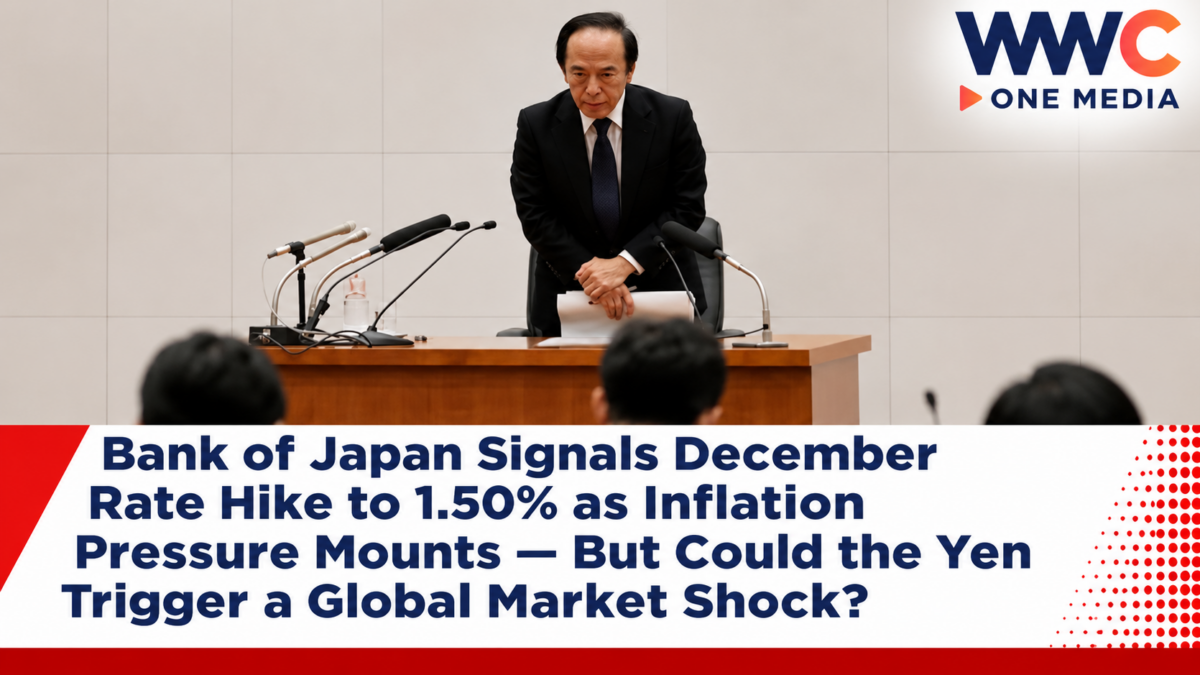
TOKYO, JAPAN — November 10, 2026 — Japan’s central bank is moving closer to another potentially consequential interest-rate increase after newly released policy discussions revealed that several Bank of Japan officials want borrowing costs raised more quickly to prevent inflation from becoming entrenched.
The Bank of Japan’s November 10 Summary of Opinions from its October 29–30 monetary-policy meeting showed growing support among policymakers for accelerating the withdrawal of monetary stimulus.
The development strengthens expectations that the central bank could increase its benchmark interest rate from 1.25% to 1.50% as early as December, extending Japan’s transition away from decades of exceptionally cheap money.
But the push toward higher rates is exposing deep divisions within the central bank.
While some policymakers believe persistent inflation demands a faster response, others warn that weak household spending, uncertain wage growth and the delayed effects of earlier increases could threaten Japan’s fragile economic recovery.
For global investors, the stakes extend far beyond Tokyo.
Higher Japanese interest rates could influence the yen, government bonds, international capital flows and investment strategies that have relied on low-cost Japanese financing.
As the Bank of Japan considers raising borrowing costs to levels not seen in more than three decades, could its next decision strengthen the yen—or trigger another wave of volatility across global financial markets?
BOJ November 10 Summary Signals Stronger Push for Interest-Rate Hikes
The Bank of Japan released its official Summary of Opinions on Tuesday, revealing that several members of its nine-person Policy Board favor moving more quickly toward a neutral interest rate.
A neutral rate is the level at which monetary policy neither significantly stimulates nor restrains economic growth.
According to the document, some policymakers believe Japan has entered a new economic environment in which prolonged monetary support is no longer necessary.
One opinion called for the next increase to be implemented without excessive caution.
Another argued that Japan should move faster toward a neutral policy setting because financial conditions remain relatively accommodative.
A separate view emphasized that underlying inflation has already reached the central bank’s 2% price-stability target, strengthening the case for additional tightening.
The comments represent a significant change from the era when the BOJ struggled to generate sufficient inflation.
For years, Japan’s central bank maintained extremely low or negative interest rates to combat persistent deflation.
Now, policymakers are debating how quickly they should increase borrowing costs to prevent inflation from exceeding their target.
Reuters reported that the November summary reinforces expectations of another increase at the BOJ’s December monetary-policy meeting.
However, the document does not constitute an official decision to raise rates.
It records individual opinions and is not a vote count or a commitment by the Policy Board.
Japan’s Interest Rate Already Stands at a 31-Year High
The BOJ’s current benchmark rate is 1.25%, its highest level since 1995.
The central bank reached that level after raising rates in September, following an earlier increase in June.
The two moves represented a faster pace of tightening than Japan experienced during much of 2024 and 2025.
In September, the central bank increased its policy rate from 1.00% to 1.25%.
But the decision was not unanimous.
Two policymakers appointed by Prime Minister Sanae Takaichi opposed the increase, illustrating concerns about the economic consequences of faster tightening.
At its October 29–30 meeting, the BOJ decided to hold rates steady at 1.25%.
Governor Kazuo Ueda indicated that policymakers needed additional time to assess inflation, financial conditions and the impact of earlier increases.
WWC ONE MEDIA previously examined the September decision in Japan Raises Rates to 31-Year High, but Yen Falls as Stocks Rally.
That report highlighted how financial markets can react unexpectedly even when a central bank raises interest rates.
The November 10 summary indicates that the next decision may be approaching sooner than some cautious policymakers would prefer.
Why the BOJ Is Worried About Inflation
Japan’s economy has undergone a major transformation after decades of weak inflation and sluggish wage growth.
Consumer prices have increased as businesses face higher energy costs, expensive imported materials and persistent labor shortages.
The weakening yen has also contributed to higher import costs.
Japan depends heavily on overseas suppliers for oil, natural gas and several industrial commodities.
When the yen loses value against the US dollar, imports priced in foreign currencies generally become more expensive in yen terms.
Businesses may eventually pass those costs to consumers.
The country’s nationwide core consumer price index, which excludes fresh food but includes energy, increased 2.1% in September from a year earlier.
That was higher than August’s 1.7% increase.
Another inflation measure excluding both fresh food and energy rose approximately 2.4%.
These figures suggest that price pressure is no longer limited to a narrow group of volatile products.
More importantly, the BOJ believes underlying inflation has reached a level broadly consistent with its long-standing 2% target.
That assessment does not mean the central bank is unconcerned about prices.
Instead, policymakers are increasingly focused on ensuring that inflation remains close to 2% rather than accelerating significantly above it.
WWC ONE MEDIA explained the inflation outlook in Japan Inflation Hits 2.1% as BOJ Eyes December Rate Hike.
December Rate Hike to 1.50% Becomes the Main Market Expectation
Economists increasingly believe that the Bank of Japan will raise interest rates at its December meeting.
A Reuters survey conducted in October found that a majority of economists expected the benchmark rate to increase to 1.50% in December.
That would represent a 25-basis-point increase from the current 1.25%.
Some economists also anticipate additional tightening in 2027.
In the survey, 39 of 65 respondents expected the policy rate to reach at least 1.75% by the end of June 2027.
The longer-term outlook remains uncertain.
Analysts’ estimates of the eventual peak rate generally cluster around 1.75% to 2.00%, although some expect borrowing costs to rise further.
The November 10 policy summary could reinforce those forecasts because several officials appear increasingly willing to act.
However, the central bank has not committed to raising rates at every meeting or following a fixed timetable.
Governor Ueda has emphasized that future decisions will depend on incoming economic data and the cumulative effects of past tightening.
A December increase is therefore a strong market expectation, not a confirmed outcome.
BOJ Policymakers Disagree Over How Fast Rates Should Rise
Although support for additional tightening is increasing, the BOJ is far from unanimous about its timing.
The November summary highlighted concerns about the strength of domestic consumption.
Households continue facing elevated prices for food, electricity and other essentials.
Higher borrowing costs could further weaken consumer demand.
Some policymakers also warned that previous rate increases have not yet fully affected the economy.
Monetary policy operates with a time lag.
A rate increase can take months to influence household spending, business investment and broader inflation.
Consequently, raising borrowing costs too quickly could produce a larger-than-expected slowdown.
Other policymakers argue that acting too slowly carries its own risks.
If inflation becomes deeply embedded in wage negotiations and corporate pricing decisions, the BOJ could eventually need even larger increases to restore stability.
The debate reflects a familiar problem facing central banks worldwide.
They must control inflation without unnecessarily damaging economic growth.
For Japan, the challenge is especially sensitive because the economy is still adjusting after decades of exceptionally low interest rates.
Japan’s Neutral Interest Rate Is Becoming the Next Big Question
The November 10 summary places particular emphasis on Japan’s neutral interest rate.
This is important because the BOJ’s policy rate has already entered the lower portion of its estimated neutral range.
BOJ staff have previously estimated Japan’s nominal neutral rate at approximately 1.1% to 2.5%.
The unusually wide range reflects the difficulty of determining exactly where monetary policy stops stimulating the economy and starts restraining it.
Some policymakers believe the neutral rate is considerably higher than the current 1.25% policy setting.
Others are more cautious.
They argue that higher rates could weaken business investment and consumption before the economy has established a sufficiently strong foundation.
Hawkish Policy Board member Naoki Tamura has previously suggested that Japan’s neutral rate may be around 2%.
But that is not an agreed target for the entire Policy Board.
The BOJ’s ultimate interest-rate destination will depend on inflation, wages, economic activity and financial conditions.
Wage Growth Could Decide Japan’s Next Monetary-Policy Move
Japan’s annual wage negotiations have become a central consideration for monetary policymakers.
For years, weak wage growth contributed to sluggish household consumption and persistent deflation.
The central bank now wants a sustainable cycle in which wages and prices increase moderately together.
If businesses continue raising wages in line with productivity and inflation, households may be better able to absorb higher prices.
That could support more stable consumer spending.
But the November policy summary revealed differences of opinion about next year’s wage outlook.
Some members believe wage growth will remain consistent with the BOJ’s 2% inflation objective.
Others doubt that wage increases will accelerate significantly beyond this year’s pace.
Weak wage growth could create a difficult situation.
Consumers may face rising living expenses without sufficient additional income to maintain their purchasing power.
That could reduce consumption and undermine economic growth.
The BOJ must therefore determine whether inflation is being supported by a healthy wage-price cycle or driven mainly by external cost pressures.
Japan’s Consumer Spending Is Showing Warning Signs
Another concern is the weakness of household demand.
The November summary acknowledged that private consumption lacks momentum despite improvements in employment and income conditions.
Official data released Tuesday also showed that September household spending declined more than economists expected.
Reuters reported that poor weather contributed to the weakness, alongside broader consumption challenges.
The figures complicate the case for faster interest-rate increases.
Higher borrowing costs can reduce the disposable income of households with variable-rate loans.
They can also make new purchases financed through credit more expensive.
For businesses, higher rates can increase the cost of investing in equipment, property and other capital projects.
However, the relationship is not entirely negative.
Higher deposit rates may benefit savers.
Banks may also earn additional interest income under certain circumstances.
The overall economic effect depends on how borrowing costs influence consumption, investment, financial institutions and confidence.
Could a BOJ Rate Hike Send the Yen Higher?
Currency markets are among the most sensitive to expectations about Japanese monetary policy.
Higher Japanese interest rates can make yen-denominated assets more attractive compared with foreign investments.
That may increase demand for the yen.
But exchange rates depend on many factors, including US interest rates, international capital flows, geopolitical risks and investor expectations.
A BOJ rate hike does not guarantee that the yen will strengthen.
In September, the currency weakened after the central bank raised rates to 1.25%.
Investors focused partly on disagreements within the Policy Board and uncertainty about future tightening.
In October, the yen strengthened even though the BOJ kept rates unchanged.
That reaction reflected expectations that additional increases could follow.
WWC ONE MEDIA examined the October market response in Japanese Yen Holds Gains Near ¥157 as Bank of Japan Keeps Rates at 1.25% — But Could a December Hike Spark a Bigger Rally?.
The contrasting reactions show why investors pay close attention to the central bank’s communication rather than the rate decision alone.
Could Japan’s Rate Hikes Trigger a Global Carry-Trade Unwind?
Japan’s interest-rate policy matters internationally because the yen has long been used as a relatively cheap funding currency.
Some investors borrow yen and use the money to purchase assets offering potentially higher returns elsewhere.
This strategy is known as the yen carry trade.
It can be profitable when Japanese borrowing costs remain low and currency movements are favorable.
But the strategy becomes riskier when Japanese rates rise or the yen strengthens sharply.
Borrowers may face higher financing costs and increased expenses when converting foreign investment proceeds back into yen.
If those pressures become severe, investors may unwind leveraged positions.
That could contribute to volatility in stock, bond and currency markets.
However, a gradual BOJ rate increase does not automatically cause a global financial crisis.
The effects depend on the scale of outstanding positions, hedging arrangements, leverage and broader market conditions.
The November 10 summary nevertheless reinforces the importance of monitoring global exposure to yen financing.
Japan’s Government Debt Faces Rising Financing Costs
Higher interest rates also have major implications for the Japanese government.
Japan carries one of the largest public-debt burdens among advanced economies.
For many years, extremely low borrowing costs helped the government manage its financial obligations.
As market yields rise, refinancing maturing debt becomes more expensive.
Japan’s Finance Ministry has considered using an assumed interest rate of 3.8% for fiscal 2027 budget calculations, compared with 3.0% in the previous fiscal year.
Kyodo reporting indicated that projected debt-servicing costs could reach approximately ¥36.64 trillion in fiscal 2027.
That figure includes both interest payments and debt redemption.
It should not be interpreted as interest expense alone.
The rising burden may create additional pressure on government finances, particularly as Prime Minister Sanae Takaichi seeks to support economic growth and strategic industries.
WWC ONE MEDIA previously examined this challenge in Japan’s Debt Bill Is About to Hit a Record — and Rising Interest Rates Are Making It Worse.
The changing interest-rate environment means government fiscal plans may face increasing scrutiny from bond investors.
AI Boom Is Also Influencing Japan’s Monetary Outlook
The Bank of Japan’s latest summary contains another important observation: artificial intelligence investment is affecting economic activity and prices.
Policymakers noted that rising global AI demand has supported Japanese industries connected to semiconductors, manufacturing equipment and data centers.
This demand has helped offset some of the economic weakness caused by higher energy and raw-material prices.
But officials also warned that the sustainability of AI-related investment remains uncertain.
A slowdown in global technology spending could weaken demand for Japanese industrial products and equipment.
That could affect manufacturing activity, exports and corporate profits.
The central bank therefore faces conflicting forces.
AI investment may support economic growth and inflation.
Weak consumer spending and expensive energy may restrain economic activity.
The appropriate interest-rate policy depends on how those factors evolve.
BOJ’s Accelerated ETF Sales Add Another Market Variable
The BOJ is also adjusting the pace at which it reduces its holdings of exchange-traded funds.
In October, the central bank decided to accelerate ETF sales to approximately ¥860 billion annually at book value, compared with its previous pace of ¥330 billion.
The change represents another element of the BOJ’s withdrawal from extraordinary monetary stimulus.
For years, the central bank accumulated substantial equity-market holdings while attempting to stimulate Japan’s economy.
Selling those assets gradually reduces its direct involvement in the stock market.
The BOJ has emphasized that disposal should proceed in a way that avoids unnecessary market disruption.
Nevertheless, faster sales could become another factor investors monitor alongside interest-rate changes.
The central bank’s efforts to normalize policy now involve more than adjusting the short-term interest rate.
They also include managing the gradual reduction of assets accumulated during years of unconventional monetary easing.
How Japan’s Next Rate Hike Could Affect Asia
Japan is an important source of investment capital for international financial markets.
Japanese banks, insurers, pension funds and other institutional investors hold substantial foreign assets.
When domestic bond yields rise, some investors may find Japanese securities relatively more attractive.
That could influence decisions about holding overseas bonds and other investments.
Potential effects include changes in foreign-exchange hedging demand, capital flows and international borrowing conditions.
However, the impact would depend on relative returns and portfolio requirements.
A 25-basis-point increase in Japan does not automatically cause Japanese investors to sell overseas assets.
Still, global financial institutions closely monitor the BOJ because its policy changes can influence several asset classes simultaneously.
For economies across Asia, including the Philippines, the indirect effects could appear through currency markets, foreign investment flows and regional bond yields.
What Happens Next for the Bank of Japan?
Investors will now focus on upcoming economic data and comments from policymakers.
The December monetary-policy meeting is widely viewed as the next opportunity for another interest-rate increase.
The main issues include whether domestic consumption stabilizes, whether inflation remains close to or above the target, and whether wage growth appears sustainable.
Further movements in oil prices and the yen will also matter.
BOJ Governor Kazuo Ueda has repeatedly emphasized that the central bank will assess economic conditions at each meeting rather than commit to a fixed pace of tightening.
That flexibility remains important.
An unexpected slowdown in the economy could encourage policymakers to delay another increase.
By contrast, stronger inflation or clearer evidence of sustained wage growth could strengthen the argument for faster action.
The November 10 summary suggests that several officials already believe the time for additional tightening is approaching.
But their views must still be translated into an actual majority decision.
The Bigger Picture: Japan Is Entering a New Era of Higher Interest Rates
The latest Bank of Japan policy summary marks another turning point in Japan’s long monetary-policy transformation.
After decades of battling deflation, the central bank believes underlying inflation has reached its 2% objective.
The debate is no longer simply about creating inflation.
It is increasingly about preventing prices from rising too quickly while preserving economic growth.
Some policymakers want the central bank to move decisively toward a neutral interest rate.
Others warn that weak consumption and the delayed impact of previous increases make a more cautious approach necessary.
The outcome could affect households, businesses, government borrowing and international financial markets.
Higher Japanese rates may support the yen and benefit some savers.
But they could also increase financing costs, pressure government debt and alter investment strategies built around cheap yen borrowing.
For Governor Kazuo Ueda, the challenge is finding the correct pace.
Move too slowly, and inflation may become harder to contain.
Move too quickly, and Japan’s fragile recovery could weaken.
With the Bank of Japan’s own policymakers increasingly calling for faster interest-rate hikes and economists forecasting a December move to 1.50%, the biggest question is whether Japan can finally normalize monetary policy without triggering a painful adjustment in the yen, government bonds and global financial markets.