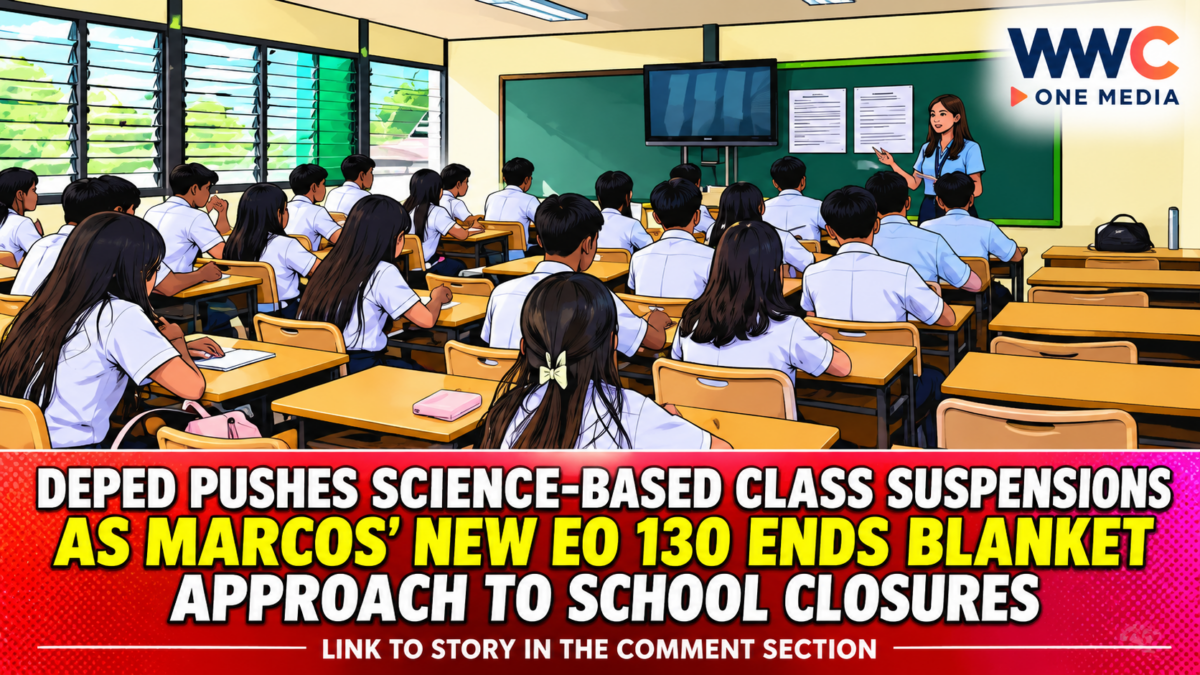
The Department of Education (DepEd) is moving toward a more precise, science-based system for suspending and resuming classes, aiming to protect students from disasters and extreme weather without unnecessarily disrupting their education.
Under the new framework established by Executive Order No. 130, signed by President Ferdinand Marcos Jr. on October 28, 2026, class suspensions will increasingly depend on official scientific warnings, local risk assessments and the actual safety conditions of individual schools.
DepEd Secretary Sonny Angara said the government is finalizing a Joint Memorandum Circular (JMC) with partner agencies to establish the detailed operational guidelines and technical thresholds for implementing the order.
The policy is intended to replace broad, blanket class cancellations with decisions that reflect conditions in specific communities and school campuses.
The goal is straightforward: keep students safe when hazards arise, but allow them to return to classrooms as soon as conditions permit. SunStar Publishing Inc.+2
Three Levels of Class Suspension Will Guide Schools and Local Governments
Executive Order No. 130 establishes three mechanisms for suspending classes, school activities and onsite work in educational institutions.
1. Automatic suspension based on scientific warnings
Classes and onsite activities will automatically be suspended when official warnings or advisories from competent government agencies reach prescribed technical thresholds.
These include information from the Philippine Atmospheric, Geophysical and Astronomical Services Administration (PAGASA), the Philippine Institute of Volcanology and Seismology (PHIVOLCS), and other relevant agencies.
Under the framework, face-to-face classes can resume once the applicable warnings expire or are lifted and the required safety assessments are completed.
2. Localized suspension ordered by local chief executives
Mayors and other local chief executives may suspend classes in areas facing specific risks.
Rather than automatically closing every school in an entire city or municipality, officials are expected to make suspension orders as targeted as possible, identifying affected barangays, communities or school zones whenever feasible.
Local governments must coordinate with relevant disaster management authorities, education officials and school representatives when determining the coverage and duration of suspensions.
3. Granular suspension decided at the school level
Individual school heads may suspend classes when site-specific assessments identify actual or imminent threats to students and personnel.
These situations may include flooding within school grounds, power failures, structural damage or security threats.
The framework also allows individual schools that have been verified as safe and structurally sound to resume face-to-face classes even when a wider city or municipal suspension remains in effect, subject to the required assessment and local government concurrence.
This third mechanism is particularly significant because it recognizes that conditions can differ considerably between schools located in the same city. SunStar Publishing Inc.+2
EO 130 Covers More Than Typhoons and Heavy Rainfall
The new policy expands the hazards that authorities must consider when deciding whether schools can safely operate.
These include:
- Typhoons and severe weather disturbances
- Torrential rainfall and flooding
- Storm surges
- Earthquakes
- Extreme heat
- Volcanic activity and related hazards
- Hazardous air pollution
- Structural damage to school facilities
- Power and other essential utility outages
This broader coverage is important because school safety is affected by more than weather forecasts.
A school may be located outside a storm’s most dangerous area but still face flooding, damaged infrastructure, unsafe roads or power interruptions.
Similarly, extreme heat can make classrooms dangerous even when there is no major weather disturbance.
By considering different types of hazards, the government aims to make class-suspension decisions more responsive to the actual risks faced by learners, teachers and school personnel. SunStar Publishing Inc.+1
DepEd and Seven Government Agencies Are Preparing the Implementing Guidelines
DepEd is leading the preparation of the Joint Memorandum Circular with several partner agencies:
- Department of the Interior and Local Government (DILG)
- Commission on Higher Education (CHED)
- Technical Education and Skills Development Authority (TESDA)
- Department of Science and Technology (DOST)
- Department of Environment and Natural Resources (DENR)
- Department of Public Works and Highways (DPWH)
The guidelines will establish the operational procedures, technical thresholds and coordination responsibilities needed to implement EO 130.
The involvement of these agencies is important because decisions about school safety require different types of expertise.
PAGASA provides weather and climate information, PHIVOLCS monitors earthquakes and volcanic activity, environmental authorities assess pollution, and public works agencies can provide information about infrastructure conditions.
The new system is intended to connect these assessments with decisions made by local governments and school administrators.
According to the Presidential Communications Office, the relevant agencies have been directed to develop the implementing guidelines within 30 days from the order’s effectivity. Presidential Communications Office+2
Marcos’ New Order Also Changes How Classes Resume After Disasters
One of the most important features of EO 130 is that it addresses not only when classes should be suspended but also when they can safely resume.
Previously, a broad suspension order could leave schools unable to reopen even when some campuses had already recovered and were safe to receive students.
The new framework introduces more localized resumption procedures.
For example, if flooding affects only a few schools in a municipality, other campuses that have passed the required safety checks may be allowed to resume in-person instruction.
School-level resumption requires documented assessments confirming that the campus is safe and structurally sound, along with the necessary coordination and local government concurrence.
This could help reduce unnecessary learning disruptions, particularly in areas where disasters affect only certain communities.
However, the policy does not give schools unrestricted authority to reopen. Safety assessments and the applicable coordination requirements remain essential. SunStar Publishing Inc.+1
Learning Must Continue Even When Face-to-Face Classes Stop
The new framework also emphasizes learning continuity.
Suspending in-person classes does not automatically mean that students must stop learning altogether.
When appropriate and feasible, schools are expected to activate alternative delivery arrangements, including:
- Printed and modular learning materials
- Online instruction
- Take-home activity packets
- Temporary learning spaces
- Other approved alternative learning arrangements
These measures are intended to prevent students from losing additional instructional time during emergencies.
The approach is particularly important in communities where prolonged weather disturbances, flooding or infrastructure damage can keep schools closed for several days.
However, alternative learning should still consider students’ access to electricity, internet connectivity, learning materials and adult support at home. A digital learning arrangement may not be practical for every household, especially in remote communities.
The challenge for DepEd will be ensuring that learning continuity plans are realistic and accessible, rather than simply transferring the burden of disrupted classroom instruction to families. SunStar Publishing Inc.+1
DepEd’s 4H Framework Will Help Schools Respond to Extreme Heat
The new suspension policy comes as schools prepare for a potentially very strong El Niño that could bring prolonged dry conditions and dangerous heat.
DepEd Memorandum No. 064, series of 2026, introduced the 4H Learning Modality Framework to guide schools in responding to heat conditions.
The four levels are:
| Level | Heat index | School response |
|---|---|---|
| Hayo | Below 27°C | Regular face-to-face classes with preventive measures and hydration breaks |
| Hinay | 27°C–32°C | Shortened class hours or flexible and blended learning arrangements |
| Hinga | 33°C–41°C | Suspension of face-to-face classes and lighter home-based learning activities |
| Hinto | 42°C and above | Suspension of all academic activities because of serious heat-related risks |
The framework gives school heads flexibility to adjust learning arrangements based on local conditions.
DepEd has also instructed schools to monitor classroom temperature and humidity, assess water availability, improve ventilation and prepare appropriate health and safety measures.
The Hinto level is particularly important because it requires the suspension of all academic activities, including home-based assignments, when the prescribed danger threshold is reached. Philippine News Agency+2
Extreme Heat Has Already Forced Schools to Suspend Classes
The need for more responsive school-safety policies is already evident in several parts of the country.
The Philippine Information Agency reported on November 5 that 65 schools in Iloilo City suspended classes after the forecast heat index reached 43°C on November 3.
The suspension affected 73,127 learners from preschool to senior high school, according to DepEd Western Visayas.
Universities also adjusted their academic activities, including West Visayas State University, Iloilo Science and Technology University, the University of the Philippines Visayas, Central Philippine University and the University of San Agustin.
The Philippine News Agency separately reported that 122 public schools in Western Visayas suspended in-person classes amid forecasts of heat indices reaching 43°C in Iloilo City and 42°C in Roxas City.
These developments demonstrate why localized decisions are important. Dangerous heat can affect particular communities and school facilities differently, making classroom-level assessments and timely announcements essential. Philippine Information Agency+1
WWC ONE MEDIA previously reported on how Cebu City officials were reviewing the implementation of DepEd’s heat-response guidelines.
Very Strong El Niño Could Make School Safety More Complicated
The new suspension rules also come as PAGASA warns that a very strong El Niño could persist through the first half of 2027.
The climate phenomenon increases the likelihood of below-normal rainfall, dry spells and drought in many parts of the Philippines.
For schools, the effects may go beyond higher temperatures.
Water shortages could affect drinking-water supplies, sanitation facilities, school feeding programs and the ability of students to remain comfortable and healthy during the school day.
DepEd has therefore instructed schools to assess water-supply reliability and prepare measures to maintain safe drinking-water access.
WWC ONE MEDIA previously examined the possible effects of the extreme heat outlook on schools and communities.
The concern is not limited to heat. Drought conditions could also affect household water supplies and local infrastructure, making school preparedness increasingly important.
EDCOM 2 Has Long Called for More Localized Suspension Decisions
The shift toward school-level decisions also reflects recommendations from the Second Congressional Commission on Education (EDCOM 2).
The commission has argued that blanket class suspensions can unnecessarily disrupt learning when hazards affect only specific locations.
Its recommendations include a system that combines automatic suspensions based on scientific thresholds, localized decisions by local officials and school-level assessments.
EDCOM 2 has also highlighted the need for learning-continuity plans so schools can maintain instruction when disasters interrupt regular classes.
In a November 3 report, the commission welcomed EO 130 as a step toward more localized and responsive decisions.
WWC ONE MEDIA previously covered Senate President Sherwin Gatchalian’s calls for class-suspension decisions to be made closer to affected communities.
Another report examined the effects of repeated school closures on the country’s disaster-response system.
Read more: Class Suspensions Expose the Need for a Better Disaster-Response System
What Parents, Students and Teachers Should Expect
For parents and students, the new framework means class-suspension announcements may become more specific to their communities and individual schools.
A suspension in one barangay will not necessarily mean that every school in the same city must close, provided the applicable rules and safety assessments allow other campuses to continue operating.
Parents should continue monitoring announcements from their local government, DepEd Schools Division Office and individual schools.
School administrators, meanwhile, will need to strengthen coordination with disaster management offices and maintain clear communication with families.
The transition will also depend on the final Joint Memorandum Circular, which will provide the detailed procedures and technical thresholds for implementing EO 130.
Until those guidelines are fully issued and operationalized, schools and local authorities must follow the applicable existing rules alongside the new executive order.
Will Science-Based Class Suspensions Finally Reduce Learning Loss?
The government’s new policy attempts to resolve a difficult problem facing Philippine education: how to protect students without repeatedly sacrificing valuable classroom time.
Blanket suspensions may be necessary when hazards threaten entire communities, but they can also disrupt schools that are not directly affected.
EO 130 introduces a framework intended to make decisions more precise, using scientific information, localized risk assessments and school-level safety inspections.
Its success, however, will depend on reliable hazard information, clear coordination, properly trained school personnel and the ability of schools to provide alternative learning arrangements when necessary.
For students, the most important outcome should be a system that does not force them to choose between their safety and their education.