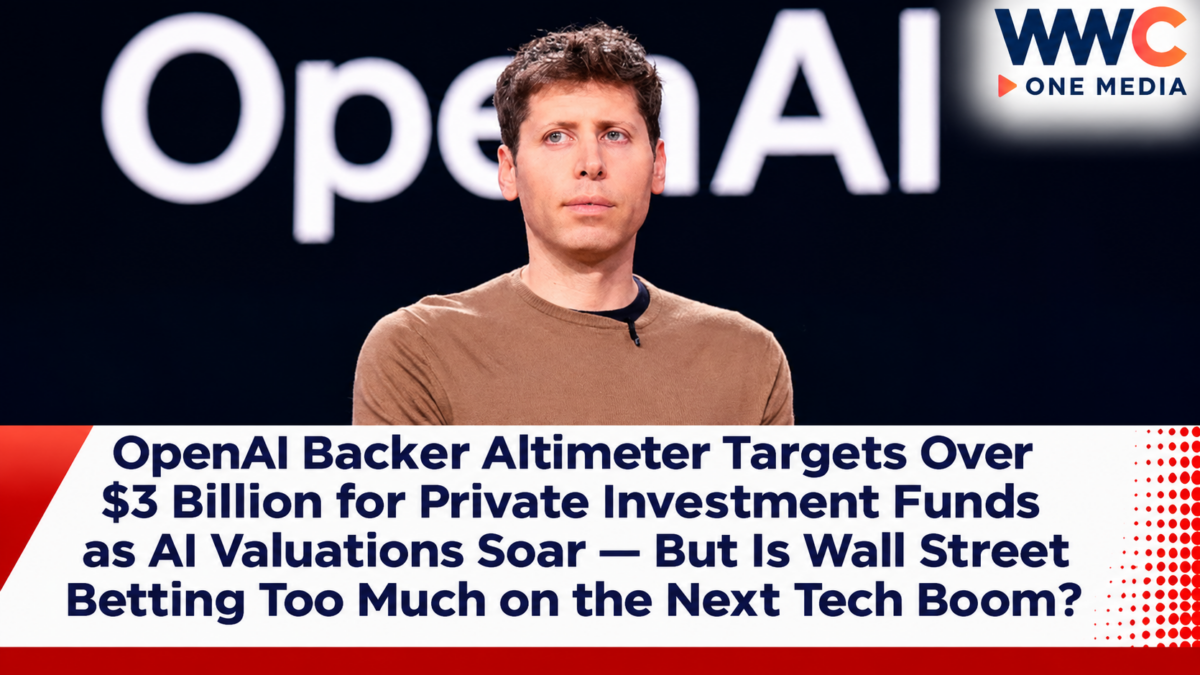
NEW YORK / SILICON VALLEY — November 10, 2026 — Wall Street’s race to capture the next generation of artificial intelligence fortunes is accelerating as Altimeter Capital, the investment firm led by billionaire investor Brad Gerstner, reportedly seeks more than US$3 billion for private-markets investment funds.
The ambitious fundraising target, reported by Bloomberg on Tuesday, November 10, comes as Altimeter strengthens its position among prominent investors backing some of the world’s most valuable artificial intelligence companies.
The firm’s investments include ChatGPT developer OpenAI and its major rival Anthropic, placing Altimeter near the center of an increasingly expensive competition to finance advanced AI technology.
But the timing raises an important financial question.
While private investment firms continue pursuing multibillion-dollar fundraising campaigns, publicly traded AI companies have experienced intense volatility as investors question the industry’s enormous spending commitments and extraordinary valuations.
Could Altimeter’s latest fundraising ambitions signal enduring confidence in artificial intelligence—or could the surge in private-market investments expose another dangerous layer of Wall Street’s AI boom?
Altimeter Targets More Than $3 Billion as Private-Market Competition Intensifies
Bloomberg reported on November 10 that Altimeter is targeting more than $3 billion across private-markets funds.
The headline establishes the overall fundraising objective, but independently accessible information does not confirm the precise allocation between the proposed funds, their individual target sizes or the amount of investor capital already committed.
That distinction matters.
A fundraising target represents the amount an investment manager intends to secure. It does not mean the entire amount has already been raised, invested or made available for transactions.
Nevertheless, Altimeter’s plans reflect the enormous sums that major investment managers are pursuing as private companies increasingly command valuations previously associated with established public corporations.
Altimeter operates across public and private investment markets, with a particular emphasis on technology and growth businesses.
Founded by Brad Gerstner, the firm has developed a reputation for investing in companies positioned to benefit from major technological and economic transformations.
Its AI exposure has become especially significant as companies such as OpenAI and Anthropic attract substantial funding commitments.
Altimeter’s Existing Fundraising Shows Its Financial Ambitions
The latest reported fundraising objective follows substantial private-market activity by Altimeter earlier in 2026.
Public regulatory filing trackers identify several Altimeter investment vehicles that have sought significant amounts of capital.
An Altimeter Premier Growth fund reported approximately $1.6 billion sold through an August 2026 filing, while an Altimeter Premier Growth Expansion vehicle reported approximately $1.5 billion sold in a June filing.
Those figures come from regulatory filing data and should not automatically be treated as components of the newly reported November fundraising target.
The distinction is important because investment firms can operate multiple funds with different mandates, investors and investment periods.
Some funds may pursue established late-stage businesses.
Others may focus on earlier-stage companies or particular investment opportunities.
The combined size of a manager’s fundraising activities also does not necessarily indicate the amount of money immediately available for new investments.
For investors, the more important questions are how the capital will be allocated, what valuation discipline the funds will apply and whether the eventual returns will justify the risks.
Why Altimeter’s OpenAI Connection Matters
Altimeter’s relationship with OpenAI is a major reason its fundraising plans are attracting attention.
In March 2026, OpenAI completed a massive financing round involving approximately $122 billion in committed capital at an $852-billion post-money valuation.
Axios identified Altimeter among the investors participating in the round, alongside prominent institutions and investment firms.
That investment placed Altimeter among the financial backers of a company widely regarded as one of the central forces behind the generative AI revolution.
OpenAI’s technology is used in consumer applications, enterprise software, developer services and other commercial products.
But developing advanced AI systems requires extraordinary amounts of computing infrastructure, engineering talent and long-term investment.
The financial commitments have consequently become enormous.
On November 6, Bloomberg reported that OpenAI had secured approximately $11 billion in new financing at a $1.25-trillion valuation, representing the first completed portion of a larger funding round.
Reuters separately confirmed the financing development through a source familiar with the matter.
The latest funding agreement demonstrated that OpenAI could still attract substantial investor support despite mounting concerns about the AI sector.
However, the company had initially pursued a larger fundraising objective.
Its target was subsequently reduced amid weaker market sentiment and growing investor scrutiny.
For additional analysis, read WWC ONE MEDIA’s report, OpenAI Secures $11 Billion at Stunning $1.25-Trillion Valuation as AI Investors Pull Back — But Why Did Its $30-Billion Funding Ambition Shrink?.
The development raises an important question for Altimeter and other venture investors.
If valuations continue rising while fundraising becomes more difficult, how much additional upside can private-market investors realistically capture?
Altimeter Also Backs OpenAI Rival Anthropic
Altimeter’s artificial intelligence investment strategy is not limited to one leading developer.
The firm has also participated in financing Anthropic, the company behind the Claude AI assistant.
In May 2026, Bloomberg reported that Anthropic raised approximately $65 billion in a financing round valuing the business at roughly $965 billion, including the new investment.
Altimeter was identified among the lead investors alongside Dragoneer, Greenoaks and Sequoia Capital.
The investment demonstrates how some major firms are increasingly willing to support competing companies in the same fast-growing industry.
Traditionally, venture capital investors have sometimes avoided simultaneously backing direct competitors because of concerns involving confidential information, governance and competing commercial interests.
But the enormous capital needs of AI developers have altered the investment landscape.
As the Los Angeles Times reported earlier in 2026, some leading investors are moving away from the traditional practice of supporting only one major company within a highly competitive market.
Altimeter’s involvement with both OpenAI and Anthropic reflects that shift.
The strategy may provide exposure to multiple potential winners.
It can also increase sensitivity to risks affecting the AI industry as a whole.
If the leading AI developers achieve strong commercial growth, investors exposed to several companies may benefit.
But if the entire sector experiences a sustained valuation correction, backing multiple competitors will not necessarily provide meaningful diversification.
Private AI Valuations Are Reaching Extraordinary Levels
The private-market investment environment has changed dramatically as AI companies attract unprecedented financing.
OpenAI’s reported $1.25-trillion November valuation illustrates how investors are assessing the potential earnings of companies that remain outside traditional stock exchanges.
Anthropic has also drawn considerable investor interest because of its enterprise AI business and its position as a major competitor to OpenAI.
These valuations reflect investor expectations about future revenue, profitability and market leadership.
They do not represent cash sitting in company bank accounts.
Nor do they guarantee that public-market investors would assign identical valuations if the companies eventually listed their shares.
Private financing arrangements can include specialized securities, investor protections and other terms that influence the economics of a transaction.
Consequently, headline valuations do not always reveal the precise financial returns available to every investor.
Private-market investors must also consider when they may be able to sell their holdings.
A company can become extremely valuable on paper while investors remain unable to convert those gains into cash.
That is one reason potential initial public offerings involving large AI developers have attracted intense attention.
A successful listing could provide liquidity and a publicly observable market valuation.
However, a disappointing offering could force investors to reconsider the prices assigned to comparable private businesses.
Wall Street’s AI Selloff Creates a Difficult Backdrop
Altimeter’s reported fundraising plans arrive during a challenging period for technology investors.
AI-related companies experienced significant selling pressure in early November as Wall Street questioned the sustainability of enormous spending commitments.
Investors became increasingly concerned about data center construction costs, rising financing requirements and the possibility that commercial AI revenues might not expand quickly enough to justify current valuations.
The market turbulence also followed the November 3 US midterm elections, which heightened uncertainty surrounding energy-intensive data center developments and potential regulatory changes.
Some AI infrastructure businesses have faced especially difficult conditions because their expansion depends heavily on financing.
Unlike established technology companies with large operating cash flows, smaller developers may need to raise additional capital to build facilities, acquire processors and secure power supplies.
When investors become more cautious, those financing needs can become a serious vulnerability.
WWC ONE MEDIA examined the wider market instability in Wall Street’s $3.2-Trillion AI Selloff Sparks Crash Fears as Nasdaq Plunges 5.5% — But Could a 30% Market Collapse Be Coming Next?.
That coverage highlights concerns about the financial consequences of highly concentrated investments in AI-related assets.
A broad market correction, however, does not necessarily mean private fundraising will stop.
Some investors may view falling public-market valuations as an opportunity to invest in high-quality companies at more attractive prices.
Others may prefer to reduce their exposure until financial conditions stabilize.
The outcome will depend on each fund’s strategy, valuation discipline and tolerance for risk.
Brad Gerstner Warns of Political Risks to AI Infrastructure
Altimeter founder Brad Gerstner has also raised concerns about the political environment surrounding AI expansion.
In remarks covered by MarketWatch in early November, Gerstner warned that changes in US political leadership and increased restrictions on data centers could threaten planned computing infrastructure.
He suggested that between 10 and 15 gigawatts of anticipated AI computing capacity might fail to materialize under a more restrictive development environment.
That figure represents Gerstner’s assessment, not a verified projection of canceled projects.
The warning reflects a broader issue facing AI developers.
Training and operating advanced models requires substantial electricity, specialized chips, cooling systems and physical facilities.
Constructing that infrastructure may depend on obtaining regulatory approvals, utility connections and sufficient local support.
Communities are increasingly raising concerns about electricity prices, water consumption and the environmental effects of large data centers.
For investors, delays in infrastructure construction can undermine financial projections.
A company expecting to generate revenue from a new facility may face higher costs if development takes longer than planned.
These challenges could influence how private investment funds evaluate infrastructure-related opportunities.
They also demonstrate that AI investment risks extend beyond the valuations of software developers.
Private Markets May Offer Opportunity — But Also Carry Risks
Private-market funds can provide access to companies before their shares become available through public stock exchanges.
That opportunity can be attractive when companies remain privately owned for extended periods while expanding rapidly.
Investors may seek exposure to businesses whose value could increase significantly before an IPO or acquisition.
However, private-market investing has important limitations.
Private assets are generally less liquid than publicly traded securities.
Their valuations may depend on periodic financing transactions, financial models or independent appraisals rather than continuous market trading.
Investment periods may also extend over several years, limiting investors’ ability to withdraw funds.
These conditions can make private portfolios appear less volatile than public stocks even when the underlying businesses face similar economic risks.
Morningstar’s October 2026 analysis of funds holding OpenAI and Anthropic investments highlighted the growing presence of private AI companies in investment portfolios.
It also emphasized that exposure to high-profile companies should not, by itself, determine an investment decision.
For Altimeter, attracting new commitments will be only one part of the challenge.
The firm will also need to identify investments whose expected financial returns compensate investors for elevated valuations, limited liquidity and the possibility of future market corrections.
Goldman’s David Solomon Sees Strong Demand Despite Market Turbulence
Altimeter’s reported fundraising drive reflects a broader divergence in investor sentiment.
Public technology stocks have faced substantial volatility, but major investment banks continue reporting demand for AI financing and related transactions.
Goldman Sachs Chief Executive David Solomon has expressed confidence in the long-term potential of AI-related dealmaking, while acknowledging the market’s changing conditions.
The investment bank has remained involved in financing major technology and infrastructure developments.
This continuing activity suggests that investors have not abandoned the sector.
Instead, capital providers are becoming more selective about which companies and projects deserve financing.
Established businesses with strong revenue, credible customers and manageable debt may continue securing substantial investment.
Companies relying primarily on optimistic future projections could encounter tougher conditions.
For deeper context, read Goldman Sachs CEO Defies AI Market Selloff as Tech Giants Fuel Record $1.88-Trillion US Bond Boom — But Is Wall Street Financing the Next Bubble? from WWC ONE MEDIA.
The contrast is striking.
Some investors are increasingly concerned about excessive AI spending, while others continue seeking opportunities to commit billions to the companies driving that expansion.
Both positions can exist simultaneously because expectations about long-term technological growth are different from judgments about near-term investment valuations.
Could the AI Boom Turn Into Another Investment Bubble?
The scale of private investment in artificial intelligence has revived comparisons with earlier technology booms.
During the internet expansion of the late 1990s, investors poured capital into companies expected to transform the global economy.
Many businesses failed or suffered severe valuation declines when expectations exceeded their financial performance.
Yet the underlying internet technologies continued developing and eventually became essential to the global economy.
Artificial intelligence could follow a similarly complex investment trajectory.
Its economic influence may continue expanding even if some companies struggle to justify their valuations.
For private investment firms, the difference between technological success and investment success is particularly important.
A transformative company can still produce disappointing returns for investors who pay excessively high prices.
Likewise, buying a strong business at a reasonable valuation can create opportunities even during periods of broader financial instability.
The central question is therefore not simply whether AI will reshape the economy.
It is whether individual investments will generate sufficient earnings and cash flow to justify the capital committed.
WWC ONE MEDIA explored these concerns in Nvidia-Backed Groq Seeks $8-Billion Valuation Just 3 Months After Funding Round — But Could Wall Street’s AI Selloff Derail Its Comeback?.
The report illustrates how rapidly changing private valuations can intensify scrutiny of the relationship between growth expectations and financial performance.
What Altimeter’s Fundraising Could Mean for Investors
The reported effort to raise more than $3 billion suggests that Altimeter is pursuing substantial additional private-market investment capacity.
But several uncertainties remain.
The final fundraising total has not been established through the accessible November 10 reporting.
The complete fund structure, precise mandates and investor commitments also require additional confirmation.
Nor can it be assumed that all the proposed capital will be directed into artificial intelligence companies.
Altimeter’s investment activities span multiple technology and growth-market opportunities, and its actual allocation decisions will depend on the terms and strategies of individual funds.
Nevertheless, the firm’s existing exposure to OpenAI and Anthropic makes its fundraising ambitions particularly relevant to the AI investment debate.
If Altimeter attracts substantial new commitments, the result could demonstrate continued investor confidence in the firm’s ability to identify profitable private-market opportunities.
But successful fundraising would not guarantee successful investments.
The ultimate test will be the financial performance of the companies receiving the capital.
The Bigger Picture: Can Silicon Valley’s Biggest AI Bets Deliver?
Altimeter’s reported $3 billion-plus private-markets fundraising objective arrives at a defining moment for artificial intelligence investment.
OpenAI has secured billions in additional financing at an extraordinary private valuation.
Anthropic has attracted major institutional backing as investors compete for exposure to advanced AI technology.
And financial institutions continue supporting large-scale technology investments despite growing concerns about infrastructure spending and stock-market volatility.
For Altimeter founder Brad Gerstner, the opportunity is substantial.
The next generation of AI companies could create significant economic value and transform industries around the world.
But the risks are equally important.
Valuations remain demanding, liquidity is limited in private markets, and the enormous cost of developing AI infrastructure creates pressure for companies to deliver meaningful commercial returns.
If AI adoption translates into sustainable profits, today’s private-market investments could prove highly rewarding.
If spending consistently outpaces revenue growth, even prominent investment firms could face disappointing returns.
As Altimeter pursues more than $3 billion in new private-market capital while backing some of Silicon Valley’s most valuable AI companies, one question now looms over Wall Street: Is Brad Gerstner positioning investors for the next trillion-dollar opportunity—or could the AI investment frenzy be approaching its most dangerous test yet?