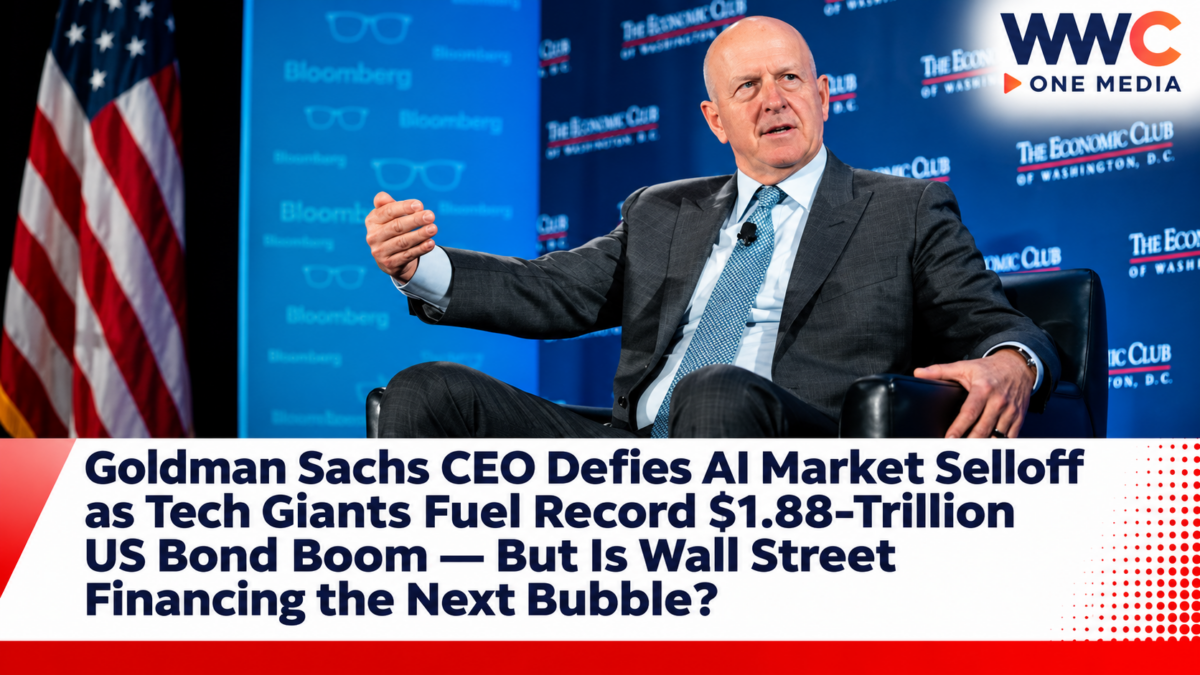
NEW YORK — November 10, 2026 — Wall Street’s artificial intelligence investment boom is facing one of its biggest tests yet, but Goldman Sachs chief executive David Solomon says the appetite for financing massive AI projects remains surprisingly strong despite a sharp selloff in technology stocks.
Speaking to CNBC’s Leslie Picker on November 9 during Goldman Sachs’ 25th Annual Alternative Summit, Solomon said investors and corporations continue seeking capital for AI infrastructure, including data centers, computing equipment and the systems needed to support increasingly powerful AI models.
His optimism comes as the market confronts a dangerous contradiction.
Technology stocks are falling, investors are questioning the returns on hundreds of billions of dollars in AI spending, and political opposition to new data centers is growing. Yet major technology companies continue raising extraordinary amounts of debt to finance expansion.
According to Reuters, US investment-grade corporate bond issuance reached approximately $1.88 trillion through November 4, already surpassing the previous annual record set in 2020.
Major technology companies accounted for a significant portion of that activity.
Amazon, Alphabet, Meta, Microsoft and Oracle had collectively raised more than $370.7 billion through bond offerings this year, based on LSEG figures cited by Reuters.
Goldman Sachs also expects hyperscaler borrowing to remain substantial in 2027, with a projection of approximately $420 billion in debt issuance reported by Reuters.
But investors are becoming more selective.
Banks and credit funds are scrutinizing whether AI borrowers can generate enough future cash flow to repay their debts.
The central question is no longer whether artificial intelligence will require enormous investment. It is whether the companies financing that expansion can earn enough money to justify the risk.
Goldman Sachs CEO Says AI Financing Demand Remains Strong
Solomon’s message challenges the assumption that falling technology stocks mean the AI investment boom is already collapsing.
Speaking to CNBC on Monday, he said Goldman Sachs had remained highly active in AI-related capital-markets transactions.
The bank expects substantial demand for financing to continue.
Solomon acknowledged that financial markets would experience periods of adjustment as investors reassess valuations, economic conditions and emerging political risks.
He nevertheless maintained confidence in AI’s long-term potential to increase productivity.
That distinction is important.
Solomon was expressing confidence in the underlying demand for AI-related investment, not promising that every AI company or investor would make money.
The financing market covers many types of transactions, including corporate bonds, equity offerings, private credit and infrastructure financing.
Some borrowers have substantial existing revenues and strong credit profiles.
Others depend on future demand for AI computing capacity and may face greater difficulty securing funding.
The existence of strong overall demand does not mean financing conditions are equally favorable for everyone.
AI Stocks Fall as Investors Question the Spending Boom
The latest volatility reflects growing doubts about whether AI spending will generate the profits investors expect.
Chipmakers, data center developers and so-called neocloud companies have experienced substantial selling pressure.
Neocloud providers specialize in offering computing capacity, often using advanced graphics processors to support AI workloads.
Their growth can depend heavily on access to capital, electricity, high-performance chips and long-term contracts with customers.
Reuters reported that the Nasdaq 100 lost approximately $2.5 trillion in market capitalization during the November 5 selloff.
The decline followed the November 3 US midterm elections and coincided with concerns about the potential for tougher oversight of AI infrastructure.
However, a decline in stock-market value is not a direct cash loss incurred by every company.
Nor does it mean the equivalent amount of financing has disappeared from the economy.
Market capitalization measures the value investors assign to outstanding shares.
Corporate financing arrangements and actual business cash flows are separate measures.
Even so, falling valuations can make it harder for some companies to raise additional equity and can influence lenders’ willingness to provide credit.
US Bond Market Hits $1.88 Trillion as Tech Giants Borrow Aggressively
One of the clearest indicators of continued financing activity is the US corporate bond market.
Reuters reported that investment-grade debt issuance had climbed to approximately $1.88 trillion through November 4.
That exceeded the previous full-year record of about $1.86 trillion in 2020.
The increase was driven partly by large financing transactions from major technology companies seeking to fund AI infrastructure.
Amazon, Alphabet, Meta, Microsoft and Oracle were among the important issuers.
The amount of money being raised demonstrates that large, established technology businesses still have substantial access to public debt markets.
But there is a catch.
More borrowing can create pressure on bond prices and force issuers to offer higher yields to attract investors.
That increases financing costs.
For companies with stable revenue and cash generation, the added expense may be manageable.
For weaker businesses relying on optimistic future growth forecasts, it can become a serious financial problem.
The bond boom therefore demonstrates both the strength of AI investment demand and the increasing financial risks associated with funding it.
Goldman Sachs Forecasts Another $420 Billion in Hyperscaler Debt
The scale of future borrowing is also attracting attention.
Goldman Sachs estimates cited by Reuters suggest major hyperscalers could issue approximately $420 billion in debt during 2027.
The term hyperscalers generally refers to companies operating extremely large cloud-computing networks and data centers.
These include businesses such as Amazon, Microsoft, Alphabet, Meta and Oracle.
Their infrastructure requires spending on advanced chips, servers, networking equipment, buildings, cooling and electricity.
Goldman has estimated that debt markets could finance roughly one-third or more of major hyperscalers’ capital expenditures.
However, these figures are forecasts rather than financing already completed.
The estimates may change as companies revise spending plans, market conditions shift or new information becomes available.
The important trend is that AI investment is increasingly drawing on bond markets instead of relying entirely on internally generated cash.
That creates opportunities for investors but also increases the importance of credit quality and project economics.
Oracle’s $10-Billion Bond Offering Highlights the Debt Rush
Oracle has become a prominent example of the enormous financing needs associated with AI infrastructure.
On November 2, the company launched a major bond offering alongside plans to raise equity capital.
The transactions were intended to support Oracle’s expanding AI and cloud-computing activities.
As previously reported by WWC ONE MEDIA, Oracle’s financing formed part of a larger wave of corporate bond sales ahead of the US midterm elections.
Related WWC ONE MEDIA coverage: Oracle Leads 17-Company Bond Rush With $10-Billion AI Debt Sale Before US Midterms — But Is Wall Street Losing Faith in Big Tech’s Borrowing Boom?
Oracle’s fundraising illustrates why the AI race has become a major issue for Wall Street.
Building large data centers can require substantial investment years before those facilities generate sufficient revenue to cover their costs.
Companies must also finance equipment upgrades as AI hardware and customer requirements evolve.
The problem is not necessarily that borrowing is inappropriate.
The risk is that revenue growth or customer demand could fall short of the assumptions supporting that borrowing.
Meta’s AI Bond Sales Reveal How Financing Strategies Are Changing
Meta Platforms has also turned to bond markets to support its AI infrastructure expansion.
The Facebook and Instagram parent raised substantial funding through US-dollar and euro-denominated bond offerings during the first week of November.
As WWC ONE MEDIA previously reported, Meta’s financing program highlighted the growing role of debt in the industry’s infrastructure race.
Related WWC ONE MEDIA coverage: Meta Raises Nearly $25 Billion in Bonds as Big Tech’s AI Debt Hits $415 Billion — But Is Wall Street Losing Faith in the AI Boom?
Meta has substantial advertising revenue that can support investment.
But its increasing financing activity shows that even profitable technology companies are reconsidering how to fund exceptionally expensive infrastructure programs.
For bond investors, the important questions include how much cash the company generates, the maturity of its debt and whether future spending can produce attractive returns.
Borrowing does not automatically indicate financial distress.
It does, however, create future obligations that must be managed.
Reuters Warns Banks Are Growing More Cautious About AI Debt
Solomon’s optimism was accompanied by a more cautious assessment from credit-market participants.
In separate reporting published November 9, Reuters found that banks and investors were becoming more reluctant to finance certain AI infrastructure projects.
Lenders are reportedly placing greater emphasis on borrowers’ cash flows, contractual guarantees, construction schedules and the ability of customers to reduce or cancel commitments.
The concerns are particularly relevant to independent data center operators and neocloud businesses.
Some of these companies have ambitious expansion plans but lack the established balance sheets of the largest technology corporations.
Reuters identified market pressure affecting CoreWeave and financing complications involving Nebius.
This creates an important distinction.
There may still be plenty of money available for strong AI borrowers while weaker or more highly leveraged companies face increasingly difficult conditions.
That is not necessarily evidence that the entire AI sector is collapsing.
It may instead indicate that financial markets are becoming more discriminating about which projects deserve funding.
Google Data Center Project Shows Why Execution Matters
The financing debate is not limited to Wall Street.
Companies must also manage the practical challenges of developing enormous computing facilities.
These include land acquisition, construction costs, electricity availability, cooling systems and equipment procurement.
A project can have substantial financing commitments and still encounter delays.
One example involves Google’s expanding data center plans in Wyoming.
As WWC ONE MEDIA previously reported, Google took control of a Wyoming data center development site previously associated with AI infrastructure company Crusoe.
Related WWC ONE MEDIA coverage: Google Takes Over Crusoe’s Wyoming AI Data Center in $17-Billion Mega-Project After Developer Loses Control — But Is Big Tech Turning Against AI Infrastructure Middlemen?
The transaction illustrates how large technology companies may reassess development arrangements as infrastructure spending increases.
But the project should not be characterized as proof that all third-party data center developers are failing.
The broader lesson is that access to financing represents only one part of a successful project.
Companies must also complete construction, secure electricity and attract paying customers.
Anthropic’s Potential IPO Could Test Investor Confidence
The market’s next major test could come from AI developer Anthropic.
The company behind the Claude AI assistant has been preparing for a possible public listing.
Goldman Sachs is among the banks involved in the potential transaction, according to CNBC.
Solomon declined to discuss the offering in detail.
His broader assessment was that market conditions remained reasonably constructive for capital-raising activity.
However, a potential IPO is not the same as a completed listing.
Final pricing, investor demand and the timing of a transaction depend on market conditions and the company’s decisions.
As WWC ONE MEDIA previously reported, Anthropic’s planned listing has attracted attention because of the enormous investment commitments associated with scaling advanced AI models.
Related WWC ONE MEDIA coverage: Anthropic’s Nasdaq IPO Nears as Claude Revenue Hits $16.96 Billion in One Quarter — But Could $895 Billion in AI Commitments Scare Off Investors?
The prospect of an Anthropic offering highlights the difference between public excitement about AI and the detailed financial disclosures investors must evaluate before buying shares.
Investors will want to understand revenue quality, operating losses, computing commitments, financing needs and the path toward sustainable profitability.
A large valuation alone would not establish that the company is financially secure.
Political Resistance to Data Centers Creates Another Challenge
Solomon also addressed growing opposition to new AI infrastructure projects.
Communities across the United States have raised concerns about electricity demand, water consumption, land use, utility prices and the environmental impact of data centers.
Following the US midterm elections, some politicians have called for additional scrutiny or restrictions on construction.
Solomon argued that computing infrastructure is important to the country’s future economic competitiveness.
He suggested that preventing development in the United States could encourage companies to build facilities elsewhere.
That is a strategic argument, not proof that every proposed data center is economically or environmentally beneficial.
Local communities still have legitimate interests in assessing infrastructure projects.
Questions about electricity costs, water supply, environmental protections and public subsidies require careful evaluation.
The challenge for policymakers is balancing investment with appropriate safeguards.
For developers, political opposition may lead to delays, higher costs or changes in project design.
Those outcomes could affect the financial assumptions supporting AI infrastructure loans.
Could AI Investment Move Outside the United States?
One of Solomon’s strongest arguments concerned international competition.
If the United States makes it excessively difficult to build computing infrastructure, he believes investment could shift toward other countries.
The argument reflects the importance of data centers to advanced AI systems.
Computing capacity is increasingly viewed as a strategic resource.
Countries seeking to attract AI investment may offer industrial land, power infrastructure, tax incentives or supportive regulation.
But the relocation of projects would depend on more than political opposition.
Developers also consider electricity prices, grid reliability, network connectivity, security requirements and access to skilled workers.
An attractive regulatory environment cannot compensate for the absence of dependable power or suitable infrastructure.
The United States remains an important market because of its technology companies, capital markets and research capabilities.
Whether individual projects move abroad will depend on their economics.
Could the AI Financing Boom Become Another Financial Bubble?
The scale of spending has revived comparisons with earlier periods of excessive investment in emerging technologies.
During the dot-com boom, investors financed many businesses based on expectations of extraordinary future growth.
Some became enormously successful.
Others failed after their business models proved unsustainable.
The AI market contains a similar uncertainty.
Artificial intelligence may create substantial long-term economic value, but that does not guarantee attractive investment returns for every company building infrastructure.
A data center can become financially vulnerable if construction costs rise, customer commitments weaken or computing equipment becomes obsolete faster than expected.
Debt increases those risks because lenders must generally be repaid regardless of how quickly a project becomes profitable.
But it would also be misleading to conclude that every AI infrastructure investment is speculative.
Many leading technology companies already have substantial businesses, established customers and significant recurring revenue.
The more useful question is which projects have realistic demand forecasts, manageable financing obligations and credible paths to cash generation.
Goldman Sachs Faces Its Own Balancing Act
Solomon’s comments are particularly significant because Goldman Sachs operates in multiple parts of the financial system.
The bank advises companies, structures financing transactions, underwrites securities and works with institutional investors.
A continued AI investment boom can generate opportunities for its capital-markets businesses.
That commercial exposure is relevant when evaluating the CEO’s optimistic comments.
Goldman also has responsibilities involving underwriting standards, credit exposure and risk management.
The bank’s own research has identified potential dangers from delayed AI monetization and the rapid increase in financial commitments.
Solomon previously warned that enthusiasm for AI could encourage excessive risk-taking.
His latest comments therefore do not eliminate the possibility of corrections.
They express a belief that AI’s long-term economic potential remains substantial even as individual valuations and financing arrangements are reassessed.
The Bigger Picture: AI Investment Is Strong, but Not Risk-Free
The November 9 remarks from Goldman Sachs CEO David Solomon reveal an important divide in financial markets.
Companies continue investing enormous sums in AI infrastructure.
Major technology firms are issuing bonds at record levels.
Goldman expects substantial financing demand to continue into 2027.
And potential transactions involving high-profile AI developers could provide another test of investor appetite.
But the risks are becoming more visible.
Technology shares have suffered sharp declines.
Borrowing costs are increasing for some issuers.
Banks are scrutinizing smaller borrowers more closely.
And growing political resistance could delay or complicate data center construction.
These developments are not necessarily contradictory.
A market can experience tremendous long-term growth while producing disappointing returns for some investors and significant losses for weaker companies.
The existence of strong financing demand does not prove that AI valuations are justified. Equally, a stock-market selloff does not prove that the underlying technology lacks economic value.
For Wall Street, the difficult task is distinguishing sustainable investment from excessive financial speculation.
For technology companies, it is converting expensive computing infrastructure into revenue and cash flow.
For governments, it is deciding how to support economic development while protecting communities and public resources.
And as Goldman Sachs continues financing the AI buildout despite growing investor anxiety, one question remains: Will the hundreds of billions flowing into artificial intelligence power a new era of global productivity—or could the growing debt burden expose the companies that borrowed too much, too soon?