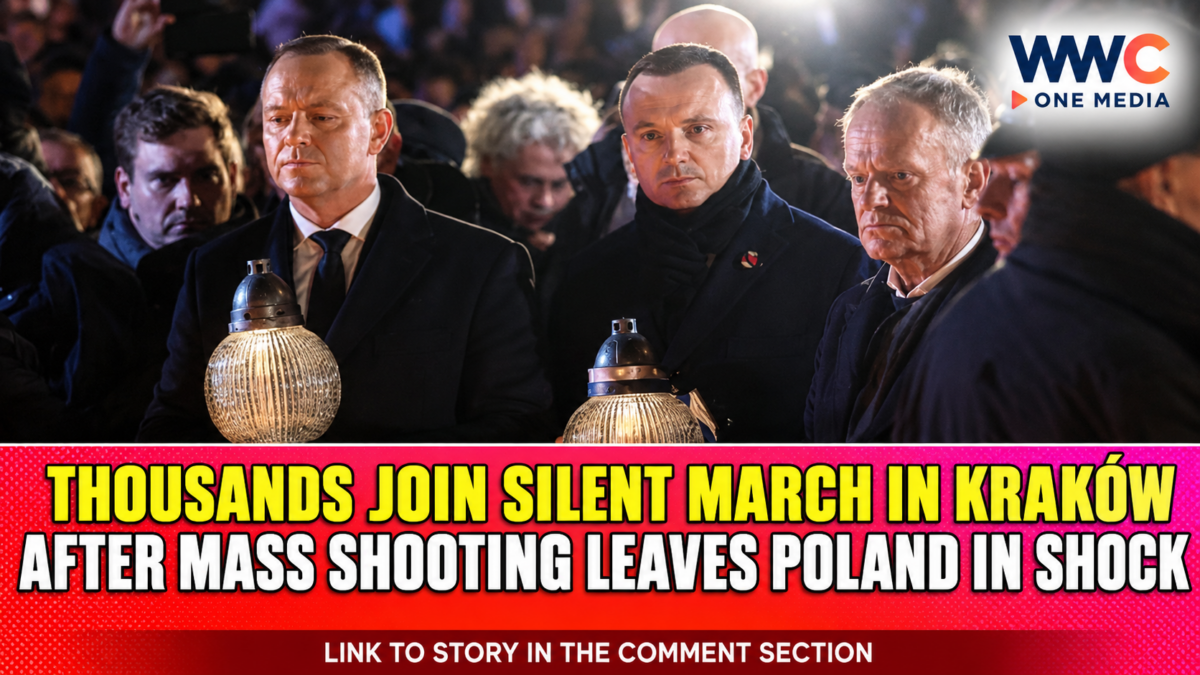
Thousands of people gathered in Kraków, Poland, on Monday, November 9, to honour the six people killed in a devastating shooting at the city’s historic Main Market Square. The silent march brought together residents, religious leaders and the country’s highest officials, including President Karol Nawrocki and Prime Minister Donald Tusk, in a rare public display of unity following an attack that has shaken the nation.
The November 7 shooting transformed one of Poland’s most famous tourist destinations into a crime scene. The suspected gunman allegedly drove into the square and opened fire, killing six people and injuring others. The attacker later died in hospital after being shot and arrested by police.
Participants in the November 9 march retraced part of the route taken by the gunman, stopping at locations where victims were killed to light candles and pay their respects. The gathering was organised as a tribute to those who lost their lives and as a show of solidarity with grieving families.
The march also carried political significance. Tusk and Nawrocki have been at odds on several issues, but both joined the public commemoration as Poland confronted the aftermath of an attack described as unprecedented in the country’s recent experience. The Straits Times+2
Six Victims Killed in Attack at Kraków’s Main Market Square
The shooting happened on Saturday, November 7, in Kraków’s historic Main Market Square, a popular gathering place surrounded by restaurants, shops and major tourist attractions.
According to reports, the 24-year-old suspect, identified by prosecutors as Michał Oksiński, allegedly opened fire from a vehicle in the busy public area. The attack left six people dead and at least 15 others injured, according to reporting by international news agencies. The victims included Polish and foreign nationals.
Police officers moved to confront the gunman. Two officers were seriously wounded during the intervention, but later regained consciousness. Their actions have been praised by Polish officials, who believe the rapid response helped prevent further casualties.
The suspect was shot, arrested and taken to hospital, where he died on November 9. His death means investigators will have to reconstruct his actions and possible motives through forensic evidence, witness accounts, digital records and other material gathered during the investigation. Reuters+2
Silent March Brings Poland’s Political Leaders Together
The November 9 commemoration began at 8pm, with participants gathering near the location where the first shots were reportedly fired. The procession moved through the city centre towards St Mary’s Basilica and ended near the Town Hall Tower.
There were no political speeches during the march. Instead, the event focused on remembrance, with candles placed at the locations where victims were killed. The ceremony concluded with a musical tribute and a prayer for those who died.
The presence of both the president and prime minister was particularly significant given their political differences. Their participation sent a message that the tragedy had become a matter of national grief beyond party divisions.
Poland had also observed two days of national mourning on November 8 and 9. Kraków extended its period of mourning through November 11, with flags on public buildings and public transport displaying signs of remembrance. Euronews+1
Investigation Continues After Suspect Dies
The suspected gunman was identified by prosecutors as 24-year-old Michał Oksiński, from Ostrowiec Świętokrzyski in southeastern Poland. He died in hospital on November 9 after being shot and arrested by police during the attack.
His death has not ended the investigation. Justice Minister Waldemar Żurek said authorities would continue gathering evidence to establish whether Oksiński acted alone or had been influenced or assisted by other individuals.
Investigators have also examined firearms and ammunition recovered from the suspect’s vehicle and property. Prosecutors said both Oksiński and his father held firearms permits, raising questions about how the weapons were obtained and whether existing safeguards were sufficient.
Poland’s government has indicated that it will review the requirements for obtaining firearms permits following the tragedy. Reuters+2
Three More Bodies Found at Suspect’s Family Home
The investigation became even more disturbing after authorities discovered three additional bodies at the suspect’s family home.
The deceased were identified as Oksiński’s father, mother and sister. Investigators believe they were also killed by the suspect, although the circumstances and precise timeline of the deaths remain part of the investigation.
The discovery has raised serious questions about what happened before the shooting in Kraków and whether the suspect’s actions began long before he entered the city’s Main Market Square.
Authorities have not established that the additional deaths were part of a wider coordinated attack. They are examining the evidence to reconstruct the sequence of events. The Guardian+2
Dispute Over Possible Far-Right Motivation
Polish officials initially indicated that the suspect may have been influenced by far-right and ultranationalist ideology. However, authorities later urged the public to avoid drawing conclusions before investigators had completed their work.
A flag bearing the words “Don’t tread on me”, commonly known as the Gadsden flag, was reportedly found in the suspect’s room. Prosecutors cautioned that the symbol has different meanings and is not, by itself, proof of extremist involvement.
The possible ideological motivation has also become a subject of political disagreement. Opposition leader Jarosław Kaczyński rejected claims linking the suspect to far-right extremism, while investigators have stressed that the motive remains unresolved.
The distinction matters: the presence of particular symbols or political interests does not independently establish why someone committed a crime. Authorities must determine whether ideology actually influenced the attack and whether anyone else was involved. Reuters+2
Police Warn of Possible Copycat Threats
Polish authorities have also raised concerns about threatening and alarming online activity following the shooting.
Reuters reported that police detained six people over online posts connected to the attack. Authorities said they were monitoring potential copycat threats and urged the public not to glorify the violence or spread unverified claims.
The concern reflects a wider challenge for security agencies: major attacks can trigger online threats, misinformation and attempts to encourage further violence.
WWC ONE MEDIA has previously examined the changing nature of online radicalisation and security concerns in its report, Singapore’s Terror Threat Remains High — But the Biggest Warning May Be Hiding Online. The circumstances in Singapore are different, but the article explores why authorities increasingly monitor extremist material and potential threats circulating online. Reuters+1
A Tragedy That Has Raised Questions Across Europe
The Kraków shooting has renewed concerns about public safety in European cities, particularly in crowded spaces that attract residents and international visitors.
It also comes amid wider debate about violent extremism and the ability of authorities to identify threats before they become deadly. A separate shooting near Paris in October, which killed one person and injured five others, also prompted a major investigation into possible extremist motivations.
That incident was unrelated to the attack in Poland, but it has added to public discussion about the threat of politically or ideologically motivated violence.
WWC ONE MEDIA previously reported on the French incident in Gunman Unleashes Deadly Shooting Rampage Near Paris, Killing One and Injuring Five. WWC One Media+1
Poland’s position as a major European security partner has also drawn international attention to the tragedy. The country has been strengthening cooperation with neighbouring states and European partners, including through missile-defence initiatives. More background is available in WWC ONE MEDIA’s report, Poland Joins Ukraine’s Missile Shield Coalition — But Europe’s Bigger Defense Plan Is Only Beginning.
The broader security debate is also reflected in WWC ONE MEDIA’s analysis, 25 Years After 9/11, America Is Asking a Hard Question: Did It Learn the Wrong Lessons?, which examines how major attacks can shape national security policies long after the immediate crisis. WWC One Media+1
What Happens Next?
Polish investigators face several important questions: why the suspect carried out the shooting, what happened at his family home, how he obtained the weapons and whether anyone else influenced or assisted him.
Authorities have said the investigation will continue despite the suspect’s death. They are expected to examine forensic evidence, digital material, witness accounts and the circumstances surrounding the three additional deaths.
The government is also expected to review firearms-permit regulations as Poland considers whether existing procedures adequately address potential risks.
For the families of the six people killed, however, the immediate priority is mourning their loved ones and receiving answers about the violence that shattered their lives.
The silent march in Kraków showed a country united in grief, even as political disagreements over the suspect’s possible motives continue.
For now, the central facts remain devastating: six people were killed in the city’s historic square, at least 15 others were wounded, and three more family members were found dead at the suspect’s home.
Poland is demanding answers, and investigators are still working to establish the full story behind one of the country’s most shocking acts of violence.