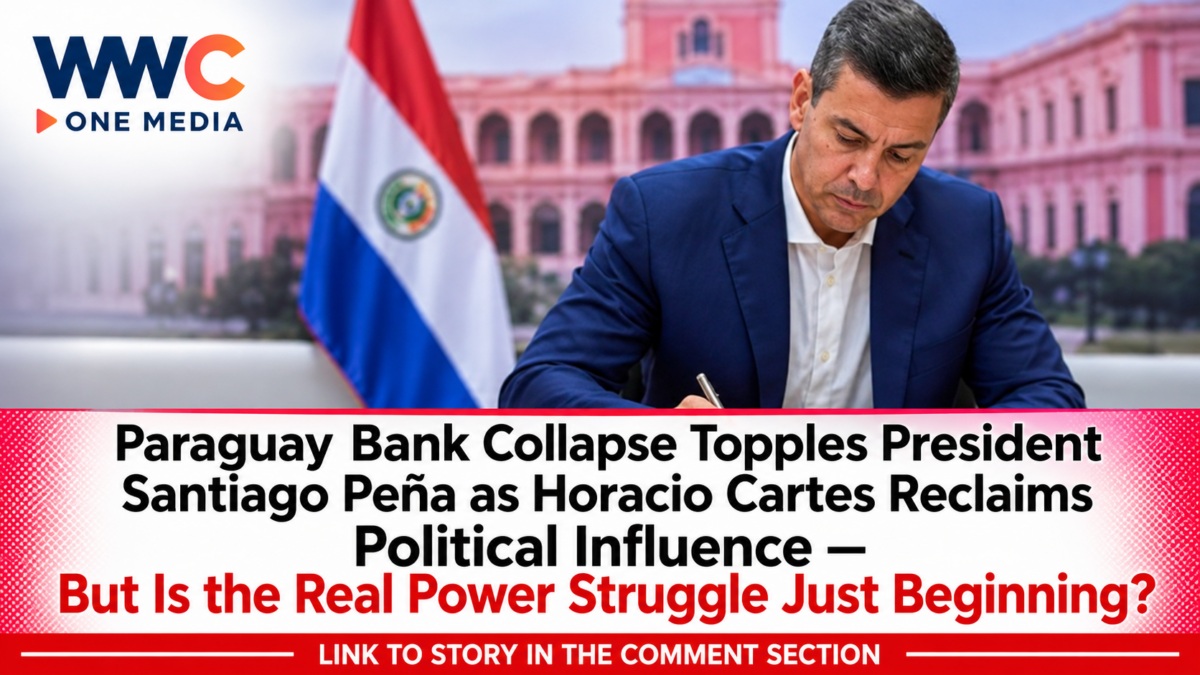
ASUNCIÓN, PARAGUAY — November 8, 2026 — A banking collapse that froze access to millions of accounts has triggered an extraordinary political upheaval in Paraguay, removing President Santiago Peña from office and opening the door for former leader Horacio Cartes to reassert his influence over the South American country’s government.
At the center of the crisis is Ueno Bank, a rapidly expanding digital lender that served approximately 2.9 million customers before Paraguayan regulators intervened on November 3 over severe solvency problems.
The collapse has disrupted household finances, pension payments and commercial activity while placing approximately US$850 million in public-sector deposits under scrutiny.
But the financial crisis has also exposed a bitter power struggle within Paraguay’s long-dominant Colorado Party.
According to a November 7 Bloomberg investigation by Ignacio Olivera Doll and Manuela Tobias, Cartes, the former president who helped bring Peña to power, has emerged as a key political beneficiary of his former protégé’s downfall.
Peña, who took office in August 2023, offered to resign on November 5 as anger over the bank failure intensified.
Lawmakers instead proceeded with impeachment.
On November 6, all 44 senators present voted to remove him, and Vice President Pedro Alliana was sworn in as Paraguay’s new president.
By November 7, Peña was facing criminal charges linked to the Ueno crisis and had been ordered into pretrial detention at a military facility.
He denies wrongdoing.
What began as a banking emergency has now become a defining political confrontation involving millions of depositors, hundreds of millions of dollars in public funds and a former president whose influence over Paraguay’s ruling party appears far from finished.
Horacio Cartes Returns to the Center of Paraguay’s Political Power
Horacio Cartes governed Paraguay from 2013 to 2018.
Before entering national politics, he built a business empire spanning tobacco, beverages, banking and agriculture.
He also became widely known through his involvement with Club Libertad, one of Paraguay’s prominent football clubs.
Cartes joined the Colorado Party in 2009 and developed his own political faction, Honor Colorado.
His rise transformed the party’s internal power structure.
Although he left the presidency in 2018, he retained considerable influence through business relationships, party leadership and support from lawmakers.
He became president of the Colorado Party in December 2022.
Cartes later backed Santiago Peña, his former finance minister, in the 2023 presidential election.
Peña’s victory extended the political influence of the Cartes-aligned faction.
But the relationship eventually became more complicated.
Bloomberg reports that Peña and Vice President Pedro Alliana began developing a political base that was increasingly independent of Cartes.
The growing rivalry created divisions over control of the ruling party, political nominations and future leadership.
For a period, Cartes appeared to be losing ground.
Then Ueno Bank collapsed.
The banking emergency gave lawmakers aligned with Cartes an opportunity to challenge Peña’s handling of a crisis that directly affected millions of Paraguayans.
Political observers interviewed by Bloomberg describe the events as a significant reversal in Cartes’ fortunes.
However, the bank’s collapse has not been legally established as an operation orchestrated by Cartes.
The confirmed facts concern the financial intervention, the political response, Peña’s removal and the resulting leadership change.
Ueno Bank’s Collapse Freezes Accounts Across Paraguay
Ueno developed into one of Paraguay’s most widely used financial institutions after expanding its digital banking services.
The lender attracted customers through mobile services, promotional offers and consumer financial products.
By 2026, it reported approximately 2.9 million customers in a country with a population of around 6.1 million.
Its digital services processed millions of transactions daily.
On November 3, Paraguay’s central bank placed the institution into a formal resolution process.
Regulators said the bank’s solvency had deteriorated below the required threshold after adjustments to its financial statements.
The findings raised concerns about whether the institution possessed adequate capital to meet its obligations.
Normal banking services were disrupted.
Customers reported being unable to access savings, use payment cards or complete transfers.
The shutdown affected households, pensioners, employees and businesses dependent on Ueno’s services.
For many Paraguayans, the crisis was immediate and personal.
Some could not access money needed for groceries, rent or transportation.
Others faced interruptions to salaries and pension payments.
The scale of the disruption triggered protests and demands for accountability.
As previously reported by WWC ONE MEDIA, Peña initially announced his resignation while the banking crisis and impeachment proceedings were still developing.
Related WWC ONE MEDIA coverage: Paraguay President Quits After Ueno Bank Collapse Locks Millions Out of Their Savings — But Will Depositors Ever Recover All Their Money?
That earlier report captured the crisis before lawmakers completed their vote to remove him.
The subsequent impeachment and criminal proceedings represent major additional developments.
Why Ueno’s Financial Problems Became a Political Scandal
The controversy is not limited to the bank’s failure.
Investigators are examining Ueno’s relationships with politically connected individuals and public institutions.
Peña previously held an ownership interest in Grupo Vázquez, the business group associated with the bank.
He has stated that he sold his stake in March 2025.
The former president denies improperly benefiting from the bank or interfering in financial supervision.
However, the lender’s rapid growth during his administration attracted attention.
Public agencies reportedly placed approximately US$850 million in funds with Ueno.
Those deposits included substantial resources associated with Paraguay’s public-sector institutions and social security system.
Authorities are examining whether the placement of public money followed appropriate financial procedures and whether regulators adequately monitored the institution’s risks.
Investigators have also examined lending involving entities connected with the bank’s owners.
These matters have raised allegations involving possible conflicts of interest and improper financial management.
But the presence of public funds at a bank does not automatically prove corruption.
Nor does a past shareholding establish that a former investor caused the institution’s failure.
Prosecutors must establish the legal responsibility of individuals through evidence and judicial proceedings.
The distinction is particularly important because the scandal has already removed a president from power.
How Cartes’ Allies Increased Pressure on Peña
Bloomberg’s November 7 investigation describes how lawmakers aligned with Cartes began pressing financial regulators for information about Ueno.
Their requests reportedly included questions about the bank’s transactions with related parties and the placement of public-sector deposits.
The scrutiny intensified as concerns about Ueno’s financial condition became more widely known.
On November 3, regulators intervened in the bank.
The following day, Cartes publicly called for urgent action to protect affected depositors.
In a statement to Peña, Cartes demanded a firm institutional response and accountability for any wrongdoing.
The intervention weakened Peña’s political position.
Lawmakers questioned his previous financial ties to the bank and whether his administration had responded adequately to regulatory warning signs.
The president’s standing within the Colorado Party deteriorated rapidly.
Even politicians who had previously supported him began distancing themselves from the administration.
Cartes ultimately backed the effort to remove his former protégé.
The result was a remarkable political reversal.
A president who had risen with Cartes’ support lost the backing needed to remain in office.
His former vice president, Alliana, emerged as his successor.
The sequence supports Bloomberg’s broader account of a struggle for influence inside the Colorado Party.
However, whether Cartes will retain decisive control over future government decisions remains a question of political developments rather than an established certainty.
Peña Offers to Resign, but Congress Moves to Impeach Him
The political crisis accelerated on November 5.
Peña announced that he would resign, saying his departure was intended to preserve institutional stability and social peace.
But lawmakers continued pursuing impeachment.
The Chamber of Deputies advanced the proceedings, and the Senate completed the constitutional process on November 6.
All 44 senators present voted to remove Peña.
One senator was absent.
The decision ended his presidency before the scheduled conclusion of his term in 2028.
The distinction between resignation and removal was politically and constitutionally significant.
Paraguay provides certain constitutional arrangements for former presidents, and the method of departure can affect those rights.
Lawmakers opted to proceed with impeachment rather than resolve the matter through Peña’s resignation alone.
Following his removal, Vice President Pedro Alliana was sworn in as president.
As WWC ONE MEDIA reported, the unanimous Senate vote transformed the crisis from a potential resignation into a completed transfer of executive power.
Related WWC ONE MEDIA coverage: Paraguay President Santiago Peña Ousted in Historic 44-0 Senate Vote as Ueno Bank Collapse Freezes Millions of Accounts — But Could Criminal Charges Be Next?
Impeachment is separate from a criminal conviction.
The Senate’s decision removed Peña from office, but allegations of criminal wrongdoing must still be resolved through Paraguay’s judicial system.
Santiago Peña Faces Criminal Charges After Losing Presidency
The banking scandal has now entered a criminal phase.
By November 7, prosecutors had charged Peña with offenses relating to breach of trust and the administration of assets for personal gain.
The allegations concern his purported use of public authority in connection with Ueno Bank.
Peña denies wrongdoing.
A judge ordered him held in pretrial detention at a military facility while the investigation continues.
The former president has the right to challenge the allegations and defend himself in court.
A detention order is not a finding of guilt.
According to the Associated Press, investigators are also examining the conduct of former banking officials and individuals associated with Ueno.
Former central bank chief Carlos Carvallo has faced scrutiny over his previous professional relationship with the lender.
The investigation raises questions about the independence and effectiveness of Paraguay’s banking supervision.
For prosecutors, the challenge is establishing whether particular officials committed legal violations rather than simply presiding over unsuccessful financial decisions.
As WWC ONE MEDIA reported on November 8, Peña’s legal difficulties have intensified since his removal.
Related WWC ONE MEDIA coverage: Paraguay’s Ousted President Santiago Peña Jailed as Ueno Bank Collapse Traps Millions of Depositors — But Could He Face 20 Years Behind Bars?
Any potential prison sentence would depend on a conviction, applicable law and the eventual judgment of the courts.
Pedro Alliana Takes Power as Paraguay’s New President
Pedro Alliana assumed the presidency on November 6 following Peña’s removal.
The former vice president is expected to serve the remainder of the presidential term through August 2028.
Alliana is a longtime member of the Colorado Party and has been associated with Cartes’ political network.
His elevation has become central to questions about who now exercises the greatest influence within the ruling party.
Bloomberg reports that Alliana had been developing political ambitions of his own before the banking crisis.
But as Peña’s position weakened, Alliana distanced himself from the outgoing administration.
He survived efforts to remove him and subsequently took office.
His government now faces the immediate task of stabilizing financial institutions and restoring public confidence.
That includes overseeing the response to frozen deposits, communicating with affected citizens and supporting legitimate investigations.
The political transition also raises questions about how Alliana will govern.
Will he exercise authority independently, or will Cartes’ party leadership continue to shape key decisions?
Both men are influential within the Colorado Party, but the precise balance of power will depend on appointments, legislative decisions and future political developments.
Cartes’ History of US Sanctions Adds an International Dimension
Cartes’ renewed political prominence also carries international significance because of his history with US sanctions.
In 2022, the United States publicly designated the former Paraguayan president for alleged significant corruption.
The US Treasury subsequently imposed financial sanctions in 2023.
American authorities accused Cartes of using his wealth and political connections to influence government decisions.
They also alleged connections involving individuals associated with Hezbollah.
Cartes denied the allegations.
The accusations are important background, but they should not be presented as criminal convictions by a court.
In October 2025, the Trump administration lifted the financial sanctions against Cartes.
According to Bloomberg, the lifting of those restrictions did not amount to a formal withdrawal of the earlier accusations.
The decision was significant because Paraguay had become increasingly important to Washington’s diplomatic strategy in South America.
Paraguay also maintains formal diplomatic relations with Taiwan, making it an important regional partner in debates involving China and the Taiwan Strait.
The financial crisis could therefore affect not only domestic politics but also Paraguay’s relationships with international partners.
Paraguay’s Taiwan Relationship Makes the Political Crisis More Significant
Paraguay is Taiwan’s only remaining formal diplomatic ally in South America.
The relationship has been important to the country’s foreign policy under successive administrations.
In September 2026, Peña used his address to the United Nations General Assembly to reaffirm Paraguay’s support for Taiwan’s international participation.
He also warned about the potential economic consequences of instability in the Taiwan Strait.
As previously covered by WWC ONE MEDIA, his remarks highlighted the importance of Taiwan to global semiconductor production and international supply chains.
Related WWC ONE MEDIA coverage: Paraguay President Backs Taiwan at UN, Warns Taiwan Strait Conflict Could Hit Global Economy
Peña’s removal does not automatically change Paraguay’s diplomatic recognition of Taiwan.
Any shift in the country’s foreign policy would require decisions by the new administration.
But international partners will be monitoring whether Alliana maintains existing diplomatic and economic commitments.
The political transition comes at a time when Paraguay’s international reputation is already under pressure from the Ueno banking crisis.
Millions of Depositors Face Uncertainty Over Their Savings
For ordinary Paraguayans, the most urgent question is not who controls the Colorado Party.
It is when they will recover their money.
Ueno’s intervention disrupted access to accounts used for everyday financial transactions.
The shutdown also affected pensioners and workers who relied on the bank for regular payments.
Paraguay’s deposit guarantee system protects eligible savings up to a prescribed limit.
The amount has been reported at approximately US$37,000 to US$38,000 per depositor, depending on the exchange rate and date of reporting.
Officials have said the guarantee covers the full balances of approximately 97% of depositors.
However, coverage eligibility does not mean that every account holder has already received payment.
By November 7, authorities reported progress in reimbursing customers, with approximately 1.2 million depositors receiving partial or full payments.
Many others were still waiting.
Customers with deposits above the insured limit may face additional uncertainty.
The recovery process will depend on the bank’s remaining assets, applicable guarantee arrangements and the progress of its resolution.
The estimated US$850 million in public-sector funds should also not be described as money already confirmed permanently lost.
The final financial impact remains to be determined.
Paraguay’s Central Bank Faces Serious Questions
Ueno’s rapid growth had already raised concerns about financial supervision.
Regulators ultimately intervened after finding that the bank’s solvency position had fallen substantially below the legally required level.
Investigators are examining whether problems involving financial reporting, related-party lending and capital adequacy were identified and addressed in time.
The crisis also forced leadership changes at Paraguay’s central bank.
Carlos Carvallo, who previously had professional ties to the lender, left the top regulatory position.
The government subsequently named Raúl Vera Bogado to lead the central bank.
The developments have raised questions about whether the regulator was sufficiently independent from political and commercial interests.
But allegations of regulatory failure must still be distinguished from proof of criminal misconduct.
The central bank has maintained that Ueno’s collapse is an isolated case rather than evidence of widespread insolvency across Paraguay’s banking system.
Restoring confidence will require transparent information about the resolution process and credible supervision of the remaining financial institutions.
Investors Watch the Guaraní, Bonds and Public Finances
The political upheaval has also affected Paraguay’s financial markets.
Reuters reported that the guaraní weakened against the US dollar during the crisis.
Paraguayan bond prices also declined as investors reassessed political and financial risks.
The turmoil is significant because Paraguay had been building a reputation for macroeconomic stability and attracting international investment.
The collapse of a major bank, particularly one holding substantial public funds, raises questions about regulatory credibility and government financial management.
Bloomberg Línea reported that the potential fiscal impact of public deposits held at Ueno could be substantial if recovery efforts fail.
However, analysts’ worst-case estimates are scenarios rather than realized losses.
The final cost to the public sector will depend on deposit protection, asset recovery and legal proceedings.
International investors will be watching whether the new government can preserve financial stability while investigating the circumstances of the collapse.
The situation is serious, but the failure of one lender does not establish that the entire national banking system has collapsed.
Why the Crisis Matters Beyond Paraguay
The Ueno scandal illustrates how financial problems can rapidly become political crises when public funds, influential business figures and weak oversight are involved.
Digital banks can grow quickly by offering convenient services and attracting large customer bases.
But rapid expansion requires effective risk management and sufficient capital.
When a lender handles millions of accounts, a sudden shutdown can disrupt a country’s payment system and affect large sections of the population.
The consequences are particularly severe when government institutions also hold substantial deposits with the bank.
The crisis offers lessons for other economies, including the Philippines, where digital banking and financial technology have expanded significantly.
Strong banking supervision, transparent management of public deposits and reliable customer safeguards are essential to maintaining confidence.
However, no evidence suggests that Philippine digital banks face the same specific financial problems as Ueno.
The comparison concerns regulatory principles rather than an identical risk.
What Happens Next for Horacio Cartes and Paraguay?
Paraguay now faces several linked challenges.
The new Alliana administration must oversee the response to the banking collapse and reassure depositors.
Financial regulators must continue returning insured deposits and assessing the institution’s remaining assets.
Prosecutors must investigate allegations involving Peña, former banking officials and other individuals connected with the crisis.
Meanwhile, the Colorado Party must manage its own internal struggle for power.
Cartes remains an influential party leader with longstanding relationships across Paraguay’s political and business establishment.
Bloomberg’s reporting indicates that the banking crisis has strengthened his position after a period of growing rivalry with Peña.
But there is still uncertainty over how much direct influence Cartes will exercise over Alliana’s administration.
The outcome will depend on political appointments, party decisions and the new president’s conduct in office.
The investigations may also reveal additional information about the relationship between Ueno, public institutions and politically connected businesses.
Those findings could influence public confidence and the future direction of Paraguay’s government.
The Bigger Picture: Has a Banking Collapse Reshaped Paraguay’s Political Order?
In less than one week, Paraguay experienced a banking failure, mass disruption of customer accounts, widespread protests, the removal of a sitting president and the transfer of power to his former vice president.
The crisis has also revived questions about the political influence of Horacio Cartes.
The former president helped establish Santiago Peña’s political career.
Their relationship later deteriorated as competing factions emerged within the ruling Colorado Party.
When Ueno collapsed, Peña lost the support required to remain president.
Cartes and his allies backed the impeachment process, while Alliana emerged as the new head of state.
The events reveal how financial instability can accelerate existing political divisions.
But they do not resolve the question of responsibility for the banking failure.
That will require financial investigations, documentary evidence and judicial proceedings.
For the millions of people affected by Ueno’s shutdown, the priority remains recovering savings and restoring access to reliable financial services.
For Paraguay’s political institutions, the challenge is ensuring accountability without allowing powerful interests to compromise the legal process.
Horacio Cartes has returned to the center of Paraguay’s political story, but the country’s immediate future will depend on more than one political figure.
As a former president faces criminal charges, a new leader takes office and millions of customers await the return of their savings, the question now hanging over Paraguay is whether the Ueno Bank collapse will produce lasting financial and political reforms—or merely shift power back into the hands of the same influential political networks.