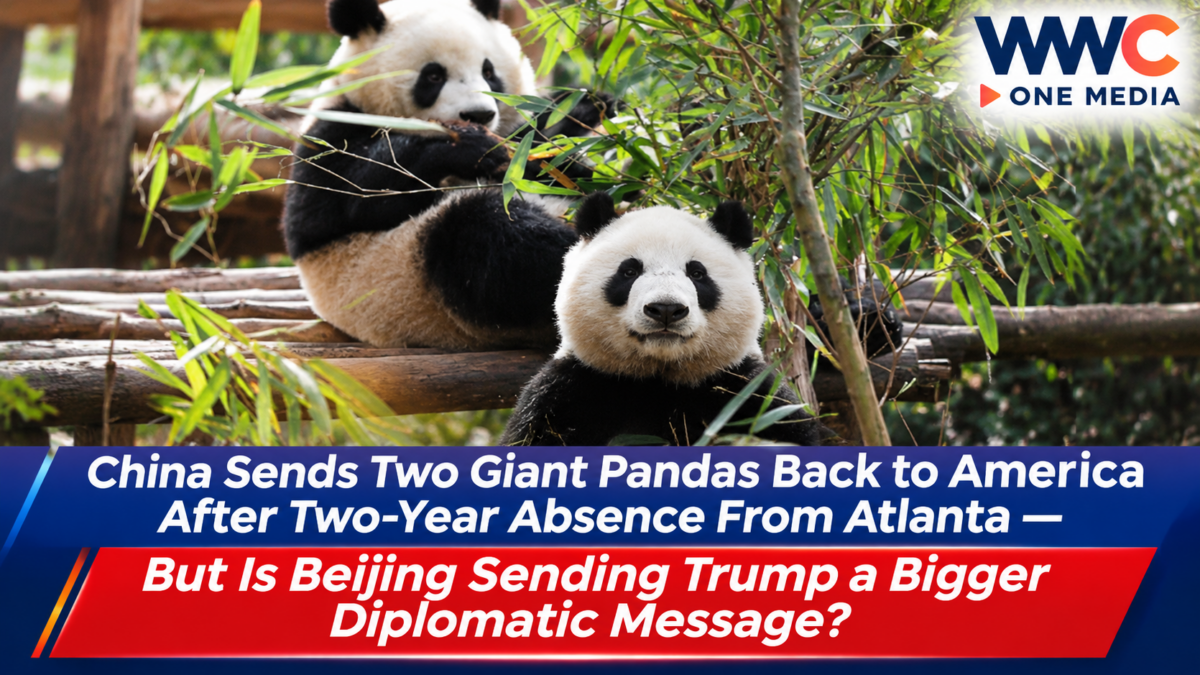
ATLANTA, GEORGIA — Two giant pandas from China have captured hearts in the United States, making their highly anticipated public debut at Zoo Atlanta in a moment that combines wildlife conservation, international diplomacy and the complicated relationship between Washington and Beijing.
Six-year-old pandas Ping Ping and Fu Shuang officially greeted visitors on Friday, November 6, delighting crowds as they munched on bamboo, explored their new surroundings and relaxed inside the newly renovated Arthur M. Blank Panda Grove.
Their arrival marks the return of giant pandas to Atlanta after a two-year absence.
But beyond the excitement surrounding the black-and-white bears lies a much bigger geopolitical story.
The two pandas are in the United States under a 10-year conservation and research agreement with China, reviving a relationship that began more than a quarter of a century ago.
The public debut also comes as the administration of US President Donald Trump presses Beijing to honor commitments involving American agricultural purchases and the supply of strategically important rare-earth minerals.
Chinese President Xi Jinping previously described the pandas as symbols of friendship between the two countries.
Now, as diplomatic tensions continue over trade, technology and global security, the return of Ping Ping and Fu Shuang raises an intriguing question.
Can two giant pandas accomplish what years of difficult negotiations have struggled to achieve—bringing the world’s two largest economies closer together?
Ping Ping and Fu Shuang Finally Meet Their American Fans
Zoo Atlanta welcomed visitors to its renovated panda habitat on November 6 after weeks of preparation.
The two pandas arrived from Chengdu, China, on September 27.
They spent more than a month adapting to their new environment before being introduced to the public.
Ping Ping is a male panda born on March 17, 2020.
Fu Shuang is a female panda who was also born in 2020.
Both are six years old.
Their first public appearance drew enthusiastic crowds eager to see giant pandas return to Atlanta.
The pandas spent much of their debut eating bamboo and relaxing inside their enclosure.
For many visitors, the attraction was a chance to experience an animal rarely seen outside China.
Others viewed the occasion as a celebration of international wildlife cooperation.
Zoo Atlanta President and CEO Raymond King emphasized the animals’ ability to inspire curiosity and bring people together.
The zoo hopes their presence will strengthen public interest in conservation while supporting long-term scientific collaboration.
Giant Pandas Return to Atlanta After Two Years
Atlanta has a long history of caring for giant pandas.
The zoo first welcomed giant pandas Yang Yang and Lun Lun from China in 1999.
Their arrival established a conservation partnership that lasted 25 years.
During that period, seven panda cubs were born at the facility.
All seven eventually returned to China.
In 2024, the original adult pair and their two youngest offspring, Ya Lun and Xi Lun, also returned to China when the previous agreement ended.
Their departure left Zoo Atlanta without giant pandas for nearly two years.
The new arrivals restore that tradition.
As WWC ONE MEDIA previously reported when Xi Jinping announced the pandas’ return to Atlanta, the Chinese leader revealed the impending arrival during his September 24 meeting with Trump at the White House.
The announcement was widely interpreted as a positive diplomatic gesture.
But the pandas’ actual arrival and public debut represent separate milestones.
They landed in September and became available for public viewing in November.
Meet Ping Ping and Fu Shuang: China’s Newest Panda Ambassadors
The two pandas have distinct personalities and physical characteristics.
Ping Ping, the male, has prominent dark markings around his eyes.
He was born at the Chengdu Research Base of Giant Panda Breeding.
His name is associated with wishes for a smooth and healthy life.
Fu Shuang, the female, has a slightly protruding forehead that helps distinguish her from her companion.
Her name is associated with happiness and good fortune.
According to Georgia Public Broadcasting, the pandas’ names carry meanings connected to peace and happiness.
Those associations have added symbolic significance to their arrival during a period of international tension.
But the animals are not simply diplomatic mascots.
They are part of a formal conservation agreement involving animal welfare, veterinary expertise and scientific research.
Their care requires specialized facilities, experienced staff and a reliable supply of food.
Zoo Atlanta has invested in improvements intended to help the pandas settle comfortably into their new environment.
Inside the Renovated Arthur M. Blank Panda Grove
The pandas’ new home has been specially prepared for their arrival.
Zoo Atlanta renovated its facilities to improve the animals’ living environment.
The upgraded habitat includes expanded indoor spaces, outdoor areas, climbing structures, pools and waterfalls.
These features are intended to provide opportunities for movement, exploration and enrichment.
Giant pandas spend much of their time eating and resting.
Their diet consists primarily of bamboo, which must be supplied in considerable quantities.
Zoo Atlanta has established a dependable source of locally grown bamboo.
The city also has climatic characteristics that can support the cultivation of suitable bamboo varieties.
The zoo’s animal care team spent several weeks observing Ping Ping and Fu Shuang before opening the exhibit.
The adjustment period helped staff monitor their behavior, feeding patterns and general welfare.
According to CBS Atlanta, the pandas have also become accustomed to supplementary foods, including specially prepared biscuits and apples.
The preparations demonstrate that international panda transfers involve considerably more than transporting animals between countries.
The 16-Hour Journey Aboard the Panda Express
Ping Ping and Fu Shuang arrived in Georgia on September 27 aboard a specially arranged FedEx Boeing 777 aircraft.
The flight was known as the “Panda Express.”
Their journey began in China and ended at Hartsfield-Jackson Atlanta International Airport.
According to reports about their arrival, the trip took approximately 16 hours.
FedEx donated the transportation.
The transfer required coordination between Chinese wildlife specialists, Zoo Atlanta and transportation personnel.
Moving giant pandas internationally involves careful planning because the animals require appropriate environmental conditions, veterinary monitoring and specialized handling.
After landing, the pandas were transported to their new home.
They then began an adjustment and observation period before meeting visitors.
The successful journey marked the beginning of their latest conservation assignment.
Why China Uses Pandas as Diplomatic Ambassadors
The arrival of Ping Ping and Fu Shuang is part of a longstanding diplomatic tradition.
China has used giant pandas to symbolize friendship and cooperation with other countries for decades.
The practice became particularly prominent in 1972.
That year, China sent two giant pandas to the United States following President Richard Nixon’s historic visit to Beijing.
The animals became powerful symbols of improving relations between the two countries.
Over time, China’s approach evolved.
Instead of permanently gifting pandas, Beijing increasingly entered into long-term lending arrangements with overseas zoos.
China generally retains ownership of the animals under these agreements.
The partnerships typically involve conservation cooperation, scientific research and animal management.
Panda diplomacy can create positive public attention.
But it also reflects the state of China’s diplomatic relationships.
Agreements may be renewed during periods of improving relations or allowed to expire amid political tensions.
That makes the new Atlanta partnership symbolically significant.
Trump and Xi’s September Meeting Set the Stage
The pandas’ return followed a high-profile meeting between Trump and Xi in Washington on September 24.
During that visit, Xi announced that the two pandas would soon arrive in Atlanta.
The announcement drew attention because relations between Washington and Beijing remain complicated.
The two countries are major trading partners.
They also compete in advanced technology, industrial manufacturing and strategic influence.
Disagreements have involved tariffs, semiconductors, agricultural purchases and critical minerals.
As WWC ONE MEDIA reported when the two countries extended their trade truce into January 2027, Washington and Beijing have attempted to manage economic tensions while negotiating a broader arrangement.
The panda announcement provided a rare, publicly appealing example of cooperation.
However, there is no evidence that the animals were exchanged in return for specific tariff concessions.
The conservation agreement and trade negotiations are distinct processes.
Their political significance comes from the broader diplomatic environment in which they are taking place.
US-China Trade Tensions Continue Despite Panda Diplomacy
The pandas’ public debut coincided with renewed American pressure on China over trade.
On November 6, senior US officials called on Beijing to fulfill commitments made under the existing trade arrangement.
Treasury Secretary Scott Bessent and US Trade Representative Jamieson Greer raised concerns about Chinese purchases of American agricultural products and access to rare-earth materials.
China has emphasized the importance of reciprocal implementation of trade commitments.
The dispute affects industries ranging from farming to advanced manufacturing.
Rare-earth minerals are particularly important because they are used in powerful magnets, electric vehicles, electronics and defense-related technologies.
As WWC ONE MEDIA reported in its November 7 analysis of Washington’s renewed demands, the two governments continue to disagree over whether earlier commitments are being implemented satisfactorily.
But the November 6 discussions did not formally end the trade agreement.
Nor did they announce a new blanket tariff increase.
The panda debut therefore unfolded during ongoing diplomacy rather than a complete breakdown in relations.
Can Two Pandas Improve US-China Relations?
The diplomatic value of pandas lies partly in their universal appeal.
Unlike tariffs or military agreements, giant pandas attract public interest across political and cultural divisions.
Their presence encourages exchanges involving scientists, veterinarians, conservation specialists and ordinary visitors.
Those relationships can continue even when governments disagree on other issues.
A family visiting Zoo Atlanta may think primarily about wildlife rather than geopolitical competition.
But the partnership also creates a visible reminder that the United States and China can cooperate.
That does not mean panda diplomacy can resolve difficult strategic disagreements.
Trade negotiations require enforceable commitments and political decisions.
Security disputes involve national interests that extend far beyond cultural exchanges.
Nevertheless, positive cooperation can help maintain communication and goodwill.
That is the potential diplomatic significance of Ping Ping and Fu Shuang.
Why Giant Pandas Are Still Vulnerable
The pandas’ return also draws attention to conservation challenges.
Giant pandas were once classified as endangered.
Their conservation status improved in 2016, when the International Union for Conservation of Nature reclassified the species as vulnerable.
The change reflected progress in protecting wild populations and habitat.
According to the AFP report carried by CNA, approximately 1,800 giant pandas remain in the wild.
China has established more than 50 panda reserves to support conservation.
But threats persist.
Habitat fragmentation, environmental changes and human activity can make survival more difficult.
Pandas depend heavily on bamboo-rich forest ecosystems.
Protecting those environments is essential.
The species’ improved conservation status should therefore be viewed as progress, not evidence that conservation efforts are no longer necessary.
Research partnerships with overseas institutions can contribute to a better understanding of panda nutrition, behavior, reproduction and health.
Could Ping Ping and Fu Shuang Produce Panda Cubs?
Both pandas are six years old and have reached an age at which reproduction may be possible.
Zoo Atlanta and its Chinese partners hope the animals may become a suitable breeding pair.
However, the existence of a male and female panda does not guarantee successful breeding.
Giant panda reproduction requires careful timing and specialized veterinary expertise.
Female giant pandas have a relatively short annual period of fertility.
Even when animals are healthy, breeding may not result in pregnancy.
Conservation teams must consider behavior, physical condition and genetic suitability.
Atlanta has experience managing successful panda births.
Its previous partnership with China produced seven cubs over 25 years.
That record provides valuable institutional expertise.
But no pregnancy or new cub has been announced involving Ping Ping and Fu Shuang.
Any prediction about future offspring would be speculative.
Singapore’s Pandas Show How International Loans Can Change
The United States is not the only country participating in China’s panda conservation diplomacy.
Singapore’s River Wonders has hosted giant pandas Kai Kai and Jia Jia since 2012.
Their original agreement was later extended.
As WWC ONE MEDIA reported in September 2026, when the pair celebrated their birthdays, the current arrangement is scheduled to end in 2027 unless further changes are agreed.
The Singapore case illustrates how panda partnerships are structured around defined agreements.
Animals can remain overseas for many years.
But their continued presence depends on arrangements between the relevant institutions and Chinese authorities.
For Atlanta, the newly signed 10-year agreement creates a longer period for conservation cooperation.
It does not mean the pandas have been permanently transferred to American ownership.
Why Japan’s Panda Return Adds Another Diplomatic Dimension
China’s panda diplomacy has also attracted attention in Japan.
Earlier in 2026, two pandas were returned from Japan amid strained relations between Beijing and Tokyo.
The tensions involved disagreements over Taiwan and regional security.
The return of pandas can attract particular attention when it occurs alongside deteriorating political relations.
However, individual transfers may also involve the expiration of existing loan agreements.
It is therefore important not to attribute every return solely to diplomatic retaliation without clear evidence.
The comparison underscores the symbolism attached to giant pandas.
Their arrival or departure can become a visible reminder of wider changes in international relationships.
Atlanta’s new arrivals have been interpreted as a positive gesture.
But their diplomatic meaning should not overshadow the conservation purpose of the agreement.
Three US Zoos Now Host Giant Pandas
With the return of pandas to Atlanta, three major American zoos currently host giant pandas on loan from China.
They are Zoo Atlanta, the Smithsonian’s National Zoo in Washington, DC, and the San Diego Zoo in California.
The National Zoo received Bao Li and Qing Bao in October 2024.
San Diego also welcomed new pandas in 2024.
The latest Atlanta arrival restores a geographic distribution spanning the eastern, western and southeastern United States.
For American visitors, this creates more opportunities to see giant pandas without traveling overseas.
For conservation professionals, the institutions provide additional settings for coordinated research.
Each programme has its own agreement and animal-care responsibilities.
What Happens Next for Zoo Atlanta’s Pandas?
The immediate priority is ensuring Ping Ping and Fu Shuang remain healthy and comfortable in their new surroundings.
Zoo Atlanta’s staff will continue monitoring feeding behavior, activity and general welfare.
The zoo will also work with Chinese conservation specialists under the terms of the research partnership.
Over time, the collaboration may support studies involving panda behavior, nutrition and reproduction.
Visitors will have opportunities to learn about the species and the challenges involved in protecting wild populations.
The pandas are expected to remain in Atlanta for 10 years under the current agreement.
However, long-term arrangements remain subject to their contractual terms and appropriate animal-welfare considerations.
For now, the most important development is that the pandas have successfully arrived and begun meeting the public.
The Bottom Line: Two Pandas, One Conservation Partnership and a Bigger Diplomatic Question
China’s giant pandas Ping Ping and Fu Shuang made their public debut at Zoo Atlanta on November 6, 2026.
The six-year-old animals arrived from Chengdu on September 27 aboard a specially arranged FedEx flight.
They will live at the zoo under a 10-year conservation and research agreement.
Their arrival restores Atlanta’s panda programme after a two-year absence and revives a relationship that originally began in 1999.
The partnership offers opportunities for scientific research, conservation education and international cooperation.
But the debut also carries diplomatic significance.
It follows Xi Jinping’s September announcement during a meeting with Donald Trump.
And it comes amid renewed disagreements between Washington and Beijing over trade, agriculture and critical minerals.
The pandas are a positive symbol of cooperation, but they do not represent a resolution of the countries’ larger disputes.
As Ping Ping and Fu Shuang settle into their new American home, one question remains: Will China’s newest panda ambassadors help create a warmer chapter in US-China relations—or will their friendly debut remain a rare bright spot in an increasingly complicated rivalry between the world’s two largest economies?