MANILA, PHILIPPINES — Bureau of Customs (BOC) Commissioner Ariel Nepomuceno has delivered an unusual message to Congress: Keep the additional confidential funds and give Customs the money it needs to operate, maintain its equipment and modernize the country’s border security systems.
The appeal comes as the government agency responsible for collecting hundreds of billions of pesos in import duties and taxes faces a major funding dispute ahead of the proposed 2027 national budget.
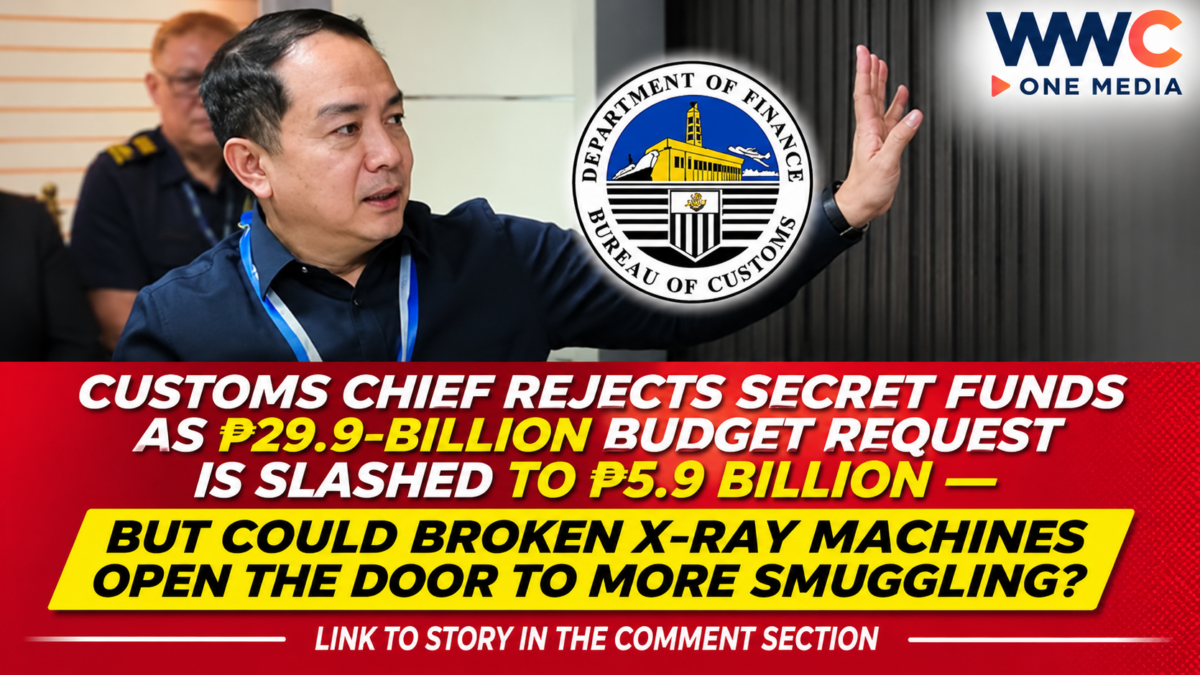
The BOC originally sought approximately ₱29.9 billion for operations and modernization, according to earlier reporting and government statements.
But its allocation under the 2027 National Expenditure Program was reduced to approximately ₱5.9 billion.
That represents a gap of roughly ₱24 billion, equivalent to about 80% of the original request.
Nepomuceno warned that the reduced allocation would leave insufficient resources for equipment maintenance, modernization and other important operational requirements.
His concern was especially direct when he discussed cargo X-ray scanners.
What happens if critical inspection equipment breaks down and Customs no longer has enough funding to repair it?
The warning comes as the Philippines confronts continuing threats involving agricultural smuggling, illicit cigarettes, illegal drugs and other prohibited or undeclared imports.
For Nepomuceno, the challenge is straightforward: the government expects Customs to collect revenue and protect national borders, but the agency says it lacks the financial resources necessary to modernize its operations.
Nepomuceno Turns Down Additional Confidential Funds
During the November 6 episode of Bilyonaryo News Channel’s Politiko Talks, Nepomuceno acknowledged that confidential funding could support the bureau’s intelligence operations.
However, he said he had declined an offer of additional funds because of the controversy surrounding such allocations.
His position reflects growing public scrutiny of confidential and intelligence spending across Philippine government agencies.
Nepomuceno argued that an increase in the bureau’s regular budget would be more useful.
The distinction is significant.
Confidential funds are generally associated with activities whose sensitive details cannot be publicly disclosed in the same manner as ordinary government expenditures.
Regular appropriations, meanwhile, can support documented operational needs, equipment acquisition, maintenance and modernization under applicable budgeting and procurement rules.
Nepomuceno did not say that intelligence gathering was unnecessary.
Instead, he argued that the agency should prioritize more transparent funding for its broader operational requirements.
His decision also does not establish that all existing intelligence-related expenditures at Customs have been eliminated.
The reported refusal concerns an offer of additional confidential funding.
Customs Asked for ₱29.9 Billion but Received Only ₱5.9 Billion in the Budget Proposal
The budget gap is one of the most important issues facing the bureau.
Nepomuceno referred to an approximately ₱29-billion request during the interview.
Earlier reporting from Daily Tribune and the Philippine Information Agency placed the detailed proposal at ₱29.9 billion.
The 2027 National Expenditure Program, however, provided about ₱5.9 billion.
According to the commissioner, the amount would barely cover essential personnel expenses and ongoing operations.
That leaves limited room for the modernization projects the agency wants to pursue.
The gap is especially important because Customs must operate within an increasingly complex international trading environment.
Cargo movements involve large volumes of shipments and numerous points of entry.
Modern customs administration requires equipment, software, skilled personnel and reliable information systems.
Underfunding any of those components can create operational difficulties.
However, the commissioner’s assessment of the budget shortfall does not automatically establish that every requested project is necessary or appropriately priced.
Congress must still examine the proposed spending in detail.
Broken X-Ray Machines Could Weaken Border Security
One of Nepomuceno’s most serious warnings concerns cargo inspection technology.
X-ray scanners allow customs officers to examine the contents of containers without manually opening every shipment.
They can help identify inconsistencies between cargo declarations and actual contents.
This capability is important when inspecting shipments that may contain contraband or falsely declared goods.
But scanners require maintenance, spare parts, technical support and eventual replacement.
If equipment becomes unusable and the bureau cannot repair it, authorities may face greater difficulty conducting timely inspections.
This does not mean every shipment would automatically enter the Philippines without inspection.
Customs officers can use other enforcement methods.
However, losing scanning capacity can reduce efficiency and create operational bottlenecks.
Nepomuceno’s warning is therefore about the potential consequences of inadequate investment.
It is not confirmation that the country’s X-ray inspection network has already collapsed.
Customs Wants 15 Modernization Projects Funded
The budget issue extends beyond X-ray machines.
Daily Tribune reported in October that the BOC was seeking resources for 15 information technology initiatives.
These include improvements involving the National Single Window and Customs Processing System.
The objective is to create a more integrated and paperless customs environment.
Such systems can potentially support faster processing, better information sharing and more consistent enforcement.
Digitalization may also reduce some opportunities for discretionary manual intervention.
But technology alone does not eliminate corruption or smuggling.
Effective modernization requires safeguards involving procurement, system access, monitoring and accountability.
The bureau must also demonstrate that proposed projects are ready for implementation and represent appropriate use of public money.
For Congress, the question is which initiatives deserve immediate funding and how their results will be measured.
Why Anti-Smuggling Operations Need More Than Intelligence Tips
Nepomuceno also discussed the bureau’s system for rewarding outside informants.
He explained that incentives are available to people outside Customs who provide useful information leading to successful enforcement operations.
He emphasized that these payments are not intended as rewards for bureau employees.
Informant networks can help authorities identify suspicious shipments and illegal trading activity.
But information alone is insufficient.
Customs personnel must still be able to verify intelligence, inspect cargo, preserve evidence and conduct enforcement operations.
That may require scanners, vehicles, laboratory equipment, surveillance capabilities and coordination with other agencies.
In other words, intelligence gathering and operational capacity must work together.
A tip about suspicious cargo has limited practical value if officers lack the equipment or personnel necessary to investigate it effectively.
Nepomuceno’s preference for a larger regular appropriation appears rooted in that operational concern.
The ₱757.4-Billion Revenue Record Strengthens Customs’ Argument
The bureau has also pointed to its collection performance.
According to official figures cited by the Philippine Information Agency, Customs collected approximately ₱757.4 billion from January through September 2026.
Daily Tribune reported a more precise figure of ₱757.406 billion.
That exceeded the bureau’s ₱748.494-billion target for the period.
The results demonstrate the agency’s importance to public finances.
Customs revenue helps fund government spending on infrastructure, education, healthcare and other services.
Nepomuceno also said the bureau collects an average of approximately ₱3.8 billion to ₱4.2 billion daily.
Those figures refer to different reporting measures and should not be combined without context.
The nine-month total is an officially reported cumulative collection figure.
The daily amount is the commissioner’s description of the bureau’s operating revenue flow.
The agency’s contribution is substantial under either measure.
But strong collections do not automatically mean every requested expenditure should be approved.
Lawmakers must still assess the effectiveness and affordability of proposed projects.
Malacañang Supports Additional Customs Equipment
Nepomuceno’s appeal has already received support from the Palace.
On October 20, Presidential Communications Office Undersecretary Claire Castro said Malacañang supported the bureau’s effort to obtain the funding needed to improve anti-smuggling operations.
She emphasized the need for additional machinery and equipment.
The Palace also acknowledged that Congress retains authority over appropriations.
That means support from the executive branch does not automatically restore the requested ₱29.9 billion.
The House and Senate must review the proposal through the legislative process.
Their decisions will determine whether Customs receives additional funding and which projects are supported.
The final appropriation may therefore differ from both the bureau’s original request and the amount in the National Expenditure Program.
Smuggling Incidents Show Why Border Security Matters
The pressure to improve Customs enforcement is not theoretical.
Philippine authorities have intercepted significant quantities of suspected smuggled tobacco products in recent months.
One case involved the discovery of cigarette shipments at a pier in Palauig, Zambales.
As WWC ONE MEDIA reported in its coverage of a ₱175-million cigarette seizure, Customs personnel worked with other enforcement agencies to investigate cargo believed to have entered through irregular channels.
Nepomuceno reiterated the agency’s commitment to strengthening enforcement and interagency coordination.
The case illustrates why Customs needs functioning detection systems, reliable intelligence and operational personnel.
However, the estimated market value of seized contraband should not be confused with the amount of unpaid taxes or an established government revenue loss.
Investigators must separately determine the applicable offenses and liabilities.
Customs Reform Also Depends on Coordination With Other Agencies
Budget increases cannot solve every enforcement problem.
Cooperation between Customs, the police, coast guard and other agencies is also important.
In August, a confrontation involving police and Customs personnel during an operation in Bulacan prompted an investigation and the relief of several police officers.
As WWC ONE MEDIA reported in its coverage of the Bulacan enforcement controversy, authorities faced questions about coordination and the circumstances surrounding an anti-smuggling operation.
The case was separate from the 2027 budget request.
Nevertheless, it demonstrates that stronger enforcement involves more than buying equipment.
Clear procedures, cooperation between agencies and accountability mechanisms are also necessary.
For Nepomuceno, modernization will need to address the wider operational environment.
Confidential Funds Remain a Major Issue in the 2027 Budget
The commissioner’s decision comes amid national controversy over confidential and intelligence funds.
According to the Department of Budget and Management, the proposed 2027 budget contains approximately ₱10.773 billion in combined confidential and intelligence allocations.
That is 8.8% lower than the ₱11.818 billion provided under the 2026 General Appropriations Act.
The proposed amount comprises ₱4.368 billion in confidential funds and ₱6.405 billion in intelligence funds.
DBM officials have emphasized that such spending remains subject to applicable accounting, liquidation and auditing rules.
But some lawmakers believe these allocations should be reduced further or eliminated for certain agencies.
As WWC ONE MEDIA reported in its examination of confidential funds in the Office of the President’s proposed budget, critics have questioned whether government agencies are being held to consistent standards of financial transparency.
Nepomuceno’s decision introduces a different perspective into that debate.
Rather than requesting more secret funding, he is asking for resources that can be tied to identifiable operational needs.
That approach does not settle the wider controversy.
But it raises a legitimate question about how security-related agencies should finance their work.
The ₱7.2-Trillion National Budget Forces Difficult Choices
The BOC’s proposed funding is only one part of the broader 2027 budget.
The government’s National Expenditure Program totals approximately ₱7.2 trillion.
It must accommodate competing demands from education, healthcare, infrastructure, social protection, public safety and debt obligations.
As WWC ONE MEDIA reported in its overview of congressional budget deliberations, lawmakers must decide how to distribute limited resources while balancing development priorities and fiscal constraints.
That creates difficult trade-offs.
A higher Customs budget could help finance technology and equipment.
But those funds would need to come from available fiscal resources or adjustments elsewhere in the spending plan.
Congress must therefore evaluate whether the expected benefits justify the cost.
The bureau’s revenue-collection role is relevant, but financial efficiency and project readiness matter too.
Budget Watchdogs Want Every Amendment Tracked
The dispute also emerges during a broader push for greater transparency in government spending.
Citizen organizations have been urging Congress to publish more complete records of changes to the proposed national budget.
As WWC ONE MEDIA reported in its coverage of the People’s Budget Coalition’s demand for a full audit trail, watchdogs want the public to know which allocations were added, removed or modified during legislative deliberations.
That principle also applies to the Customs request.
If Congress increases BOC funding, the public should be able to determine which projects receive additional money.
The bureau should be able to explain how the allocations will improve inspections, reduce processing delays or strengthen enforcement.
Transparency is especially important when large sums are being redirected.
An increase in a regular agency budget can be legitimate and necessary.
But it should still be supported by clear documentation and appropriate oversight.
Could Better Technology Help Customs Fight Corruption?
Nepomuceno has linked modernization to the bureau’s wider reform agenda.
Digital systems can potentially reduce opportunities for manipulation by creating clearer records of transactions and decisions.
Automated procedures may also make it easier to detect inconsistencies in cargo declarations.
However, technology is not a substitute for institutional integrity.
Digital systems can themselves be vulnerable to manipulation if access controls and auditing procedures are weak.
Equipment procurement can also become a source of controversy if contracts are not properly managed.
For modernization to succeed, Customs will need effective safeguards involving procurement, cybersecurity, internal accountability and personnel training.
That means any budget increase should come with measurable implementation requirements.
Lawmakers could reasonably ask how many scanners will be repaired or acquired, which ports will benefit and when the improvements will become operational.
They could also require reporting on system performance and enforcement outcomes.
The objective should be stronger border security and more efficient revenue collection, not simply a larger budget on paper.
What Happens Next for the BOC Budget?
Nepomuceno says the bureau has already presented its funding concerns to both chambers of Congress.
He also reported that several lawmakers appeared receptive to the request.
But political support does not guarantee approval.
The Senate must examine the funding proposal and determine whether to recommend additional appropriations.
Any differences between the House and Senate versions would have to be reconciled during the budget process.
The final spending measure would then require enactment.
For Customs, the most important questions concern the amount eventually approved and how the money may be used.
The bureau has identified operational maintenance, scanning equipment, digital systems and border security as priorities.
Congress will need to determine how much additional funding can be justified.
No final 2027 allocation restoring the full ₱29.9-billion request has been confirmed in the reporting reviewed.
The Bottom Line: Customs Wants Investment, Not More Secret Funds
Bureau of Customs Commissioner Ariel Nepomuceno has declined an offer of additional confidential funds while appealing for a substantially higher regular budget.
The bureau sought approximately ₱29.9 billion for its 2027 operations and modernization programme.
But the National Expenditure Program allocated approximately ₱5.9 billion.
Nepomuceno says the amount leaves insufficient resources for essential equipment maintenance and technological improvements.
His warning about broken X-ray scanners highlights the operational consequences he believes could follow if the funding gap remains unresolved.
The BOC has reported collecting ₱757.4 billion during the first nine months of 2026.
Malacañang has expressed support for stronger anti-smuggling equipment.
But Congress must still decide whether to approve additional funding.
For taxpayers, the issue involves more than an agency’s budget request.
It concerns the government’s ability to secure its borders, enforce customs laws, collect revenue and demonstrate that public money is being used effectively.
And as the country’s top Customs official refuses additional secret funds while warning that an underfunded agency could struggle to maintain critical inspection equipment, one question now hangs over Congress: Will lawmakers invest in modernizing the Philippines’ border defences—or could the next major smuggling scandal expose the cost of leaving Customs without the tools it says it needs?