
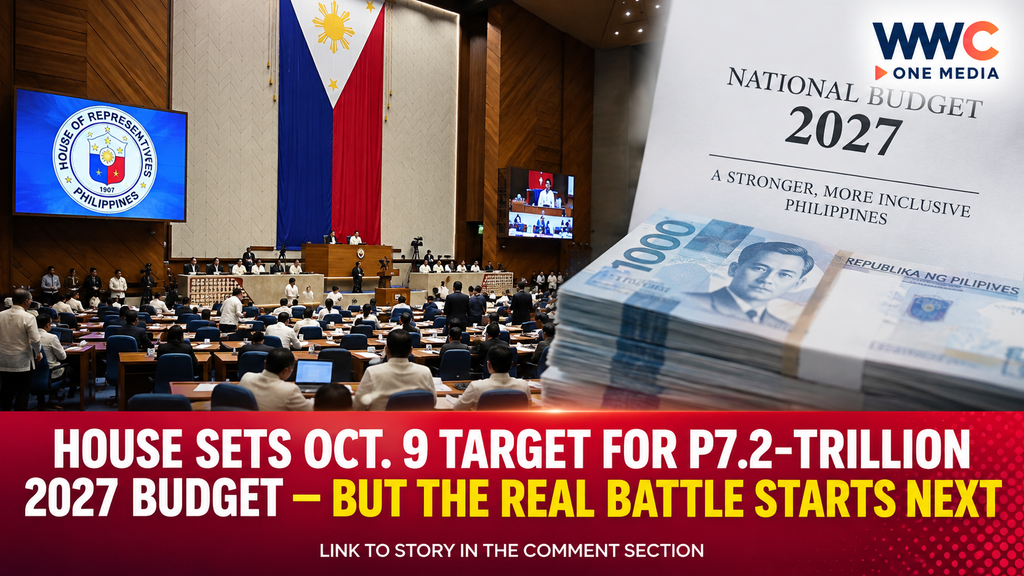
MANILA, Philippines — The House of Representatives is racing to approve the proposed P7.2-trillion national budget for 2027 by October 9, after lawmakers completed committee-level deliberations and prepare to take the spending plan to the plenary next week.
House Committee on Appropriations Vice Chair Romeo Momo Sr. said Wednesday that the committee had completed its final budget hearing on schedule, clearing the way for plenary debates on the proposed General Appropriations Bill (GAB).
Momo said the House remains on track to pass the measure on third and final reading by October 9, the end of the chamber’s current legislative calendar.
The target puts the House on a tight timetable as lawmakers begin scrutinizing how billions of pesos will be distributed among education, healthcare, infrastructure, agriculture, social protection, security and other government priorities.
Where will the P7.2 trillion go?
The proposed 2027 National Expenditure Program (NEP) is worth P7.2 trillion, about P407 billion or 6% higher than the 2026 national budget. It is equivalent to roughly 21.7% of the country’s GDP.
The Department of Budget and Management said the proposed spending plan was narrowed down from more than P11 trillion in agency funding proposals.
In other words, agencies initially requested substantially more money than what the government could accommodate, forcing budget planners to prioritize programs based on fiscal space, readiness and expected impact.
The largest sectoral allocation is for social services, with about P2.456 trillion, or 34.1% of the proposed budget.
Economic services would receive approximately P1.833 trillion, while infrastructure investments under the government’s Build Better More program are projected at P1.467 trillion.
Education remains a major priority
The proposed budget includes around P1.326 trillion for education, covering basic and higher education.
Of this amount, approximately P975.96 billion is earmarked for the Department of Education, while P176.5 billion is proposed for higher education programs.
The DBM said the education allocation is equivalent to nearly 4% of GDP and would meet the UNESCO-recommended benchmark for the second time.
Healthcare would receive approximately P353.8 billion, while around P261.7 billion is proposed for agriculture-related programs supporting farmers, fisherfolk, irrigation, agrarian reform and food security.
The proposed allocation for the Department of Social Welfare and Development is about P241.6 billion, including P99.08 billion for the Pantawid Pamilyang Pilipino Program (4Ps).
Infrastructure gets a major push
Infrastructure remains one of the government’s central spending priorities, with P1.467 trillion proposed for the Build Better More infrastructure program.
The allocation covers more than traditional roads and bridges, extending to transportation, agriculture, digital connectivity, education, health and other infrastructure projects.
The government says these investments are intended to improve connectivity, productivity and access to jobs, markets and essential services.
But the budget comes with a major fiscal challenge
Behind the headline-grabbing P7.2 trillion is another number that lawmakers and economic analysts are watching closely: the government’s debt burden.
The DBM has allocated approximately P1.143 trillion in the proposed 2027 budget for debt burden, primarily interest payments and net lending to government corporations. Interest payments alone account for about P1.114 trillion.
Broader national government debt-service expenditure, including principal amortization, is projected at approximately P2.704 trillion.
The government’s projected debt stock is also expected to reach about P21.48 trillion by the end of 2027, according to DBM figures cited by GMA News.
That fiscal pressure is particularly significant as the Philippine economy has experienced slower growth. Reuters reported that economic growth slowed to 2.3% year-on-year in the second quarter of 2026, the weakest pace since 2021, while first-half growth stood at 2.6%.
Confidential and intelligence funds also face scrutiny
The proposed 2027 budget contains about P10.773 billion in combined confidential and intelligence funds, down 8.8% from the P11.818 billion allocated under the 2026 General Appropriations Act.
The proposed amount consists of approximately P4.368 billion in confidential funds and P6.405 billion in intelligence funds.
The DBM said the allocations remain subject to existing budgeting, utilization, liquidation and auditing rules.
House deliberations enter the next stage
With committee hearings completed, lawmakers are now preparing for plenary debates, where individual departments and agencies’ proposed allocations can face closer questioning.
The House has also begun public briefings designed to explain the budget process, with discussions organized around infrastructure, education and social services under Speaker Faustino “Bojie” Dy III’s leadership.
The October 9 target, however, is not the final step.
Even if the House approves its version on third reading, the proposed budget must still undergo the Senate’s legislative process before the two chambers reconcile differences and ultimately send the final appropriations measure to the President for enactment.
The Senate has already begun scrutinizing the proposed P7.2-trillion spending plan. The Development Budget Coordination Committee presented the proposal to senators last week, marking the start of the chamber’s examination of the government’s spending priorities.
The bigger question: where will every peso go?
The proposed P7.2-trillion budget is being presented by the administration as a plan focused on people-centered growth, infrastructure, education, healthcare, food security and social protection.
But with mandatory expenditures consuming a significant portion of available fiscal space, slower economic growth and rising debt obligations, lawmakers face a difficult balancing act: approve enough spending to support growth while ensuring that public funds remain sustainable and effectively used.
For now, the House has set its target.
October 9 is the date lawmakers are racing toward — but the more consequential fight may be over which programs survive the scrutiny, which allocations change, and ultimately where the country’s P7.2 trillion will actually go.
Leave a Reply