
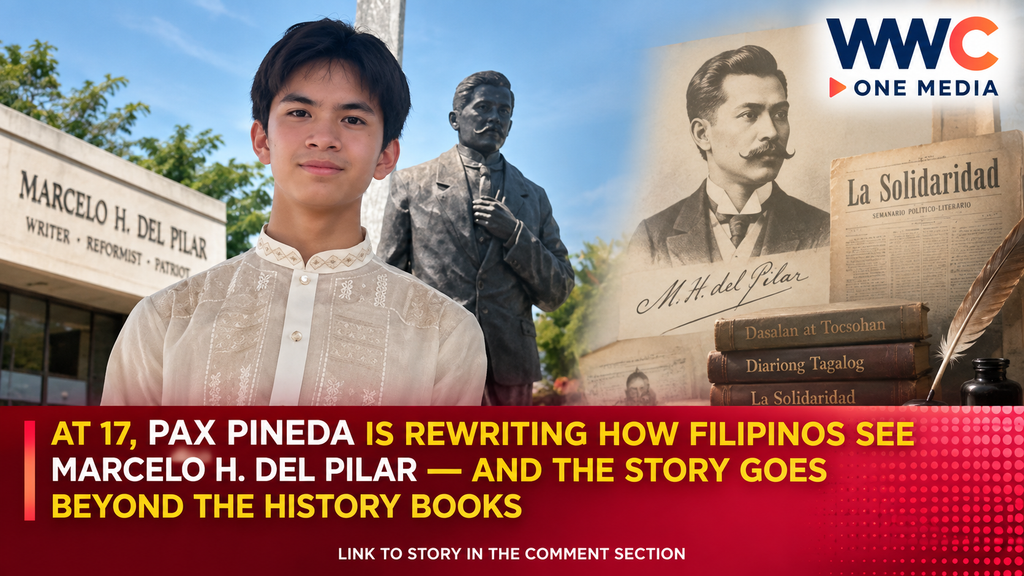
At 17, Pax Pineda Is Reframing Marcelo H. Del Pilar’s Legacy—Not Just as a Hero, But as a Father
MANILA, Philippines — What if Filipinos stopped seeing Marcelo H. Del Pilar only as the reformist, writer and Propaganda Movement leader printed in history textbooks—and started seeing the husband, father and deeply human man behind the national hero?
That is the question 17-year-old Pax Pineda, Del Pilar’s great-great-great-grandson, is asking through his debut exhibition at the Ayala Museum.
Titled “MARCELO: THE MAN BEHIND THE HERO (Reflections on the Legacy of Marcelo H. Del Pilar),” the exhibition places Del Pilar’s personal sacrifices alongside his better-known political and literary contributions. It runs from September 4 to October 18, 2026, at the Ayala Museum’s Diorama Experience Gallery and is co-presented by the museum and the National Historical Commission of the Philippines (NHCP).
A 17-year-old descendant takes a different look at a national hero
Pineda is not approaching Del Pilar simply as a student researching a figure from the past.
He is part of the family line.
The Hong Kong-based Filipino senior at ESF South Island School is Del Pilar’s direct great-great-great-grandson. Yet reports about the exhibition emphasize that Pineda sought to balance that personal connection with historical research rather than treating the exhibition simply as a family tribute.
His central idea is simple but powerful: heroes should not be reduced to dates, publications and political accomplishments.
Instead, Pineda wants audiences—particularly younger Filipinos—to understand the emotions, relationships and sacrifices behind Del Pilar’s public life.
The man behind “Plaridel”
Marcelo Hilario del Pilar, better known by his pen name Plaridel, was born in Bulacan in 1850 and became one of the most prominent Filipino voices of the reform movement against Spanish colonial rule.
He was a lawyer, journalist and writer who became heavily involved in campaigns criticizing abuses under Spanish colonial rule.
The National Commission for Culture and the Arts’ Philippine History Source Book records that Del Pilar founded Diariong Tagalog in 1882 and later continued his reform advocacy in Spain through La Solidaridad.
His role in La Solidaridad became particularly significant.
The newspaper became an important platform for Filipino reformists in Spain, advocating political and social reforms for the Philippines. Del Pilar eventually took over its editorship and used the publication to press the reform movement’s demands.
But that familiar historical narrative is only part of Pineda’s story.
Behind the revolution was a family left behind
The exhibition draws attention to the personal cost of Del Pilar’s years of activism abroad.
Among the materials presented are personal letters to his daughters, Sofia and Anita, allowing visitors to see him not simply as a political writer but as a father maintaining a relationship with his children despite the enormous distance separating them.
The exhibition also places his better-known works—including “Dasalan at Tocsohan” and La Solidaridad—alongside materials that illuminate his private life.
That contrast is at the heart of Pineda’s approach.
The historical figure known for challenging colonial authority was also a man dealing with homesickness, poverty, family separation and personal sacrifice.
A story that sounds surprisingly familiar today
Pineda’s own life abroad has also influenced how he understands his ancestor.
Growing up in Hong Kong, he sees parallels between Del Pilar’s prolonged separation from his family and the experiences of Filipinos living overseas today.
The circumstances are obviously different, but the emotional theme remains familiar: leaving home while carrying the hope of building something better for those left behind.
That connection gives the exhibition a contemporary dimension.
Instead of asking young Filipinos to memorize another list of historical facts, Pineda wants them to ask a more personal question:
What would you sacrifice for the people and country you love?
Del Pilar’s sacrifice came at a tremendous cost
Historical records show just how demanding Del Pilar’s reform campaign became.
He continued his work in Spain despite difficult financial circumstances, and La Solidaridad eventually ceased publication in 1895 after years of struggle and declining funds.
Del Pilar died in Barcelona in 1896, far from the Philippines and his family.
His life therefore carries a difficult contradiction: the man remembered for fighting for the Filipino nation spent significant portions of his final years separated from the very family he loved.
That is precisely the human dimension Pineda wants audiences to confront.
Why this matters to younger Filipinos
Pineda’s goal is not to diminish Del Pilar’s status as a historical figure.
It is almost the opposite.
By showing his vulnerabilities and sacrifices, the young curator hopes to make Del Pilar more relatable—and therefore more meaningful—to a new generation.
A teenager may struggle to connect with nineteenth-century political journalism or debates over colonial reforms.
But love for family?
Homesickness?
Being separated from people you care about?
Standing up for something you believe is right?
Those are experiences that remain recognizable across generations.
The exhibition is also part of Pineda’s own story
For Pineda, the Ayala Museum exhibition is more than an exploration of his ancestor.
It represents the beginning of his own journey into history.
He has expressed plans to study history at a university in the United States. Away from his academic interests, he is also an active football player who has competed in Hong Kong’s highest youth division.
At only 17, he is already using his family’s history to ask a question that extends far beyond Marcelo H. Del Pilar:
How do we remember the people who helped build the Philippines—and how much of their humanity have we forgotten?
THE BIGGER PICTURE
Marcelo H. Del Pilar’s historical importance is well established. He was a leading reformist, journalist and propagandist whose writings challenged aspects of Spanish colonial rule and helped articulate Filipino demands for political and social reform. Academic research has likewise recognized his importance as a communicator and journalist of the late 19th century.
What makes Pineda’s exhibition different is the perspective.
Rather than replacing the traditional story of Plaridel, it adds another layer to it:
the man behind the name.
And perhaps that is why a 17-year-old descendant is the one telling this story now.
Because sometimes, the best way to make history relevant isn’t to add more dates to a textbook.
It’s to remind people that the names printed on those pages were once living, breathing human beings who had families, fears, dreams and sacrifices of their own.
Leave a Reply