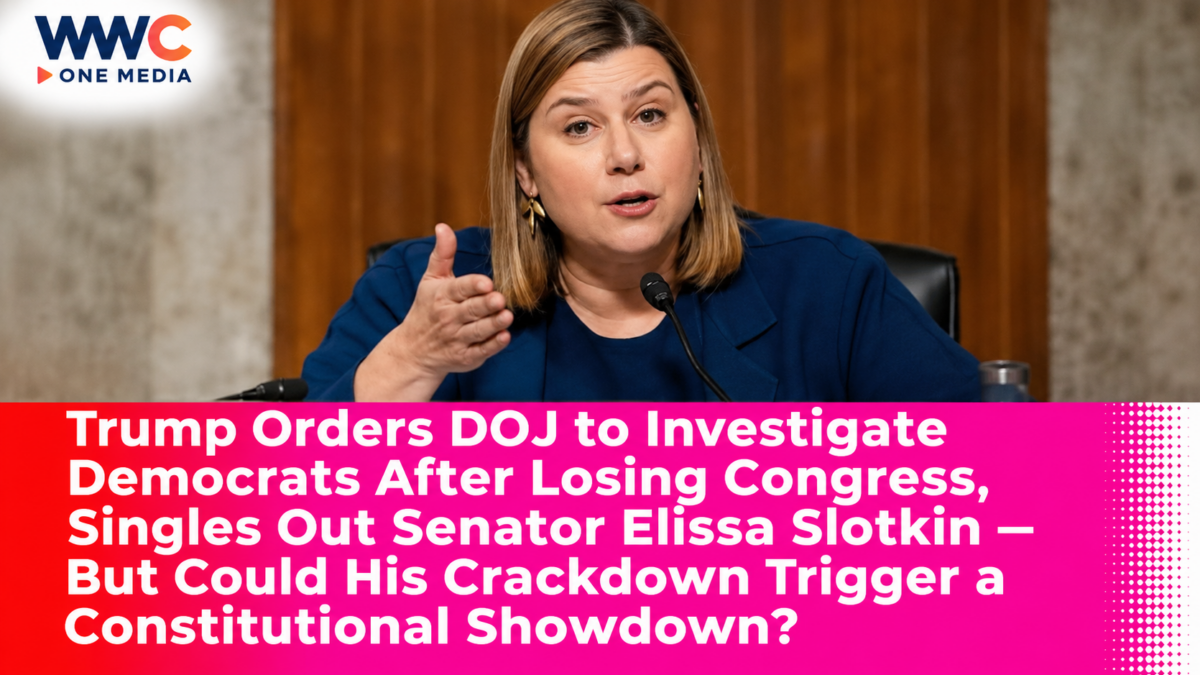
WASHINGTON, UNITED STATES — President Donald Trump has ignited a new political confrontation in Washington after publicly directing the US Department of Justice to investigate Democratic leaders over alleged threats against Republican officials, donors and supporters.
The extraordinary demand came on Saturday, November 7, just four days after Democrats secured control of both chambers of Congress in the US midterm elections.
But Trump’s latest move goes beyond another confrontation between political rivals.
The president is accusing Democrats of criminal intimidation at the very moment they are preparing to investigate his administration once they assume control of Congress in January 2027.
In a Truth Social post, Trump alleged that Democratic politicians were using threats of impeachment and other forms of punishment to intimidate administration officials and Republican supporters.
He characterized the alleged conduct as extortion and ordered the Justice Department to examine it immediately.
However, Trump did not publicly identify the specific threatening letters he referenced or provide evidence establishing that a crime had occurred.
The Justice Department had not immediately confirmed whether it would open a new investigation.
The president also singled out Michigan Democratic Senator Elissa Slotkin, reviving an earlier dispute over her comments about holding Trump administration officials accountable for alleged misconduct.
Slotkin rejected the suggestion that seeking accountability amounted to improper intimidation.
The confrontation now raises a fundamental question about the separation of powers in Washington.
Can the president direct federal prosecutors to examine opposition lawmakers for discussing investigations and impeachment—or will the dispute intensify concerns about the political independence of the Justice Department?
Trump Accuses Democrats of Threatening Republican Officials
The controversy began when Trump published a statement on Truth Social on November 7.
He accused Democratic leaders of threatening administration officials and other individuals with impeachment and punishment.
Among those he identified as alleged targets was Attorney General Todd Blanche.
Trump described the Democratic conduct as unlawful and said he was directing the Justice Department to investigate.
His accusations followed a series of statements by Democratic politicians outlining their plans for congressional oversight once the incoming majority takes office.
Democrats have discussed possible investigations into government spending, business relationships, administration policies and alleged corruption.
Some lawmakers have also raised the possibility of impeachment proceedings against senior officials.
But congressional oversight and the constitutional impeachment process are not automatically criminal acts.
Lawmakers have authority to investigate executive-branch conduct as part of Congress’s legislative and oversight responsibilities.
Whether any particular communication crosses the line into unlawful threats or extortion depends on its content, circumstances and the applicable law.
The reporting available as of November 8 does not establish that Democratic leaders committed the crimes alleged by Trump.
Why Elissa Slotkin Became Trump’s Latest Target
One of the most prominent figures in the dispute is Senator Elissa Slotkin of Michigan.
Slotkin previously worked as a CIA analyst and national security official before entering Congress.
She became a central figure in the latest controversy after comments she made during an October 13 event at the University of Chicago.
During the discussion, Slotkin argued that a future Democratic-controlled Congress should examine cases of alleged corruption involving the Trump administration.
She suggested that accountability efforts could discourage young people from accepting jobs in an administration where they feared becoming involved in improper conduct.
Her comments triggered criticism from several Republicans.
Utah Senator Mike Lee accused Slotkin of seeking to intimidate young conservatives who might want to pursue careers in public service.
Slotkin rejected that interpretation.
In an October 19 statement issued by her Senate office, she pushed back against criticism and argued that her comments had been taken out of context.
Her office also cited reporting from The Detroit News noting that the exchange did not include a call to prosecute prospective staff members simply for joining the administration.
The distinction is significant.
Slotkin’s position was that officials who violate the law should face accountability.
Her Republican critics argued that the prospect of investigations could discourage people from entering government service based on political affiliation.
The disagreement became part of the wider debate over how the incoming Democratic Congress should exercise its oversight authority.
Slotkin Pushes Back: Accountability Is Not the Same as Intimidation
Following Trump’s November 7 statement, Slotkin responded publicly.
Her central argument was that public officials who violate the law or misuse taxpayer money should be held accountable.
Those who have not committed wrongdoing, she argued, should have nothing to fear from legitimate investigations.
The response reflected her longstanding position that Congress must examine credible allegations of government misconduct.
But the issue is politically contentious.
Republicans have accused some Democrats of using the prospect of investigations to discourage support for Trump’s administration.
Democrats, meanwhile, argue that investigating possible misconduct is an essential responsibility of Congress.
Both positions must ultimately be assessed against the law and the evidence.
Legitimate investigations require identifiable purposes, lawful procedures and respect for individual rights.
At the same time, public officials cannot automatically avoid scrutiny by characterizing oversight requests as political harassment.
The conflict is therefore not simply about which party controls Congress.
It concerns the limits of presidential authority, congressional oversight and prosecutorial independence.
DOJ Previously Investigated Slotkin — But a Grand Jury Declined Charges
The latest confrontation is particularly significant because Slotkin has already faced federal investigative scrutiny.
In November 2025, Slotkin appeared in a video alongside other Democratic lawmakers with national security backgrounds.
The lawmakers reminded military and intelligence personnel of their responsibility to refuse unlawful orders.
Trump sharply criticized the video.
His administration subsequently examined whether the participating lawmakers had engaged in criminal misconduct.
However, a federal grand jury later declined to indict the lawmakers.
That outcome matters.
A grand jury’s refusal to return an indictment means the proposed charges were not approved through that proceeding.
It does not constitute a judicial declaration resolving every question about the underlying dispute.
But it also means the lawmakers were not charged through that effort.
The November 7 directive is a separate development.
There has been no verified public confirmation that a new indictment, criminal charge or formal Justice Department investigation has resulted from Trump’s latest statement.
Democrats’ Midterm Victory Changes Washington’s Balance of Power
Trump’s announcement came immediately after one of the most consequential US midterm elections in recent years.
On November 3, Democrats won control of both the House of Representatives and the Senate.
The result represented a major political setback for Trump’s Republican Party.
As previously reported by WWC ONE MEDIA in its coverage of the historic Democratic midterm victory, the election significantly changed the balance of power in Washington.
The incoming Democratic majorities will have greater authority to conduct hearings, pursue investigations and demand information from government agencies.
They will also influence legislation, federal spending and the Senate confirmation process.
However, the change is not immediate.
Republicans retain their existing congressional majorities until the new Congress convenes on January 3, 2027.
Democrats will gain their expanded committee powers when the new congressional session begins.
That timing is central to understanding the current confrontation.
Trump remains president.
But the opposition party is preparing to acquire stronger institutional tools to scrutinize his administration.
The president’s Justice Department directive adds another potential dispute before that transition occurs.
Democrats Prepare a Major Investigation of the Trump Administration
The incoming Democratic leadership has already outlined an ambitious oversight agenda.
According to Associated Press reporting, lawmakers are considering investigations involving alleged self-enrichment, government contracts, immigration enforcement and business relationships associated with Trump and his family.
Potential subjects include cryptocurrency transactions, real-estate interests, the handling of government records and the administration’s use of executive authority.
These are proposed areas of scrutiny, not findings that the president or his associates committed criminal offences.
Republicans and the White House have rejected allegations of wrongdoing and criticized the proposed investigations as potentially politically motivated.
Democrats argue that voters gave them a mandate to examine government conduct and restore accountability.
As WWC ONE MEDIA previously examined in its report on the Democrats’ five-front congressional strategy, the incoming majority could pursue oversight across federal spending, the Iran war, cryptocurrency regulation, artificial intelligence and executive-branch decision-making.
The scope could become substantial.
But Democrats must decide which investigations deserve priority.
Pursuing too many inquiries simultaneously could dilute their impact.
Concentrating on a smaller number of cases could make it easier to communicate findings to voters.
Either way, evidence and lawful procedure will determine the credibility of the investigations.
Incoming Oversight Chairman Robert Garcia Signals a Confrontational Approach
California Democratic Representative Robert Garcia is expected to assume leadership of the House Oversight Committee when the new Congress convenes.
Garcia has promised aggressive scrutiny of the Trump administration.
His statements following the midterm elections have emphasized investigating alleged corruption and examining actions taken by federal agencies.
The Washington Post reported that Garcia told potential subjects of congressional oversight to prepare for legal scrutiny.
Attorney General Todd Blanche subsequently criticized Democrats’ rhetoric during a Fox News appearance.
He argued that the incoming majority was moving too quickly toward investigations and threatened political retaliation.
These competing statements provide important context for Trump’s November 7 announcement.
Democrats say they are preparing to exercise powers granted to Congress.
Republicans say some of the rhetoric surrounding those plans has become threatening.
The central legal question is whether any conduct goes beyond ordinary political advocacy and congressional oversight.
As of November 8, no evidence presented in the reporting reviewed establishes that the alleged Democratic communications amounted to criminal extortion.
Can Trump Legally Order the Justice Department to Investigate His Political Opponents?
The president oversees the executive branch, which includes the Department of Justice.
That gives the White House substantial authority over administration policy and senior appointments.
However, federal criminal investigations must comply with applicable law and constitutional protections.
Prosecutors are responsible for determining whether evidence supports an investigation and whether criminal charges can be justified.
Political disagreement alone is not a criminal offence.
Similarly, a lawmaker’s support for impeachment or government oversight does not automatically establish unlawful intimidation.
The Constitution assigns the House of Representatives the power of impeachment and the Senate the authority to try impeachments.
Congress also has recognized oversight powers connected to its legislative responsibilities.
Those powers have limits.
Lawmakers cannot use official authority to commit crimes, and investigations must satisfy relevant legal requirements.
But criticizing government officials or demanding accountability does not become criminal simply because the executive branch considers it hostile.
The confrontation could therefore raise difficult questions if federal prosecutors pursue cases involving lawful congressional activity.
The decisive issue would be the evidence and the legal basis for any investigation.
The Justice Department Is Already Facing Intense Political Scrutiny
Trump’s latest directive arrives during a difficult period for the Justice Department.
The agency has experienced several senior leadership departures and controversy involving politically sensitive investigations.
On November 6, Jason Reding Quiñones, the US attorney overseeing a high-profile investigation into alleged misconduct by former government officials, and John Eisenberg, head of the department’s National Security Division, resigned.
Their departures intensified questions about staffing and the future of major investigations.
As WWC ONE MEDIA reported in its coverage of the Justice Department leadership changes, the resignations occurred as the department was confronting internal disagreements and increasing political scrutiny.
Those departures are separate from Trump’s November 7 directive.
There is no established evidence that the resignations were caused by the dispute involving Slotkin or Democrats’ impeachment plans.
But the developments contribute to uncertainty about the department’s leadership and priorities.
For Attorney General Blanche, the challenge is overseeing federal law enforcement while facing pressure from an administration and Congress that increasingly disagree about the department’s role.
Could Democrats Investigate the DOJ Investigation Itself?
The confrontation has created the possibility of a broader oversight dispute.
Once Democrats assume control of congressional committees, they could seek information about Justice Department decisions involving political figures.
Such inquiries might examine how investigations were initiated, what evidence supported them and whether established procedures were followed.
But no specific congressional investigation into Trump’s November 7 directive has been formally established in the reporting reviewed.
The possibility remains a political and legal scenario.
A committee seeking documents from the Justice Department could encounter disputes involving executive privilege, confidentiality or law-enforcement sensitivities.
Those disagreements can lead to negotiations or litigation.
They do not automatically establish wrongdoing by either branch.
Still, the situation could become significant if the department formally pursues an investigation involving lawmakers who are simultaneously preparing to scrutinize the administration.
That would create a highly contentious relationship between the executive and legislative branches.
The Final Weeks of Republican Congressional Control Could Become Critical
Democrats’ victory means Republicans are approaching the end of their current congressional majorities.
The transition creates a limited period during which Republican leaders may attempt to advance priorities before control changes.
As WWC ONE MEDIA reported in its analysis of the Republicans’ remaining legislative window, lawmakers face difficult decisions involving spending, defence and other major policies before January 2027.
The political environment could become even more confrontational if disputes over Justice Department investigations escalate.
But the president’s constitutional powers will not disappear when Democrats take control of Congress.
Trump will retain authority to veto legislation and exercise executive responsibilities.
Democrats, meanwhile, will gain expanded oversight powers and greater influence over the legislative process.
Neither side will be able to exercise unlimited authority.
That balance could produce compromise, prolonged gridlock or repeated disputes over the limits of government power.
What Does Trump’s Accusation of Extortion Actually Mean?
Extortion is a serious legal allegation.
Federal criminal law contains different provisions addressing threats, coercion and attempts to obtain money or other benefits through unlawful conduct.
However, the precise elements depend on the statute involved.
A demand for documents from a congressional committee does not automatically qualify as extortion.
Neither does discussing impeachment or promising to investigate alleged misconduct.
For a criminal case to succeed, prosecutors would need evidence satisfying the elements of a specific offence.
That could require proof of unlawful threats, prohibited objectives or other circumstances defined by the applicable statute.
Trump’s characterization of Democratic conduct as extortion is therefore an allegation.
It is not equivalent to a prosecutor establishing probable cause, a grand jury returning an indictment or a court entering a conviction.
The distinction is essential for accurate reporting.
Readers should not confuse a president’s public accusation with a verified criminal finding.
Could the Confrontation Influence the 2028 Presidential Election?
Although the 2028 election remains two years away, the current dispute may influence the political environment leading into that campaign.
Democrats are attempting to demonstrate that their congressional victory can produce meaningful oversight.
Republicans are seeking to portray the incoming majority as focused on political retaliation rather than economic concerns.
Both parties face risks.
Democrats could lose public support if investigations appear excessive or disconnected from voters’ priorities.
Republicans could face criticism if the Justice Department is perceived as being used to pursue political opponents without adequate evidence.
Public confidence may depend on whether political leaders respect the distinction between lawful accountability and partisan retaliation.
The outcome could shape attitudes toward congressional oversight, presidential authority and the federal justice system.
But its electoral impact cannot be reliably predicted at this stage.
What Happens Next?
Several developments will determine whether the dispute becomes a major legal confrontation.
The first is whether the Justice Department confirms that it has opened a formal investigation following Trump’s directive.
The second is whether the administration identifies the allegedly threatening communications and specifies which laws may have been violated.
The third is whether Democrats proceed with their planned oversight activities after taking control of Congress in January.
The fourth is how lawmakers, prosecutors and courts respond if conflicts arise over investigative authority.
Slotkin’s role will remain closely watched because she has already been the subject of an earlier unsuccessful attempt to secure a grand jury indictment.
For now, the most important confirmed development is Trump’s public instruction to the Justice Department.
The existence of a new criminal case has not been established.
The Bottom Line: Trump’s DOJ Directive Opens a New Chapter in Washington’s Political Battle
President Donald Trump has escalated his confrontation with Democrats after their sweeping November 3 midterm victory.
On November 7, he publicly directed the Justice Department to investigate Democratic leaders whom he accused of threatening Republican officials and supporters.
He also singled out Senator Elissa Slotkin, reviving a controversy over her remarks about investigating alleged government misconduct.
Slotkin has defended her position as support for lawful accountability.
Reuters, CNBC and The Washington Post reported that Trump did not provide evidence substantiating his broad criminal accusations.
The Justice Department did not immediately confirm a new investigation.
The political stakes are nevertheless substantial.
Democrats are preparing to assume control of both chambers of Congress in January 2027.
They have promised greater scrutiny of the administration.
Trump remains president and retains significant executive authority.
The result could be an extended confrontation over congressional investigations, prosecutorial independence and the constitutional separation of powers.
For voters, the central question is whether both branches of government can perform their lawful responsibilities without turning political disagreement into unsupported criminal accusations.
And as Trump demands a Justice Department investigation of Democrats preparing to investigate his own administration, one question now hangs over Washington: Will the confrontation produce evidence of genuine wrongdoing—or could it become a defining battle over who has the power to hold America’s most powerful officials accountable?