NEW YORK / SAN FRANCISCO / MANILA — November 8, 2026 | WWC ONE MEDIA | Global Business, Artificial Intelligence, Entrepreneurship and Employment
A new generation of entrepreneurs is challenging one of the oldest rules of business: to build a bigger company, you must hire more people.
Across the United States, founders are using artificial intelligence to perform tasks that previously required employees, freelancers or expensive professional services.
From bookkeeping and advertising to product photography, customer service and business strategy, AI tools are allowing some entrepreneurs to operate multiple businesses without maintaining a traditional workforce.
And the results are attracting attention.
Alex Willen, an American entrepreneur operating 12 e-commerce brands without employees, expects his businesses to generate between $2.5 million and $3 million in revenue during 2026.
Meanwhile, Kristin Ginn, a former Microsoft employee who launched an AI consulting business in March, has secured approximately $250,000 in received or contracted business through the end of the year without hiring employees or regular contractors.
Their experiences were highlighted in a November 7 CNBC report examining how artificial intelligence is reshaping America’s smallest businesses.
The individual success stories coincide with a remarkable shift in business applications.
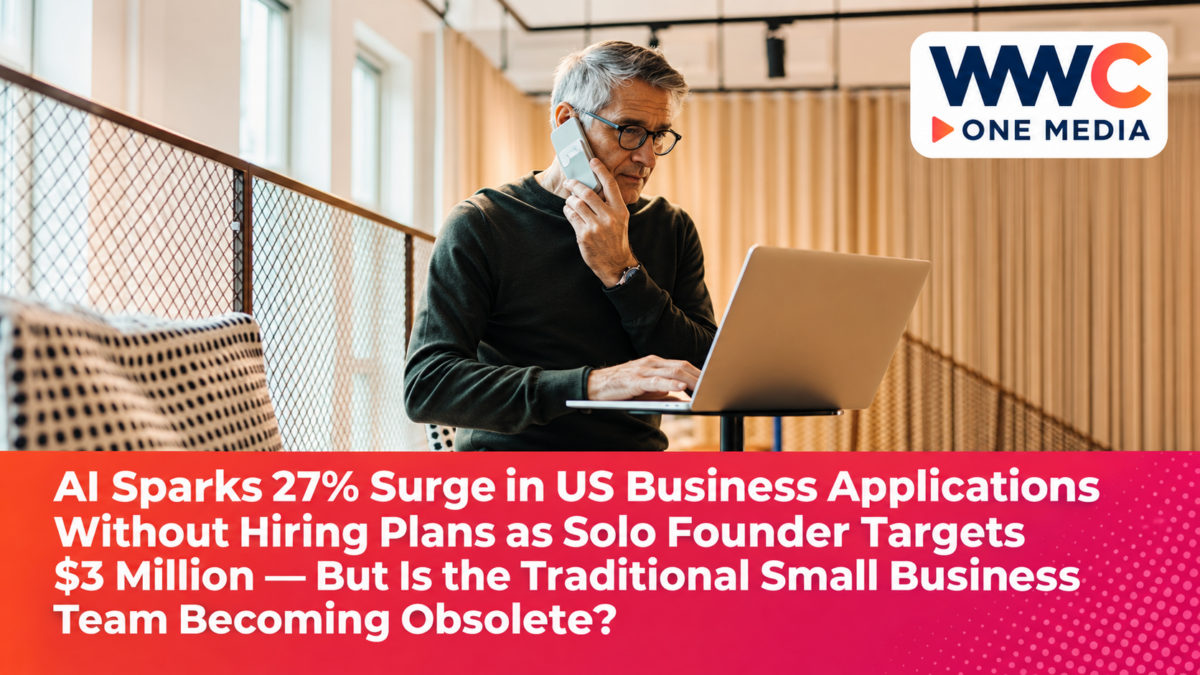
Preliminary research by economist Liya Palagashvili of George Mason University’s Mercatus Center found that applications without early indications of hiring increased 26.8% in industries highly exposed to artificial intelligence between the first quarters of 2024 and 2026.
During the same period, applications more likely to become employers declined 6.4% in those industries.
The findings suggest that technology may be changing how entrepreneurs launch and expand businesses.
But they do not establish that AI alone caused the shift.
And the implications extend beyond startup founders.
If individuals can generate millions of dollars in sales while using AI to perform work previously handled by employees, could the next entrepreneurial boom create more businesses but fewer traditional job opportunities?
No Employees, 12 Businesses and Up to $3 Million in Projected Revenue
Willen’s experience offers a striking example of how AI can change the economics of entrepreneurship.
He operates 12 e-commerce brands without maintaining a payroll workforce.
His businesses sell products through online marketplaces and independent websites.
The entrepreneur expects combined revenue of approximately $2.5 million to $3 million in 2026.
But that figure is a projection, not verified year-end revenue.
It is also important to distinguish revenue from profit.
A company generating $3 million in sales may still face significant expenses involving inventory, manufacturing, shipping, advertising, software and marketplace fees.
The amount the owner ultimately earns could be substantially lower.
Nevertheless, Willen’s business model illustrates how automation can reduce the number of people required to manage multiple operations.
He uses Anthropic’s Claude for activities including bookkeeping, customer service, advertising and inventory-related work.
He also uses OpenAI image-generation tools to produce visual materials for product listings.
Tasks that traditionally required a photographer, designer or administrative worker can now be completed or assisted by software.
According to Willen, a traditional product photography session could cost approximately $2,000 to $5,000.
Professional design work for new listing images could add another $300 to $1,000.
Those estimates describe his business experience, not universal industry prices.
By reducing the need for some external services, he can retain more revenue or redirect money toward other priorities.
However, AI-generated images and advertisements still require appropriate quality control, product accuracy and compliance with marketplace rules.
How AI Helped Transform a Small E-Commerce Brand
One of Willen’s examples involves Lone Trail, a business selling outdoor accessories.
When he acquired the brand, its Shopify website generated only a small portion of sales.
He initially considered whether maintaining the independent website was worthwhile.
Instead, he used AI tools to rebuild the online store and support advertising campaigns.
According to Willen, the Shopify channel originally accounted for approximately 1% of sales.
During a recent 30-day period, its share reportedly increased to approximately 30%.
The change suggests that AI-supported website development and marketing can create opportunities for entrepreneurs with limited resources.
But the figures come from the owner’s account.
They are not independently audited financial results.
The example also should not be interpreted as proof that any small business can achieve similar growth simply by subscribing to an AI service.
Product demand, marketing strategy, customer experience and competition remain important.
AI may make certain work less expensive, but it does not guarantee that customers will purchase a company’s products.
Former Microsoft Employee Builds an AI Consultancy Without Staff
Another example involves Kristin Ginn.
Ginn left Microsoft in March 2026 to establish trnsfrmAItn, a consulting company helping organizations adopt artificial intelligence.
Within approximately seven months, she secured around $250,000 in business received or contracted through year-end.
She operates without employees or regular contractors.
Her company uses AI to assist with proposals, pricing, strategic planning and other business functions.
She is also examining whether AI agents can take over parts of labor-intensive client processes.
An AI agent is a software system designed to perform multiple steps toward a defined task, sometimes interacting with tools or other digital systems.
Such systems may reduce repetitive administrative work.
But they also require oversight, especially when handling sensitive business information or making decisions with financial consequences.
For Ginn, AI allows a small organization to deliver services that might previously have required a larger team.
Her example highlights an important change.
Entrepreneurs may be able to launch businesses with access to sophisticated capabilities before they can afford to hire specialists.
However, her $250,000 figure includes contracted work, not necessarily cash already collected or net profit.
New Business Applications Without Hiring Signals Rise 26.8%
The individual examples are supported by an emerging trend in US business-formation data.
Economist Liya Palagashvili analyzed Census-based business applications in industries with significant potential exposure to AI.
She found that quarterly applications without early indications of future payroll employment increased from approximately 222,000 in the first quarter of 2024 to 281,000 in the first quarter of 2026.
That represents an increase of approximately 26.8%.
By contrast, applications in the same industries showing stronger indications of becoming employer businesses declined 6.4%.
In a comparison group covering construction and wholesale trade, applications without early hiring signals declined approximately 0.4%.
The difference is noteworthy.
Industries where AI can automate administrative, analytical or digital tasks appear to be experiencing a greater increase in business applications associated with potentially non-employer operations.
But the evidence has limits.
A business application is not the same as a company that has begun trading.
Some applicants never launch an operating business.
Others may eventually hire employees.
The Census-based measure identifies characteristics associated with likely hiring plans; it does not confirm the eventual employment status of each enterprise.
The 26.8% increase therefore describes a category of business applications, not a verified 26.8% increase in successful zero-employee companies.
Palagashvili also cautioned that the findings are preliminary and descriptive.
They do not prove that AI caused the increase.
AI Is Changing the Cost of Starting a Business
Historically, entrepreneurs often needed significant resources to launch a professional operation.
A business might require a designer to create marketing materials, a bookkeeper to manage accounts and administrative support to handle routine customer inquiries.
A more sophisticated venture could also need software developers, researchers and marketing specialists.
Those expenses created barriers for people with limited starting capital.
AI is reducing some of those barriers.
Today, an entrepreneur may use different tools to draft marketing copy, analyze sales information, organize customer requests and prepare business documents.
These systems do not eliminate every operating expense.
They may also produce inaccurate information.
But they can reduce the time and cost associated with some administrative and creative tasks.
That creates an opportunity for founders who previously lacked the money to establish a traditional team.
The result could be more small businesses competing in markets once dominated by larger organizations.
However, having access to technology does not automatically create a competitive advantage.
As more businesses adopt similar tools, differentiating products and attracting customers may become increasingly difficult.
Stanford Economist Warns of a Major Change in Company Structure
Stanford economist Erik Brynjolfsson believes the implications extend beyond individual productivity.
AI can allow people to complete a much broader range of work without relying on the traditional organizational structures used by businesses.
That could encourage the creation of more small, specialized producers.
But Brynjolfsson also sees the possibility of greater concentration among large technology companies.
Major platforms provide the infrastructure, software and distribution channels used by smaller businesses.
As more entrepreneurs depend on those systems, the platforms themselves may become increasingly powerful.
This creates a potential divide.
At one end are small businesses using AI to operate with limited staff.
At the other are enormous companies benefiting from computing infrastructure, customer networks and global distribution.
Medium-sized businesses may find themselves in a difficult position if they lack the flexibility of a solo founder and the resources of a technology giant.
Brynjolfsson and researcher Zoë Hitzig discussed related economic possibilities in their September research on AI and the use of knowledge within organizations.
Their analysis suggests that AI could alter the way information is managed and decisions are made across companies.
But the long-term effects remain uncertain.
The potential restructuring of business organizations is a research-based scenario, not an established prediction that medium-sized companies will disappear.
The Hidden Catch: Solo Founders Still Depend on Big Tech
Operating without employees does not necessarily mean operating independently.
Willen uses AI tools from major technology providers.
He also relies heavily on Amazon to distribute products.
According to CNBC, approximately 80% of his overall revenue still comes through Amazon.
Ginn, meanwhile, identifies LinkedIn as an important source of customers for her consulting business.
These arrangements create a different form of dependence.
A company may avoid hiring additional staff but remain vulnerable to changes in marketplace rules, advertising costs, platform access or software pricing.
If a major platform changes its algorithms, raises fees or suspends an account, a small business could experience a significant disruption.
AI can reduce certain operating expenses.
But it does not eliminate the importance of distribution, customer relationships and business continuity.
For entrepreneurs, one of the most important challenges may be building a business that can survive changes in the platforms it uses.
FreshBooks Survey Shows Entrepreneurs Are Trying AI Before Hiring
CNBC also cited survey findings from accounting and invoicing company FreshBooks.
According to the reported results, 79% of surveyed solopreneurs said they had tried AI before hiring someone for a task they could not perform themselves.
The proportion reached 86% when microbusiness owners were included.
Those figures suggest that many entrepreneurs are actively using AI as an alternative to immediately purchasing professional services or adding workers.
But the results should be interpreted within the context of the survey.
They do not establish that 79% of all American business owners have stopped hiring.
Nor do they demonstrate that AI can perform every specialized business function at a professional standard.
A sole proprietor may use AI to prepare a first draft of a document while still consulting a qualified accountant, lawyer or other specialist when necessary.
The technology may reduce routine workload without completely replacing professional judgment.
Other Research Finds AI-Adopting Businesses Are Hiring More
The most important counterpoint comes from payroll and human resources company Gusto.
Its September 2026 research reached a different conclusion about existing small businesses.
Gusto examined companies that adopted AI and compared their employment growth with similar businesses that were aware of AI but had not adopted it.
The study found that AI-adopting firms increased headcount by approximately 7% more than comparable non-adopters during the following year.
Among businesses with fewer than 10 employees, the difference was approximately 10%.
This suggests that AI may support hiring in some companies rather than simply replacing workers.
The explanation is straightforward.
If AI makes a business more productive, it may become profitable to expand operations.
A restaurant could use AI to reduce administrative workload, then hire additional kitchen or customer-service staff.
A healthcare practice could automate scheduling and paperwork, allowing it to employ more professionals who provide direct patient care.
A small manufacturer might improve planning and use the savings to increase production.
However, Gusto’s findings are observational and based on its customer data.
They do not prove that AI caused every additional hire.
The evidence also covers existing businesses, which differ from the new solo enterprises discussed in CNBC’s report.
Both trends can be true: AI may help some founders start without employees while enabling other businesses to expand their workforces.
AWS Reports Faster Revenue Growth at AI-Native Startups
Amazon Web Services has published research pointing to the commercial potential of businesses built around AI from the beginning.
Its June 2026 Engines of Growth report examined more than 3,400 startup founders and senior leaders across 20 countries.
According to AWS, AI-native startups reported average annual revenue growth of approximately 156%, compared with 65% for startups overall.
The study also found that 55% of AI-native startups generated more than $400,000 in revenue per employee.
These findings indicate that some young companies are using AI to support substantial output with relatively lean teams.
However, the research is based on a defined group of surveyed startups.
The reported average growth rates should not be interpreted as forecasts for every new AI company.
The revenue-per-employee figure also does not mean that all AI-native startups generate $400,000 per worker.
The results illustrate what may be possible for certain businesses, not a guaranteed formula for success.
AI Could Transform Employment Without Eliminating Every Job
The broader employment implications are complicated.
Some tasks previously assigned to junior employees or outside contractors may become cheaper to perform with AI.
That could reduce demand for certain types of routine work.
At the same time, lower operating costs may make new products and businesses financially viable.
Those ventures could generate demand for marketing, logistics, customer support, technical services and other work.
The final employment effect will depend on how quickly companies adopt the technology and whether productivity gains lead to additional economic activity.
A business with no employees may still purchase services from contractors, manufacturers, delivery companies and online platforms.
Likewise, a company using AI can continue employing people in roles that require physical work, specialized expertise or personal interaction.
The distinction between task automation and complete job elimination is crucial.
AI may automate part of an occupation without replacing every responsibility performed by a worker.
Why This Matters for Philippine MSMEs
The implications are highly relevant to Philippine micro, small and medium enterprises.
Many Filipino entrepreneurs operate with limited capital and small teams.
They often manage marketing, customer inquiries, inventory and accounting themselves.
AI tools could help reduce the administrative burden.
As WWC ONE MEDIA reported on AI adoption among Philippine small businesses, local enterprises are exploring technology that can improve customer service, pricing, marketing and daily operations.
But the potential benefits come with risks.
Business owners need to protect customer information and verify AI-generated outputs.
They must also consider subscription expenses, cybersecurity and the reliability of automated processes.
A tool that produces inaccurate financial records or misleading advertising could create problems rather than savings.
For Filipino entrepreneurs, AI should therefore be treated as a business capability requiring proper oversight—not a guaranteed replacement for employees or professional advisers.
Filipino Online Sellers Are Already Learning to Operate More Efficiently
The rise of e-commerce provides another point of comparison.
Online marketplaces allow small sellers to reach customers without opening multiple physical stores.
Digital marketing tools help entrepreneurs promote products to audiences across the country.
As WWC ONE MEDIA reported on Shopee’s expanding affiliate-driven sales, creator-led commerce is becoming an important opportunity for Philippine MSMEs.
AI could make it easier for those sellers to prepare promotional material, organize product information and analyze marketing performance.
But the technology does not eliminate logistical expenses or competition.
Entrepreneurs still need reliable suppliers, suitable products, affordable shipping and effective customer service.
The experiences of American solo founders demonstrate possibilities, not guaranteed results for Filipino online sellers.
UnionBank Is Training Filipino Entrepreneurs to Use AI
Philippine financial institutions are also supporting business owners who want to improve their digital capabilities.
As WWC ONE MEDIA reported on UnionBank’s BOOSTcamp entrepreneurship program, the bank trained 27 entrepreneurs representing 24 businesses.
The six-week program covered AI, digital marketing, financial management and business development.
Initiatives like this reflect the growing importance of combining technology with practical business skills.
A small business owner may understand how to use an AI chatbot but still need guidance on customer acquisition, pricing and financial planning.
The ability to generate content quickly does not automatically create profitable sales.
Training remains essential to turn technology adoption into measurable business improvements.
Women Entrepreneurs in Siargao Are Using AI to Expand Digital Opportunities
AI adoption is not limited to major cities or technology startups.
As WWC ONE MEDIA reported on women entrepreneurs in Siargao, international development initiatives have supported the use of AI-enabled tools for business advice and digital marketing.
An International Labour Organization-supported chatbot has helped women entrepreneurs access technical guidance and develop promotional content.
The initiative illustrates how digital tools may help overcome barriers involving distance and access to specialized services.
For entrepreneurs in remote communities, obtaining business advice can involve significant time and travel expenses.
Digital assistance may make certain resources easier to access.
However, the success of such programs still depends on internet connectivity, digital literacy and the relevance of the information provided.
AI can make business support more accessible, but reliable training and human assistance remain important.
Can AI Replace the Traditional Startup Team?
The answer depends on the business.
A digital consultant may be able to automate a substantial portion of research, proposals and scheduling.
An online retailer may reduce dependence on outside designers or administrative workers.
But a restaurant still needs people to prepare and serve food.
A construction company requires physical labor, technical expertise and site supervision.
A healthcare business needs qualified professionals to deliver patient care.
Even in digital businesses, founders may eventually need employees as demand expands.
AI can reduce the workload associated with starting a company, but it does not guarantee that every organization can operate indefinitely without staff.
The more realistic development is that some companies may be able to achieve greater scale before making their first hire.
That could change how entrepreneurs budget, invest and organize work.
Three Possible Outcomes for the AI-Powered Entrepreneurship Boom
Scenario 1: More entrepreneurs launch profitable businesses with smaller teams.
Lower startup costs could allow individuals to enter markets that previously required significant investment in staff or professional services.
Scenario 2: Established small businesses use AI to hire more workers.
Productivity gains could help companies expand sales and create additional employment opportunities, consistent with Gusto’s findings.
Scenario 3: Market power becomes more concentrated among digital platforms.
More entrepreneurs could depend on a small number of AI providers, marketplaces and advertising platforms, increasing the influence of those companies.
These scenarios are not mutually exclusive.
Different industries may experience all three at the same time.
The Bigger Question: Will AI Create More Entrepreneurs but Fewer Traditional Jobs?
Artificial intelligence is changing what it means to start a business.
A founder can now access software capable of assisting with financial administration, marketing, customer service and content production.
Those capabilities can reduce the need for early hiring and make entrepreneurship more accessible.
The numbers suggest that something important is happening.
Business applications without early hiring signals increased 26.8% in AI-exposed industries between early 2024 and early 2026.
Alex Willen expects his 12 online brands to produce up to $3 million in combined annual revenue without employees.
Kristin Ginn has built a consulting business with approximately $250,000 in received or contracted work without establishing a traditional staff.
But the broader picture is more complicated.
Gusto’s research suggests that existing businesses adopting AI may actually expand employment faster.
AWS finds that AI-native startups are reporting strong revenue growth with leaner organizations.
And economists warn that the concentration of technological power among major platforms could become an increasingly important issue.
The evidence does not show that AI has made employees obsolete. It suggests that technology is changing when businesses need to hire, what work people perform and how companies compete.
For entrepreneurs, the opportunity is to build more with fewer resources.
For employees, the challenge is preparing for a labor market in which some routine tasks are increasingly automated.
And for governments, the responsibility is ensuring that technological progress supports broader economic opportunity.
As the next generation of AI-powered businesses emerges, one question could define the future of entrepreneurship:
Will artificial intelligence unleash a historic wave of independent business owners who can compete with corporate giants—or could the rise of million-dollar, zero-employee startups reshape the job market in ways workers and policymakers are not yet prepared to confront?