WASHINGTON, D.C. / MANILA, PHILIPPINES — November 7, 2026 | WWC ONE MEDIA | Artificial Intelligence, US Politics, Energy, Environment and Global Technology Investments
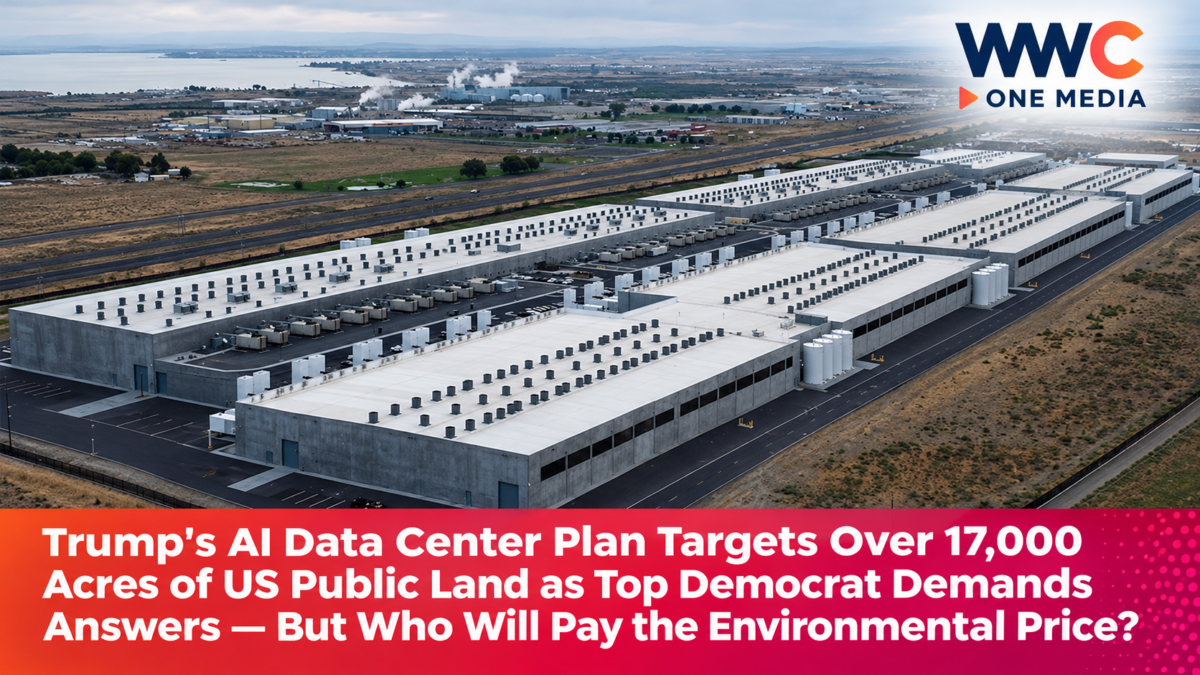
President Donald Trump’s aggressive push to accelerate artificial intelligence development is facing growing congressional resistance after a senior Democratic senator demanded answers about plans to use thousands of acres of federally owned land for massive data centers.
US Senator Martin Heinrich of New Mexico has challenged the administration over at least 15 proposed data-center and infrastructure developments involving more than 17,000 acres of public land across six Western states.
The proposals could affect parts of Arizona, Idaho, Nevada, Oregon, Utah and Wyoming.
In a formal letter dated November 6, 2026, Heinrich pressed Bureau of Land Management Director Steve Pearce to explain the legal basis for the projects, identify the companies behind them and disclose which federal lands are being considered.
The demand comes amid intensifying concerns over the electricity requirements, water consumption, environmental consequences and public accountability associated with America’s rapidly expanding artificial intelligence industry.
The controversy is particularly sensitive because an earlier data-center project on federal land near Boulder City, Nevada, was temporarily halted after an appeals board raised serious questions about the adequacy of its environmental review.
For the Trump administration, accelerated construction is part of a national strategy to preserve America’s technological advantage over China.
For critics, the rush threatens to prioritize corporate infrastructure needs over the interests of nearby communities and the multiple public uses of federally managed land.
And for investors, the political backlash introduces another potential obstacle to an industry already struggling with enormous financing requirements and constraints on electricity supply.
As the administration attempts to turn federal land into a foundation for the next generation of AI infrastructure, a critical question is emerging: Can the United States expand its computing power without compromising public-land protections—or could the rush to build create a major legal and political confrontation?
Senator Martin Heinrich Demands Answers From Trump’s Interior Department
The immediate controversy centers on a November 6 letter from Senator Martin Heinrich to Bureau of Land Management Director Steve Pearce.
Heinrich is the senior Democrat on the Senate Energy and Natural Resources Committee.
Following Democrats’ success in the November 3 midterm elections, he is positioned to assume the committee’s chairmanship when the new Congress convenes in January 2027.
That prospective role gives his inquiry considerable political significance.
The committee oversees federal energy policy, public-land management and other issues directly connected to the administration’s AI infrastructure plans.
In his letter, Heinrich expressed strong opposition to the prospect of constructing privately operated data centers on federally managed land.
He questioned whether the agency was properly considering public access, environmental responsibilities and the interests of communities near proposed developments.
Rather than asking only for a general policy explanation, Heinrich demanded detailed information about individual projects.
His questions concern the specific companies involved, land areas under consideration, environmental review requirements and opportunities for public comment.
He gave the agency until November 20, 2026, to respond.
The letter is a congressional oversight request, not a court order or a completed investigation finding wrongdoing.
At Least 15 Data Center Proposals Cover More Than 17,000 Acres
The scale of the administration’s plans is attracting attention.
According to Bloomberg’s November 6 report, the Bureau of Land Management is reportedly considering at least 15 proposals for data centers or associated infrastructure involving more than 17,000 acres of federal land.
The proposals stretch across six Western states:
- Arizona
- Idaho
- Nevada
- Oregon
- Utah
- Wyoming
The land could be used for various purposes associated with data centers, including computing facilities, electrical transmission lines, access roads and other infrastructure.
This distinction is important.
The total acreage does not mean every acre would be occupied by buildings containing AI servers.
Nor does it mean all the proposals have received final government approval.
The administration is considering developments that could collectively require a substantial amount of land.
The uncertainty over the exact locations and project details is one reason lawmakers are demanding more information.
Trump’s 2025 Executive Order Opened the Door to Public-Land Data Centers
The policy originates partly from an executive order signed by Trump on July 23, 2025.
Executive Order 14318, titled Accelerating Federal Permitting of Data Center Infrastructure, directed federal agencies to facilitate faster development of major AI computing facilities and supporting infrastructure.
The order identifies advanced computing as a priority for American technological and economic leadership.
It also encourages the use of suitable federal lands for data-center development.
The administration argues that the United States must expand its computing capacity quickly to compete with China and other international rivals.
Large-scale AI development requires specialized processors, advanced networking systems and enormous amounts of electricity.
The White House wants to remove unnecessary regulatory delays that could postpone these investments.
The order also addresses financing support, streamlined environmental reviews and the role of federal agencies in identifying suitable locations.
However, the executive order states that implementation must remain consistent with applicable law.
It does not automatically eliminate environmental protections or authorize every proposed project.
That distinction is central to the current controversy.
Nevada’s Townsite Data Center Became the First Major Legal Test
One project has already demonstrated the risks of accelerated approval.
In June 2026, the Bureau of Land Management approved a proposed data center near Boulder City, Nevada.
The development involved roughly 88 acres of federally managed land.
The land had previously been associated with authorization for a solar energy and battery-storage project.
The developer sought to amend the existing right-of-way grant to accommodate a data center.
But Boulder City officials and environmental organizations challenged the decision.
They argued that the new use was substantially different from the original solar project and required an updated environmental assessment.
On September 1, the Interior Board of Land Appeals granted a stay, temporarily halting the authorization while the challenge proceeded.
The board concluded that the challengers had demonstrated substantial grounds for questioning the agency’s environmental review.
This was not a final ruling permanently prohibiting all future development at the site.
It was a temporary administrative intervention.
Nevertheless, the case has become an important warning about the legal difficulties facing efforts to approve data centers under existing permits prepared for different projects.
Why Environmental Reviews Matter
The National Environmental Policy Act, commonly known as NEPA, is a central element of federal environmental decision-making.
It requires federal agencies to consider environmental consequences when undertaking specified major actions.
Depending on the proposed development and applicable requirements, that process may involve an environmental assessment or a more detailed environmental impact statement.
Environmental review can help identify effects on wildlife, water supplies, nearby communities, recreation and other uses of land.
It can also provide opportunities for public participation.
The Nevada dispute concerned whether the Bureau of Land Management had adequately considered the changed circumstances when converting authorization for a solar project into permission for a data center.
The Interior Board of Land Appeals questioned the agency’s reliance on the earlier environmental analysis.
The dispute illustrates a basic legal principle.
A federal agency may seek to accelerate development, but it must still operate within the requirements of environmental law.
For developers, insufficient review can create the risk of delays, appeals and additional project expenses.
For communities, environmental review provides a mechanism for raising concerns before construction proceeds.
The Trump Administration Defends Its Approval Process
The Interior Department has defended its approach.
In response to Bloomberg, a department spokesperson said applications involving public lands continue to follow established environmental-review procedures.
The department maintains that proposed projects receive careful evaluation and that the process includes opportunities for public participation.
Officials say they are focused on balancing economic development with the protection of natural resources and community interests.
The administration’s argument is that America cannot afford years of unnecessary delay while other countries rapidly expand AI infrastructure.
Faster permitting, from this perspective, could support investment, employment and national security.
But critics are questioning whether the promised safeguards are consistently applied.
The Nevada administrative stay demonstrates why those concerns cannot simply be dismissed.
At the same time, one disputed project does not establish that every proposal under consideration has violated environmental law.
Each project will require assessment according to its own location, impacts and legal circumstances.
Three More Democratic Senators Demand Transparency
Heinrich is not the only lawmaker raising objections.
On October 29 and 30, Senators Ron Wyden and Jeff Merkley of Oregon and Alex Padilla of California demanded answers from Interior Secretary Doug Burgum.
The senators questioned the department’s dealings with data-center developers and investors.
They cited reports that Burgum had held repeated meetings with representatives of the industry.
Their letter sought additional information about how the administration was identifying public land for development.
The senators also asked whether officials had adequately consulted local communities and tribal governments.
They requested a response by November 16.
Their inquiry is distinct from Heinrich’s November 6 letter.
However, the two efforts demonstrate an increasingly coordinated Democratic push for transparency concerning the administration’s AI infrastructure policy.
Both inquiries raise questions about the use of public assets, environmental responsibilities and the decision-making process behind large technology projects.
Interior Secretary Doug Burgum Faces Questions About Industry Relationships
Burgum has played a prominent role in the administration’s push to expand data-center infrastructure.
As interior secretary, he oversees a department responsible for substantial areas of federal land.
An investigation published by ProPublica on November 6 examined Burgum’s financial exposure to the AI industry and his meetings with technology companies.
The report identified substantial investments in businesses linked to AI development.
It also described meetings involving representatives of companies such as Amazon, Microsoft and Alphabet.
Such relationships raise potential questions about conflicts of interest and disclosure.
However, ownership of investments or meetings with industry representatives do not automatically establish corruption or an unlawful decision.
Determining whether any conflict violates applicable ethics rules requires examining the official’s financial interests, duties, disclosures and relevant legal requirements.
The senators are seeking greater transparency so that those relationships can be evaluated.
The information requested could help clarify whether particular companies received unusual treatment during the consideration of public-land projects.
American Voters Are Increasingly Opposing Data Centers
The political controversy is unfolding just days after the November 3 US midterm elections.
Data-center development became a significant local campaign issue as communities raised concerns about electricity prices, water supplies, noise and tax incentives.
Reuters reported on November 6 that opposition to data centers gained considerable support in the elections.
The Associated Press also documented numerous successful candidates and ballot measures favoring tighter restrictions on development.
Although the exact counts vary depending on the tracking methodology and which measures are included, the overall trend is clear.
A growing number of communities want greater control over where large computing facilities are built.
WWC ONE MEDIA previously examined that backlash in America Rejects AI Data Centers in 46 of 47 Local Votes as Big Tech Faces a Massive Backlash — But Could the Trillion-Dollar AI Boom Be in Danger?.
That reporting highlighted how local concerns are becoming a major obstacle for developers.
The November 6 Senate inquiry shows that the debate is now extending directly into federal public-land management.
The AI Data Center Fight Is Becoming a Political Problem for Trump
Trump has made AI infrastructure expansion an important part of his economic strategy.
He argues that the United States must maintain its technological leadership while rivals increase computing investment.
But some voters who otherwise support his economic agenda have become concerned about the local consequences of large data-center developments.
Electricity costs are among the most sensitive issues.
Residents worry that utilities may need to build expensive power infrastructure to supply new facilities.
Those costs could potentially influence household electricity bills, depending on how utilities and regulators allocate them.
Water consumption and changes to local land use have also generated opposition.
WWC ONE MEDIA explored the political problem in Trump Is Betting Big on AI Data Centers — But His Own Voters Could Turn Them Into a GOP Midterm Nightmare.
The article described the tension between national AI ambitions and community concerns.
The current public-land dispute adds another challenge.
Unlike projects developed entirely on private property, federal-land proposals involve assets managed on behalf of the American public.
That creates additional questions about access, environmental protection and the appropriate use of government-controlled resources.
Could Data Centers Drive Electricity Prices Higher?
AI data centers are extremely power-intensive facilities.
They require large clusters of processors, servers and networking equipment.
The computing hardware must operate alongside cooling systems and other equipment needed to maintain performance.
Large projects can require hundreds of megawatts of electrical capacity.
Connecting such facilities to the grid may require new substations, transmission lines and generating resources.
Those investments can be expensive.
The central policy question is how the costs should be allocated.
If infrastructure is developed primarily to serve a particular data-center customer, regulators may consider whether that customer should pay a significant share of the costs.
If costs are distributed across the wider electricity system, households and other businesses could face higher bills.
But data centers do not necessarily increase electricity prices by the same amount in every location.
The effect depends on existing supply, grid capacity, electricity contracts, utility regulation and the structure of local markets.
WWC ONE MEDIA previously examined the issue in AI Data Centers Are Setting Off Alarms in Washington — And Now Congress Is Moving on the Power Bill.
That report covered efforts to protect electricity customers from being unfairly charged for infrastructure needed by large computing facilities.
The federal-land controversy adds another question: should the availability of government-managed land influence where those facilities are allowed to expand?
Water Consumption and Western States’ Environmental Risks
Electricity is not the only concern.
Many data centers use water in cooling systems, although requirements vary depending on technology and facility design.
Western states already face water-management challenges involving drought, agriculture, municipal consumption and environmental protection.
A new computing facility could increase demand for local water resources.
But the size of that impact depends on the facility’s cooling technology, climate, operational practices and access to alternative water sources.
Some operators use air cooling, recycled water or other methods designed to reduce freshwater consumption.
Consequently, it would be misleading to claim that every proposed data center will consume the same amount of water.
The relevant question is whether environmental assessments provide enough information for communities to understand the likely effects.
Heinrich’s request for details about the locations and purposes of proposed developments could help make those evaluations possible.
Why Public-Land Development Raises Special Questions
Federal public lands serve multiple purposes.
They may support wildlife habitats, recreation, grazing, cultural activities, conservation and certain forms of economic development.
The Bureau of Land Management operates under a framework that requires consideration of multiple uses and long-term resource stewardship.
That means a proposed data center must be evaluated alongside other potential uses of the land.
A project offering economic benefits may also create costs for people who rely on the area for recreation or other activities.
There are also questions about access roads, transmission lines, construction equipment and long-term changes to landscapes.
Supporters of development argue that carefully selected locations could help expand America’s digital infrastructure without displacing residential neighborhoods.
Critics counter that the public should have a meaningful opportunity to determine whether such projects belong on federal lands at all.
Both considerations are relevant.
The policy challenge is determining which projects, if any, satisfy legal requirements and offer benefits sufficient to justify their impacts.
The AI Investment Boom Is Already Facing Financial Pressure
The political dispute comes during a difficult period for AI infrastructure investors.
Technology shares have experienced substantial volatility as markets reassess the costs and financial returns of data-center expansion.
Specialized cloud companies have faced questions about debt, construction delays and electricity availability.
Some developers depend on significant borrowing to purchase computing equipment and build facilities.
If projects encounter lengthy permitting disputes, financing costs can increase.
The resulting delays can also postpone the revenue expected from customer contracts.
WWC ONE MEDIA examined these pressures in Bank of America Predicts $2.1 Trillion AI Data Center Explosion by 2028 — But Could a Global Power Shortage Bring the Entire Boom Crashing Down?.
The report discussed projected investment growth and the infrastructure constraints that could prevent some developments from proceeding on schedule.
The current congressional inquiry creates another uncertainty for developers considering federal-land sites.
Even if a project appears attractive economically, legal challenges and political opposition can affect its timetable.
Could Federal Public Lands Become an AI Construction Shortcut?
The administration’s strategy partly reflects the difficulty of finding suitable locations for large computing facilities.
Developers need land with access to electricity, communications networks and transport infrastructure.
They also need permission to construct facilities and connect them to local utilities.
Federal property may appear attractive because a single government agency controls significant areas of land.
But public ownership does not eliminate competing uses or environmental obligations.
It can also create additional requirements involving federal environmental review and public consultation.
The Nevada dispute demonstrates the consequences of treating a new data-center project as equivalent to a previously approved development with a different purpose.
A solar facility and a data center may have very different infrastructure requirements and effects on surrounding communities.
Federal agencies must determine whether existing approvals adequately cover those differences.
If they do not, additional review may be necessary.
The speed of development will therefore depend not simply on executive policy but on the legality and quality of individual permitting decisions.
Trump Previously Suggested Paying Communities to Accept Data Centers
The administration has also explored ways to address public opposition.
In October, Trump proposed that technology companies provide financial benefits to communities hosting data centers.
The idea was that residents might become more supportive if they received compensation or other economic advantages.
WWC ONE MEDIA covered the proposal in Trump Tells Big Tech to Pay Americans for Hosting AI Data Centers — But Who Will Really Foot the Electricity Bill?.
Potential benefits could include local investment, infrastructure improvements or other community arrangements.
But financial compensation would not automatically resolve every concern.
Residents may still object to land use, water demand or environmental impacts.
Public-land development presents an additional complexity because federally managed land may be used by people who do not live immediately beside a proposed facility.
Determining whose interests should be represented can therefore be challenging.
The debate concerns not only whether communities receive economic benefits, but also who has authority to decide how public resources are used.
What the November 20 Deadline Could Reveal
Heinrich’s letter asks BLM to provide detailed information by November 20, 2026.
The requested material could clarify the number and nature of proposed developments.
It may also reveal the companies backing specific projects, the land areas involved and the environmental-review procedures planned.
That information would help lawmakers assess whether existing federal requirements are being followed.
It could also help communities determine whether proposed infrastructure would affect nearby land and resources.
But the deadline does not guarantee that the agency will provide every requested document or that Congress will immediately launch formal investigations.
The response will depend on the department’s handling of the inquiry and any subsequent oversight decisions.
Heinrich’s position as a prospective committee chairman increases the political significance of the request.
The incoming Congress could choose to examine public-land data-center approvals more closely.
However, the precise direction of that oversight remains to be determined.
What the Controversy Means for Philippine AI Infrastructure
The debate has relevance beyond the United States.
Countries across Asia are also evaluating how to attract investment in data centers while managing energy costs and environmental resources.
The Philippines has opportunities to expand digital infrastructure supporting cloud computing, artificial intelligence and business services.
But developers need reliable electricity, suitable locations, telecommunications connectivity and predictable regulatory processes.
The American dispute illustrates the importance of considering those requirements before approving major projects.
Access to land alone is not enough.
Projects must be financially viable and compatible with the needs of nearby communities.
The Philippines operates under different property, environmental and regulatory laws, so the US public-land controversy does not directly determine Philippine policy.
Nevertheless, the underlying questions about energy infrastructure, water availability, environmental review and public consultation are relevant to local planning.
There is no confirmed Philippine project directly affected by Heinrich’s November 6 letter.
Its significance is as a warning about the political and environmental difficulties that can accompany rapid AI infrastructure expansion.
The Bigger Question: Can America Build AI Infrastructure Without Sacrificing Public Accountability?
The United States is attempting to expand its artificial intelligence capabilities at extraordinary speed.
Trump’s administration views data centers as essential infrastructure for economic growth, technological competitiveness and national security.
But the rush to build has generated growing resistance among residents, environmental groups and lawmakers.
At least 15 proposals involving more than 17,000 acres of federal land are now under scrutiny.
The controversy has intensified following a Nevada administrative decision temporarily halting one of the first major data-center projects approved on BLM land.
Senator Martin Heinrich wants the government to disclose the legal authority, developers, locations and review procedures behind the wider expansion effort.
Other Democratic senators have raised related questions about Interior Secretary Doug Burgum’s involvement.
The Interior Department maintains that proposed developments are subject to established environmental review and public participation requirements.
The coming weeks could help determine whether that explanation satisfies lawmakers and affected communities.
For technology companies, the outcome could influence how quickly future facilities are authorized.
For investors, it adds uncertainty to already expensive infrastructure plans.
And for the public, it raises an important question about the management of land owned by the federal government.
As Trump’s administration considers more than 17,000 acres of public land for AI data centers while a top Democratic senator demands transparency, one question could define America’s next technological battle: Will federal lands help the United States accelerate its AI ambitions—or could environmental disputes, rising electricity costs and congressional resistance turn the expansion into a costly political and legal showdown?