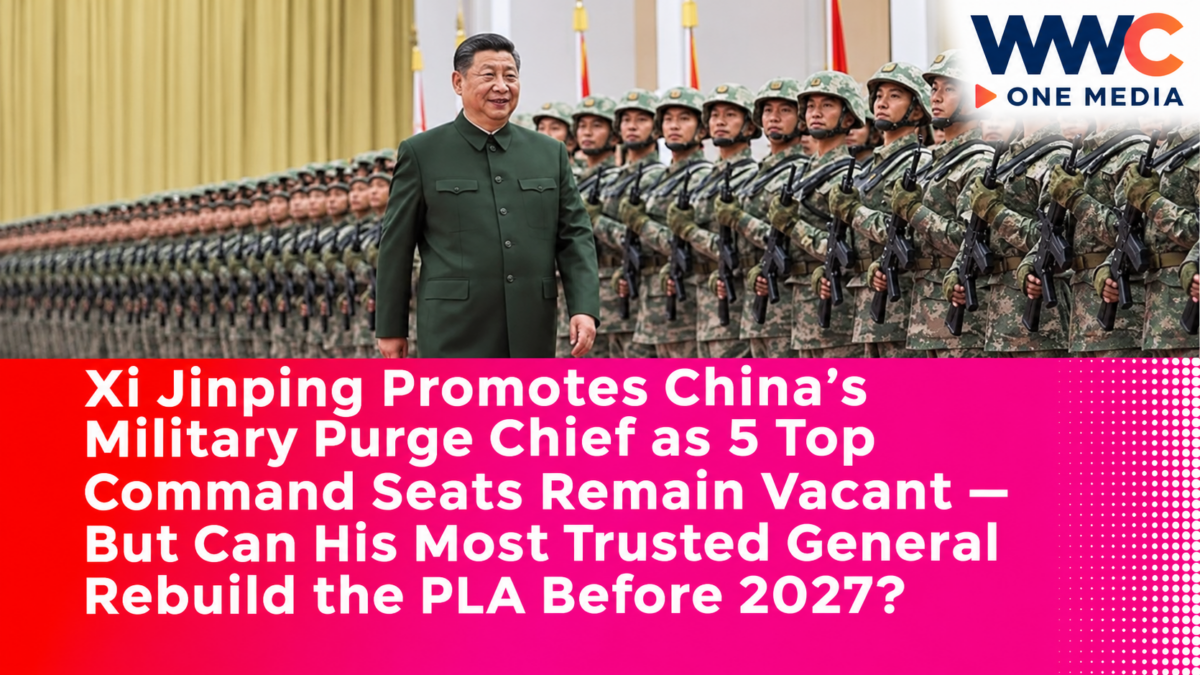
BEIJING, CHINA / MANILA, PHILIPPINES — November 7, 2026 | WWC ONE MEDIA | World Politics, China Military, Indo-Pacific Security and Global Affairs
Chinese President Xi Jinping has elevated the general who helped oversee one of the most sweeping military purges in modern Chinese history, placing a trusted anti-corruption enforcer at the center of efforts to rebuild the country’s depleted military leadership.
General Zhang Shengmin, 68, has been promoted to the Communist Party’s powerful Politburo, giving him a stronger political position as Xi prepares to appoint a new generation of senior commanders.
The move comes at an extraordinary moment for China’s People’s Liberation Army (PLA).
Of the seven officials who originally occupied China’s Central Military Commission following the 2022 Communist Party Congress, only Xi and Zhang remain.
The others have been removed amid investigations and disciplinary proceedings that have shaken the military establishment.
According to Bloomberg’s November 6 analysis, Xi Taps Military ‘Hatchet Man’ to Rebuild China’s Army Command, Zhang is now positioned to influence the selection and assessment of officers who could fill vacant senior posts.
The appointments will be particularly important ahead of the PLA’s 100th anniversary in August 2027 and the Communist Party’s leadership reshuffle later that year.
But Xi faces a difficult contradiction.
His campaign has strengthened the leadership’s ability to enforce political discipline while removing experienced officers responsible for commanding the armed forces.
That raises questions about military continuity, professional expertise and China’s ability to carry out complex operations.
As Zhang moves from overseeing military investigations to helping rebuild the command structure, the central question is whether Xi can create a more disciplined and effective fighting force—or whether the crackdown has weakened the very institution he is trying to strengthen.
Xi Elevates Zhang Shengmin to China’s Powerful Politburo
Zhang’s promotion was announced on October 29 following a major four-day Communist Party meeting in Beijing.
The gathering, known as the Fifth Plenum of the party’s 20th Central Committee, focused on strengthening party discipline, governance and anti-corruption measures.
The Communist Party elected Zhang to the Politburo, making him the body’s only military representative.
His elevation was particularly unusual because Politburo membership is typically determined during the party’s national congress, held every five years.
According to AFP and the South China Morning Post, the appointment was the first promotion of this kind outside a party congress since 1994.
The decision gives Zhang greater standing within the Communist Party’s political leadership.
It also places him in a stronger position to help shape the future of China’s military hierarchy.
However, membership in the Politburo does not mean Zhang has replaced Xi as commander-in-chief.
Xi remains chairman of the Central Military Commission and retains ultimate authority over China’s armed forces.
Who Is General Zhang Shengmin?
Zhang Shengmin has spent much of his career working within China’s military political and disciplinary institutions.
He joined the People’s Liberation Army in 1978 at the age of 19.
Trained as an artillery officer, Zhang eventually advanced through positions involving political supervision and military discipline.
His prominence increased after Xi intensified efforts to combat corruption throughout the armed forces.
From 2017 until July 2026, Zhang led the Central Military Commission’s principal anti-corruption watchdog.
During that period, numerous senior officers were investigated, dismissed or subjected to disciplinary proceedings.
Zhang became vice chairman of the Central Military Commission in 2025.
His latest Politburo appointment further consolidates his position.
Analysts interviewed by AFP described Zhang as someone whose political loyalty and long-standing disciplinary responsibilities appear to have earned Xi’s confidence.
But Zhang’s professional background differs from that of several commanders removed during the purges.
His career has been closely associated with oversight and political discipline rather than operational command of major military formations.
That distinction may matter as China attempts to rebuild a leadership team capable of directing sophisticated military operations.
China’s Seven-Member Military Command Has Shrunk to Two
The Central Military Commission is China’s highest military decision-making body.
It oversees the armed forces and plays a central role in military policy, senior appointments and strategic direction.
The commission’s leadership lineup appointed in 2022 originally contained seven officials.
Following successive removals, only Xi and Zhang remain from that lineup.
The departures include some of China’s most senior and influential generals.
Former CMC vice chairman Zhang Youxia was among those removed during the crackdown.
Liu Zhenli, formerly a senior figure responsible for joint military operations, also lost his position.
Beijing accused removed officers of serious disciplinary violations and other misconduct.
Those are official allegations and disciplinary findings reported by Chinese authorities; the public evidence does not independently establish every accusation or the full circumstances of each removal.
The scale of the disruption is difficult to ignore.
WWC ONE MEDIA previously examined the leadership crisis in China’s Military Purges Raise Questions Over PLA War-Fighting Readiness as Xi Tightens Control.
That report discussed how senior-level vacancies could complicate military planning while Beijing continues developing advanced weapons systems and conducting regional operations.
The critical issue now is rebuilding a credible chain of command.
Why Xi Removed So Many Senior Generals
Xi’s campaign is officially presented as an effort to eliminate corruption and reinforce Communist Party control over the military.
Chinese authorities have identified misconduct involving military procurement, promotions and the misuse of official positions.
The government argues that corruption damages military effectiveness and weakens national security.
From that perspective, removing compromised officers is necessary to develop a more disciplined force.
But outside analysts have also raised questions about political loyalty.
Some dismissed officials held influential positions within the military establishment, making their removal significant beyond the specific disciplinary accusations.
The extraordinary scale of the crackdown has prompted debate about whether Xi is primarily eliminating corruption, removing potentially disloyal networks or pursuing both objectives.
These explanations are not mutually exclusive.
However, analysts cannot independently establish Xi’s private motives from the personnel changes alone.
What is clear is that the campaign has transformed the PLA’s senior leadership.
Zhang Shengmin Is Now Expected to Help Rebuild the Top Command
Zhang’s appointment comes as Beijing faces the challenge of selecting replacements for numerous senior positions.
The task goes beyond filling seats on the Central Military Commission.
China also needs a functioning hierarchy across its military services, theater commands and central departments.
A new generation of commanders must be capable of coordinating ground forces, air operations, naval activity, missile systems and increasingly complex information networks.
Zhang’s experience investigating senior officers could make him influential in assessing candidates’ political reliability.
But professional qualifications will also matter.
Commanders need operational expertise, familiarity with advanced military technology and the ability to make decisions under pressure.
Analysts have warned that promoting officers primarily because of their loyalty could create long-term weaknesses.
Others argue that removing corrupt networks could eventually improve discipline and institutional performance.
The outcome will depend heavily on the quality of the replacements.
The July 2026 Appointments Revealed How the Rebuilding Is Progressing
Xi has already begun installing new military leaders.
In July, he promoted Zhang Shuguang and Wang Gang to the rank of general.
Zhang Shuguang became head of the Central Military Commission’s discipline inspection organization, replacing Zhang Shengmin in that role.
Wang Gang was identified as commander of the PLA Air Force.
Reuters reported that the appointments formed part of efforts to replenish military leadership following years of investigations.
The changes also demonstrate that China’s anti-corruption campaign has not ended with Zhang Shengmin’s promotion.
Instead, responsibility for enforcing discipline has passed to another senior officer.
Zhang Shengmin can now exercise broader political influence while the watchdog institution continues functioning under new leadership.
But a number of senior military appointments remained unsettled.
Channel News Asia reported in August that several important positions appeared to be occupied by acting or lower-ranking officers whose appointments had not been publicly confirmed.
That suggests China’s military reconstruction is occurring gradually rather than through a single sweeping replacement.
Could China’s Military Purges Damage Combat Readiness?
This is one of the most important questions facing Xi.
The PLA has invested heavily in modernizing its capabilities.
Its development programs include advanced naval vessels, military aircraft, missile systems, cyber capabilities and increasingly sophisticated command-and-control technologies.
But effective military operations require more than equipment.
Senior commanders must coordinate different branches of the armed forces, interpret intelligence and make decisions during rapidly changing situations.
Removing experienced officers can disrupt established relationships and institutional knowledge.
Uncertainty about appointments may also complicate planning and decision-making.
Research by the Center for Strategic and International Studies has highlighted the extraordinary scale of leadership turnover.
Its analysis indicates that the purges have affected a substantial portion of China’s senior military officer corps.
However, the removal of top commanders does not establish that the entire PLA has become incapable of carrying out operations.
China’s theater commands, military services and other organizational structures remain active.
The question is whether the disruption has reduced the armed forces’ effectiveness in the most complex circumstances.
Taiwan’s Security Is Central to the 2027 Debate
The leadership changes have attracted particular attention because of Beijing’s military modernization goals.
Xi has identified 2027 as an important milestone in the development of the PLA.
The date coincides with the 100th anniversary of the armed forces.
US officials have previously assessed that Xi wants the military to have stronger capabilities for a potential operation involving Taiwan by that time.
But 2027 is not a confirmed deadline for a Chinese invasion.
The distinction is essential.
Developing military readiness does not mean Beijing has decided to launch an attack on a particular date.
WWC ONE MEDIA previously explored the issue in US Officials Say Chinese Invasion of Taiwan Before 2028 Increasingly Unlikely.
That report discussed assessments suggesting leadership disruption and military preparedness could influence Beijing’s calculations.
A large-scale operation against Taiwan would involve substantial logistical and operational challenges.
It would require coordination among naval, air, missile, ground and support forces.
A stable and experienced senior command structure would be important in directing such an operation.
However, outside observers cannot determine the PLA’s actual combat readiness simply by counting vacant leadership seats.
China Continues Military Operations Despite Leadership Turmoil
The PLA has not stopped operating during the crackdown.
Chinese military units continue training, conducting exercises and maintaining a presence in strategically contested areas.
This includes operations near Taiwan and in the South China Sea.
For example, Chinese naval and air forces carried out a joint exercise around Scarborough Shoal in September.
WWC ONE MEDIA covered the operation in China Holds Naval and Air Drills Around Disputed Scarborough Shoal in South China Sea.
The activity involved Chinese units operating near waters claimed by both Beijing and Manila.
China presents these exercises as legitimate activities protecting its territorial claims.
The Philippines disputes China’s expansive claims and continues asserting its maritime rights.
The exercises demonstrate that China’s operational military institutions remain active despite the personnel upheaval.
But routine exercises do not establish that the PLA could successfully conduct a much larger and more complex military campaign.
Zhang’s Promotion Also Strengthens China’s Military Diplomacy
Zhang is not only becoming more influential within China’s domestic political structure.
He is also representing Beijing in international military engagements.
On November 3, just days after his Politburo appointment, Zhang met Russian Defense Minister Andrei Belousov in Beijing.
Reuters reported that the two discussed strengthening strategic communication and military cooperation.
Zhang described closer China-Russia defense relations as important to their broader strategic partnership.
The meeting was his first publicly reported engagement with a foreign defense minister after his Politburo elevation.
It demonstrates that Zhang’s responsibilities extend beyond anti-corruption investigations.
He is participating in high-level diplomacy involving one of China’s most important strategic partners.
However, the meeting does not establish that China and Russia concluded a new mutual-defense treaty or announced a specific military operation.
Its verified significance lies in the continuation of senior-level defense contacts.
China’s Military Leadership Crisis Matters to the Philippines
The rebuilding of China’s military command has direct relevance to the Indo-Pacific.
The Philippines faces continuing maritime disputes with China involving contested features and surrounding waters in the South China Sea.
Changes in Beijing’s military leadership could influence strategic priorities, operational oversight and military diplomacy.
But any specific effect on Chinese activities near Philippine waters remains uncertain.
A leadership purge in Beijing does not automatically mean Chinese forces will withdraw from disputed areas.
Nor does it establish that China is preparing an imminent confrontation.
For Manila, the practical concern is maintaining maritime awareness, strengthening defense capabilities and avoiding dangerous incidents.
WWC ONE MEDIA previously examined Philippine military modernization in Philippines Is No Longer a Military Weakling — But Is Its Armed Forces Buildup Moving Fast Enough?.
The article discussed Manila’s efforts to improve maritime security, surveillance and external defense.
China’s personnel upheaval adds another factor for regional security planners to assess.
However, the Philippines must plan according to observable military capabilities and activities rather than assumptions about instability inside Beijing’s leadership.
Xi’s 2027 Political Reshuffle Raises the Stakes
China is preparing for another major Communist Party Congress in 2027.
The congress is expected to involve senior leadership decisions across the party and military.
Xi is widely expected by analysts to seek another term as Communist Party leader.
Zhang’s October promotion places him in a stronger position ahead of that process.
The timing is especially significant because the military leadership must be rebuilt while China continues pursuing major modernization objectives.
Xi faces several interconnected choices.
He needs to replace removed generals, preserve political discipline and ensure that new commanders possess sufficient professional expertise.
At the same time, he must maintain continuity across China’s military institutions.
The next appointments may reveal whether Beijing is prioritizing experienced operational commanders, politically trusted disciplinary officials or a combination of both.
Until those appointments are formally announced, predicting the final composition of the leadership would be premature.
The Risk of Replacing Experience With Political Loyalty
The most difficult question concerns the balance between military professionalism and political control.
Xi has repeatedly emphasized that the PLA must remain loyal to the Communist Party.
That principle has long been central to China’s political system.
However, modern military operations require specialized expertise and a command environment where officers can communicate realistic assessments.
Analysts caution that an atmosphere of intense political scrutiny may discourage officers from reporting mistakes or challenging unrealistic expectations.
If commanders become reluctant to communicate unfavorable information, senior leaders could receive incomplete assessments of military capabilities.
The opposite argument is that removing corruption and patronage networks may allow more qualified officers to advance.
Both possibilities need to be considered.
The outcome will depend on whether future commanders are selected for competence as well as reliability—and whether institutional reforms improve military performance.
Could Xi’s Crackdown Produce a Stronger PLA?
China’s leadership argues that stronger discipline is essential to military modernization.
Corrupt procurement practices can waste resources and undermine equipment quality.
Improper promotion systems can place unsuitable officers in important positions.
Eliminating those problems could improve organizational effectiveness.
But the process of removing senior commanders also carries costs.
Training replacements requires time.
Building effective relationships between commanders and their subordinates takes experience.
Coordinating different military branches becomes more difficult when the senior hierarchy is unsettled.
Beijing’s challenge is therefore not simply removing compromised officials.
It must create a command structure capable of making difficult decisions and managing complex operations.
Zhang’s promotion demonstrates that Xi trusts him with a central role in that process.
Whether the choice ultimately improves combat readiness remains unproven.
The Bigger Question: Can Xi Rebuild China’s Military Before 2027?
China is approaching a critical period in its military and political development.
The PLA’s centenary arrives in August 2027.
The Communist Party’s next leadership reshuffle is also expected that year.
Meanwhile, the Central Military Commission has been reduced to Xi and Zhang Shengmin following a sweeping campaign against senior officials.
Zhang now holds a powerful position in the Politburo and may become an important figure in evaluating candidates for the military’s next leadership generation.
For Xi, the appointment offers an opportunity to rebuild the armed forces around officials he considers dependable.
For military analysts, it raises questions about whether a command structure reshaped through extensive purges can retain the experience necessary for effective operations.
For Taiwan, the Philippines and other regional governments, the consequences could influence the future security environment.
But neither a stronger PLA nor an imminent military crisis can be inferred from the promotion alone.
The real test will be the quality of China’s future appointments, the continuity of its operational command and its ability to carry out military objectives without further leadership disruption.
As Xi Jinping promotes his longtime military anti-corruption enforcer to the Politburo while five seats in the original seven-member military commission remain vacant, one question could define China’s next chapter: Will Zhang Shengmin help rebuild a more disciplined and formidable PLA before the 2027 centenary—or could the sweeping purge leave Beijing struggling to restore the military experience and command stability it needs most?