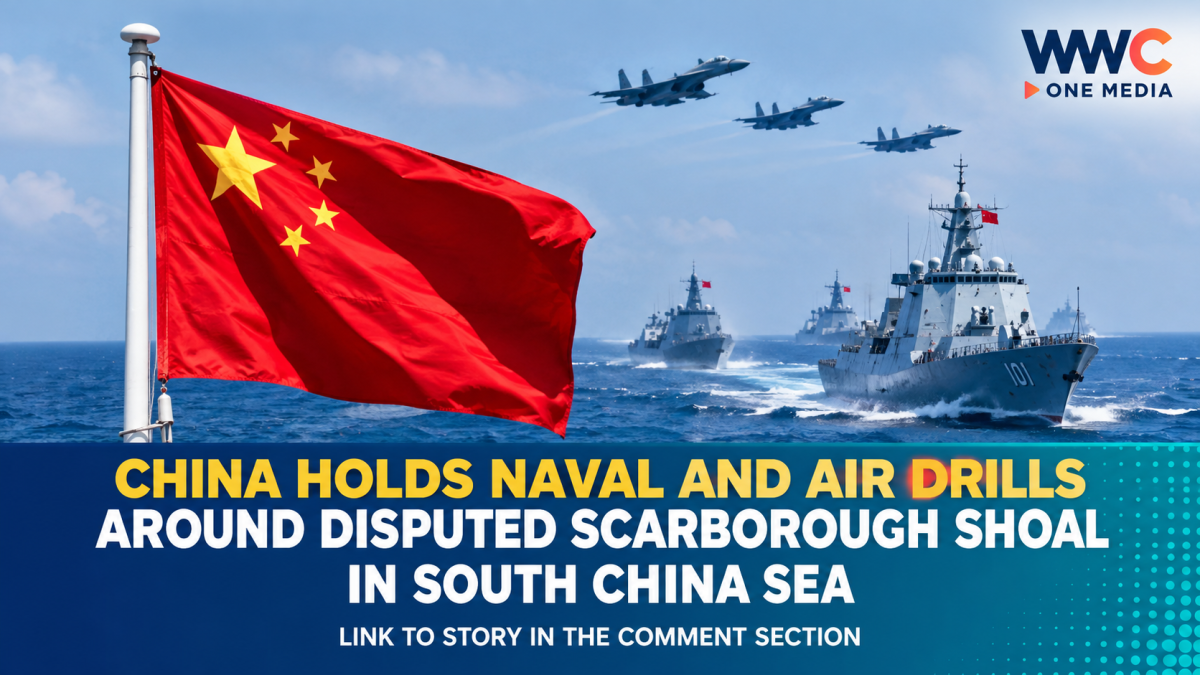
China’s military conducted a joint naval and air exercise around the disputed Scarborough Shoal in the South China Sea on Sept. 27, adding to tensions in waters claimed by both China and the Philippines.
The exercise was carried out by naval and air units of the People’s Liberation Army Southern Theater Command in the waters and airspace around the shoal, which China calls Huangyan Dao and the Philippines refers to as Bajo de Masinloc.
China’s military said the drills focused on reconnaissance and early warning, rapid maneuvering, joint search-and-rescue operations and coordination between naval and air forces. The command said the exercise was intended to test and strengthen its ability to protect what Beijing describes as its territorial sovereignty and maritime rights.
The exercise also involved various aircraft, including early-warning and reconnaissance aircraft and unmanned aerial vehicles, as well as naval vessels including the guided-missile frigate Yulin and supply ship Qinghaihu. A search-and-rescue scenario was conducted during the exercise.
China described the operation as a response to actions by unspecified countries that it said had undermined regional peace and stability. Beijing did not identify a specific incident in its announcement.
The China Coast Guard conducted separate drills around the shoal on the same day, focusing on maritime law-enforcement activities including boarding and inspection, preventing intrusions and forced towing.
The Scarborough Shoal is one of the most sensitive flashpoints in the South China Sea. China claims sovereignty over the feature, while the Philippines also asserts a claim. The area is located within the broader maritime zone that Manila says falls under its rights under international law.
The latest exercise comes amid increased Chinese and Philippine maritime activity in the region. On Sept. 27, the Philippine Coast Guard said it deployed an aircraft and the BRP Teresa Magbanua after monitoring a China Coast Guard vessel northwest of Cabra Island, Occidental Mindoro. The Philippine agency also reported monitoring three Chinese navy vessels in the area.
The Philippine Coast Guard said the Chinese vessels were operating in an area that Manila considers part of its exclusive economic zone and said its forces would continue monitoring and challenging foreign vessels operating there without authorization. Those statements reflect the Philippine government’s position and are disputed by Beijing’s broader claims in the South China Sea.
The latest drills do not by themselves indicate that military conflict is imminent, but they demonstrate the continued use of military and coast guard forces in contested waters. Regular exercises also provide opportunities for China to test coordination among ships, aircraft and other assets in a strategically important area.
For the Philippines, the activity adds another layer to an already active maritime security environment involving Chinese coast guard and naval deployments, Philippine patrols and international military cooperation.
The bigger issue now is how frequently such exercises and maritime encounters occur around disputed features — and whether increased military activity will lead to stronger deterrence and crisis-management measures or create more opportunities for dangerous encounters at sea.