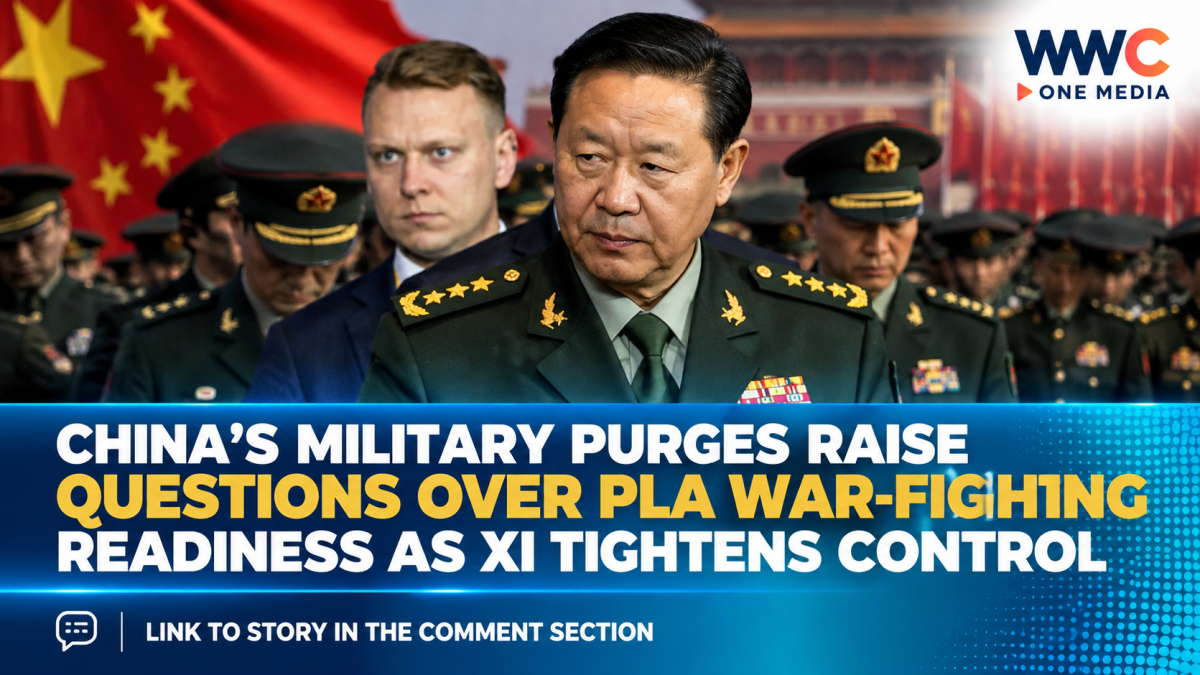
China’s sweeping purge of senior military commanders is raising fresh questions about the People’s Liberation Army’s ability to conduct a major conflict, even as President Xi Jinping appears to be strengthening his political control over the armed forces.
The latest shake-up saw two of China’s most senior military figures, Zhang Youxia and Liu Zhenli, expelled from the Communist Party and the military after investigations into alleged corruption, political disloyalty and serious disciplinary violations. Their cases have been referred to military prosecutors.
Zhang was particularly significant. He served as vice-chairman of the Central Military Commission, the body overseeing China’s armed forces, and was regarded as Xi’s closest military ally. He was also one of the few senior Chinese commanders with actual combat experience, having served during China’s 1979 border war with Vietnam. Liu, meanwhile, was chief of staff of the CMC’s Joint Staff Department.
Their removal is the latest stage of a military crackdown that has intensified in recent years. Investigations into Zhang and Liu were announced in January, while they were removed from the state Central Military Commission in August before being formally expelled from the Party and military this week.
The scale of the broader purge has become increasingly difficult to ignore. A CSIS database tracking senior PLA officers reported that more than 100 senior military officials had been officially purged or gone missing since 2022, although the database’s latest published figures only run through February 2026. It also found that many senior leadership positions remained vacant at that point.
For China’s military, the timing is particularly important. The PLA is simultaneously undergoing rapid modernization while expanding exercises and deployments around Taiwan and in contested areas of the South and East China Seas. The leadership disruption therefore comes as Beijing continues to emphasize military preparedness.
Analysts differ over what the purges mean for China’s actual war-fighting capability.
One concern is that removing experienced commanders and leaving senior positions vacant could disrupt decision-making, command relationships and preparations for complex operations. A National Defense University analysis previously noted that the scale of the purge had probably set back Xi’s goal of preparing the PLA for combat by 2027 because important positions were vacant or being filled by less experienced officers.
Reuters also reported that regional military officials and security analysts are watching closely because the extensive leadership changes could affect China’s ability to conduct complicated operations, including a potential Taiwan contingency. At the same time, analysts stressed that the PLA’s operational machinery remains intact through its joint staff, theatre commands, military services and Communist Party structures.
The Chinese leadership presents the purge differently. State media has portrayed the removed commanders as having undermined Party control through corruption, political violations and abuse of authority. From Beijing’s perspective, eliminating corrupt or disloyal officials is intended to strengthen discipline and ultimately improve the military rather than weaken it.
The political consequences are also significant.
Zhang’s downfall is especially notable because of his long-standing relationship with Xi’s family and his previous status as the second-ranking military commander. The allegations of disloyalty and faction-building against such senior figures have added a political dimension to what initially appeared to be a predominantly anti-corruption campaign. Analysts cited by Reuters described those allegations as an unusually serious escalation.
The shake-up could also complicate China’s military-to-military engagement with other countries. Zhang had played a role in high-level US-China military contacts, including a 2024 meeting with then-US National Security Adviser Jake Sullivan. With senior positions still being reshuffled, it remains unclear who will take over some of the responsibilities previously handled by the purged commanders.
At the same time, there is no evidence that the purges have brought China’s military operations to a halt. The PLA continues weapons testing, military exercises and deployments, suggesting that the disruption at the top has not stopped the broader force from carrying out routine activities.
That leaves China facing a complicated military transition: Beijing is trying to eliminate corruption and enforce political loyalty while simultaneously building a more technologically advanced force capable of operating in increasingly demanding strategic environments.
The bigger question now is whether the removal of so many senior commanders will ultimately strengthen the PLA through tighter discipline or create longer-term gaps in experience and command cohesion at precisely the moment China is pushing for greater military readiness.