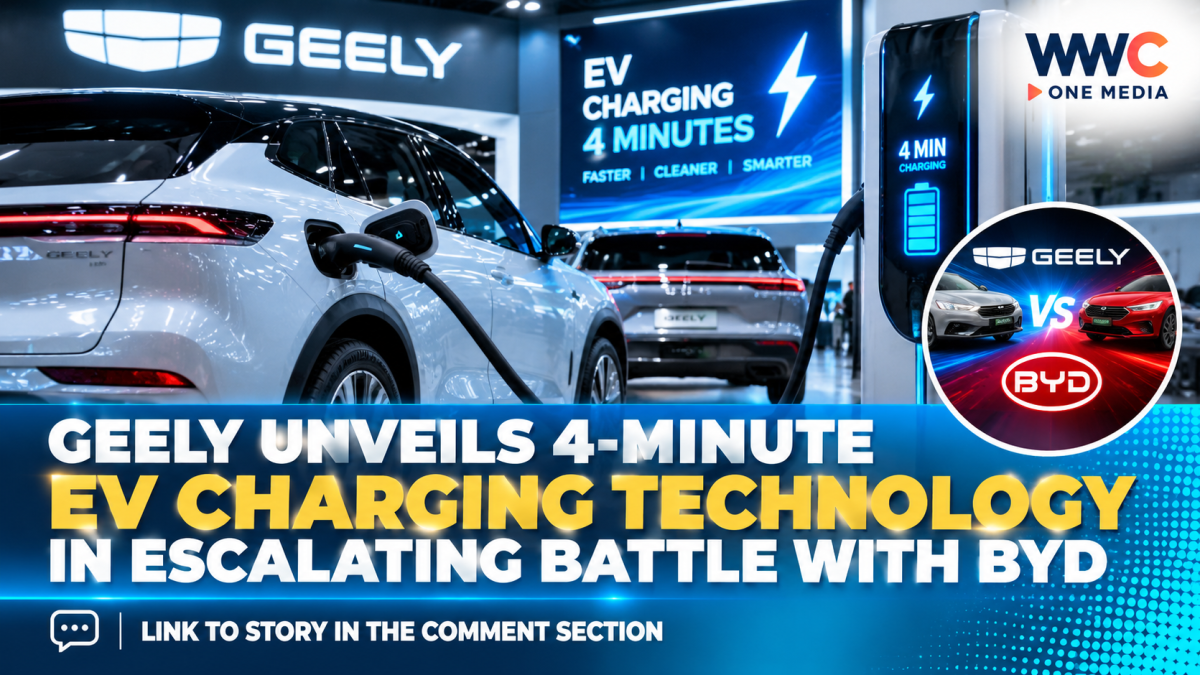
China’s Geely is taking the electric-vehicle charging race to another level, unveiling a new system that can charge an EV from 10% to 70% in just 4.5 minutes and from 10% to 97% in 8 minutes and 40 seconds under normal conditions.
The technology, launched in Ningbo on September 23, combines a 2.25-megawatt charging station, a high-rate battery and artificial intelligence designed to manage charging speed, heat and battery health. Geely says the system represents its fastest production-ready charging performance to date.
The move puts Geely directly into an increasingly intense technology race with BYD, which has been aggressively expanding its own megawatt-level fast-charging network.
BYD’s second-generation flash-charging system, introduced earlier this year, can charge compatible vehicles from 10% to 97% in about nine minutes. Geely’s latest system cuts that claimed time to 8 minutes and 40 seconds, while its 10%-to-70% result is 4.5 minutes.
The difference is not simply about charger power.
Geely is using an AI system called Xingrui PowerMind, developed with Chinese AI company StepFun, to coordinate the vehicle, battery, charging station, cloud systems, electrical grid and energy storage.
The system can predict battery temperatures up to 30 seconds in advance and adjust charging power dynamically. Geely says its thermal-management system is designed to keep average battery temperature below 55°C and peak temperature below 65°C during ultra-fast charging.
That focus on heat is critical because extremely rapid charging generates significant thermal stress. Geely has therefore introduced a five-point liquid-cooling system covering the charging station’s energy-storage battery, charging pile, cable, charging port and vehicle battery.
The company is also addressing another major concern among EV buyers: whether repeated ultra-fast charging could shorten battery life.
Geely says its lithium-ion pulse-restoration technology, combined with AI-controlled charging, can increase battery cycle life by up to 20%. That figure is a company claim, meaning real-world durability will depend on how the technology performs across different vehicles, climates and charging conditions.
The new charging technology was unveiled alongside Geely’s next-generation battery and an upgraded Galaxy E5 electric SUV as the automaker tries to regain momentum in China.
China’s EV market has become increasingly competitive, with manufacturers battling not only over price but also range, intelligent driving, battery technology and charging speed. Reuters reported that China’s EV sales had declined for 11 consecutive months through August, adding pressure on automakers to differentiate their products.
BYD has also been expanding its charging infrastructure rapidly. The company has targeted 20,000 flash-charging stations by the end of 2026, while Geely is betting that ultra-fast charging will increasingly resemble the convenience of traditional petrol stations.
Other Chinese manufacturers are also pushing the technology forward. Battery maker Sunwoda recently announced a flash-charging solution with performance comparable to BYD’s system, while Hongqi demonstrated a battery that reached 70% from 10% in 3 minutes and 41 seconds in a test, although a mass-production timeline had not been announced.
The charging race is therefore moving beyond simply asking how quickly an EV can be plugged in. Automakers must also solve the infrastructure, electrical-grid, battery-temperature and long-term durability challenges that come with delivering enormous amounts of power in minutes.
For consumers, the payoff could be significant. If these systems become widely available, charging an EV could eventually take roughly the same amount of time as a conventional fuel stop, potentially reducing one of the major practical concerns surrounding electric vehicles.
But the technology will only have its full impact if compatible vehicles and high-powered charging stations become widely available.
The bigger question now is whether Geely’s ultra-fast charging push can translate from headline-making laboratory and real-world tests into a large-scale charging network capable of changing how drivers use EVs.