CANBERRA, AUSTRALIA / WASHINGTON / MANILA, PHILIPPINES — November 7, 2026 | WWC ONE MEDIA | Global Politics, Energy, US-Iran Conflict and Asia-Pacific Economy
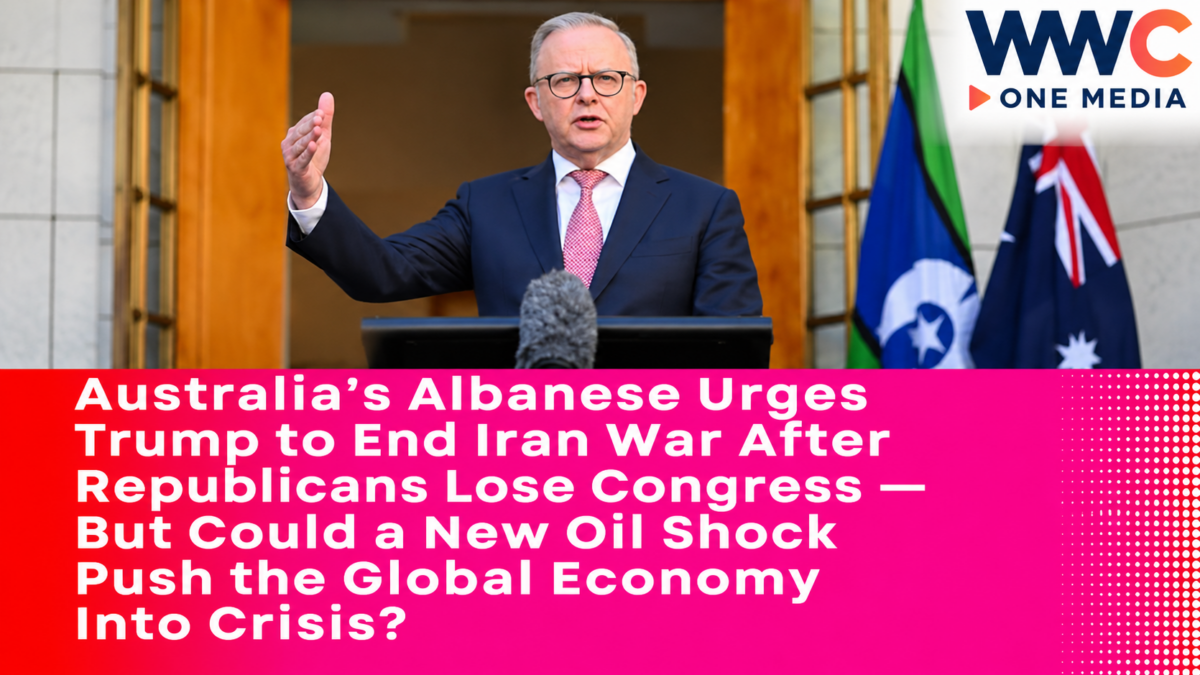
Australian Prime Minister Anthony Albanese is renewing his call for the United States and Iran to de-escalate their prolonged conflict after a devastating midterm election defeat weakened President Donald Trump’s Republican Party and intensified international pressure for a diplomatic settlement.
Speaking after returning from the Commonwealth Heads of Government Meeting in the Caribbean, Albanese said the November 3 US elections delivered a significant political message about the economic consequences of war, trade restrictions and rising living costs.
Democrats captured both chambers of Congress as American voters expressed frustration over the prolonged Iran conflict and its impact on household finances.
For Australia, the stakes are especially high.
Disruptions to energy shipments through the Strait of Hormuz have contributed to higher fuel costs, inflation and renewed pressure on interest rates.
Australia’s central bank raised its benchmark cash rate to 4.85% on November 3, its highest level in approximately 18 years, adding another burden for mortgage holders and businesses.
According to Bloomberg’s November 7 report, Australia’s Albanese Urges Iran De-Escalation After US Midterms, the Australian leader intends to continue encouraging Washington to pursue peace rather than allowing the conflict to escalate.
But Albanese is not abandoning Australia’s close relationship with the United States.
He has emphasized that Canberra will maintain diplomatic cooperation with Trump even when the two leaders disagree.
The central question is whether Trump’s election setback will create an opportunity for a negotiated end to the Iran conflict—or whether the president could still authorize military action that sends global energy markets into another crisis.
Albanese Says Iran War and Tariffs Hurt Republicans in US Midterms
The Australian prime minister’s comments followed a sweeping Democratic victory in the US congressional elections.
In a November 7 interview with ABC News, Albanese described the results as particularly significant.
He identified the Iran war, inflation and US trade tariffs as major issues affecting voters.
The conflict has strained global energy markets and added to living-cost pressures in multiple economies.
Higher fuel prices have become especially politically sensitive because their effects are visible to consumers at petrol stations and through transportation expenses.
Albanese argued that these economic pressures contributed to the Republican Party’s defeat.
However, the election should not be attributed to the war alone.
American voters were also weighing broader economic conditions, domestic political controversies and the performance of the Trump administration.
The election results have nevertheless increased pressure on Washington to explain how it intends to bring the conflict to an end.
Australia Wants the Strait of Hormuz Reopened
One of Albanese’s clearest priorities is restoring reliable commercial shipping through the Strait of Hormuz.
The narrow waterway connects the Persian Gulf with international markets and is one of the world’s most important routes for petroleum shipments.
Disruptions have affected energy supplies and created substantial uncertainty for oil-importing economies.
The consequences extend far beyond countries directly involved in the fighting.
When petroleum becomes more expensive, businesses may face higher transportation, manufacturing and distribution costs.
Those increases can eventually affect food prices, airline fares, freight charges and household expenses.
Albanese said leaders attending the Commonwealth summit wanted the conflict to end and the shipping route to reopen.
The Australian government also continues to support negotiations addressing concerns about Iran’s nuclear program.
But reopening the waterway will require more than an announcement.
The United States and Iran must resolve disputes involving maritime restrictions, sanctions and security guarantees.
Albanese Refuses to Abandon Diplomacy With Trump
Despite their differences, Albanese has rejected the idea that he should adopt a more confrontational approach toward the US president.
Australia and the United States maintain a longstanding security alliance with extensive military, intelligence and economic cooperation.
That relationship remains important as Canberra navigates geopolitical tensions in the Indo-Pacific.
The prime minister said he would continue raising the need for de-escalation directly with Trump.
He also emphasized that Australia’s national interests require constructive engagement with Washington.
This approach reflects a difficult diplomatic calculation.
Public criticism of US military policy may appeal to Australians frustrated by the economic effects of the war.
But maintaining access to American decision-makers is also important when Australia is seeking changes to US trade policy and greater regional security cooperation.
Albanese is attempting to achieve both objectives: advocating for peace while preserving the alliance.
Trump Acknowledges the Iran War Damaged His Party
The political pressure on Trump has become more visible since the midterm elections.
The president acknowledged that the Iran conflict and rising fuel prices likely contributed to Republican losses.
However, he continued defending the decision to pursue military action against Iran, arguing that preventing Tehran from obtaining nuclear weapons remained an important objective.
Vice President JD Vance went further in his criticism of the war’s political consequences.
The differing emphasis illustrates the challenge confronting Republicans after the election.
Some see the conflict as a necessary national-security undertaking.
Others worry that its economic and electoral costs have become unsustainable.
WWC ONE MEDIA examined Trump’s response in Trump Admits Iran War Hurt Republicans in Midterm Defeat but Says He Would Do It Again — Why His ‘Transfer the Love’ Remark Is Raising Bigger Questions.
The election defeat has changed Washington’s political environment, but it has not automatically ended the conflict or removed Trump’s authority as president.
Can the US and Iran Reach a Peace Agreement?
Fresh diplomatic activity offers some hope for de-escalation.
The Associated Press reported on November 7 that Iran was reviewing proposals conveyed through Qatar aimed at bridging differences with Washington.
The proposals involve potential confidence-building measures concerning the US naval blockade, access to frozen Iranian funds, international nuclear inspections and the reopening of the Strait of Hormuz.
Iran continues to seek sanctions relief and broader security commitments.
Disagreements also remain over Iran’s nuclear activities and the conditions required for a durable ceasefire.
The International Atomic Energy Agency has reported significant unresolved concerns regarding Iranian enriched uranium.
A temporary arrangement could potentially reduce immediate tensions without settling every underlying disagreement.
However, no comprehensive new peace agreement had been confirmed as of the latest reporting.
Negotiations remain vulnerable to military incidents, disagreements over sanctions and conflicting political demands.
Trump Faces a Choice Between Negotiation and Escalation
The US midterm results may influence Trump’s calculations.
Democrats will have greater congressional power when the next Congress convenes in January 2027.
They will be able to expand oversight of the administration’s policies, scrutinize military spending and challenge certain legislative priorities.
But the new balance of congressional power does not automatically prevent the president from conducting military operations.
Trump retains substantial authority over foreign policy and military decisions, subject to constitutional and statutory constraints.
Bloomberg reported on November 4 that Trump had no immediate plans for another major strike against Iran, while keeping military options available.
The situation remains uncertain.
WWC ONE MEDIA explored the possible outcomes in Trump Faces Major Political Setback After US Midterm Elections — Will He Strike a Deal With Iran or Risk Another Escalation?.
A negotiated settlement could reduce the economic and political burden of the conflict.
Renewed attacks, however, could provoke retaliation and further threaten regional shipping.
The election makes diplomacy politically attractive, but it does not guarantee that the opposing sides can reach an acceptable agreement.
Australia Faces Its Own Cost-of-Living Crisis
Albanese’s diplomatic appeal comes as Australians confront rising borrowing costs and persistent inflation.
The Reserve Bank of Australia raised its cash rate to 4.85% on November 3, continuing its efforts to contain price pressures.
Higher interest rates can increase mortgage repayments, raise business financing costs and discourage consumer spending.
The conflict in the Middle East has complicated monetary policy by adding pressure to fuel and transportation prices.
Central banks can influence domestic demand through borrowing costs.
They cannot directly guarantee the restoration of international oil supplies.
WWC ONE MEDIA previously examined Australia’s monetary-policy dilemma in Australia Raises Interest Rates to 18-Year High of 4.85% as Inflation Surges — But Could a Housing Crash Be the Price of Victory?.
The report explored the impact of higher interest rates on mortgage holders, the property market and economic growth.
For Albanese, ending the Iran conflict could help ease one source of imported inflation, although it would not automatically eliminate domestic price pressures.
Why Higher Oil Prices Are Hurting Australian Households
Recent Australian household-spending data reveal how rising prices can complicate the economic outlook.
According to the Australian Bureau of Statistics, household spending reached approximately A$82.6 billion in September, increasing 0.6% from the previous month.
The result exceeded economists’ expectations.
But stronger spending in dollar terms does not necessarily mean consumers are becoming wealthier.
Households may spend more simply because essential goods and services cost more.
WWC ONE MEDIA examined this distinction in Australia’s Household Spending Beats Forecasts at A$82.6 Billion as Fuel Costs Surge — But Could the Unexpected Rebound Trigger Even Higher Interest Rates?.
The report explained how rising fuel expenses can increase nominal spending without producing an equivalent improvement in living standards.
That is why Albanese’s call for de-escalation has domestic economic significance.
A sustained reduction in international oil prices could eventually ease some costs for Australian consumers and businesses.
But the timing and size of any relief would depend on fuel markets, domestic taxes and other factors.
Australian Opposition Says the Government Cannot Blame Everything on Iran
Albanese’s government also faces criticism over its economic management.
Opposition Leader Angus Taylor argues that domestic government policies and spending decisions have contributed to inflation.
The opposition wants stronger fiscal restraint and has criticized the Labor government’s handling of household costs.
Treasurer Jim Chalmers, meanwhile, has pointed to international developments, including decisions made in Washington and Tehran, as major sources of financial pressure.
Both external and domestic factors can influence inflation.
Global oil prices affect transportation and production costs.
Government spending, household demand, wages and local supply constraints can also affect domestic prices.
The debate therefore cannot be settled simply by attributing all inflation to the Iran war or all inflation to Australian fiscal policy.
Albanese has said his government will continue identifying savings as it prepares its midyear economic and fiscal outlook.
But he has not provided a complete new list of savings measures.
Commonwealth Leaders Discuss Trade and Global Stability
Albanese’s remarks followed his attendance at the Commonwealth Heads of Government Meeting in the Caribbean.
The summit provided an opportunity to discuss international trade, the economic consequences of conflict and cooperation among member countries.
Albanese emphasized the importance of maintaining relationships with countries such as Canada and the United Kingdom.
He also discussed the possibility of stronger international cooperation on artificial intelligence regulation.
The Commonwealth does not include the United States or China, giving participating governments an alternative forum for exchanging views on economic and geopolitical challenges.
However, the meeting did not produce a confirmed settlement concerning Iran.
Its relevance lies in demonstrating that governments beyond the Middle East are increasingly concerned about the conflict’s global economic consequences.
Australia’s Alliance With the US Faces Another Diplomatic Test
Australia’s national-security strategy remains closely connected to Washington.
The two countries cooperate through defense arrangements, intelligence partnerships and the AUKUS security framework.
Albanese is expected to participate in additional international engagements later in November, including meetings in Asia.
His schedule includes the ASEAN summit in the Philippines and other regional events.
A possible encounter with Trump could provide another opportunity to discuss Iran, tariffs and broader security issues.
But no new US-Iran agreement should be inferred from the planned diplomatic meetings.
The Australian government will need to balance several priorities: encouraging de-escalation, seeking changes to US trade restrictions and protecting cooperation on Indo-Pacific security.
What the Iran Crisis Means for the Philippines
The Philippines has a direct economic interest in developments affecting the Strait of Hormuz.
As a major importer of petroleum products, the country is exposed to fluctuations in international energy prices.
Higher oil costs can affect local fuel prices, public transportation, freight services and the cost of moving agricultural products.
Those pressures can eventually contribute to inflation.
Filipino workers and families with relatives in the Middle East may also be concerned about regional security.
A durable agreement reducing the risk of renewed hostilities could improve economic confidence.
But lower international oil prices would not necessarily translate into immediate or identical reductions in Philippine retail fuel prices.
Exchange rates, taxes, inventories and local distribution costs remain important.
For Philippine policymakers, the central concern is maintaining economic resilience while the diplomatic situation remains uncertain.
What Happens Next in the Iran Negotiations?
Several developments will determine whether diplomatic momentum continues.
The United States and Iran must assess proposals involving maritime access, sanctions and nuclear inspections.
Qatar and other regional intermediaries will continue attempting to narrow the differences between the parties.
Washington must decide how much military and economic pressure to maintain during negotiations.
Iran must determine whether proposed concessions provide sufficient guarantees to justify reopening important shipping routes.
Australia and other US partners can advocate for de-escalation, but they cannot independently impose a settlement on Washington and Tehran.
Further military incidents could undermine negotiations even if neither side initially intends to return to full-scale war.
That makes the coming diplomatic contacts particularly important.
The Bigger Question: Will Trump’s Midterm Defeat Finally Bring Peace?
The November 3 US midterm elections have altered the political environment surrounding the Iran conflict.
Republican losses have increased pressure on Trump to address concerns about the war and the cost of living.
Australia’s prime minister is among the international leaders urging a negotiated end to hostilities.
The economic reasons are compelling.
Disrupted energy shipments have contributed to inflation and financial uncertainty.
Australia is dealing with an 18-year-high cash rate, while other oil-importing economies remain vulnerable to further price increases.
There are signs of renewed diplomatic engagement involving Iran, Qatar and the United States.
But major disagreements remain over sanctions, maritime restrictions, nuclear activities and regional security.
For Albanese, the challenge is persuading Washington to pursue peace without damaging the alliance on which Australia’s broader security policy depends.
For Trump, the challenge is finding a settlement that addresses US security objectives while reducing the costs of a prolonged conflict.
As Australia demands de-escalation following Trump’s devastating midterm defeat, one question could shape the next chapter of global politics and energy markets: Will mounting economic and electoral pressure finally push Washington and Tehran toward a lasting peace—or could another confrontation in the Strait of Hormuz unleash an even more damaging oil-price shock?