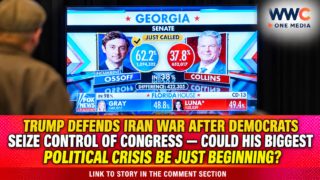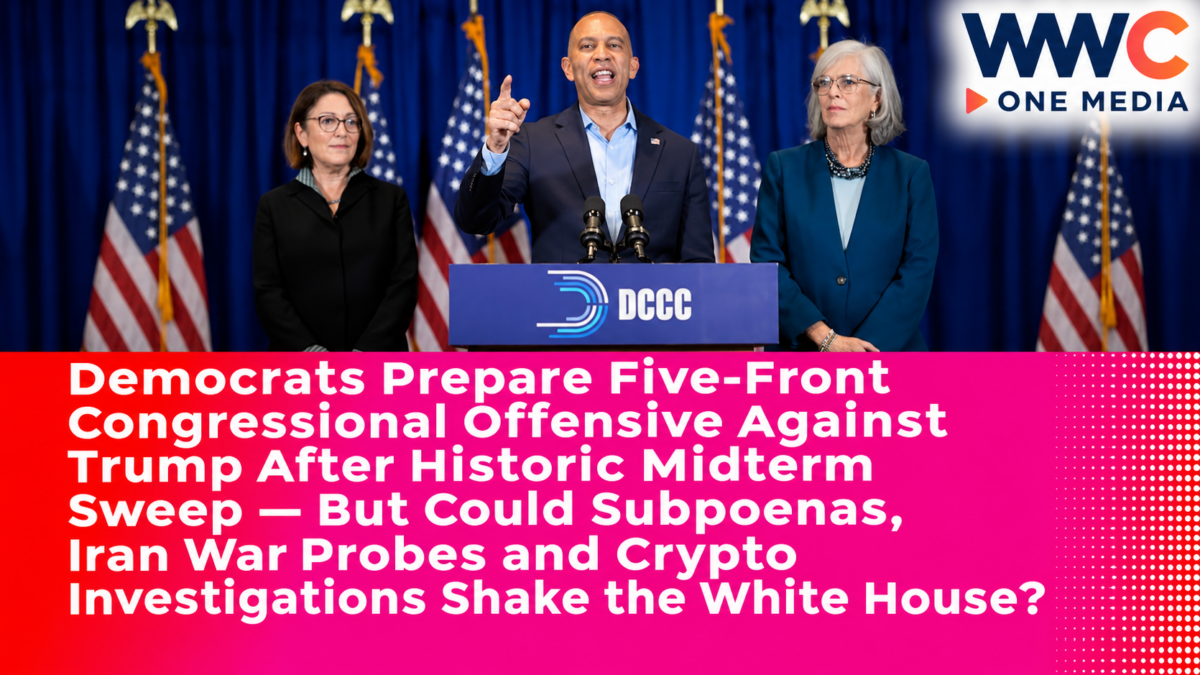
WASHINGTON, D.C. / MANILA — President Donald Trump is heading into what could become the most confrontational period of his second presidency after Democrats captured both chambers of the United States Congress in the November 3 midterm elections.
The victory gives Democrats the opportunity to take control of powerful congressional committees, launch investigations, issue subpoenas and challenge some of the White House’s most controversial policies.
But the incoming majority is preparing a much broader offensive than investigations of Trump and his associates alone.
According to Bloomberg Government’s November 4 analysis, Democrats are positioning themselves to challenge the administration across five major areas: congressional investigations, federal spending, the Iran war, artificial intelligence and cryptocurrency regulation.
The political consequences could extend from the Pentagon and Justice Department to Wall Street, Silicon Valley and the global digital-asset market.
House Democratic leaders are preparing to examine alleged conflicts of interest, government contracts and the administration’s handling of sensitive records.
Other lawmakers are gearing up to challenge Trump’s proposed $1.5 trillion defense budget, investigate the conduct of the Iran war and potentially impose tougher oversight on AI companies.
Meanwhile, Senator Elizabeth Warren is positioned to lead the Senate Banking Committee, creating new uncertainty for the cryptocurrency industry’s efforts to secure a favorable regulatory framework.
As Democrats prepare to exercise their newly won congressional powers, could the administration’s final two years become dominated by subpoenas, budget battles and regulatory investigations—or will Trump successfully defend his agenda against the new majority?
Democrats’ Midterm Victory Changes the Balance of Power in Washington
The November 3 elections produced a sweeping political reversal.
Democrats secured majorities in both the House of Representatives and Senate, ending unified Republican control of Congress.
The results gave the opposition party greater influence over legislation, federal spending, confirmation proceedings and investigations into executive-branch activity.
WWC ONE MEDIA previously covered the election’s significance in Democrats Capture Both Houses of Congress in Sweeping Midterm Victory — Trump Faces Major Political Setback With Two Years Left in Office.
The change will become particularly significant when the new Congress convenes in January 2027.
Until then, Republicans continue to hold their existing committee leadership positions, subject to any intervening changes.
Democratic control will not automatically allow Congress to enact every policy it wants.
The president retains veto authority, and most legislation faces procedural requirements in the Senate.
But committees can exercise considerable influence even when the legislative process is gridlocked.
Their ability to demand records, summon witnesses and examine federal spending could fundamentally change the relationship between the White House and Capitol Hill.
First Front: Democrats Prepare Sweeping Investigations Into Trump
Congressional investigations are likely to become one of the most visible consequences of the midterms.
Representative Robert Garcia of California is positioned to chair the House Oversight Committee, while Maryland Representative Jamie Raskin is expected to lead the House Judiciary Committee.
Both have signaled plans to scrutinize the administration.
Garcia indicated the confrontational tone immediately after the election with a brief warning to potential investigation targets: “Lawyer up!”
His anticipated priorities include examining the Trump family’s business relationships, government contracts, possible conflicts of interest and allegations involving immigration enforcement.
Democrats also intend to review the administration’s handling of documents connected to Jeffrey Epstein.
Raskin has identified executive-branch conduct, tariff policies and government accountability as potential areas of scrutiny.
The two lawmakers are expected to coordinate their agendas to avoid unnecessary duplication.
However, planned investigations must be distinguished from established wrongdoing.
A congressional inquiry does not mean that any individual has been charged with a crime or found responsible for misconduct.
The Epstein Files Could Become a Major Political Flashpoint
The handling of Jeffrey Epstein-related records is among the issues Democrats have highlighted for potential investigation.
Lawmakers may seek documents, testimony and explanations concerning how federal agencies have handled requests for disclosure.
The issue carries significant public interest because of Epstein’s history of sexual abuse and his connections with prominent individuals.
However, association with Epstein does not itself establish participation in criminal conduct.
Congressional investigators would need to distinguish allegations, confirmed evidence and unrelated personal or professional contacts.
The administration may also dispute the release of particular records on grounds involving privacy, legal restrictions or executive confidentiality.
Any resulting conflict could lead to litigation.
The ultimate scope of disclosure will depend on applicable law and decisions made by the relevant institutions.
Congressional Oversight Could Extend Beyond the White House
Democrats may also examine the activities of federal agencies responsible for financial regulation, housing and government spending.
These investigations could cover allegations that agency leaders obstructed oversight, misused resources or failed to comply with statutory responsibilities.
WWC ONE MEDIA previously reported on Trump’s Housing Regulator Accused of ‘Unprecedented’ Obstruction as Watchdog Faces 80% Staff Cuts — But Who Will Police America’s Mortgage Giants?.
That report examined an oversight dispute involving the Federal Housing Finance Agency and its inspector general.
The inspector general alleged that agency actions interfered with required oversight responsibilities.
Those allegations are separate from the new Democratic committee plans.
However, they illustrate the types of executive-branch governance disputes that could attract closer congressional attention.
Committee investigations may request records and testimony, but their ability to compel compliance can be contested.
Executive-privilege claims and court proceedings could significantly delay certain inquiries.
Second Front: Democrats Target Trump’s Federal Budget
One of Congress’s most powerful responsibilities is deciding how federal money is appropriated.
Democrats are preparing to use that authority to challenge the administration’s spending priorities.
Representative Rosa DeLauro of Connecticut and Senator Patty Murray of Washington are positioned to lead the House and Senate Appropriations committees.
Both have opposed elements of Trump’s fiscal agenda.
Their concerns include proposed reductions in domestic programs, executive control over grant funding and spending decisions associated with Elon Musk’s Department of Government Efficiency.
Democrats have also challenged Trump’s proposed $1.5 trillion defense budget.
The conflict is especially important because government departments cannot simply spend whatever amounts the administration prefers.
Congress authorizes and appropriates funding within the applicable legal framework.
The executive branch then carries out spending responsibilities under those laws.
Disagreements over whether the White House has properly implemented congressional funding decisions could become a major source of investigation.
December 11 Government Funding Deadline Creates Immediate Pressure
The next major budget deadline arrives on December 11, 2026.
A temporary funding law currently provides government financing through that date.
Lawmakers must approve additional funding or another extension to avoid a potential shutdown affecting parts of the federal government.
The approaching deadline creates a complicated political situation.
The newly elected Democrats will not yet have assumed control of congressional committees when the December 11 deadline arrives.
That means negotiations will initially take place under the existing congressional leadership structure.
However, the election outcome may influence bargaining positions because lawmakers know control will shift in January.
Some Democrats may prefer extending funding negotiations until the new Congress convenes.
Others may favor reaching a broader bipartisan agreement to reduce uncertainty.
Neither approach guarantees an outcome.
A government shutdown remains a risk if lawmakers fail to agree on funding legislation.
Budget Director Russell Vought Could Face Closer Scrutiny
Office of Management and Budget Director Russell Vought may become an important figure in Democratic oversight.
Lawmakers have criticized proposals they believe would give political appointees excessive control over federal spending decisions.
DeLauro and Murray have expressed concern that administrative practices could undermine congressional funding requirements.
Incoming committee leaders may seek testimony and documentation regarding how appropriated funds have been distributed, delayed or withheld.
Such investigations could have consequences for federal grant recipients, public agencies and government contractors.
However, disagreements over executive spending authority often involve complicated constitutional and statutory questions.
A political accusation that funds were improperly withheld does not automatically establish a legal violation.
The administration may argue that its actions are permitted under existing budget laws.
Courts could ultimately be asked to resolve some disputes.
Third Front: The Iran War Puts Pete Hegseth Under Pressure
The Trump administration’s military conflict with Iran is expected to become another major focus of congressional oversight.
The war has generated controversy over military strategy, civilian consequences, energy prices and the administration’s use of executive authority.
Democrats argue that Congress must exercise stronger supervision over the conduct and financing of military operations.
Defense Secretary Pete Hegseth could face extensive questioning.
Representative Adam Smith of Washington is positioned to lead the House Armed Services Committee.
Senator Jack Reed of Rhode Island is expected to play a leading role in Senate defense oversight.
Their priorities could include reviewing military operations, defense procurement, leadership decisions and compliance with applicable war-powers requirements.
Reuters reported on November 4 that Trump publicly defended Hegseth’s performance despite speculation about the defense secretary’s political future.
The president’s defense of Hegseth does not eliminate Congress’s ability to conduct oversight.
Could Democrats Investigate the Pentagon’s $1.5 Trillion Defense Plan?
Trump’s proposed $1.5 trillion defense budget is likely to become a major point of disagreement.
Supporters of higher defense spending argue that substantial resources are necessary for military readiness, ongoing operations and international security commitments.
Critics question whether the proposed amount is affordable and whether all requested spending is justified.
Democratic lawmakers may seek detailed explanations of procurement programs, military operations and contractor payments.
The Iran conflict has also raised concerns about disruptions to important energy shipping routes.
WWC ONE MEDIA previously examined the regional security risks in Iran Says It Struck an Oil Tanker in the Strait of Hormuz — Now the World Is Watching What Happens Next.
That report explored the potential consequences of attacks affecting one of the world’s most important oil and gas shipping corridors.
The connection to congressional oversight is significant.
Military operations affect not only defense budgets but also international commerce, energy security and household fuel costs.
However, the Pentagon’s proposed spending amount is not equivalent to money Congress has already approved.
Funding levels remain subject to the legislative process.
War Powers Could Trigger a Constitutional Showdown
Congressional Democrats may also pursue resolutions concerning presidential war-making authority.
The United States Constitution divides responsibilities involving military operations between Congress and the president.
Congress has powers relating to declarations of war, military funding and legislation.
The president serves as commander in chief.
Disagreements over the boundaries of those powers have persisted across administrations.
The Iran conflict may bring those disputes into sharper focus.
Some lawmakers have discussed possible impeachment proceedings involving Hegseth.
But discussion of impeachment is not the same as a formal conviction or removal.
Impeachment requires approval in the House, while conviction and removal require a two-thirds vote in the Senate.
Democratic control of both chambers does not automatically mean the party has the supermajority necessary to remove an official.
Fourth Front: AI Giants Face Tougher Congressional Questions
Artificial intelligence may become one of the most consequential economic policy debates under the new Congress.
Rapid growth in AI computing has driven enormous investment in semiconductors, data centers, electricity infrastructure and digital services.
But it has also created concerns about safety, privacy, employment and the concentration of technological power.
Senator Maria Cantwell of Washington is positioned to chair the Senate Commerce Committee.
Representative Frank Pallone of New Jersey could take control of the House Energy and Commerce Committee.
Both panels have responsibilities relevant to technology policy.
Democrats may use hearings and investigations to examine how major AI companies develop, test and deploy advanced systems.
Potential issues include consumer protection, transparency, cybersecurity and the effects of automation on workers.
However, the Democratic Party does not have a single unified approach to AI regulation.
Some lawmakers favor extensive safety requirements.
Others prefer targeted oversight that preserves innovation and international competitiveness.
Data Center Electricity Costs Could Become a Major Political Battle
One particularly important issue is the rapidly increasing electricity demand of AI data centers.
Large facilities can require substantial new power-generation and transmission capacity.
That has prompted concerns about whether ordinary households should bear the cost of infrastructure required by technology companies.
WWC ONE MEDIA previously examined the issue in AI Data Centers Are Setting Off Alarms in Washington — And Now Congress Is Moving on the Power Bill.
That report discussed the Ratepayer Protection Act, which passed the House with overwhelming bipartisan support before encountering disagreement in the Senate.
The legislation concerns how states and utilities should allocate infrastructure costs associated with large electricity users.
The incoming Congress could revisit that debate.
But tougher oversight does not necessarily mean a nationwide prohibition on AI data center construction.
Any new legal requirements would depend on the actual wording of proposed legislation, negotiations in Congress and the president’s response.
AI Regulation Could Affect Nvidia, Microsoft, Amazon and Google
Major AI developers and infrastructure operators could face increased requests for information.
Companies such as Microsoft, Amazon, Alphabet and Meta are investing heavily in data center capacity.
Nvidia and other semiconductor suppliers also benefit from demand for advanced computing equipment.
Congressional inquiries could examine electricity consumption, safety practices, consumer protection and the impact of AI on employment.
However, an investigation does not establish that a company has violated the law.
Nor does a proposal for tighter AI regulation automatically imply that all AI-related stocks will decline.
Market reactions depend on how investors evaluate potential costs, competition, future earnings and the likelihood of legislation.
Companies with established infrastructure might even benefit from certain restrictions if those rules make competing projects more difficult to develop.
The financial effects will depend on specific policies rather than political headlines alone.
Fifth Front: Trump’s Crypto Interests Face Renewed Scrutiny
Cryptocurrency regulation is likely to become another major battleground.
Democrats have questioned whether existing and proposed rules adequately address conflicts of interest involving public officials with financial stakes in digital-asset businesses.
President Trump’s cryptocurrency ventures have become central to that debate.
WWC ONE MEDIA previously reported on Trump’s $1.4 Billion Crypto Income Becomes Flashpoint as Senate Crypto Bill Stalls.
That report examined the Digital Asset Market Clarity Act and disagreements over ethics safeguards.
The proposed legislation sought to clarify federal oversight of digital assets while establishing rules for different types of crypto businesses.
Supporters argued that clearer regulation would encourage innovation and provide greater legal certainty.
Critics argued that the proposed protections were insufficient to address financial conflicts involving senior public officials.
The Senate failed to advance the measure in a September procedural vote.
The Democratic victory makes its future even more uncertain.
Elizabeth Warren Could Become Crypto’s Most Powerful Congressional Critic
Senator Elizabeth Warren is positioned to chair the Senate Banking Committee.
She has repeatedly called for stronger rules governing cryptocurrency businesses, financial transparency and conflicts of interest.
Warren has also argued that crypto legislation should address illicit financing and consumer protection.
Her potential leadership could change the direction of discussions about the CLARITY Act and related measures.
In the House, Representative Maxine Waters is a leading contender to chair the Financial Services Committee.
However, committee leadership is not finalized simply because Democrats have won the election.
Internal party decisions will determine the eventual chairs.
Some Democratic lawmakers support establishing a comprehensive digital-asset framework.
Others are concerned about the effectiveness of proposed consumer and ethics protections.
The result could be a slower legislative process or renewed negotiations.
It would be premature to declare that cryptocurrency has been banned or that the CLARITY Act can never return.
Crypto Companies Face Uncertainty, but Not Automatic Defeat
The digital-asset industry has invested substantial resources in advocating for regulatory clarity.
Supporters argue that a predictable framework would help cryptocurrency exchanges, payment providers and blockchain developers operate legally within the United States.
They also warn that prolonged uncertainty could push investment into other jurisdictions.
Critics counter that rules must prevent fraud, protect consumers and avoid creating favorable treatment for businesses linked to powerful officials.
Those perspectives will likely shape the next legislative negotiations.
The new congressional majority may place greater emphasis on oversight before advancing major industry legislation.
However, Democrats’ control does not automatically eliminate all bipartisan support for digital assets.
Several lawmakers from both parties have expressed interest in establishing clear market rules.
The political challenge is finding an agreement that can attract sufficient congressional support and survive presidential review.
Democrats Still Face One Major Obstacle: Trump’s Veto
The Democratic victory gives Congress substantial influence, but it does not give lawmakers unrestricted control over federal policy.
Trump remains president and retains the constitutional authority to veto legislation.
Overriding a presidential veto generally requires a two-thirds vote in both chambers.
Democrats do not automatically possess that level of support.
Many Senate bills also face a 60-vote procedural threshold.
This means legislation addressing AI regulation, federal spending and cryptocurrency may still require negotiations with Republicans.
Congressional investigations operate differently from ordinary legislation.
Committees may conduct hearings and issue subpoenas within the scope of their legal powers.
But enforcement disputes can end up in court.
The administration may raise objections involving executive privilege, jurisdiction or other legal protections.
As a result, even a highly aggressive oversight agenda may encounter significant delays.
What the Political Shift Means for the Philippines
The new congressional balance has potential implications for businesses and consumers in the Philippines.
American policy changes can influence global financial markets, semiconductor investment, cryptocurrency regulation and energy prices.
Congressional scrutiny of the Iran war could affect political expectations surrounding Middle Eastern security.
Changes to AI policy could influence technology companies operating across Asia.
And new cryptocurrency legislation could affect the international regulatory environment for digital-asset businesses.
However, these effects are not automatic.
A congressional hearing in Washington does not immediately change Philippine law.
Similarly, a proposed American regulation does not necessarily apply to Philippine financial institutions or consumers.
The practical consequences will depend on the final policies adopted, market responses and domestic regulatory decisions.
For Philippine investors and businesses, the most important development is the likelihood of greater uncertainty as Washington debates economic and national security priorities.
Five Critical Questions Facing Trump’s Final Two Years
First, how aggressively will Democrats use their investigative powers?
Incoming committee leaders have signaled strong interest in executive oversight, but they must decide how to allocate time and resources.
Second, can Congress avoid a government shutdown?
The December 11 funding deadline arrives before the new Democratic majority takes office.
Third, will the Iran war trigger a major confrontation over military funding and presidential authority?
Lawmakers are preparing to scrutinize the Pentagon and the administration’s military decisions.
Fourth, can Democrats agree on AI regulation?
The party contains competing views on technology safety, innovation and infrastructure development.
Fifth, what happens to cryptocurrency legislation?
The CLARITY Act’s future remains uncertain as lawmakers debate ethics protections and financial regulation.
The Bigger Picture: Could Congressional Committees Reshape Trump’s Presidency?
The 2026 midterm elections have transformed the political environment facing President Trump.
For much of his second term, Republican control of Congress gave the White House substantial influence over legislative priorities and congressional oversight.
That balance is changing.
Democrats are preparing to use congressional committees to examine administration decisions, challenge federal spending, scrutinize military operations and reshape debates over emerging technologies.
The implications reach across government and business.
Federal agencies could face more frequent hearings.
Technology executives may be called to explain their operations.
Cryptocurrency companies could encounter tougher questions about financial safeguards.
And defense officials may face greater scrutiny over military strategy and spending.
But investigations are not convictions, proposed legislation is not enacted law, and congressional control does not eliminate presidential veto powers.
The effectiveness of the Democratic agenda will depend on legal authority, political unity, evidence and the ability to maintain public support.
Voters also expect action on healthcare, housing and the cost of living.
Democrats must balance their oversight ambitions with those economic priorities.
As Democrats prepare to take control of congressional committees and confront Trump across five major policy battles, could their new investigative powers fundamentally reshape the final two years of his presidency—or will political gridlock and legal resistance prevent Washington’s biggest investigations from delivering meaningful results?