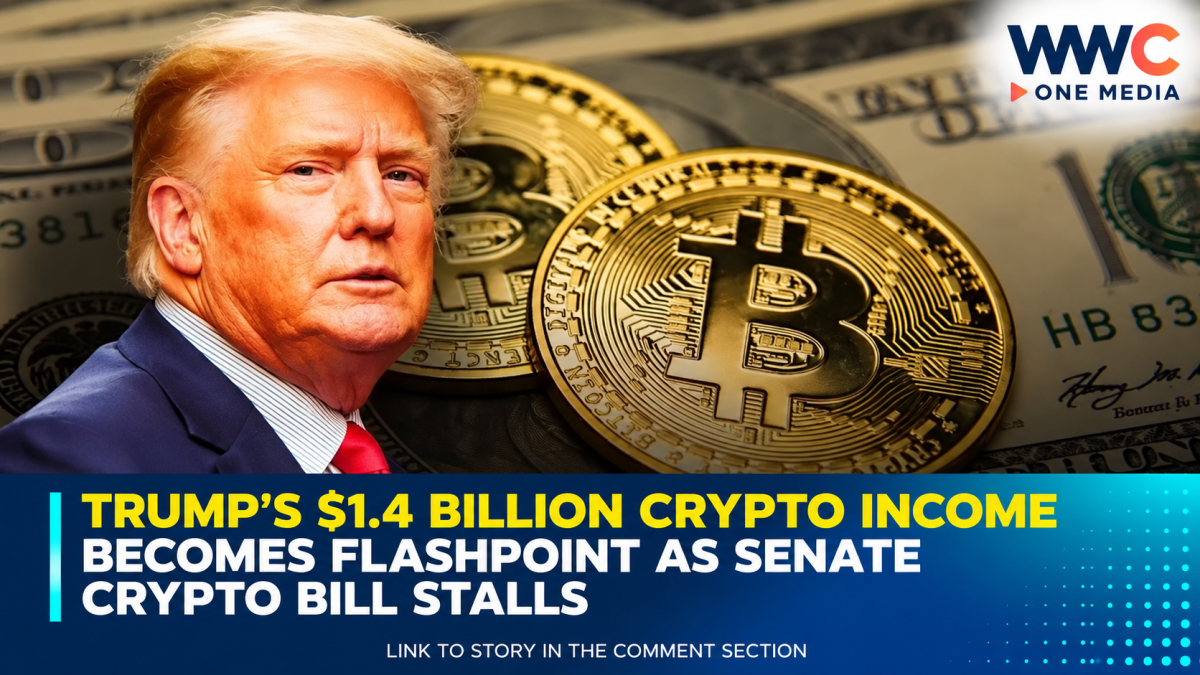
WASHINGTON — The cryptocurrency industry spent years pushing Washington toward a clearer regulatory framework.
It got closer than ever.
Then the debate collided with an increasingly difficult question: How should Congress regulate an industry from which the sitting president has reported more than $1.4 billion in income?
That question became a central flashpoint as the U.S. Senate considered the Digital Asset Market Clarity Act, commonly known as the CLARITY Act.
On September 15, the legislation failed to advance in a 49–50 procedural vote, falling well short of the 60 votes required. Three Republicans—Susan Collins, Josh Hawley and Jerry Moran—also voted against advancing the measure.
The result represented a setback for an industry that had made crypto market-structure legislation one of its top priorities.
But it also exposed an unusual political problem.
The industry’s strongest ally in the White House has become inseparable from the debate over how the industry should be regulated.
The $1.4 billion number that changed the debate
Trump’s latest financial disclosure reported more than $1.4 billion in income from crypto-related ventures during 2025.
Reuters reported that nearly $800 million came from World Liberty Financial, the crypto venture Trump co-founded with his sons and other partners.
That figure included more than $520 million from token sales and about $250 million from the sale of interests in the World Liberty business, according to Reuters’ review of the disclosure.
Trump also reported approximately $635 million from sales connected to his $TRUMP meme-coin business.
The numbers placed Trump’s personal financial interests directly into the political conversation surrounding the legislation.
The White House has said Trump has made the United States more supportive of cryptocurrency and that his family handles his business interests.
But Democratic lawmakers argued that legislation establishing the rules for a rapidly expanding industry should contain stronger safeguards governing conflicts of interest.
The crypto industry’s biggest legislative push hits a wall
The CLARITY Act is designed to establish a broader federal regulatory framework for digital assets.
Supporters say clearer rules could reduce years of uncertainty over whether particular crypto assets and businesses fall primarily under the jurisdiction of the Securities and Exchange Commission or the Commodity Futures Trading Commission.
The legislation also contains provisions addressing consumer protections, enforcement, market structure and decentralized finance.
Republican lawmakers who sponsored the bill described the latest draft as the product of more than a year of bipartisan negotiations and said it included 126 substantive changes requested by Democrats.
But the revised legislation still could not secure enough votes.
Trump agreed to new ethics restrictions
The White House and Republican lawmakers made concessions in an effort to address concerns about Trump’s crypto interests.
The revised proposal included restrictions on federally elected officials, federal judges and their spouses issuing digital assets.
It also included provisions concerning officials with significant financial interests in crypto-issuing entities, including requirements involving divestment or blind trusts.
Another important change gave state attorneys general a role in enforcing parts of the law, a provision sought by Democrats who questioned whether federal enforcement alone would provide sufficient safeguards.
Republican sponsors characterized the changes as significant ethics protections.
But they were not enough to produce the 60 votes needed to move the legislation forward.
Why Democrats still objected
Democrats who opposed advancing the bill focused heavily on whether the ethics provisions would adequately prevent a president or other government officials from benefiting financially from the industry they are helping regulate.
The AP reported that Democratic senators wanted stronger requirements, including a mechanism that could require Trump—or future presidents—to divest certain crypto holdings after reaching specified thresholds.
They also sought stronger enforcement provisions.
Those negotiations continued almost until the vote.
But no agreement was reached that could bring enough Democratic senators aboard.
That distinction is important.
The Senate vote was not simply a vote on whether cryptocurrency should be regulated.
It was also a dispute over what the regulatory framework should look like and what ethical restrictions should apply to government officials with financial interests in crypto.
Crypto companies had already invested heavily in politics
The industry’s political influence is another major part of the story.
Reuters reported in June that cryptocurrency companies had spent approximately $189 million on the 2026 U.S. elections at that point, making crypto the largest corporate political spender identified in the report.
The AP separately reported that the crypto industry spent more than $130 million in congressional races during the 2024 election cycle.
That spending helped establish crypto as a significant political force in Washington.
The industry’s objective has been relatively straightforward: secure legislation that gives digital-asset businesses greater legal certainty and establishes clear rules for operating in the United States.
But the Trump administration has created a complication that did not exist to the same degree during earlier legislative efforts.
The president himself has substantial financial exposure to the sector.
Trump’s crypto businesses are at the center of the controversy
Trump’s relationship with cryptocurrency has changed dramatically.
During his first presidential campaign and first term, Trump expressed skepticism about cryptocurrency.
His position changed substantially before his return to the White House.
His family became involved in World Liberty Financial, while the Trump Organization and affiliated entities became associated with the $TRUMP meme coin.
The latest financial disclosure made the scale of that involvement much clearer.
Reuters reported that Trump’s crypto-related income increased dramatically compared with the previous year’s disclosure.
The Washington Post similarly reported that the president’s 2025 disclosure showed more than $1.4 billion in cryptocurrency-related income, including revenue connected to his meme coin and World Liberty Financial.
That financial connection has become one of the central issues in the legislative debate.
Supporters say the bill is bigger than Trump
The political dispute over Trump’s crypto holdings should not obscure what the legislation itself attempts to accomplish.
Supporters argue that the United States needs a comprehensive framework for digital assets rather than relying primarily on enforcement actions and regulatory interpretations.
Axios reported that the bill would create a durable federal framework defining how digital assets can be issued, traded and sold and would clarify the respective roles of the SEC and CFTC.
Republican supporters also argued that failing to advance the bill could leave American companies operating under continued uncertainty.
The White House warned that regulatory uncertainty could make it harder for the United States to maintain leadership in digital assets.
Those arguments remain part of the broader debate over what comes next.
Banks have their own concerns
The CLARITY Act debate was not solely about Trump’s finances.
Banking groups and lawmakers also raised concerns about provisions affecting stablecoins and competition between banks and crypto companies.
The latest Republican draft gave the Treasury secretary additional authority to respond to situations in which stablecoin-related activity could contribute to deposit outflows from banks.
That issue illustrates how complicated crypto legislation has become.
The debate now involves not only Bitcoin and digital-asset exchanges but also banking regulation, payments, consumer protection, financial stability and the boundaries between different federal regulators.
What the failed vote means for crypto
The failed procedural vote does not necessarily mean that cryptocurrency regulation is permanently dead.
But it does mean that the industry’s preferred legislative path has encountered a major obstacle.
Axios reported that Republicans had been working on the measure for more than a year, while the AP reported that the bill could face a long delay because Congress is approaching the midterm-election period.
The political calendar now matters.
Congressional control could change after the November elections, potentially altering the negotiations over crypto regulation.
At the same time, federal agencies could continue developing crypto-related policies within their existing authority.
The industry now faces a different Washington
For years, the crypto industry’s biggest political challenge was convincing lawmakers that digital assets deserved a permanent place within the American financial system.
That argument gained considerable ground.
But the Trump presidency has added another layer.
The president has become both a major political advocate for crypto policy and a person with substantial reported financial interests in the industry.
That combination has made ethics an unavoidable part of the legislative conversation.
It has also divided lawmakers who otherwise agree that the United States needs clearer cryptocurrency rules.
The political money is not going away
The crypto industry’s political spending is another reason the story is unlikely to end with one failed vote.
The industry has demonstrated a willingness to spend heavily on elections and lobbying.
That spending has already affected congressional races and helped make cryptocurrency a mainstream political issue.
For crypto companies, clearer regulation could determine how exchanges, token issuers, blockchain developers and other businesses operate for years.
For lawmakers, however, the question increasingly includes another issue:
Can Congress establish rules for an industry while also establishing credible safeguards for politicians and government officials who have financial interests in that same industry?
The next chapter could be even more consequential
Trump’s reported $1.4 billion in crypto-related income did not single-handedly determine the Senate vote.
But it undeniably became part of the debate over whether the proposed regulatory framework contained sufficient ethics safeguards.
The Senate’s 49–50 vote demonstrated that the legislation could not yet assemble the coalition required to advance.
The crypto industry now faces a more complicated road to federal legislation.
It has money, political influence and support from many lawmakers.
But it also faces a debate that is no longer simply about whether crypto deserves regulatory clarity.
It is about who writes those rules, who enforces them—and what happens when the people writing the rules have financial interests in the industry they are regulating.
And with the 2026 midterm elections approaching, the next fight over crypto may move as much through campaign politics as it does through the Senate chamber.