NEW YORK, UNITED STATES / MANILA, PHILIPPINES — November 5, 2026 | WWC ONE MEDIA | Global Business, Artificial Intelligence, SpaceX, Nvidia and Financial Markets
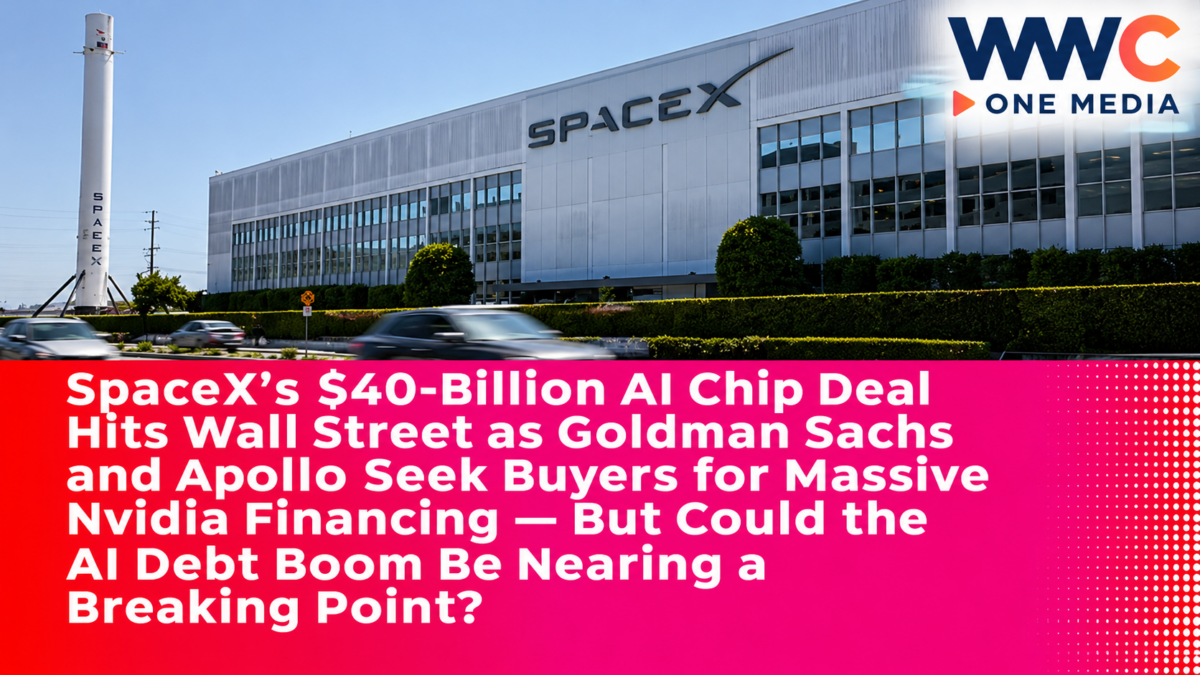
Wall Street’s artificial intelligence financing boom is entering another high-stakes test as Goldman Sachs and Apollo Global Management seek investors willing to purchase portions of a massive $40-billion financing arrangement supporting Elon Musk’s SpaceX.
The transaction, described by SpaceX as the largest committed graphics-processing-unit financing of its kind, is designed to fund advanced Nvidia chips and computing infrastructure for the company’s rapidly expanding AI operations.
But the effort to distribute the financing across institutional investors is unfolding amid growing concerns about AI-related debt, expensive computing equipment and the possibility that enormous infrastructure investments may not generate sufficient financial returns.
According to Bloomberg’s November 4 report, Goldman, Apollo in Talks to Sell SpaceX’s $40 Billion AI Deal, the two financial firms have begun approaching Wall Street investors ahead of a formal syndication process.
Some potential investors are reportedly being asked to take positions of as much as $500 million.
The move comes shortly after SpaceX announced a binding commitment for approximately $40 billion in financing with an Apollo-managed entity.
The arrangement will finance Nvidia’s next-generation Vera Rubin processors, which are expected to arrive during the first half of 2027.
The proposed financing structure could help SpaceX expand its computing capacity while keeping the borrowing within a separate equipment-owning entity.
However, investors must still evaluate the structure’s risks, repayment arrangements and dependence on the continued economic value of rapidly evolving AI hardware.
The central question is whether SpaceX’s enormous financial commitment represents a breakthrough in funding artificial intelligence—or another warning that the AI infrastructure boom is becoming dangerously dependent on debt.
Goldman Sachs and Apollo Approach Wall Street to Sell Portions of SpaceX’s $40-Billion Financing
Goldman Sachs and Apollo are attempting to distribute portions of SpaceX’s structured financing to institutional investors.
Bloomberg reported that potential buyers are being approached for commitments of as much as $500 million before formal syndication begins.
Syndication is a common financial-market process in which loans or other obligations are distributed among multiple investors.
Rather than one institution carrying the entire financing exposure, portions can be allocated across banks, asset managers, private-credit funds and other eligible investors.
The structure can broaden funding availability and reduce concentration for individual lenders.
But it also exposes the transaction to changes in investor demand and borrowing costs.
Goldman Sachs is leading the loan portion of the transaction, while Apollo is a major investor in the bond financing.
Pacific Investment Management Company, or PIMCO, has also participated, according to Bloomberg.
The reported structure includes an $8.3-billion senior secured loan and several bond tranches.
Senior secured lenders generally receive contractual priority over certain other creditors and benefit from specified collateral protections.
However, secured financing is not risk-free.
Investors must evaluate equipment values, lease payments, legal structures and the financial strength of the ultimate customer.
Reuters separately reported on November 4 that Goldman and Apollo were seeking buyers for portions of the arrangement, citing Bloomberg.
Reuters emphasized that it could not independently confirm the private negotiations.
SpaceX’s Official Filing Confirms the $40-Billion AI Equipment Commitment
The underlying financing arrangement is supported by an official SpaceX announcement and a filing with the US Securities and Exchange Commission.
On October 26, SpaceX disclosed that it had entered into a binding commitment letter with an entity managed by Apollo Global Management.
Under the arrangement, the Apollo-managed entity will acquire GPU pods and related equipment before leasing them to SpaceX.
The master finance lease is expected to close before the end of 2026, subject to specified conditions.
Each equipment tranche will have a lease term of approximately five to five-and-a-quarter years.
The leases are expected to begin when the equipment is delivered, with initial deliveries scheduled for the first half of 2027.
SpaceX expects principal payments totaling approximately $40 billion over the applicable lease terms.
Interest and other expenses are additional.
That distinction is important.
The reported $40 billion is not the company’s total expected financing expense including every interest payment and fee.
It also does not mean Goldman Sachs and Apollo are selling $40 billion worth of SpaceX shares.
The transaction concerns the financing of computing equipment.
How SpaceX Plans to Purchase $47.3 Billion in Nvidia AI Hardware
Bloomberg reported that the transaction involves approximately $47.3 billion of computing equipment, including Nvidia’s next-generation Rubin processors.
The reported funding plan combines the debt package with approximately $7 billion in lease prepayments.
The equipment will support SpaceX’s growing artificial intelligence infrastructure.
Vera Rubin is Nvidia’s next-generation computing platform, designed for increasingly demanding AI workloads.
Advanced processors are essential for training large artificial intelligence models and running applications that require substantial computing capacity.
For SpaceX, the investment supports the expansion of its AI services, including Grok and commercial computing infrastructure.
But the equipment also creates a difficult financial question.
AI processors can lose economic value as manufacturers introduce more powerful hardware.
A processor that is highly competitive when installed may face significantly stronger alternatives several years later.
Investors must therefore consider whether the equipment can generate enough revenue throughout its lease term to justify the financing costs.
Why SpaceX Is Using a Special-Purpose Financing Structure
One of the most significant aspects of the transaction is its use of a special-purpose financing entity.
According to Bloomberg, the equipment will be purchased through a vehicle managed by Apollo-backed Atlas SP.
That entity will own the hardware and issue debt supported by the lease arrangement.
SpaceX will then pay to use the equipment over several years.
The structure is designed to isolate financing obligations from SpaceX’s direct corporate borrowing and protect its credit profile.
However, off-balance-sheet debt structuring does not eliminate SpaceX’s economic payment obligations.
The company’s lease commitments remain significant.
The ultimate accounting treatment also depends on the applicable rules and final contractual terms.
The structure is particularly important because SpaceX is pursuing enormous investment plans involving satellites, launch technology and artificial intelligence.
Financing AI hardware through a separate entity could help diversify its funding sources.
But the arrangement still depends on reliable payment streams, enforceable contracts and the commercial performance of SpaceX’s businesses.
SpaceX’s Lease Includes Strict Payment Commitments
Bloomberg’s review of financing documents revealed provisions intended to provide stronger protection to investors.
SpaceX’s obligations to pay rent are described as unconditional.
The reported terms do not permit the company to suspend its lease payments under force majeure provisions.
Such clauses ordinarily address extraordinary events that prevent contractual performance.
Under the reported structure, SpaceX would continue owing rent even if certain unexpected events affected the equipment.
These terms could make the financing more attractive to investors seeking predictable contractual payments.
However, a strong payment covenant is not the same as guaranteed repayment.
Lenders still face credit risk if the obligated company experiences financial difficulty.
The equipment’s market value, the enforceability of contractual protections and the borrower’s financial performance remain important considerations.
Investors must therefore evaluate both the legal structure and SpaceX’s ability to generate sufficient cash flow.
Elon Musk Says SpaceX Has an Advantage Over AI Cloud Competitors
SpaceX’s financing announcement comes as Elon Musk warns that many specialized AI cloud providers could struggle to secure funding.
These companies, sometimes called neoclouds, operate computing infrastructure designed to serve artificial intelligence developers.
Unlike more diversified technology companies, some neocloud businesses depend heavily on revenue from renting GPU capacity.
Musk has argued that lenders are becoming increasingly reluctant to finance companies without substantial revenue outside AI data centers.
SpaceX, by comparison, generates revenue from its Starlink satellite communications network and space-launch services in addition to artificial intelligence operations.
That diversification could support its creditworthiness.
But it does not remove all financing risks.
SpaceX must still manage enormous capital expenditures while ensuring that new infrastructure produces satisfactory returns.
The broader debate is whether rapidly growing demand for AI computing justifies the amount of debt being raised to fund it.
Goldman Sachs Remains Bullish on AI Financing Despite Market Volatility
The latest transaction follows comments from Goldman Sachs Chief Executive David Solomon about the strength of global AI financing demand.
Solomon has argued that companies and institutional investors continue seeking opportunities connected to artificial intelligence infrastructure, despite recent pressure on technology shares.
WWC ONE MEDIA previously examined those comments in Goldman Sachs CEO Sees Explosive Demand for AI Megadeals Despite Tech Stock Selloff — But Could a Trillion-Dollar Financing Boom Turn Into Wall Street’s Next Crisis?.
SpaceX’s transaction illustrates the growing importance of investment banks in arranging complex financing for AI infrastructure.
But strong deal activity does not guarantee strong investment returns.
The profitability of individual transactions ultimately depends on borrowing costs, customers’ ability to pay and the performance of the underlying assets.
Oracle’s $10-Billion Bond Offering Shows How Fast AI Borrowing Is Growing
SpaceX is not the only company seeking enormous amounts of capital for AI infrastructure.
Oracle recently entered the bond market with a $10-billion debt offering alongside a separate equity financing initiative.
WWC ONE MEDIA covered the development in Oracle Leads 17-Company Bond Rush With $10-Billion AI Debt Sale Before US Midterms — But Is Wall Street Losing Faith in Big Tech’s Borrowing Boom?.
The transaction reflects the substantial cost of building data centers, purchasing processors and developing cloud-computing infrastructure.
However, Oracle’s financing and SpaceX’s arrangement involve different borrowers, contractual structures and credit risks.
They should not be treated as interchangeable investments.
The common theme is that artificial intelligence infrastructure increasingly requires financing on a scale previously associated with major industrial and infrastructure projects.
Anthropic’s AI Chip Deal Highlights the Growing Role of Private Credit
Private-credit firms have become increasingly important participants in the financing of AI equipment.
Rather than relying exclusively on traditional bank loans, companies are using structured debt arrangements supported by long-term equipment leases and other contractual obligations.
WWC ONE MEDIA examined this trend in Anthropic Offers Blackstone More Than 10% Returns in $60 Billion AI Chip Deal — But the Rising Cost of AI Financing Signals a Bigger Problem.
That report discussed a separate proposed financing package involving specialized AI processors.
The transactions illustrate how private investors are helping fund the growing demand for computing power.
But they also demonstrate why lenders increasingly scrutinize credit quality, equipment values and the financial performance of AI developers.
Higher returns offered to lenders can compensate for additional risk, but they can also increase the cost of operating AI infrastructure.
Wall Street’s Technology Correction Raises Questions About the Deal’s Timing
Goldman Sachs and Apollo are seeking buyers during a particularly sensitive period for technology markets.
Investors have become more cautious about companies spending billions on artificial intelligence infrastructure without demonstrating sufficient profitability.
Recent declines in technology stocks have raised questions about valuations, borrowing costs and the sustainability of the industry’s expansion.
WWC ONE MEDIA previously examined the selloff in Nasdaq-100 Crashes Into 10% Correction as AI Giants Lose Trillions — But Is Wall Street’s Biggest Tech Bubble Finally Bursting?.
Market volatility does not necessarily mean demand for Nvidia processors has collapsed.
But it can make investors more selective about financing arrangements.
If lenders demand higher yields, complex transactions may become more expensive.
That matters for SpaceX because its ultimate financing rate has not yet been finalized.
A higher cost of capital could increase the expense of acquiring the computing capacity needed for future growth.
What the $40-Billion Deal Means for Nvidia
Nvidia stands to benefit from the expansion of demand for next-generation AI hardware.
The SpaceX financing arrangement is intended to support the purchase of Vera Rubin processors and related equipment.
However, the full financial contribution to Nvidia will depend on finalized orders, delivery schedules, contractual terms and revenue recognition.
The financing announcement should not automatically be treated as $47.3 billion of revenue already recognized by Nvidia.
For the semiconductor industry, the transaction demonstrates how purchasing decisions are increasingly linked to complex financial arrangements.
Customers may require substantial financing before installing the equipment needed to run advanced AI systems.
That creates an important connection between financial markets and semiconductor demand.
A tightening of credit conditions could potentially affect hardware purchases even when the technology remains in demand.
What Happens Next to the SpaceX Financing?
Several developments will determine whether the transaction proceeds as planned.
First, Goldman Sachs and Apollo will need to complete the syndication process and secure sufficient investor participation.
Second, the parties must finalize the financing terms, including applicable interest rates and contractual arrangements.
Third, SpaceX must satisfy the closing conditions outlined in its October agreement.
Finally, Nvidia equipment must arrive as scheduled before the corresponding lease payments begin.
SpaceX expects the master lease to close before the end of 2026, with equipment deliveries beginning in the first half of 2027.
However, the company’s regulatory filing warns that timing and terms could change.
The reported investor discussions do not establish that every portion of the financing has already been successfully sold.
The Bigger Question: Is SpaceX Leading the Next AI Revolution—or Testing Wall Street’s Limits?
SpaceX’s $40-billion AI financing commitment reflects the extraordinary scale of the global race for computing power.
The transaction involves some of the most influential institutions in finance, including Goldman Sachs, Apollo and major investment managers.
It is designed to provide access to next-generation Nvidia processors without requiring SpaceX to fund every equipment purchase through ordinary corporate borrowing.
But the financing also highlights the risks associated with the AI boom.
Advanced processors are expensive.
Their commercial lifespans can be affected by rapid technological change.
Debt obligations must be serviced regardless of whether future AI demand meets expectations.
And investors are becoming increasingly sensitive to the relationship between infrastructure spending and financial returns.
SpaceX’s existing satellite and launch operations may provide financial advantages compared with more narrowly focused AI infrastructure providers.
However, its diversified revenue base does not guarantee that every computing investment will succeed.
For Goldman Sachs and Apollo, the immediate challenge is convincing institutional investors that the transaction offers adequate compensation for its risks.
For Nvidia, the opportunity is to support another enormous expansion of AI computing capacity.
And for Elon Musk, the deal represents a major commitment to building the infrastructure behind SpaceX’s artificial intelligence ambitions.
As Goldman Sachs and Apollo seek Wall Street investors for SpaceX’s record $40-billion chip financing, one question could define the next chapter of the AI revolution: Will this landmark deal unlock an extraordinary new era of computing—or could the enormous debt commitments powering artificial intelligence become the industry’s next financial reckoning?