CEBU, Philippines — November 5, 2026 — More than a year after Typhoon Tino devastated Cebu and claimed 143 lives, the province is facing a massive ₱11.174-billion rehabilitation requirement, with damaged roads, bridges, schools and health facilities still awaiting full restoration.
The latest assessment, presented by Cebu provincial officials on November 4, highlights the enormous challenge of rebuilding communities after one of the province’s deadliest recent disasters.
Although the provincial government has reported recovery spending and assistance for thousands of affected families, several priority infrastructure projects remain in procurement, while officials have yet to provide a complete breakdown of how much funding national agencies and local governments have committed toward the overall recovery programme.
The situation raises a pressing question: One year after Tino, why are some communities still waiting for the infrastructure they need to recover?
₱11.174 Billion Needed to Rebuild Cebu
The ₱11.174-billion requirement comes from a Post-Disaster Needs Assessment conducted jointly by the Office of Civil Defense Region 7, national government agencies and local government units.
Provincial government representative Aldwin Empaces clarified that the amount represents the overall rehabilitation requirements of affected communities—not a bill that Cebu’s provincial government alone must pay.
The assessment covers damaged infrastructure, housing, schools, health facilities and other recovery needs.
Among the largest identified requirements are:
- ₱2.3 billion for roads
- ₱1.9 billion for bridges and footbridges
- ₱1 billion for schools
- ₱737 million for slope protection
- ₱137 million for barangay health centres
The listed requirements for roads, bridges, slope protection and health centres total approximately ₱5.074 billion. Including schools brings these identified categories to approximately ₱6.074 billion, with the remaining assessment covering other recovery needs.
The figures underline the scale of the damage and the need for sustained funding from different levels of government.
However, officials have not yet provided a complete accounting of how much of the ₱11.174 billion has already been committed, released or remains unfunded.
Seven Priority Bridges Still Facing Procurement Delays
One of the most visible problems is the slow rehabilitation of bridges damaged by Tino.
The Cebu Provincial Government identified seven priority bridge projects—five in Compostela and two in Balamban—to restore access to upland communities.
But a year after the typhoon, several projects have yet to move into full construction.
In Compostela, five spillways are scheduled to be upgraded into flat-slab bridges, with a combined allocation of ₱104.6 million. Another ₱59.9 million has been allocated for the Gimbal-Dapdap Road project.
In Balamban, the Dakit and Luca bridge projects have a combined allocation of ₱42.1 million.
During the November 4 briefing, officials said a contract had been awarded for the Dakit Bridge retrofitting project.
The Luca Bridge project, however, remained unawarded after its first bidding failed. A second bidding was scheduled for November 10.
The delays have raised concerns among residents who rely on these routes for transportation, access to schools and daily economic activities.
In an earlier October report, SunStar Cebu found that only two of the five Compostela bridge projects had undergone bidding, while the remaining projects were still being prepared for procurement.
Provincial Engineering Office head Hector Jamora attributed the delays to technical reassessments, redesign requirements and updated Department of Public Works and Highways standards.
The engineering teams were also diverted to emergency response and recovery work following the magnitude 6.9 earthquake that struck northern Cebu on September 30, 2025, just weeks before Tino.
The provincial government says the projects must meet stronger structural requirements rather than simply restore the damaged crossings to their previous condition.
A ₱15-Million Road Project Could Restore Access in Compostela
While some bridges remain in procurement, work is progressing on a separate road project in Barangay Mulao, Compostela.
The provincial government is opening a 300-metre road section under a ₱15-million project that includes slope protection.
Jamora said the road opening could be completed by mid- to late November 2026, with concreting targeted to begin in January 2027.
The road alignment was also adjusted to improve its ability to withstand heavy rainfall.
The project is part of the wider effort to improve access to communities affected by damaged roads and crossings.
However, the completion of this road will not eliminate the need to finish the remaining bridge projects.
Thousands of Families Have Received Housing Assistance
Beyond infrastructure, the provincial government has also reported financial assistance for families whose homes were damaged by Tino.
The Capitol reported ₱142.25 million in housing assistance for 14,238 families, with each qualified household entitled to ₱10,000.
The largest numbers of beneficiaries included:
- Balamban — 4,363 families
- Talisay City — 4,207 families
- Mandaue City — 1,133 families
The provincial disaster management dashboard also listed ₱100 million released to Cebu for road repair and rehabilitation in Tabogon.
These figures show that recovery has involved both direct financial assistance and larger infrastructure programmes.
However, receiving housing assistance does not necessarily mean that a family’s home has been fully rebuilt or that all recovery needs have been addressed.
A separate SunStar report on Cebu City found that housing reconstruction was estimated to be only 60 to 70 percent complete one year after Tino, while livelihood recovery had reached approximately 95 percent.
The city also acknowledged that some families had received lots but had yet to construct permanent homes.
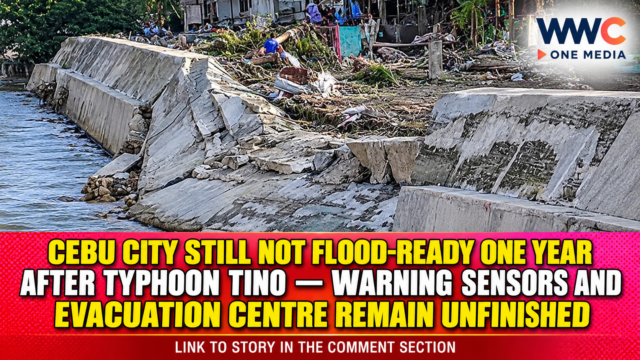
Cebu City Still Needs Better Flood Warning Systems and Evacuation Facilities
The anniversary of Tino has also exposed gaps in disaster preparedness.
Cebu City Mayor Nestor Archival said the city was still working to improve flood monitoring, emergency response and evacuation facilities.
One proposed measure is a river-monitoring sensor system involving coordination with neighbouring local governments, including Liloan and Mandaue City.
The sensors are intended to detect rising river levels and provide earlier warnings to communities at risk of flooding.
However, the project still lacks a confirmed operational timetable and publicly announced budget.
The city is also considering a dedicated evacuation facility that could accommodate families displaced by typhoons, fires and other emergencies.
Such a facility could reduce the need to use public schools as temporary shelters, allowing classes to continue with less disruption.
But the proposed centre has no announced site, final budget or construction schedule.
The situation illustrates the difference between planning disaster-resilience projects and having operational systems that can protect residents before the next emergency.
Tino’s Health Consequences Extended Beyond the Flooding
The impact of Tino was not limited to damaged homes and infrastructure.
The Provincial Health Office reported 528 leptospirosis cases following the typhoon, consisting of 504 probable cases and 24 confirmed cases.
Floodwater exposure can increase the risk of leptospirosis, a bacterial infection that can enter the body through cuts or through the eyes, nose and mouth.
To support prevention efforts, the province distributed 566,874 doses of doxycycline to local government units.
Flooding also damaged equipment at Cebu Provincial Hospital in Danao City, requiring replacements and assistance from other provincial hospitals.
Provincial health officer II Sheila Faciol said preparations for future disasters include strengthening medicine supplies, staffing and hospital equipment across the province’s 16 hospitals.
The figures show that rebuilding after a major typhoon must include healthcare capacity, not just roads and buildings.
Cebu Wants to Rebuild Differently, Not Simply Repair What Was Damaged
Provincial officials say the recovery programme is intended to make Cebu more resilient to future disasters.
Provincial Disaster Risk Reduction and Management Office chief Dennis Pastor described a flood-mitigation approach combining engineered structures with nature-based solutions.
The strategy involves slowing runoff in upstream areas, retaining water in midstream locations and improving drainage downstream.
The province is also coordinating with academic institutions and other experts to develop measures addressing flooding, drought and landslides.
Five batches of climate and disaster risk assessment training have been conducted for municipal disaster officers and planning personnel.
The approach reflects a growing recognition that rebuilding damaged infrastructure without addressing the underlying risks could leave communities vulnerable to another major storm.
Cebu’s challenge is particularly complicated because the province was already recovering from the September 2025 earthquake when Tino struck.
The two disasters placed additional pressure on engineering teams, local budgets and national rehabilitation programmes.
National Government Funding Remains a Major Part of the Recovery Challenge
The funding issue had already drawn attention months before the first anniversary of Tino.
In July 2026, the Regional Development Council Region 7 pressed national agencies to expedite the release of more than ₱6.6 billion in rehabilitation funding for Cebu’s earthquake and typhoon recovery.
The Philippine Information Agency reported that the Department of Public Works and Highways Region 7 had proposed 148 repair and rehabilitation projects worth approximately ₱4.5 billion under its Quick Response Fund.
At that time, around ₱856 million had been released, while the council sought the remaining ₱3.6 billion.
The council also endorsed a request for ₱2.9 billion under the Disaster Rehabilitation and Recovery Assistance Program for 14 local government units affected by Tino.
These figures cover different disaster-recovery programmes and should not be added directly to the latest ₱11.174-billion assessment. They also include earthquake-related requirements, not just Tino damage.
Nevertheless, they demonstrate why the province cannot rely on its own resources alone to complete the recovery.
The release of national funding, local government coordination and timely procurement will all influence how quickly damaged facilities can be restored.
What Happens If Another Major Storm Hits Before Recovery Is Complete?
The biggest concern is not simply how much money Cebu needs.
It is whether critical infrastructure, warning systems and evacuation facilities will be ready before another destructive weather event affects the province.
Unfinished bridges can restrict access to upland communities. Incomplete drainage and flood-monitoring systems can leave residents with less time to respond to rising water. Delayed housing reconstruction can leave families more vulnerable when another disaster strikes.
WWC One Media has previously examined the wider Cebu flood problem in its report on 65 developers placed under scrutiny over flood-mitigation measures.
The province’s recovery challenge also connects to the broader national disaster problem, as explored in WWC’s report on storm damage reaching ₱12.4 billion across the Philippines.
For communities still dealing with damaged roads, homes and public facilities, the real measure of recovery will be whether government plans translate into completed projects and safer living conditions.
THE BOTTOM LINE
Cebu needs an estimated ₱11.174 billion to recover from Typhoon Tino, which killed 143 people and devastated communities across the province in November 2025.
The provincial government has reported housing assistance for 14,238 families and allocations for infrastructure projects, but several priority bridges remain in procurement, while Cebu City is still working on flood-warning improvements and permanent evacuation facilities.
The rehabilitation plan is also expected to incorporate stronger engineering standards, better flood management and climate-resilient infrastructure.
The challenge now is turning the multibillion-peso assessment into actual funding, completed construction and safer communities.
One year after Tino, Cebu is still rebuilding. The question is whether the next disaster will arrive before the province is ready.