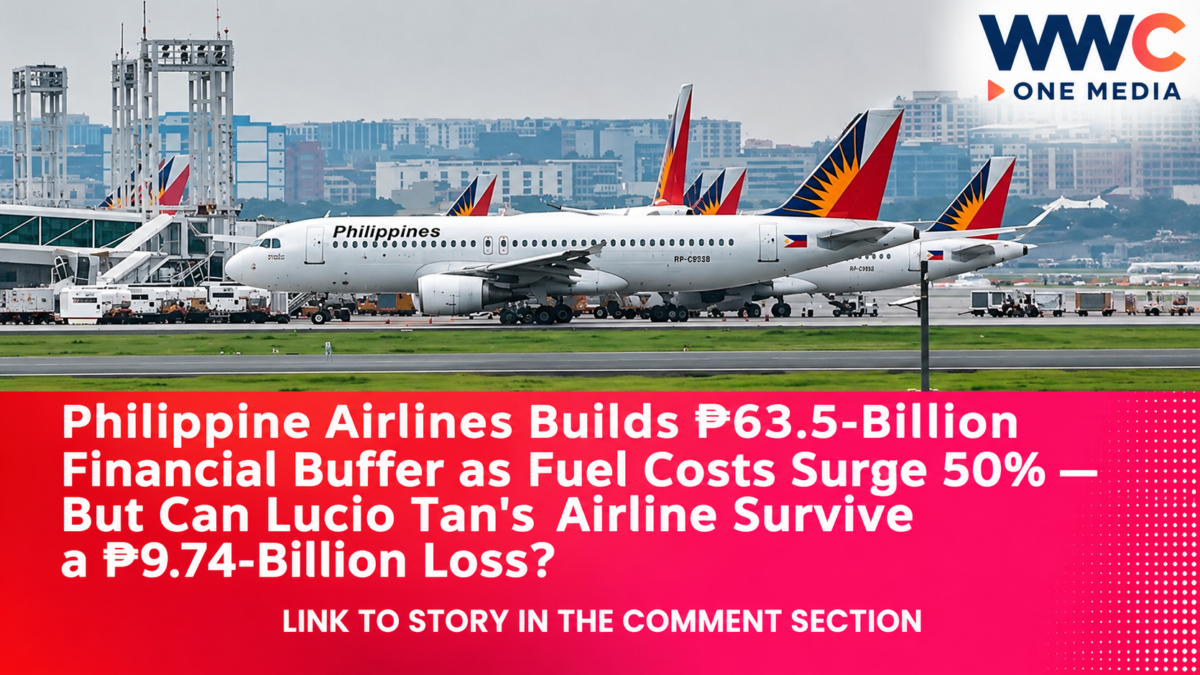
MANILA, Philippines — November 5, 2026 | WWC ONE MEDIA | Aviation, Business & Financial Markets
Lucio Tan’s Philippine Airlines (PAL) has built a financial buffer worth approximately $1 billion, or ₱63.5 billion, as soaring jet fuel costs, geopolitical tensions and increasingly expensive aircraft investments threaten to derail the flag carrier’s financial recovery.
But behind the airline’s rapidly growing reserves lies a troubling reality.
PAL recorded a ₱9.74-billion net loss during the first nine months of 2026, reversing a ₱9.88-billion profit during the same period last year.
The airline’s fuel expenses surged nearly 50% to ₱62.04 billion, overwhelming the benefits of stronger revenue and higher passenger yields.
In response, PAL has more than doubled its cash and short-term investments, adjusted airfares and fuel surcharges, reduced selected flight frequencies and strengthened its access to financing.
According to its September 30 financial statements, cash and short-term investments reached ₱55 billion, compared with ₱25.4 billion at the end of 2025.
The company also reported approximately $135 million in committed credit lines, bringing its broad liquidity measure to around ₱63.5 billion.
However, the financial buffer is not entirely cash.
The company’s filing specifies that only $35 million of the reported credit lines was fully available at the reporting date.
Meanwhile, PAL is preparing for another major expansion involving Boeing 787 Dreamliners, Airbus A350 aircraft and its planned entry into the oneworld global airline alliance.
The question now is whether the flag carrier can use its stronger financial position to survive the fuel crisis—or whether mounting debt, aircraft commitments and expensive jet fuel could overwhelm its recovery.
PAL More Than Doubles Cash Reserves in Nine Months
Philippine Airlines has made liquidity protection a central financial priority.
At the beginning of 2026, the carrier held approximately ₱25.4 billion in cash.
By September 30, its cash and short-term investments had increased to ₱55 billion.
The change represents an increase of roughly ₱29.6 billion.
In US-dollar terms, the company’s earnings announcement reported $879 million in cash and short-term investments, compared with $431 million at the end of 2025.
The substantial increase provides additional financial flexibility as management confronts unusually high operating costs.
Cash reserves can help airlines pay suppliers, maintain aircraft, support operations and manage unexpected disruptions.
However, the increase did not come exclusively from operating profits.
The company raised additional financing through debt issuance, including $350 million in senior unsecured notes.
That distinction matters because borrowing can strengthen immediate liquidity while also creating future interest and repayment obligations.
A larger cash balance is positive for short-term financial flexibility, but it does not automatically mean an airline has become more profitable or less indebted.
Breaking Down PAL’s Reported $1-Billion Financial Buffer
The $1-billion headline refers to a broad liquidity measure.
The airline’s financial statements show the following components as of September 30, 2026:
- ₱55 billion: Cash and short-term investments.
- Approximately ₱8.46 billion: Reported committed credit lines of up to $135 million.
- Approximately ₱63.5 billion: Combined headline liquidity measure.
But PAL’s detailed filing makes another important disclosure.
Of the $135 million in committed credit lines, only $35 million was described as fully available on September 30.
That is equivalent to approximately ₱2.19 billion.
Consequently, the full credit-line figure should not be treated as unrestricted cash immediately available for spending.
The difference is important when assessing the company’s ability to meet financial obligations during a prolonged industry downturn.
PAL reported that its broader cash and committed-facilities measure represented approximately 30% of trailing annual revenue.
That was above management’s minimum liquidity target of 15%.
The buffer provides breathing room, but access conditions, debt obligations and future operating expenses will determine how much financial flexibility the airline ultimately retains.
Fuel Costs Jump Nearly 50% as Middle East Conflict Disrupts Aviation
Fuel has become PAL’s biggest financial challenge.
During the first nine months of 2026, jet fuel expenses increased 49.8% to approximately $1.02 billion.
That represented an increase of $339.4 million compared with the previous year.
The average jet fuel price paid by the airline rose 52.7% to $152.72 per barrel.
Fuel accounted for 39.6% of operating expenses, compared with 30.7% during the first nine months of 2025.
This dramatic increase reflects the impact of geopolitical disruption linked to the Middle East conflict.
Oil supply concerns, changes in refining markets and disrupted international transportation routes have contributed to higher fuel costs.
For airlines, the consequences are immediate.
Aircraft require large quantities of aviation fuel, and much of that cost must be paid regardless of whether a flight is completely full.
The pressure is particularly difficult for long-haul carriers operating flights between Asia, North America and Europe.
Even when passenger demand remains healthy, a sudden increase in fuel prices can erase operating margins.
For PAL, the increase in fuel expenses was large enough to overwhelm the benefits of growing revenue.
₱9.74-Billion Net Loss Reverses Last Year’s Profit
PAL’s nine-month financial results illustrate the severity of the challenge.
The carrier reported a net loss of ₱9.74 billion, compared with net income of ₱9.88 billion in the corresponding period of 2025.
In US-dollar terms, the airline reported a $159-million net loss versus a $158.7-million profit a year earlier.
Total revenue rose 4% to $2.50 billion, up from $2.40 billion.
But total operating expenses increased much faster, rising 15.9% to $2.57 billion.
The imbalance demonstrates why higher revenue does not always mean stronger profitability.
An airline can charge more for tickets, improve revenue management and strengthen cargo sales while still losing money if expenses rise more quickly.
PAL President Richard Nuttall said the company had responded through disciplined capacity management, improved commercial initiatives and strict control of expenses.
Management remains focused on protecting liquidity while positioning the airline for a return to stronger profitability.
However, no guaranteed timetable for a return to net profit was provided in the announcement.
Passenger Numbers Fall Even as Revenue Grows
The airline’s results revealed another significant development.
PAL carried approximately 11.6 million passengers during the first nine months of 2026.
That represented a 6% decline from the comparable period last year.
Its passenger load factor also fell to 77.5%, compared with 79.4% previously.
Yet total revenue increased.
Passenger revenue climbed 1.9% to $2.08 billion, reflecting improved yields and commercial initiatives.
Ancillary revenue rose 6% to $235.1 million, supported by services such as premium-seat upgrades and prepaid baggage.
Cargo revenue surged 34.8% to $158.5 million.
The numbers suggest that PAL was earning more revenue from a smaller passenger base while benefiting from stronger freight operations.
But the airline still faced substantial cost pressure.
The challenge is whether it can improve revenue per flight sufficiently to compensate for expensive fuel and other fixed operating expenses.
Higher Fuel Surcharges Could Mean More Expensive Flights
One of PAL’s responses has been to adjust fares and fuel surcharges.
The strategy allows the airline to recover part of its higher fuel bill from travelers.
But fuel surcharges in the Philippines are subject to Civil Aeronautics Board regulations.
WWC ONE MEDIA previously reported on Airline Fuel Surcharges Jumping to Level 17, Pushing Philippine Airfares Higher in October.
The October 1–15 adjustment allowed higher surcharge ceilings for domestic and international flights.
Under that schedule, allowable domestic fuel surcharges ranged from ₱559 to ₱1,635 per passenger, depending on flight distance.
International surcharges could be substantially higher on long-haul routes.
These were historical ceilings for the specified October period, not automatic surcharges applying to every ticket in November.
Airlines must comply with the applicable approved charges for each period.
For passengers, the important consideration is the total fare, including taxes, charges and optional services.
For PAL, raising prices may help offset fuel costs, but excessive fare increases could also reduce demand.
Why PAL Is Reducing Flights on Selected Routes
The airline has also adjusted its network and capacity.
Management said it reduced flights on selected routes to contain costs.
This approach can help airlines avoid operating services that generate insufficient revenue relative to their expenses.
An aircraft departure involves fuel, crew, maintenance, airport fees and other costs.
When fuel prices rise sharply, flights that were previously profitable can become financially unattractive.
Reducing frequency may improve the profitability of the remaining services.
But the decision can also reduce travel choices for passengers and affect destinations dependent on air connectivity.
PAL has not published a comprehensive route-by-route profit breakdown in the reviewed announcement.
Consequently, specific route profitability should not be inferred simply because an airline has adjusted its schedules.
Cebu Pacific Is Facing Similar Financial Pressure
PAL is not the only Philippine carrier struggling with fuel costs.
Its main domestic competitor, Cebu Pacific, has also faced difficult operating conditions.
WWC ONE MEDIA examined the situation in Cebu Pacific Defies September Travel Slump With 1.91 Million Passengers — But Falling Overseas Demand and a ₱5.9-Billion Loss Tell a Bigger Story.
Cebu Pacific’s parent company recorded a first-half 2026 net loss of approximately ₱5.89 billion.
The airline subsequently adjusted international capacity while focusing on routes where passenger demand and operating economics remained more attractive.
The two carriers use different business models.
PAL operates as a full-service network airline, while Cebu Pacific emphasizes low-cost operations.
Nevertheless, both are exposed to fuel-price volatility and the need to manage aircraft utilization carefully.
Their results indicate that the problem is broader than a single company’s management strategy.
PAL Raises $350 Million Through Five-Year Notes
One of the most important sources of PAL’s stronger liquidity was its financing activity.
In July and August 2026, the airline issued $350 million in five-year senior unsecured notes.
The proceeds helped increase cash reserves.
The notes mature in 2031.
Debt financing can provide immediate capital for working requirements, aircraft-related commitments and financial stability.
However, it also creates obligations to pay interest and repay principal.
For investors, the relevant question is whether PAL can generate enough operating cash flow and earnings to manage those obligations comfortably.
The airline reported $247 million in free cash flow during the first nine months of 2026.
That was a positive development despite the net loss.
But the company still faces debt servicing, lease obligations, operating expenses and future aircraft investment.
A strong cash balance therefore must be evaluated alongside the liabilities supporting it.
Debt-to-EBITDA Ratio Climbs Above Management’s Target
PAL’s detailed quarterly filing provides an additional warning.
Its total debt-to-EBITDA ratio, excluding specified ground property lease obligations, reached 6.36 times as of September 30.
That was above management’s medium-term target of no more than 3.5 times.
The company’s net debt-to-EBITDA ratio stood at 4.26 times.
EBITDA measures earnings before interest, taxes, depreciation and amortization.
The ratio compares indebtedness with a measure of operating earnings.
When earnings decline, the ratio can rise even if a company is also increasing its liquidity.
The deterioration reflected weaker EBITDA amid higher fuel costs and increased financial obligations.
However, a debt-to-EBITDA ratio exceeding management’s internal target does not automatically establish default.
The company separately disclosed that its bond covenant included an incurrence test rather than a conventional maintenance requirement.
PAL reported compliance with relevant disclosed debt conditions at the reporting date.
The key challenge is restoring earnings while carefully managing borrowing.
Japan’s BBB Rating Provides a Vote of Confidence
Despite the financial pressure, PAL has achieved an important credit-rating milestone.
In October 2026, Japan Credit Rating Agency assigned the airline a BBB long-term foreign-currency issuer rating with a stable outlook.
That falls within JCR’s investment-grade category.
WWC ONE MEDIA previously covered the development in Philippine Airlines Wins Investment-Grade BBB Rating From Japan — But Rising Debt and Fuel Costs Could Test Its Global Comeback.
The rating reflects PAL’s established market position, international network, financial discipline and liquidity.
However, not every ratings agency assesses the airline in the same way.
Fitch Ratings assigned PAL a BB rating, while Moody’s gave it a Ba2 rating.
Both ratings fall below investment grade on their respective scales.
The differences demonstrate that creditworthiness is assessed through several methodologies and assumptions.
PAL’s investment-grade recognition from JCR is meaningful, but it is not a guarantee that the airline’s financial position will remain strong regardless of future fuel prices or debt levels.
PAL’s Fleet Expansion Adds Another Financial Challenge
PAL is also preparing for a major fleet modernization program.
At the Farnborough International Airshow in July, it signed memoranda of understanding involving:
- 15 Boeing 787-10 Dreamliner aircraft, with options for five more.
- Nine additional Airbus A350-1000 aircraft, with purchase rights for five more.
The combined base number is 24 widebody aircraft, with potential rights covering 10 additional jets.
The program is intended to support long-haul network development, passenger service improvements and operating efficiency.
However, the memoranda of understanding must be distinguished from completed aircraft deliveries or fully finalized purchase contracts.
Delivery schedules, financing arrangements and contractual commitments may change as negotiations progress.
The airline is seeking to expand and modernize while managing a difficult financial environment.
Newer aircraft may provide fuel-efficiency advantages compared with the older equipment they replace.
But acquiring them requires substantial capital and long-term planning.
The benefits depend on purchase terms, utilization, demand and the future cost of operating each aircraft.
A Bigger Fleet Does Not Guarantee Bigger Profits
PAL has continued adding aircraft to its operating fleet.
Its November 4 earnings release said three Airbus A350-1000s and two Airbus A320s joined the fleet during 2026.
The operating fleet increased from 79 to 86 aircraft, reflecting other fleet movements as well.
Modern aircraft can improve passenger comfort and potentially lower certain operating costs.
They may also allow an airline to serve new markets or increase capacity.
But a larger fleet can become financially burdensome when passenger demand weakens or costs increase.
Aircraft create lease, financing, maintenance, staffing and operating obligations.
For PAL, the critical issue will be matching capacity with economically sustainable demand.
Expanding faster than the market can absorb may weaken profitability.
Expanding too cautiously may allow competitors to gain market share.
Middle East Conflict Adds More Than Fuel-Price Risk
The Middle East crisis has also disrupted airline operations.
In October, Philippine Airlines canceled selected Manila–Riyadh flights following reported attacks affecting aviation infrastructure in Saudi Arabia.
WWC ONE MEDIA documented the developments in Philippine Airlines Cancels Manila–Riyadh Flights After Saudi Airport Attacks — But More Disruptions Could Follow.
The specific cancellations reflected safety concerns and operational assessments.
They did not establish that PAL had permanently suspended all services to Saudi Arabia.
Geopolitical disruption can affect airline costs in several ways.
Aviation fuel may become more expensive.
Airspace restrictions can require longer routes.
Security concerns may force cancellations, schedule changes or additional precautions.
These developments can increase operating costs even when the underlying demand for travel remains strong.
Tourism Growth Still Provides Opportunities
Despite rising costs, PAL continues to identify opportunities in domestic and international tourism.
In October, the airline deployed a widebody Airbus A330 aircraft on its Manila–Bohol route.
WWC ONE MEDIA covered the expansion in Philippine Airlines Deploys 309-Seat Airbus A330 on Manila–Bohol Route — But Can Bigger Flights Transform the Island’s Tourism Industry?.
The move increased the number of seats available on selected services to Bohol-Panglao International Airport.
It also illustrated how PAL can respond to demand from domestic tourism destinations.
However, an increase in seating capacity does not guarantee stronger profitability.
An airline must fill enough seats at sustainable yields to cover operating costs.
For PAL, the balance between travel demand and operating expenses remains the central challenge.
Oneworld Membership Could Support International Growth
PAL is also preparing to join the oneworld airline alliance.
The carrier received an invitation in June 2026 and expects to become the network’s 16th member.
The alliance includes major international airlines and can provide opportunities for connecting flights, frequent-flyer cooperation and broader international connectivity.
For PAL, membership could improve its ability to attract passengers traveling between the Philippines and destinations served by other alliance members.
It may also support higher-value business and premium travel.
But membership is not the same as an immediate increase in profit.
The commercial benefits will depend on integration, passenger demand, partnership arrangements and the airline’s ability to operate the expanded network efficiently.
What Other News Outlets Confirm
InsiderPH reported on November 4 that PAL had built a financial buffer of approximately ₱63.5 billion, including cash and committed financing.
PAL’s original quarterly filing independently confirms its cash balance, credit-line disclosures, debt ratios and liquidity objectives.
The airline’s own November 4 earnings release confirms its $159-million nine-month loss, 49.8% fuel-cost increase, higher revenue and $247 million in free cash flow.
BusinessMirror separately reported the financial deterioration and its connection to high fuel costs.
The Philippine Star independently confirmed that the airline returned to a net loss despite stronger revenue.
The available evidence supports the conclusion that PAL has materially strengthened its reported liquidity.
But the original filing also establishes that not all of the reported credit-line capacity was fully available at the reporting date.
That qualification is essential to understanding the $1-billion headline.
The Bottom Line: PAL Has More Cash, but Also More Financial Pressure
Philippine Airlines has strengthened its financial defenses at a moment when the global airline industry is facing exceptional uncertainty.
Its cash and short-term investments more than doubled to ₱55 billion.
Including committed credit facilities, the airline reported a broader financial buffer of around ₱63.5 billion.
The stronger position could help PAL absorb unexpected costs, maintain operations and manage its investment commitments.
But the airline also recorded a ₱9.74-billion loss during the first nine months of 2026.
Fuel expenses surged nearly 50%, debt-to-EBITDA increased above management’s target, and expensive aircraft plans remain ahead.
The financial buffer is therefore a defensive measure, not proof that the airline’s profitability problems have been resolved.
PAL has gained important financial flexibility, but its long-term recovery will depend on restoring earnings, managing borrowing and ensuring that fleet expansion produces sustainable returns.
As Lucio Tan’s flag carrier prepares to modernize its fleet while facing a costly fuel crisis, will its ₱63.5-billion liquidity buffer be enough to protect the business—or could another surge in jet fuel prices threaten one of the Philippines’ most ambitious airline expansion plans?