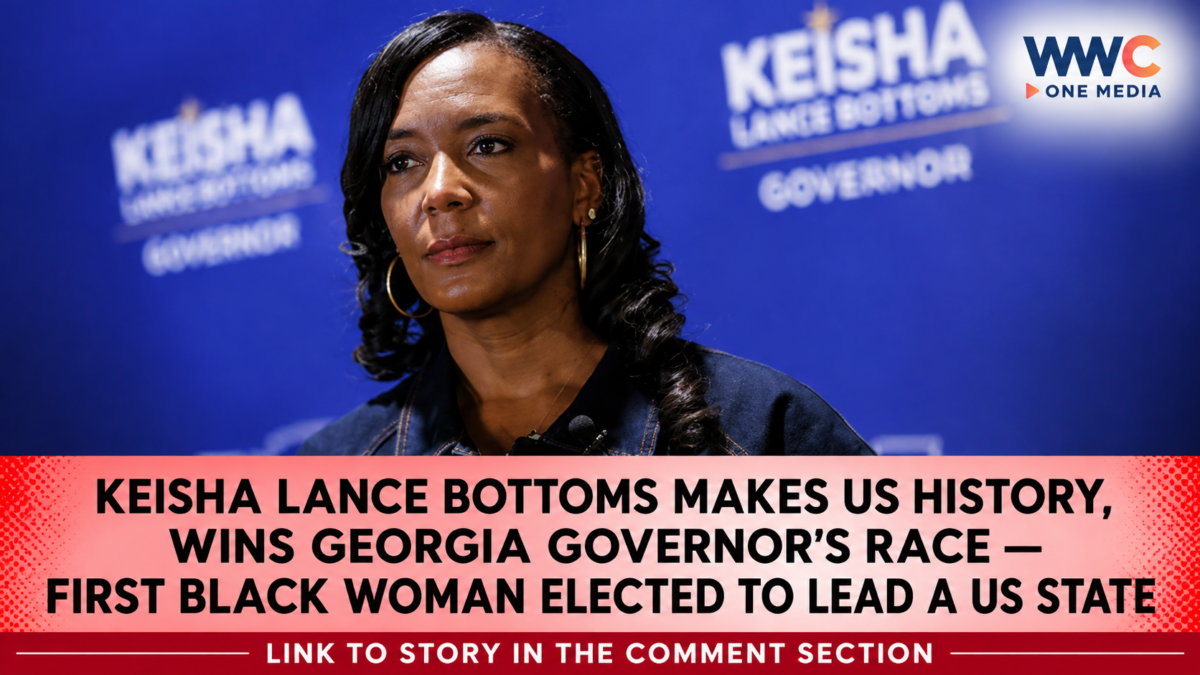
Georgia has made American political history.
Democrat Keisha Lance Bottoms has won the state’s gubernatorial election, defeating Republican businessman Rick Jackson and becoming the first Black woman elected governor of a US state.
The victory also makes Bottoms Georgia’s first female governor and ends more than two decades of Republican control over the state’s highest executive office.
The former Atlanta mayor secured the historic win in the November 3, 2026, midterm elections, according to projections by major US news organizations. She will succeed outgoing Republican Governor Brian Kemp, who was prevented from seeking another consecutive term after serving two terms.
The result is significant not only because it breaks a longstanding racial and gender barrier, but also because it changes the political landscape of one of America’s most closely watched battleground states.
Bottoms defeated Jackson, a billionaire healthcare entrepreneur who reportedly spent more than US$200 million of his personal fortune trying to win the governorship.
Her victory also represents a major comeback for a politician whose public career has included leading Atlanta through the COVID-19 pandemic, navigating protests over police violence and later serving in former President Joe Biden’s White House.
But the historic achievement comes with an enormous responsibility.
Bottoms must now turn campaign promises on healthcare, affordability, public safety and economic development into actual government policies — potentially while facing resistance from Republican lawmakers.
Georgia has elected a Black woman governor for the first time. The question now is whether Bottoms can turn that historic breakthrough into a lasting political transformation.
Keisha Lance Bottoms Breaks a Historic Barrier in American Politics
Bottoms’ victory marks a first in the history of US state governorships.
No Black woman had previously been elected governor of a US state. Her election therefore represents a major milestone for Black women in American politics, who have long played an important role in Democratic electoral coalitions but remained underrepresented in the country’s highest state executive offices.
She will also become the first woman to lead Georgia as governor.
The significance extends beyond representation.
Georgia is a major Southern state that has experienced substantial political changes over the past decade. Once considered a reliably Republican stronghold, it has become a competitive battleground in presidential, Senate and statewide elections.
Bottoms’ win demonstrates that Democrats can still secure major victories in the state despite Republican success in the 2024 presidential election.
Her election also follows the unsuccessful gubernatorial campaigns of fellow Democrat Stacey Abrams, who became the first Black woman nominated for governor by a major US political party in 2018.
Abrams lost to Kemp in both 2018 and 2022.
Bottoms has now achieved what earlier Democratic campaigns could not: winning Georgia’s highest executive office.
Who Is Keisha Lance Bottoms?
Bottoms, 56, is a former Atlanta mayor whose political career has taken her from local government into the national spotlight.
Before becoming mayor, she served on the Atlanta City Council.
She won the mayoral election in 2017 and took office in January 2018, serving until January 2022.
Her four-year tenure coincided with some of the most challenging periods in recent American history.
Atlanta faced the COVID-19 pandemic, economic disruption and protests following the murder of George Floyd in 2020.
Bottoms became nationally recognised for her response to the demonstrations and her public disagreements with Kemp over pandemic restrictions.
Her administration also faced criticism over crime, policing and the city’s handling of public disorder during the protests.
Those controversies became important issues during her gubernatorial campaign, with Republican opponents questioning whether her record as mayor qualified her to lead an entire state.
After leaving Atlanta City Hall, Bottoms joined the Biden administration.
She served as a senior adviser to Biden and director of the White House Office of Public Engagement, giving her experience in federal government and national political affairs.
Her background became a central part of her campaign message: she argued that her experience managing a major American city and working in the White House prepared her to lead Georgia.
Rick Jackson’s More Than US$200 Million Campaign Spending Could Not Secure Victory
Bottoms’ Republican opponent was Rick Jackson, a billionaire healthcare entrepreneur and founder of Jackson Healthcare.
Jackson entered the race as a political outsider, presenting his business background and personal story as evidence that he could bring a different approach to state government.
He campaigned on tax cuts, public safety, deregulation and economic development.
His personal background also became a major feature of his campaign. Jackson has spoken about growing up in foster care and overcoming difficult circumstances before building his healthcare staffing business.
But the race attracted national attention for another reason: the extraordinary amount of money Jackson spent trying to win.
The Associated Press and Atlanta Journal-Constitution reported that Jackson spent more than US$200 million of his own money on the campaign.
His spending gave him a substantial financial advantage in advertising and campaign operations.
Despite that investment, Bottoms emerged as the projected winner.
The result highlights an important reality of American elections: campaign spending can influence visibility and political messaging, but it cannot guarantee that voters will support a candidate.
Jackson conceded the race and said he respected the decision made by Georgia voters.
His defeat represents a major setback for Republicans who hoped to maintain control of the governorship.
Georgia’s Governor’s Mansion Returns to Democratic Control After 24 Years
Bottoms’ victory ends a long period of Republican dominance in Georgia’s governorship.
The last Democrat elected governor of Georgia before the Republican era was Roy Barnes, who won in 1998.
Republican Sonny Perdue defeated Barnes in 2002 and took office in January 2003.
The Republican Party subsequently retained the governorship through the administrations of Perdue, Nathan Deal and Brian Kemp.
Bottoms’ election therefore ends approximately 24 years of Republican control, measured from the 2002 election and the beginning of the next gubernatorial term.
The political shift is particularly important because Georgia has become one of the most consequential states in national elections.
Its electoral votes helped Joe Biden win the presidency in 2020, while Donald Trump carried the state again in 2024.
The changing results demonstrate that Georgia’s electorate is competitive and that neither party can safely assume permanent control.
For Democrats, Bottoms’ win is an opportunity to establish a stronger statewide presence.
For Republicans, losing the governorship creates a new challenge in a state where the party has held substantial political influence for years.
Trump’s Endorsement of Jackson Becomes a Political Setback
The Georgia gubernatorial election was also closely watched because of President Donald Trump’s involvement in the Republican campaign.
Jackson positioned himself as a supporter of Trump’s political agenda and campaigned on policies aligned with conservative priorities.
Trump endorsed Jackson and appeared with him during the campaign’s closing weeks.
Bottoms, meanwhile, sought to connect her opponent to the president’s national political record.
Her victory is therefore a setback for Trump’s preferred candidate in a state that supported him in the 2024 presidential election.
However, it would be inaccurate to attribute Jackson’s defeat entirely to Trump’s endorsement.
Voters were also considering local economic conditions, healthcare, public safety, taxes, abortion policy and the candidates’ individual records.
The result is part of a broader national midterm picture, but Georgia’s gubernatorial race remains a separate election with its own candidates and issues.
Barack Obama and Kamala Harris Helped Energise Bottoms’ Campaign
Bottoms attracted support from prominent Democratic figures during the campaign.
Former President Barack Obama appeared at a rally supporting her candidacy in the final days before the election.
Former Vice President Kamala Harris also campaigned with Bottoms, helping bring national attention to the Georgia contest.
Their involvement reflected the importance Democrats placed on winning the governorship.
Georgia has become a crucial state for the party’s future electoral strategy, and Bottoms’ campaign offered an opportunity to demonstrate that Democrats could win statewide even in a politically divided environment.
Senator Jon Ossoff also supported Bottoms and campaigned alongside her.
The presence of national Democratic figures helped reinforce the message that the election was not simply about Georgia’s next governor, but also about the future direction of American politics.
Healthcare Expansion Could Become Bottoms’ Biggest Policy Test
One of the central issues in Bottoms’ campaign was healthcare.
She promised to expand Medicaid under the Affordable Care Act, a policy that could extend coverage to additional low-income adults in Georgia.
Georgia has historically faced challenges involving uninsured residents and access to affordable healthcare, particularly in rural communities.
Bottoms argued that expanding coverage could help families obtain medical care while strengthening hospitals and healthcare providers.
Her campaign also focused on improving affordability and raising the minimum wage to US$15 an hour.
She proposed increasing compensation for public employees and addressing economic pressures facing working families.
These proposals could become major priorities once she takes office.
However, campaign promises are not the same as enacted policies.
Medicaid expansion would require administrative preparation and coordination with the federal government. Significant changes to state spending and employment policy could also require legislative approval.
Bottoms will need to demonstrate how she intends to finance and implement her proposals.
Georgia’s Six-Week Abortion Ban Could Become Another Major Political Battle
Abortion policy was another important difference between Bottoms and Jackson.
Bottoms campaigned on repealing Georgia’s six-week abortion ban, one of the most restrictive abortion laws in the United States.
The law generally prohibits most abortions once embryonic cardiac activity can be detected, subject to specific exceptions.
Bottoms supports expanding reproductive rights and has argued that women should have greater control over decisions involving pregnancy and healthcare.
Jackson defended Georgia’s existing restrictions.
The issue could become one of the most contentious areas of Bottoms’ administration.
However, winning the governorship does not automatically repeal state law.
Any effort to change Georgia’s abortion restrictions would face legal and legislative challenges.
The composition of the state legislature will therefore be crucial in determining how much of Bottoms’ campaign agenda can become reality.
Data Centers and Technology Investment Could Test Georgia’s Economic Direction
Georgia has attracted major investment in data centres, technology infrastructure and related industries.
These developments can generate construction jobs, attract businesses and contribute to local economic activity.
But they also raise concerns about electricity consumption, water use, land requirements and the pressure placed on public infrastructure.
Bottoms proposed pausing new data-centre development to give the state more time to evaluate its impact.
She also raised concerns about the expansion of surveillance technology, including additional Flock camera installations.
Jackson generally supported a more business-friendly approach, emphasising investment, economic development and reducing government regulation.
The disagreement reflects a growing debate across the United States.
Governments must balance the economic benefits of technology investment with questions about environmental impact, public resources and community concerns.
Bottoms’ proposed pause does not mean that Georgia has already imposed a statewide construction ban.
The details, legal authority and potential economic consequences of any future action remain to be determined.
Can Bottoms Govern With a Republican-Controlled Legislature?
Winning the governorship gives Democrats control of Georgia’s executive branch, but it does not automatically give the party control of the entire state government.
The Georgia legislature has historically been controlled by Republicans.
That creates a potential obstacle for Bottoms, particularly if lawmakers oppose her proposals on Medicaid expansion, abortion rights, taxation or data-centre development.
A governor has important powers, including proposing budgets, appointing officials and signing or vetoing legislation.
But major policy changes generally require cooperation from the legislature.
Bottoms may therefore face a difficult political environment from the beginning of her administration.
She will need to negotiate with lawmakers who may have different priorities and political interests.
Her ability to build bipartisan support could determine whether her historic victory produces substantial policy changes or becomes a prolonged struggle with the state legislature.
Jon Ossoff’s Reelection Adds to Georgia Democrats’ Momentum
Bottoms was not the only Democrat to secure an important victory in Georgia on election night.
Democratic Senator Jon Ossoff also won reelection, defeating Republican challenger Mike Collins, according to election projections.
Ossoff’s victory preserved an important Democratic-held Senate seat.
The two results have different consequences: Ossoff retained his existing position in Washington, while Bottoms flipped the governorship from Republican to Democratic control.
Together, the victories strengthen the Democratic Party’s position in a state that has become central to national electoral calculations.
WWC One Media covered Ossoff’s victory in Democrat Jon Ossoff Defeats Trump’s Senate Pick in Georgia, Securing a Crucial Battleground Victory — But Can Democrats Turn It Into Control of Congress?.
The result also reinforces the importance of Georgia ahead of the 2028 presidential election.
However, a gubernatorial victory and a Senate victory do not automatically determine control of Congress. The House and Senate have their own election results and majority requirements.
Georgia’s Changing Voters Helped Turn a Republican Stronghold Into a Battleground
Georgia’s political transformation did not happen overnight.
The Atlanta metropolitan area has expanded, the state’s population has become more diverse and Democratic voter-registration and mobilisation efforts have grown.
Black voters have played a central role in the Democratic coalition.
Stacey Abrams’ campaigns in 2018 and 2022 also brought national attention to Georgia’s electoral infrastructure and voter participation.
Although Abrams lost both gubernatorial elections, her campaigns helped strengthen Democratic organising and build a broader coalition.
Bottoms’ victory reflects the continuing importance of these political changes, alongside her own campaign strategy and the choices made by voters in 2026.
The result does not mean Georgia is now permanently Democratic.
Trump’s 2024 victory in the state shows that Republicans remain competitive.
Instead, Bottoms’ win reinforces Georgia’s status as a state where both parties must work hard to secure statewide victories.
The 2026 Midterms Could Reshape the Political Future of the United States
The Georgia result comes during a nationwide midterm election with significant consequences for President Trump’s administration.
The midterms determine control of Congress and can influence how much room a president has to advance legislation, oversee government agencies and implement national priorities.
Bottoms’ victory is one of several Democratic gains receiving attention across the country.
WWC One Media examined the wider election environment in Record 48 Million Americans Vote Early in 2026 Midterms as Democrats Surge in Key Battlegrounds — But Could Election Day Change Everything?.
Other major gubernatorial victories have also reshaped state-level political leadership.
In Ohio, Democrat Amy Acton defeated Republican Vivek Ramaswamy in another closely watched contest. Read: Democrat Amy Acton Defeats Trump-Backed Vivek Ramaswamy in Historic Ohio Governor Race — But Could This Political Earthquake Reshape the 2028 Election?.
In Florida, Democrat Kathy Castor also secured another House term despite the national attention surrounding the state’s redistricting battle. Read: Democrat Kathy Castor Defies Trump’s Florida Redistricting Gamble to Win 11th House Term — But Could the GOP’s Own Map Cost It Congress?.
These races are separate contests, but together they help illustrate the changing political landscape following the November 3 elections.
Could Bottoms’ Victory Influence the 2028 Presidential Race?
Georgia is expected to remain one of the most important states in the 2028 presidential election.
Its electoral votes have become highly contested, and both parties are likely to invest heavily in the state.
Bottoms’ victory gives Democrats a new statewide leader who could become an influential figure in future national political discussions.
Her administration’s performance may also affect how voters evaluate the Democratic Party’s ability to govern.
The result could influence future campaign strategies involving healthcare, affordability, economic development and voting rights.
However, it is too early to conclude that Bottoms’ victory guarantees a Democratic win in 2028.
Presidential elections depend on national conditions, candidates, turnout, economic performance and developments that may not yet be predictable.
For now, the immediate challenge is governing Georgia successfully.
A Historic Win Is Only the Beginning
Bottoms’ election is a milestone for Georgia and American politics.
She has broken a barrier that remained in place throughout the country’s history of state governorships.
Her victory also marks a political shift in a state that Republicans controlled for more than two decades.
But historic elections create expectations.
Georgia voters will want to see whether Bottoms can deliver on healthcare, affordability, public safety and economic development.
She must also navigate a potentially divided state government and manage the expectations of a diverse electorate that includes both enthusiastic supporters and sceptical voters.
The next four years will determine whether her election becomes a lasting turning point in Georgia politics.
The Bottom Line
Keisha Lance Bottoms has won Georgia’s gubernatorial election, becoming the first Black woman elected governor of a US state and the first woman to lead Georgia.
Her victory over Republican billionaire Rick Jackson ends approximately 24 years of Republican control of the governorship and delivers Democrats a major win in one of America’s most important political battlegrounds.
The result also carries national significance because it comes during the 2026 midterm elections and follows a highly competitive campaign involving President Donald Trump and prominent Democratic leaders.
Bottoms now faces the difficult task of turning her campaign promises into policies.
Healthcare expansion, abortion rights, minimum-wage increases, public-sector pay and data-centre development could become major areas of debate during her administration.
Her ability to deliver those changes may depend on whether she can work with a legislature that may resist parts of her agenda.
The historic achievement is undeniable. But the real measure of her leadership will come after the celebrations end and governing begins.
Will Keisha Lance Bottoms turn her historic victory into a new political era for Georgia — or could resistance from Republicans and the challenges of governing a divided state stand in the way of her promises?