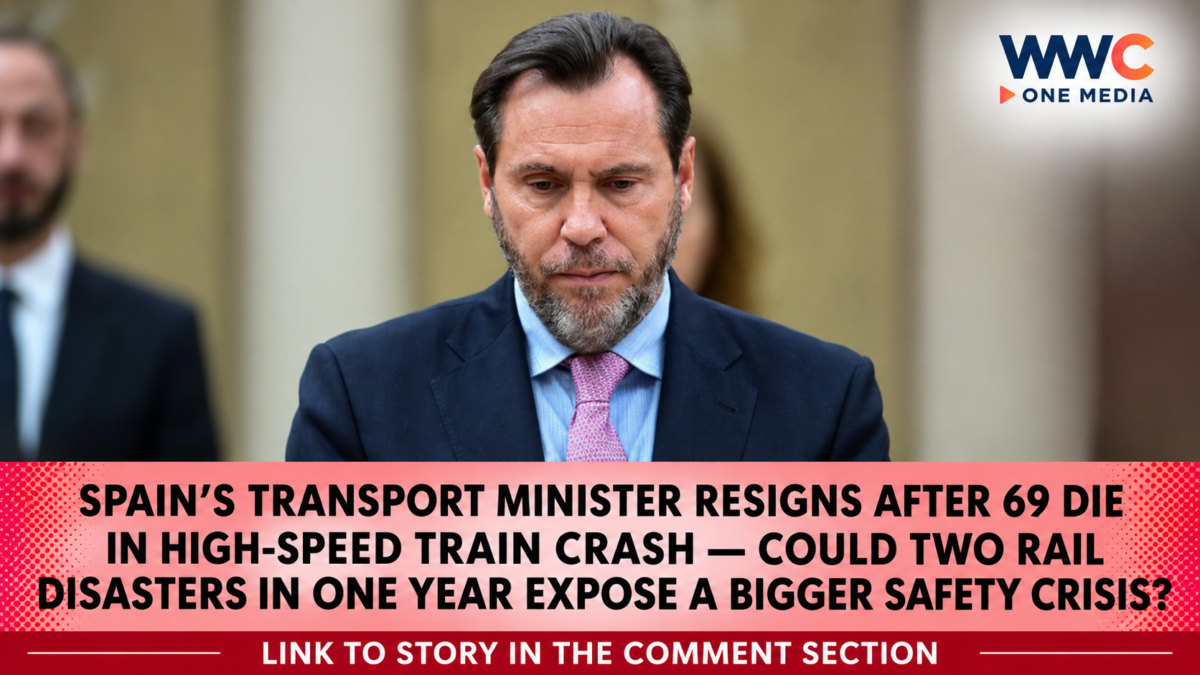
Spain’s Transport Minister Óscar Puente has announced his resignation following a devastating high-speed train collision that killed 69 people, triggering renewed scrutiny of the country’s railway safety system and raising difficult questions about how such a disaster could happen.
Puente announced on Tuesday, November 3, that he would step down after the October 28 collision near Urda, in Spain’s central Toledo province. He also confirmed that he would withdraw from the candidate lists for the country’s November 29 general election.
His announcement came after an hours-long appearance before lawmakers, where he addressed the circumstances surrounding the disaster, defended the government’s railway policies and outlined measures intended to prevent another tragedy.
The resignation marks a major political consequence of a crash that has shaken public confidence in Spain’s celebrated high-speed rail network.
But the latest disaster is not an isolated incident. Another collision on the Madrid–Seville railway corridor in January killed 46 people. With two deadly accidents in less than a year, pressure is mounting on the government to explain whether the problem goes beyond individual mistakes and points to deeper weaknesses in railway infrastructure, maintenance and safety procedures.
Transport Minister Says He Cannot Remain in Office After Two Deadly Crashes
Puente announced his decision at the end of his appearance before the Permanent Deputation of Spain’s Congress of Deputies.
He said a transport minister in a country like Spain could not remain in office after two accidents of such severity within less than a year.
According to his account, he had decided to resign shortly after learning about the October 28 collision. However, he remained in his position while emergency operations continued, preliminary investigations began and the government prepared its initial compensation and railway-safety measures.
His decision came after repeated calls for his resignation from opposition politicians and critics who questioned the government’s handling of the railway network.
Puente had previously rejected demands that he leave office. His announcement therefore represented a significant change in his position.
Prime Minister Pedro Sánchez praised the minister for his service and said he had placed the victims first and acted out of political responsibility.
However, the resignation does not end the wider political controversy. Opposition parties and railway unions continue to demand answers about the circumstances that led to the crash and whether adequate safeguards were in place.
What Happened in the October 28 Spain Train Collision?
The latest disaster happened when a high-speed train operated by Spain’s state-owned Renfe collided with a stationary train operated by private company Iryo.
The collision occurred near Urda, in Toledo province, on the Madrid–Seville high-speed line.
Authorities confirmed that 69 people were killed, while around 200 others were injured.
The sequence of events began with a failure involving the LZB signalling and safety system, which plays an important role in monitoring train movements and helping prevent collisions.
The system failure automatically stopped several trains operating along the affected section.
With the automatic system unavailable, traffic controllers at a central control centre in Madrid took responsibility for managing movements along the route.
According to the explanation provided by Puente, a controller authorised the Renfe train to resume its journey even though the Iryo train remained stopped farther ahead.
The Renfe train subsequently struck the stationary service.
Investigators estimated that the impact occurred at a speed of approximately 160 to 200 kilometres per hour.
The exact sequence of decisions, communications and technical failures remains under investigation. The minister’s explanation should therefore not be treated as a final determination of criminal or legal responsibility.
A Second Deadly Crash on the Same Railway Corridor
One of the most troubling aspects of the October disaster is that it followed another major collision on the Madrid–Seville line in January 2026.
That earlier accident occurred near Adamuz, in Córdoba province, when a train derailed and collided with another train travelling in the opposite direction.
The January disaster killed 46 people.
The two accidents involved different immediate circumstances. The January collision involved a derailment, while the October disaster followed a signalling-system failure and the movement of a train toward another service that had stopped ahead.
Nevertheless, both tragedies have intensified questions about the condition, maintenance and management of the same important railway corridor.
The fact that two fatal accidents occurred within nine months has made it increasingly difficult for authorities to reassure passengers that the network is operating safely.
Spain’s high-speed railway system has long been regarded as one of the country’s major infrastructure achievements. It is the world’s second-largest high-speed network, after China’s.
Before the two deadly accidents in 2026, the network had gone more than three decades without a fatal crash since its introduction.
The latest tragedies have therefore created a serious challenge for a system that has been central to Spain’s transportation strategy and international reputation.
Was the Disaster Caused by Human Error or a Wider System Failure?
The investigation has raised a difficult question: Was the October collision primarily the result of a controller’s decision, or did weaknesses in the railway’s safety arrangements make a catastrophic mistake possible?
Puente described the decision to allow the Renfe train to continue while another train remained stopped ahead as erroneous and difficult to explain.
However, railway unions have argued that focusing on one controller risks overlooking wider problems affecting the railway system.
Representatives of railway workers have raised concerns about staff workloads, working conditions and the repeated failure of the ageing LZB system.
They argue that controllers are being expected to manage increasingly demanding operations while dealing with technical problems and staffing pressures.
The concerns are particularly significant because railway safety depends on multiple layers of protection.
Signalling equipment, automatic braking systems, communication procedures, control-centre staffing and emergency protocols are supposed to work together to prevent one mistake or technical failure from becoming a major disaster.
If one safety layer fails, other safeguards should help prevent a collision.
That is why investigators must establish not only why the LZB system failed, but also why the backup procedures did not prevent the Renfe train from approaching the stationary Iryo service.
The final investigation will be critical in determining whether responsibility lies with an individual decision, technical deficiencies, management practices or a combination of factors.
Railway Workers Warn About Staffing and Maintenance Concerns
The debate has also turned toward working conditions across Spain’s railway network.
Railway unions have challenged the suggestion that the October collision can be explained simply as an individual controller’s mistake.
They have pointed to growing workloads, concerns about staffing levels and the pressure placed on employees responsible for coordinating train movements.
The Associated Press reported that railway workers had raised concerns about deteriorating working conditions and the demands placed on traffic controllers.
The Semaf train drivers’ union has also criticised the continued use of what it describes as degraded operating systems and called for improvements to railway safety.
The union announced planned strike action involving Renfe train drivers on November 10 and 12, adding to pressure on railway operators and the government.
Separately, workers at Adif, the state-owned railway infrastructure manager, have discussed industrial action over safety concerns.
These disputes are significant because railway safety is not determined by equipment alone. Staff training, workload, fatigue management and clear emergency procedures also play important roles in preventing accidents.
The government has promised to improve conditions in control centres and strengthen staffing arrangements.
However, railway workers will be watching whether those promises lead to concrete changes.
Spain Announces New Railway Safety Measures After the Crash
Before announcing his resignation, Puente presented a package of measures designed to improve railway safety and restore public confidence.
One major step involves reducing train services on the Madrid–Seville line until the Railway Safety Agency completes a review of the safety system and the government advances the delayed deployment of the European Rail Traffic Management System, known as ERTMS.
The government also announced a proposed speed limit of 40 kilometres per hour in situations where a driver must visually identify obstacles ahead after a signalling-system failure.
Other measures include:
- Recruiting additional railway personnel.
- Improving working conditions in railway control centres.
- Reviewing staff breaks and fatigue monitoring.
- Strengthening procedures when automatic safety systems are unavailable.
- Accelerating the deployment of standardised European railway signalling technology.
- Increasing compensation and insurance support for victims.
The government also proposed using artificial intelligence to help monitor communications between train drivers and control-centre personnel.
Puente said the proposed system would detect irregularities and monitor conversations to help minimise the possibility of human error.
Spain also plans to develop a real-time digital model of its railway network to improve monitoring and operational decision-making.
These measures could strengthen railway oversight, but they will need to be implemented, tested and independently evaluated before their effectiveness can be established.
Families of Victims to Receive Financial Assistance
The government has also announced a €30 million emergency aid package for the families of those killed and injured in the October collision.
The proposed support includes improvements to compulsory passenger insurance payments, faster compensation processing and better coverage for people temporarily unable to work because of their injuries.
The government has pledged to double compulsory passenger insurance payouts for crash victims.
However, financial assistance cannot reverse the loss suffered by families who have lost loved ones.
The compensation package is intended to provide immediate support while investigations and other legal processes continue.
Authorities have also been working to identify victims and return remains to their families.
According to an update published by the Australian Broadcasting Corporation on November 4, all 69 victims had been identified and families or relevant consulates had been notified.
The tragedy also involved foreign nationals, including Americans, Canadians and Australians, underscoring the international impact of the disaster.
Spain’s High-Speed Rail Network Faces a Crisis of Public Confidence
The latest crash has raised questions about whether Spain’s railway expansion and operational demands have been matched by sufficient investment in maintenance and safety upgrades.
Spain has one of Europe’s most extensive high-speed rail systems, connecting major cities and supporting tourism, business travel and domestic mobility.
The network’s expansion has also allowed private operators to compete with the state-owned Renfe.
However, more trains and more passengers place additional demands on tracks, signalling systems, maintenance teams and control centres.
Reuters reported that Spain’s high-speed railway investment has historically placed substantial emphasis on building new infrastructure, while a smaller share has been directed toward maintenance, renewals and upgrades.
That distinction is important.
A railway network can expand rapidly, but its long-term safety depends on maintaining existing infrastructure and ensuring that signalling and control systems remain reliable.
The October crash has intensified debate over whether modernisation has kept pace with the growing demands placed on the system.
The government has defended its investment and pointed to ongoing upgrades, but the investigations will need to establish whether any infrastructure or operational shortcomings contributed to the disaster.
Political Pressure Mounts Ahead of Spain’s November 29 Election
Puente’s resignation comes at a particularly sensitive moment for Spain’s government.
Prime Minister Pedro Sánchez called an early general election for November 29, placing the railway disaster just weeks before voters are expected to head to the polls.
The opposition had already demanded accountability following the October collision.
The minister’s departure may address one part of that political pressure, but it does not resolve the questions surrounding railway management, maintenance and safety.
The government will also have to explain how it intends to restore public trust while investigations into both deadly accidents continue.
For Sánchez, the issue extends beyond the departure of one cabinet member.
The railway network is a major public service used by millions of passengers. Any perception that the government failed to maintain adequate safety standards could become a major issue in the election campaign.
The political consequences may therefore continue long after Puente leaves office.
Why Spain’s Railway Problems Matter Beyond Its Borders
Spain’s experience also highlights a wider challenge facing countries that depend on high-speed rail systems.
Modern railways rely on complex signalling technology, centralised control centres, automated safety systems and highly trained personnel.
When those systems work together, they allow trains to travel at high speeds while maintaining safe distances and coordinated movements.
But technical failures, inadequate backup procedures or operational mistakes can have devastating consequences.
The Netherlands, Malaysia and Thailand have also experienced railway disruptions linked to signalling and infrastructure problems, although those incidents were not comparable in scale or outcome to Spain’s fatal collision.
WWC One Media has previously reported on a suspected railway sabotage incident in the Netherlands that disrupted services across several locations. Read: Dutch Rail Services Hit by Suspected Sabotage During Morning Rush Hour.
In Malaysia, signalling cable theft disrupted airport rail services, highlighting how damage to a relatively small part of railway infrastructure can affect passenger operations. Read: KLIA Express Train Services Disrupted After Two Cable Theft Incidents.
Bangkok’s MRT Blue Line has also experienced a signalling failure that disrupted services and forced passengers to adjust their journeys. Read: Bangkok MRT Blue Line Suddenly Disrupted by Signal Failure.
These incidents differ significantly from the Spanish tragedy, but they demonstrate why reliable signalling, infrastructure protection and operational safeguards are essential to modern public transportation.
For countries investing heavily in railway expansion, the lesson is clear: new tracks and faster trains must be matched by dependable maintenance, effective safety systems and adequate staffing.
What Happens After Óscar Puente’s Resignation?
Puente’s announcement marks the end of his political role as transport minister, but the investigations and safety reforms will continue.
Authorities must establish the full sequence of events behind the October 28 collision, including the technical failure, the decisions made by railway controllers and the procedures that allowed the Renfe train to continue.
Investigators are also examining the January disaster, which killed 46 people on the same railway corridor.
The government must now demonstrate that the promised safety measures will be implemented and that the railway system can operate reliably without exposing passengers and workers to unnecessary risks.
The appointment of a successor will also be important as Spain attempts to manage the aftermath of two deadly accidents and prepare for the November 29 election.
For passengers, the immediate concern is no longer simply whether trains will run on time. It is whether they can trust the system to protect their lives.
The Bottom Line
Spain’s Transport Minister Óscar Puente has announced his resignation after a high-speed train collision near Urda killed 69 people, becoming the second deadly railway disaster on the Madrid–Seville line in less than a year.
The October 28 crash involved a Renfe train striking a stationary Iryo service after a failure involving the LZB signalling system and a subsequent decision by railway controllers to allow the Renfe train to continue.
The January collision, which killed 46 people, has further intensified scrutiny of the country’s railway infrastructure and safety arrangements.
Puente’s departure represents a major political consequence, but it does not establish the final cause of either accident or settle questions about institutional responsibility.
The government has promised new safety measures, additional staffing, improved control-centre conditions, faster signalling upgrades and financial assistance for victims’ families.
The real test will be whether those measures address the weaknesses identified by investigators and prevent another tragedy.
With 115 people killed in two major railway disasters within the same year, will Spain’s promised reforms be enough to restore public confidence — or will the investigations uncover deeper problems that demand even greater accountability?