
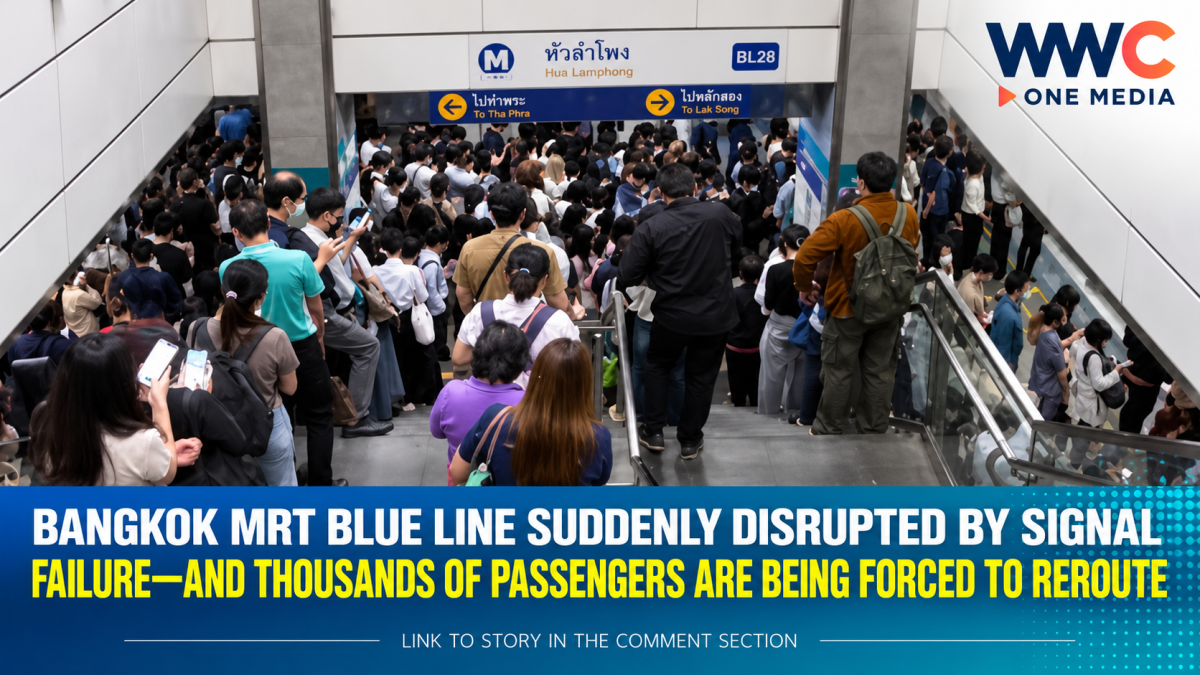
A signalling-system failure disrupted Bangkok’s MRT Blue Line on Saturday, September 12, 2026, forcing passengers to change routes as authorities worked to restore normal service.
The disruption was reported at Hua Lamphong Station, with services affected between Itsaraphap and Phetchaburi stations. Passengers travelling toward Tha Phra and Lak Song were among those affected.
What happened?
According to the Bangkok Post, the disruption was caused by a failure in the signalling system, temporarily affecting train operations on a key section of the Blue Line.
A service advisory urged passengers to allow extra travel time or consider alternative transportation while technicians worked to resolve the problem.
The incident was also being discussed by passengers in Bangkok, with reports indicating that some trains were stopped short of their intended destinations and passengers were asked to leave the trains.
Which stations were affected?
The affected section is particularly significant because the Blue Line runs through central Bangkok and connects several major transport and commercial areas.
The Blue Line’s official route includes Hua Lamphong, Sam Yan, Silom, Sukhumvit, Phetchaburi, Phra Ram 9 and Thailand Cultural Centre, before continuing north toward Bang Sue and around the Blue Line loop toward Tha Phra and Lak Song.
Passengers can normally transfer between the Blue Line and other major transport systems at several points, including Sukhumvit/Asok, Phetchaburi/Makkasan Airport Rail Link, Silom/Sala Daeng and Bang Wa.
Why the disruption matters
The MRT Blue Line is one of Bangkok’s most important urban rail corridors. The system stretches approximately 48 kilometres and has 38 stations, making a signalling failure capable of creating knock-on effects for commuters moving through central Bangkok.
Under normal operations, BEM says the Blue Line runs from roughly 6 a.m. until midnight, with trains operating more frequently during peak periods.
That means even a temporary interruption can quickly affect commuters trying to reach offices, shopping districts, tourist destinations and connecting rail services.
What passengers should do
Passengers travelling through the affected portion of the Blue Line should:
- Allow additional travel time.
- Check MRT service announcements before entering a station.
- Consider alternative routes if their destination lies within the disrupted section.
- Use connecting BTS, Airport Rail Link or other transport services where practical.
- Follow instructions from station personnel rather than attempting to board stopped or restricted services.
For passengers unfamiliar with Bangkok’s rail network, the Phetchaburi–Makkasan connection can be particularly useful because Phetchaburi Station connects with the Airport Rail Link.
Was the entire Blue Line shut down?
No. Available reports indicate that the disruption affected a section of the line rather than meaning that every Blue Line station was closed.
This distinction is important because the affected portion and operating status can change while technicians work on the signalling problem. Passengers should therefore rely on the latest operator announcements rather than assume that the entire network is unavailable.
The bigger picture
The latest disruption also highlights how heavily Bangkok depends on its integrated rail network.
The MRT Blue Line serves as a backbone connecting Bangkok’s underground and elevated rail infrastructure, while interchange stations allow passengers to move between the MRT, BTS and Airport Rail Link.
For now, the immediate priority is restoring the signalling system safely and getting trains back to normal operations.
The big question for commuters is how quickly the disruption will be resolved—and whether further delays will ripple across Bangkok’s transport network during the busy Saturday travel period.




Leave a Reply