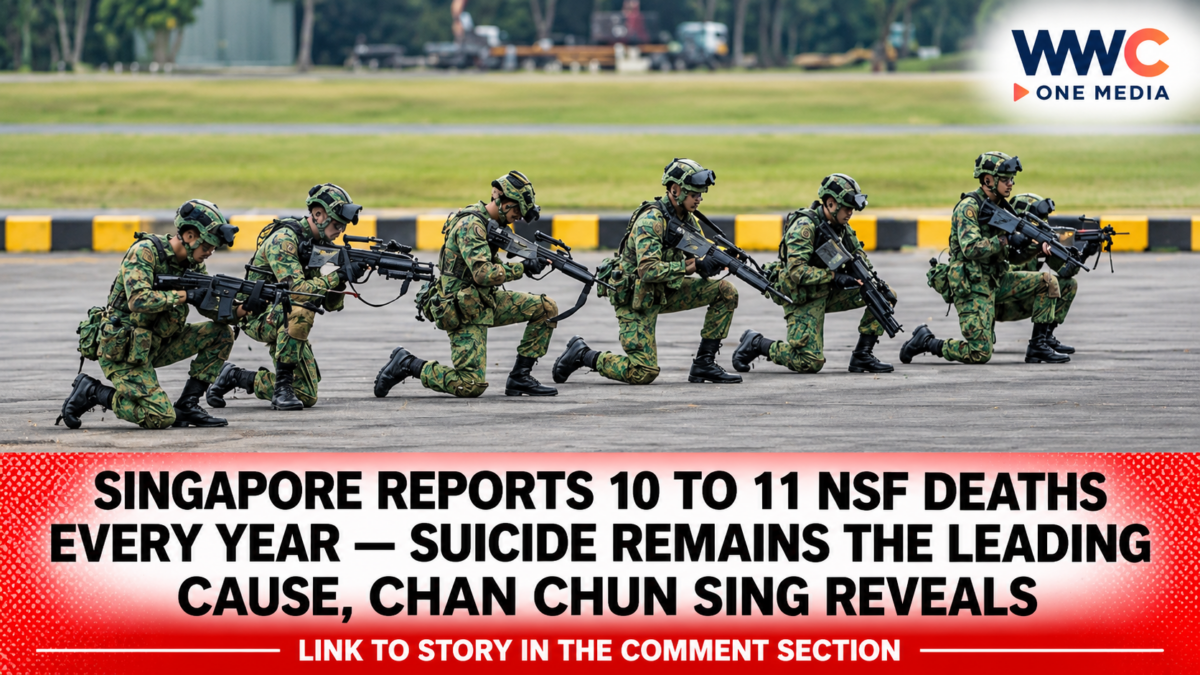
Singapore has recorded an average of 10 to 11 deaths among full-time national servicemen (NSFs) each year over the past decade, with suicide identified as the leading cause, followed by road traffic accidents.
The figures, covering the period from 2016 to 2025, were disclosed by Defence Minister Chan Chun Sing in a written parliamentary reply on November 3. The statistics cover NSFs serving in the Singapore Armed Forces (SAF), Singapore Police Force (SPF) and Singapore Civil Defence Force (SCDF).
Chan said approximately four NSFs died by suicide annually during the 10-year period, translating to an average annual suicide rate of 0.009 per cent among full-time national servicemen.
The disclosure has renewed attention on the safety and well-being of young Singaporeans serving their mandatory national service, particularly the importance of mental health support, early intervention and accountability when deaths occur during service.
10 to 11 NSF Deaths Recorded Annually Between 2016 and 2025
According to Chan, approximately 45,000 male Singaporeans and permanent residents serve full-time national service across the three uniformed services every year.
Between 2016 and 2025, an average of 10 to 11 NSFs died annually while serving.
Importantly, the figure includes deaths from different causes. These include suicide, road traffic accidents and natural causes such as illnesses.
The statistics were provided in response to a parliamentary question from Workers’ Party MP Fadli Fawzi of Aljunied GRC, who asked about the number of NSFs who had died from unnatural causes over the previous decade, the main causes of those deaths and the measures introduced to prevent similar incidents.
Although the question focused on unnatural deaths, Chan’s published response gave the average number of deaths from various causes. The 10-to-11 figure should therefore not be interpreted as the annual number of unnatural deaths alone.
Suicide Is the Leading Cause, With Road Accidents Second
Chan identified suicide as the leading cause of death among NSFs during the 10-year period, followed by road traffic accidents.
He said the pattern was consistent with the broader national trend among males aged 10 to 30.
On average, about four full-time national servicemen died by suicide each year between 2016 and 2025. This represented an average annual suicide rate of 0.009 per cent among NSFs.
For comparison, Singapore’s national suicide rate among males was 0.014 per cent in 2024, the latest year for which national suicide figures had been finalised at the time of the parliamentary reply.
While the NSF rate was lower than the national male rate cited by the minister, the figures cover different populations and time periods. The comparison should not obscure the individual lives represented by the statistics or the need to address preventable deaths.
Chan acknowledged the profound impact of every death on families and loved ones, extending his condolences to those affected.
MINDEF and MHA Say Every Death Is Thoroughly Investigated
The Ministry of Defence (MINDEF) and Ministry of Home Affairs (MHA) are responsible for the safety and well-being of NSFs serving in the uniformed services under their respective portfolios.
Chan said every NSF death is thoroughly investigated. Where relevant, measures are introduced to reduce the likelihood of similar incidents happening again.
The minister also addressed a separate question from Workers’ Party MP Kenneth Tiong concerning the publication of death statistics.
Chan said MINDEF and MHA already issue news releases when a serviceman dies in camp or while carrying out official duties.
The statement provides an overview of the government’s position, although the published reply did not provide a detailed year-by-year breakdown or a separate numerical breakdown for the SAF, SPF and SCDF.
That leaves important questions about the distribution of deaths across the three services and how trends may have changed over the decade.
Two NSF Deaths in Recent Months Brought Renewed Attention
The parliamentary disclosure comes after two NSFs died in separate incidents in Singapore over the preceding months.
On September 6, a 20-year-old SCDF full-time national serviceman, Lance-Corporal Muhammad Nur Ilham Mohammed Iswadi, was found unconscious while on duty at Marina Bay Fire Station.
He was taken to Singapore General Hospital, where he later died. The case was reported publicly, and investigations were conducted into the circumstances surrounding his death.
On October 8, another 20-year-old NSF died after being found unconscious at the foot of a building at Basic Military Training Centre School 3 on Pulau Tekong.
MINDEF said the serviceman was not involved in training at the time. He was given emergency medical attention before being evacuated by helicopter to Singapore General Hospital, where he was pronounced dead.
Police investigations into the Pulau Tekong incident were ongoing, according to reports at the time.
These two cases are separate incidents. Their causes should not be assumed, and neither should be classified as suicide without official confirmation.
The recent deaths have nevertheless brought additional public attention to the circumstances surrounding the safety of young servicemen during their period of national service.
SAF Has Mental Health Support and Referral Measures for NSFs
Beyond physical safety, mental health support remains an important part of the discussion.
In an April 2026 parliamentary reply, Senior Minister of State for Defence Zaqy Mohamad outlined measures the SAF uses to identify and assist NSFs experiencing psychosocial stressors that could affect their mental health.
These include identifying potential difficulties through Basic Military Training surveys and regular interviews with commanders.
Where necessary, servicemen may be referred to counselling, rehabilitation services and financial assistance schemes. The SAF also works with external social support partners, including the Ministry of Social and Family Development’s Social Service Offices and Family Service Centres.
MINDEF has also been piloting CaseConnect, which is intended to help relevant officers and social service professionals coordinate support for individuals who require assistance.
The SAF encourages NSFs who need help to approach their commanders, the SAF Mental Health Office or the counselling hotline.
The SAF’s 24-hour counselling hotline is 1800-278-0022. According to the Central Manpower Base, the service is confidential, staffed by trained counselling personnel, and callers may remain anonymous.
These are SAF-specific support measures. The parliamentary reply did not establish that identical arrangements operate across the SPF and SCDF.
For further context on mental health advocacy in Singapore, WWC One Media previously reported on Allan Lee’s efforts to help others after surviving two suicide attempts.
The Bigger Question: Are Existing Safeguards Enough?
The newly disclosed figures provide a rare decade-long overview of deaths among full-time national servicemen.
They also highlight why discussions about national service safety cannot be limited to physical training, operational procedures or accident prevention.
Suicide being the leading cause of death makes mental health awareness, accessible counselling, supportive leadership and early identification of distress especially important.
The existence of support systems is significant, but their effectiveness also depends on whether servicemen feel comfortable using them, whether warning signs are recognised in time and whether individuals receive appropriate help when they ask for it.
The recent SCDF death also recalls earlier concerns about operational safety. In 2022, firefighter Edward H was reported to have died following a firefighting operation. WWC One Media previously covered the case and the questions surrounding the circumstances of his death: the report on the SCDF firefighter who died after joining Marina Bay Fire Station.
National service remains a major commitment involving tens of thousands of young Singaporeans. Their safety and welfare are therefore matters of public interest, not simply internal administrative concerns.
For additional background on the SAF and its national service responsibilities, WWC One Media has also covered President Tharman’s visit to an SAF unit and Singapore’s digital intelligence operations.
Greater transparency about trends, lessons from investigations and the effectiveness of preventive measures could help the public better understand how the system is responding to these losses.
The Bottom Line
Singapore’s disclosure that an average of 10 to 11 full-time national servicemen died annually between 2016 and 2025 offers an important look at the risks faced by young men serving in the SAF, SPF and SCDF.
Suicide was the leading cause, accounting for an average of about four deaths each year, followed by road traffic accidents. The government says every death is thoroughly investigated and that preventive measures are introduced where appropriate.
The figures also underline the importance of distinguishing between statistics and individual circumstances. Not every death has the same cause, and the two recent NSF deaths should not be linked to suicide without confirmed findings.
As Singapore continues to rely on national service as a central part of its defence and emergency response systems, the challenge is to ensure that the people serving are protected not only through physical safety measures but also through meaningful mental health support.
With suicide remaining the leading cause of NSF deaths, what more should Singapore do to strengthen mental health support, identify warning signs earlier and protect young servicemen throughout their national service?