
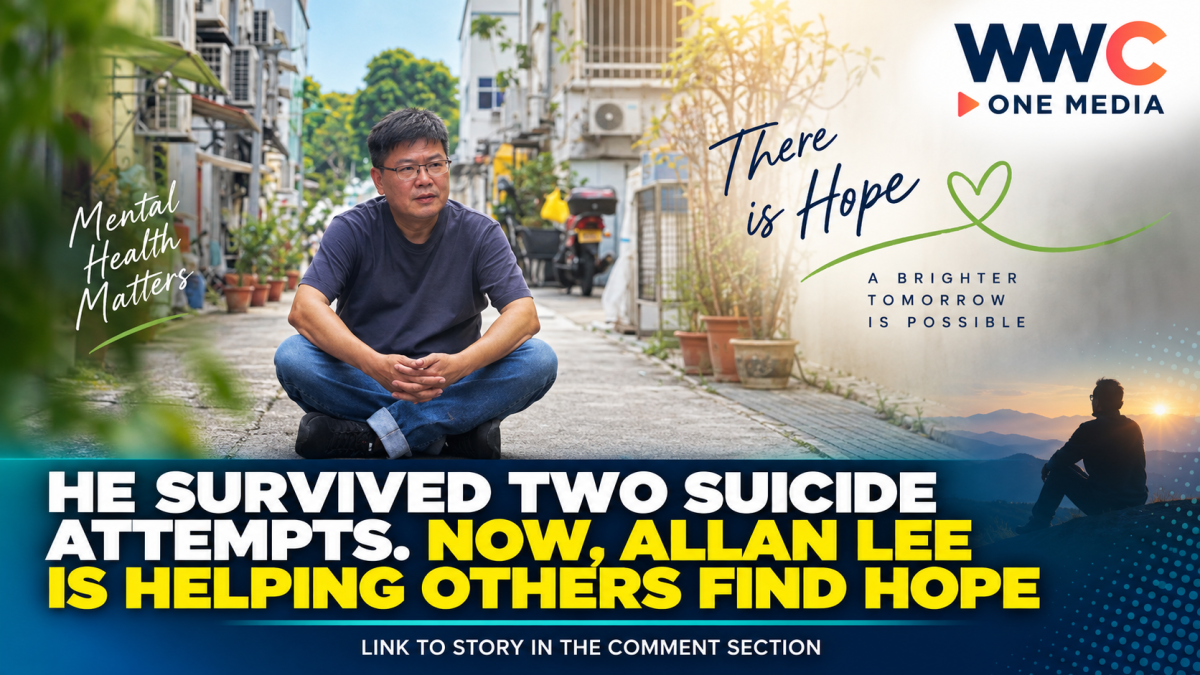
SINGAPORE — At 51, Allan Lee is a chief operating officer, mental health advocate and someone who openly shares his journey to help others who may be silently struggling.
But years ago, his life was falling apart behind a carefully maintained image of success.
He held a senior position in the media industry. He showed up to work, smiled and carried on as if everything was normal.
Inside, however, he was battling overwhelming stress, financial problems, a failing marriage and a deteriorating mental state.
By his early 40s, Allan had survived two suicide attempts.
Today, he says those experiences gave him a new purpose: helping others realise that seeking help is not weakness — and that even after reaching rock bottom, recovery is possible.
A Life That Was Quietly Falling Apart
Allan said his struggles began mounting when he was in his late 30s.
He was dealing with intense pressure from his work in the media industry while also facing financial difficulties after making investments that went badly.
At the same time, his marriage was breaking down.
The combination became overwhelming.
As his mental health worsened, Allan said he began hearing troubling voices in his head that contradicted his thoughts and made decision-making increasingly difficult.
His sleep gradually disappeared.
He would lie in bed with his eyes closed but remain completely awake. The exhaustion eventually affected his concentration at work and even his safety while driving.
He also lost his appetite and recalled going without food for days because he simply did not feel hungry.
Yet almost nobody around him knew what he was going through.
Putting on a Strong Front
Allan said he felt enormous pressure to appear strong.
As someone holding a senior position, he believed there was an unwritten expectation that leaders should always appear to be in control.
He also did not want his parents to worry.
So he continued to show up.
He smiled.
He talked.
He acted as if everything was normal.
But behind that public image, he said his life was breaking down.
Allan did not initially seek professional help because of the stigma surrounding mental health and fears about how it could affect his career and reputation.
Instead, he convinced himself that he could handle everything alone.
Two Attempts and a Life-Changing Diagnosis
Around the age of 40, Allan reached a breaking point and survived his first suicide attempt.
He later sought counselling and psychiatric help and was diagnosed with bipolar disorder.
But recovery was not immediate.
Six to eight months after his first attempt, Allan experienced what he described as a relapse.
He struggled to rebuild his life and had to rediscover who he was while dealing with people who did not always understand his condition.
Then came another devastating moment.
Allan survived a second suicide attempt.
But this time, something inside him began to change.
Instead of seeing his survival only through the pain of what had happened, he began to wonder whether there was still a reason for him to keep going.
He decided that if he had reached rock bottom, the only direction left was up.
Recovery Wasn’t a Straight Line
Allan stressed that recovery was difficult and far from linear.
The first few months were especially challenging.
To rebuild his life, he began creating a strict daily routine and setting small goals for himself.
Instead of trying to fix everything at once, he focused on taking one step at a time.
He celebrated even the smallest victories.
Allan also returned to activities he enjoyed, including music and photography.
Today, he plays in a tribute band for Hong Kong rock band Beyond and specialises in insect photography.
Keeping himself engaged also helped him manage difficult thoughts and memories.
But Allan said one of the most important parts of his recovery came from something simple:
People who stayed.
The Friends Who Kept Checking In
Allan credits his friends and family with playing a crucial role in his recovery.
One close friend called him every day, sometimes simply asking how he was and whether he had eaten.
Another friend accompanied him for dinner every day for three years.
His mother also became an important part of his support system, showing greater concern and making sure he had warm food waiting when he came home.
Those small acts of kindness gradually changed how Allan viewed his life.
He began to realise that despite everything he had gone through, he was not completely alone.
And that gave him hope.
Turning Pain Into a New Purpose
During the Covid-19 period, Allan made a career transition into the education sector.
While working in a school, he met many people who were stressed, uncertain about their futures and struggling with work and family pressures.
Some began opening up to him.
Allan discovered that simply listening could make a difference.
People later sent him thank-you cards, and he began to wonder whether helping others could become his second calling.
Over time, more people approached him — colleagues, friends, people from hobby groups and even neighbours.
Allan began writing about mental health and sharing his experiences through talks and events.
He also became an ambassador for MindsHeart Singapore, a corporate counselling organisation that works with companies on workplace stress.
However, Allan makes one thing clear:
He is not a mental health professional.
Instead of diagnosing or treating people, he encourages those who are struggling to seek proper professional support and helps point them toward appropriate services.
Why Adults in Their 30s and 40s Can Struggle in Silence
Allan’s story also comes amid growing concern about mental health struggles among adults.
According to statistics cited by AsiaOne, suicide deaths among people aged 30 to 39 in Singapore rose by 50 per cent in 2024.
The age group faces a unique combination of pressures, according to Associate Professor Daniel Fung, senior consultant at the Institute of Mental Health’s Department of Developmental Psychiatry.
Career expectations, financial commitments, housing, marriage, children and caring for ageing parents can all converge during this period of life.
For many people, there is also pressure to appear successful and stable.
That can make it even harder to admit they are struggling.
A person may have a job.
A home.
A family.
And still feel completely overwhelmed.
As Allan’s story shows, outward success does not always reveal what someone is experiencing inside.
‘Seeking Help Is Not Weakness’
Today, Allan’s message to others is simple.
Seek help.
He understands why people hesitate.
Many fear being judged.
Some worry about their careers.
Others feel pressure to look strong in front of their families, friends and colleagues.
But Allan now believes that asking for help is an act of courage.
He once believed he could manage everything on his own.
Now, after surviving his darkest moments, he wants others to know they do not have to.
His journey from crisis to advocacy is not presented as an easy or perfect recovery story.
There were relapses.
There was pain.
There were setbacks.
But there were also small victories, supportive friends and family members, professional help and the gradual rediscovery of purpose.
At 51, Allan Lee is still moving forward.
And by sharing the story he once kept hidden, he hopes someone else may decide to keep going too.
Sometimes, a simple question — “How are you?” or “Have you eaten?” — can mean more than we realise.
And sometimes, reaching out for help can be the bravest decision a person makes.
WWC ONE MEDIA J.M.D




Leave a Reply