NEW YORK CITY, United States — November 4, 2026 | WWC ONE MEDIA | US Politics, Midterm Elections & Global Affairs
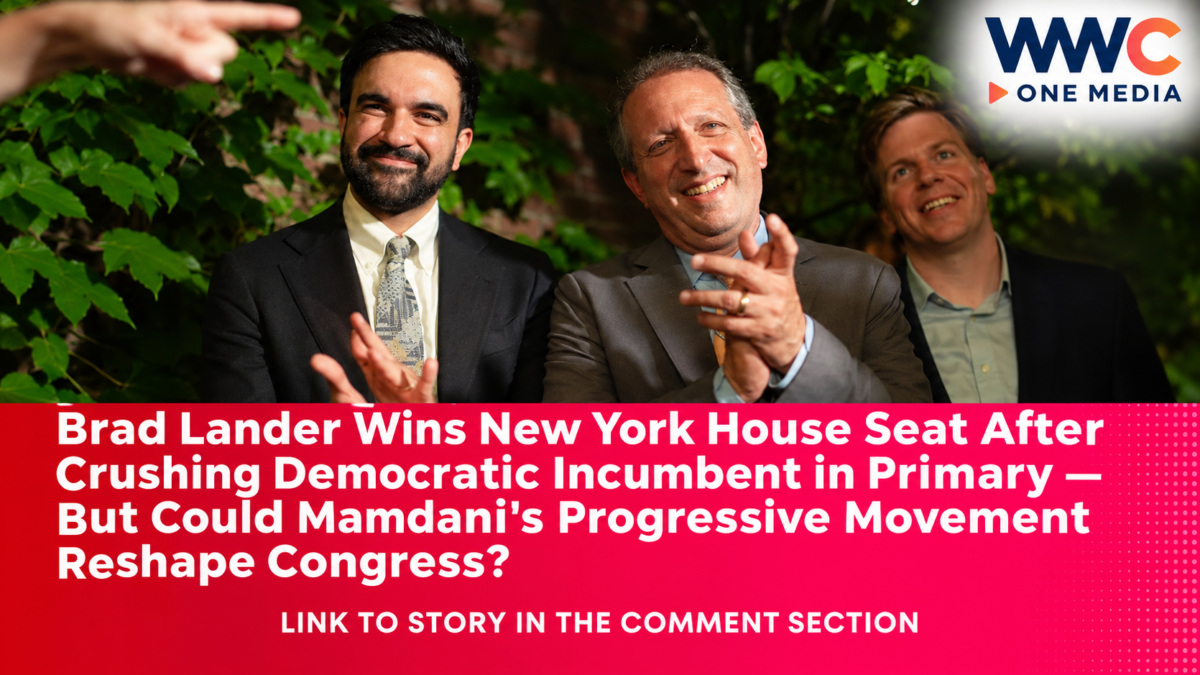
New York’s progressive political movement has secured another major congressional victory as former city comptroller Brad Lander wins the race for New York’s 10th Congressional District, strengthening a growing group of lawmakers aligned with Democratic Mayor Zohran Mamdani.
Bloomberg reported on November 4 that Decision Desk HQ projected Lander’s victory in the November 3 midterm elections.
Lander defeated Republican Jennifer Moore in the general election after delivering one of the Democratic Party’s most striking primary victories earlier this year.
In June, he defeated incumbent Democratic Congressman Dan Goldman with approximately 66% of the primary vote, transforming what had been an internal party challenge into a broader debate about the Democratic Party’s future.
The congressional district covers parts of Brooklyn and Lower Manhattan, including communities such as Park Slope, Sunset Park and the Financial District.
But while Lander’s general-election victory was widely anticipated in this heavily Democratic district, the political consequences could extend far beyond New York.
His election adds another prominent progressive voice to Congress at a time when Democrats are debating how aggressively to challenge President Donald Trump’s policies and which political direction to pursue ahead of the 2028 presidential election.
The bigger question is whether Lander’s victory signals the growing strength of Mamdani’s progressive coalition—or whether ideological disagreements could make it harder for Democrats to govern effectively.
Brad Lander Wins New York’s 10th Congressional District
Lander secured the congressional seat after emerging as the Democratic nominee during a competitive primary campaign.
His Republican opponent, Jennifer Moore, also appeared on the Conservative Party ballot line.
Lander ran with the Democratic and Working Families Party nominations.
A third candidate, Nickie Kane, was listed as a write-in candidate associated with the No Kings Party.
The district was previously represented by Dan Goldman, who won election in 2022 and secured another term in 2024.
Because Goldman lost the Democratic primary, he was not the incumbent candidate on the November general-election ballot.
The distinction matters when describing the result.
Lander’s victory keeps the congressional district in Democratic hands. It is not a Democratic pickup from Republicans.
Its primary significance is the political change within the Democratic Party itself.
Lander is expected to bring a different legislative approach from Goldman, particularly on immigration, affordability and foreign policy.
A 66% Primary Landslide Changed Everything
Lander’s path to Congress was largely determined during the June 23 Democratic primary.
According to certified election results, he received 58,047 votes, or approximately 66.0%.
Goldman received 29,781 votes, or approximately 33.8%.
The victory represented a decisive rejection of an incumbent who had entered Congress with substantial financial resources and high-profile political connections.
Goldman, an heir to the Levi Strauss family fortune, previously served as a lead counsel during Trump’s first impeachment proceedings.
He also received support from prominent Democratic officials, including Governor Kathy Hochul and House Democratic leader Hakeem Jeffries.
Lander, meanwhile, received endorsements from Mamdani and Senator Bernie Sanders.
The primary became a high-profile contest between competing factions of the Democratic Party.
Goldman’s supporters emphasized legislative experience and the need for effective representation in Washington.
Lander’s coalition argued that the party needed stronger positions on immigration enforcement, economic inequality and US foreign policy.
The overwhelming primary result strengthened Lander’s position heading into the general election.
Who Is Brad Lander?
Lander is a longtime New York political figure with experience in local government and financial oversight.
He previously served on the New York City Council, representing parts of Brooklyn from 2010 through 2021.
He later became New York City comptroller, serving from 2022 through 2025.
As comptroller, Lander was responsible for oversight functions involving the city’s finances, contracts and public pension systems.
Before holding elected office, he worked with community-development and urban-policy organizations.
His political career has been associated with progressive policies involving housing, labor rights, climate change and government accountability.
In 2025, he entered the Democratic mayoral race.
He finished behind Mamdani and former Governor Andrew Cuomo in the primary.
However, his political relationship with Mamdani became increasingly important.
The two supported one another during the mayoral contest, and Mamdani subsequently endorsed Lander’s congressional campaign.
That alliance helped position Lander as one of the progressive movement’s most recognizable candidates for federal office.
Zohran Mamdani’s Influence Extends to Congress
Lander’s victory is one of several developments demonstrating Mamdani’s influence over New York’s progressive political movement.
The New York mayor endorsed multiple candidates challenging more established Democratic figures in congressional primaries.
Three candidates associated with his political coalition emerged victorious in their respective general-election races: Brad Lander, Claire Valdez and Darializa Avila Chevalier.
The Associated Press previously reported that Mamdani’s primary endorsements had helped progressive candidates defeat established Democratic incumbents.
The victories suggest that the mayor’s political organization has developed influence beyond City Hall.
However, the results should not be interpreted as proof that every New York Democrat supports the same policy positions.
New York remains politically diverse, and the Democratic Party includes moderates, liberals and progressives with different priorities.
The movement’s next challenge is translating campaign victories into effective legislation.
What Lander’s Win Means for Donald Trump
The election comes during a politically sensitive period for President Donald Trump.
Republicans entered the November 3 midterms controlling both chambers of Congress.
Democrats campaigned on concerns involving living costs, immigration enforcement, government accountability and the war involving Iran.
WWC ONE MEDIA previously examined these issues in US Midterms 2026: Six Things That Could Decide Control of Congress — Is Trump Facing a Political Turning Point?.
The election is widely viewed as a major test of the president’s political influence.
Lander has been a vocal critic of the administration, particularly regarding immigration enforcement.
His election could add another lawmaker willing to pursue more aggressive congressional scrutiny of federal immigration practices.
But an individual House member cannot independently change federal policy.
The ability to pass legislation, conduct investigations and influence government spending depends on committee assignments, congressional majorities and cooperation among lawmakers.
Immigration Enforcement Became a Defining Issue
One of the most controversial moments in Lander’s political career occurred during a visit to a federal immigration facility in Manhattan in June 2025.
Federal agents detained him while he was attempting to accompany an individual through an immigration enforcement process.
The incident attracted national attention and intensified debate over federal immigration policies.
Lander framed the encounter as evidence of the need for greater transparency and accountability.
Goldman and other critics questioned aspects of Lander’s actions during the incident.
The controversy became part of the 2026 primary campaign.
For Lander, immigration enforcement remains an important policy issue as he prepares to enter Congress.
However, disputes involving the administration should be evaluated using documented facts and applicable law.
Political disagreement does not automatically establish that government officials acted unlawfully.
Likewise, lawful congressional oversight does not depend on a lawmaker agreeing with the administration.
Housing and Affordability Could Shape His Agenda
Housing affordability is another major issue in New York’s 10th District.
The district includes neighborhoods where rent, housing prices and everyday expenses remain significant concerns.
Lander has supported policies intended to strengthen tenant protections and expand affordable housing.
Those priorities align with parts of Mamdani’s economic agenda.
But federal housing policy requires cooperation among congressional lawmakers and agencies.
Local governments also retain authority over many land-use and housing matters.
The relationship between New York City and Washington is especially relevant because major projects may require federal approvals or financing.
WWC ONE MEDIA previously covered one example in With World Leaders Waiting at the UN, Trump Meets New York Mayor Zohran Mamdani.
The September report described discussions about housing and the proposed Sunnyside Yards redevelopment.
The meeting demonstrated that local and federal leaders may cooperate on practical issues despite major political differences.
For Lander, advancing housing policy could involve similar negotiations.
Political opposition to Trump does not eliminate the need for federal cooperation on projects benefiting New York residents.
Foreign Policy Divisions Helped Define the Primary
Lander’s primary victory also reflected disagreements within the Democratic Party over Israel and the war in Gaza.
Goldman maintained a more supportive position toward Israel.
Lander criticized the incumbent’s approach and argued for a different response to the conflict.
The American Israel Public Affairs Committee, or AIPAC, became part of the wider debate over political influence and campaign support.
For progressive voters, the dispute highlighted questions about US foreign aid, human rights and the Democratic Party’s foreign-policy priorities.
However, the election outcome should not be reduced to a referendum on one international issue.
Lander and Goldman also disagreed on immigration, economic policy and political leadership.
Voters may have supported Lander for different combinations of reasons.
His victory nevertheless provides evidence that progressive foreign-policy arguments can attract substantial support within certain Democratic constituencies.
Will Progressives Challenge Democratic Leadership?
One of the most important questions is how Lander and other newly elected progressives will work with Democratic congressional leaders.
Hakeem Jeffries, a New York Democrat, is a central figure in the House Democratic leadership.
Jeffries endorsed Goldman during the June primary.
Lander subsequently defeated Goldman and won the general election.
That history could create political tension, although disagreement during a primary does not necessarily prevent future cooperation.
Congressional leaders must build coalitions involving lawmakers from districts with very different political preferences.
Progressive representatives may favor more ambitious proposals on healthcare, immigration, taxation and government spending.
Moderates may prefer incremental legislation or bipartisan compromise.
Both factions face the challenge of passing legislation through the House and Senate while responding to constituents’ needs.
A successful congressional majority generally requires sufficient agreement to turn political priorities into actual votes.
Lander’s Victory Is Not a Republican Seat Flip
The difference between Lander’s victory and Democratic wins in Republican-held districts is particularly important for accurate election reporting.
New York’s 10th District was already represented by a Democrat.
Goldman’s defeat occurred within the Democratic primary, not against a Republican in November.
The general-election victory therefore preserves Democratic control of the seat.
By contrast, when Democrats defeat Republican candidates in districts previously represented by Republicans, those outcomes can contribute directly to a net increase in Democratic House seats.
This distinction matters when calculating control of Congress.
A party may experience major ideological changes among its elected members without increasing its overall number of seats.
Lander’s victory has substantial political implications for the Democratic Party’s direction.
But it should not be counted as a Republican-to-Democratic pickup in national House majority calculations.
Record Early Voting Adds to the National Election Story
The November 3 midterms were preceded by exceptionally strong early voting participation.
By October 30, nearly 48 million Americans had already cast early or mail ballots, according to figures compiled by the University of Florida Election Lab.
WWC ONE MEDIA examined the increase in Record 48 Million Americans Vote Early in 2026 Midterms as Democrats Surge in Key Battlegrounds — But Could Election Day Change Everything?.
The high participation demonstrated the political intensity of the election.
However, early-voting totals alone do not establish which party ultimately wins.
Changes in voting methods, party registration and local turnout patterns can affect the numbers.
In Lander’s case, his strong primary performance and the district’s Democratic voting history already suggested he would be favored in November.
The general-election projection provides the actual political development.
The New Democratic Congress Could Face Tough Choices
The results of the 2026 midterms could significantly influence the final two years of Trump’s presidency.
A Democratic-controlled House would have stronger authority over congressional committees and oversight.
It could investigate executive agencies, examine government spending and challenge selected administration policies.
However, even a House majority would not provide Democrats with unrestricted legislative power.
Major legislation generally requires approval in both chambers of Congress and the president’s signature, unless a veto is overridden.
WWC ONE MEDIA previously examined the financial-market implications in JPMorgan Maps the Stocks That Could Win After the Midterms — But Gridlock May Be Wall Street’s Favorite Outcome.
The report discussed how different election outcomes could influence healthcare, energy, financial markets and regulation.
For lawmakers such as Lander, those policy debates will involve difficult choices.
Progressive campaign promises may encounter political resistance even within a Democratic-controlled chamber.
The challenge will be balancing ideological commitments with the practical requirements of governing.
What Independent Election Reporting Confirms
Bloomberg reported on November 4 that Decision Desk HQ projected Brad Lander as the winner of New York’s House election.
Local reporting from the New York Post also included Lander among the successful congressional candidates supported by Mamdani.
The New York State Board of Elections and Ballotpedia confirm that Lander won the June 23 Democratic primary against Goldman.
Ballotpedia documents the certified primary figures, including Lander’s 58,047 votes and 66.0% share.
The Associated Press independently examined Mamdani’s role in supporting progressive candidates during the June primaries.
PIX11 covered the Goldman–Lander contest and the ideological disagreements that shaped the campaign.
Together, these sources establish the candidates, electoral history and political significance of Lander’s victory.
However, the certified June primary figures must not be confused with the November general-election results.
The official general-election vote margin should be taken from updated election returns and state certification.
The Bottom Line: A Safe Democratic Seat With Major Political Implications
Brad Lander’s victory in New York’s 10th Congressional District represents an important milestone for the city’s progressive movement.
His decisive primary defeat of Dan Goldman demonstrated that established Democratic incumbents can face powerful challenges from within their own party.
His subsequent general-election win brings that political change to Congress.
For Mamdani, the result strengthens a network of progressive allies beyond City Hall.
For Democratic congressional leaders, it introduces another outspoken lawmaker whose policy priorities may sometimes differ from those of the party establishment.
And for Trump, it adds a prominent critic of his administration to the House of Representatives.
Lander’s victory is not a Republican seat lost to Democrats. It is a Democratic district choosing a substantially different political direction.
As Brad Lander prepares to enter Congress alongside other Mamdani-backed progressives, will their victories give Democrats the energy and ideas needed to challenge Trump’s agenda—or could growing ideological divisions threaten the party’s ability to govern?