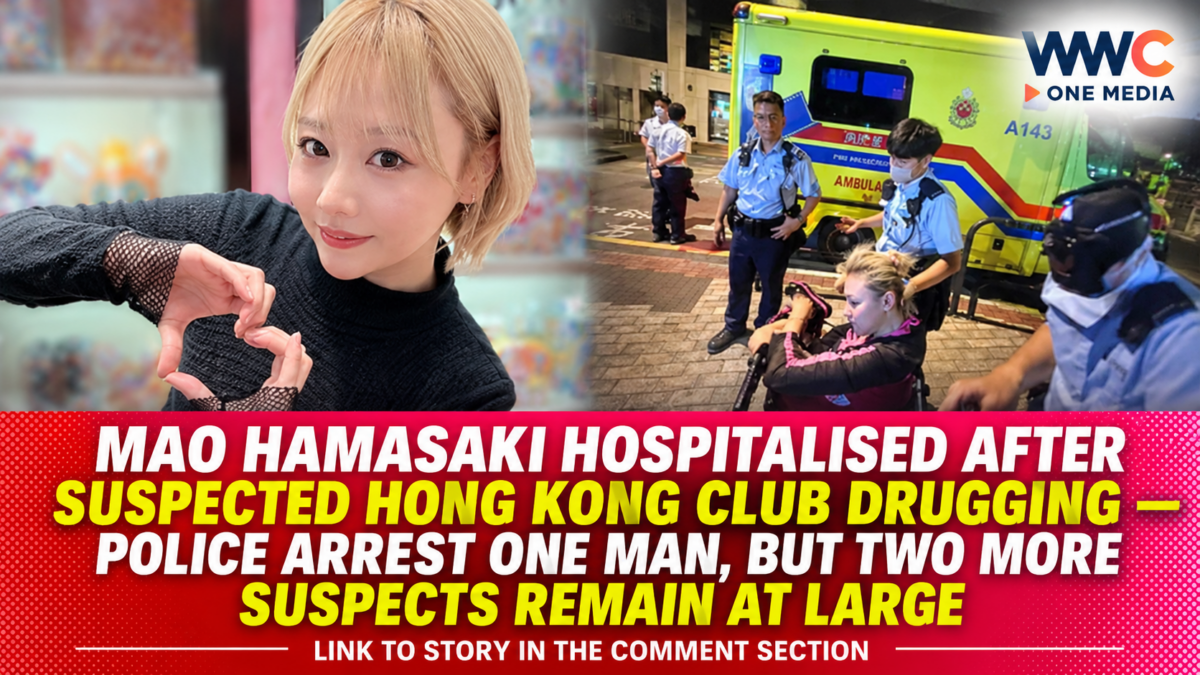
HONG KONG — Former Japanese adult film actress turned disc jockey Mao Hamasaki is recovering after an alarming suspected drink-spiking incident at a Hong Kong nightclub that left her hospitalised in intensive care and triggered a police investigation.
The 33-year-old performer, also known as DJ Mao, reportedly became disoriented, suffered severe convulsions and temporarily lost consciousness after consuming a drink during a Halloween weekend event in Tsim Sha Tsui.
The incident has since taken a significant turn.
Hong Kong police arrested a 61-year-old man on November 2 in connection with the suspected poisoning. Investigators are also pursuing two other individuals reportedly connected to the incident who remain at large.
Hamasaki has regained consciousness and is recovering, but the case has raised serious questions about drink safety, nightclub security and the protection of performers working in unfamiliar nightlife environments.
What initially appeared to be a medical emergency has now developed into a criminal investigation — and authorities are still trying to establish exactly what happened inside the venue.
A Halloween Night Out Turns Into a Medical Emergency
The incident happened during the early hours of November 1, following Hamasaki’s scheduled DJ performances at different nightlife establishments in Hong Kong.
She had been working during Halloween celebrations and was expected to perform at another venue in Tsim Sha Tsui after an earlier engagement in Wan Chai.
According to accounts reported after the incident, Hamasaki consumed a beverage at the Tsim Sha Tsui establishment before experiencing sudden physical symptoms.
Her condition reportedly deteriorated rapidly.
She became disoriented, experienced convulsions and eventually lost consciousness. Her manager noticed that something was seriously wrong and arranged for her to receive medical attention.
Emergency responders transported her to Queen Elizabeth Hospital, where she was admitted for treatment and monitoring.
The seriousness of her condition prompted her admission to the intensive care unit.
Photographs subsequently shared through her social media account showed her being assisted into an ambulance.
A message accompanying the images indicated that she had been drugged while working.
The incident quickly attracted attention because it involved a performer who had travelled between nightlife venues for professional engagements.
What Hamasaki Says Happened Before She Collapsed
After regaining consciousness, Hamasaki shared more details about the experience through social media.
In her account, she said she had consumed two orange-flavoured cocktails before her second DJ performance.
She recalled noticing cloudy material or residue at the bottom of the glasses but initially assumed it was orange pulp.
At the time, she did not consider it an immediate warning sign.
Approximately 40 minutes to an hour later, she began her DJ set.
Hamasaki described experiencing unusual physical sensations, including intense dryness in her eyes. Her memory of what followed became increasingly unclear.
During the performance, she reportedly toasted with a customer using the same drink.
Shortly afterward, her body became stiff, and she found herself unable to move normally.
She eventually lost consciousness and later regained awareness in an ambulance.
She was reportedly informed that she had experienced convulsions.
Her account has become an important part of the public understanding of the incident, although investigators will need to establish the full sequence of events through witness statements, available surveillance footage and forensic evidence.
Medical Tests Reportedly Detected Four Substances
One of the most concerning developments involved the medical testing conducted after Hamasaki was admitted to hospital.
Her manager said initial urine screening returned positive results for four different substances.
The findings raised concerns that the beverage may have been contaminated with more than one drug.
However, the specific substances and their respective concentrations have not been fully established in the publicly available information reviewed for this report.
It is also important to distinguish between preliminary screening results and final toxicological conclusions.
A positive screening result can help medical professionals identify substances requiring further investigation, but additional testing may be needed to establish precisely what was present and in what quantities.
For now, the reported results form part of the circumstances surrounding the suspected drugging.
Doctors reportedly considered her condition serious enough to require intensive care and continued observation.
Her recovery has been encouraging, but the incident remains under police investigation.
Police Arrest a 61-Year-Old Man
The investigation moved forward on November 2 when Hong Kong police arrested a 61-year-old local man in Central.
He was detained in connection with the suspected drugging incident at the Tsim Sha Tsui establishment.
Authorities are investigating the case as suspected administering of poison with intent to injure.
The arrest represents a significant development because it indicates that investigators have identified at least one person they wish to question in connection with the incident.
However, an arrest does not establish that the suspect committed the alleged offence.
Police must continue gathering evidence and determine whether there is sufficient material to support any criminal charges.
The investigation is also examining the circumstances surrounding the drink, the people present at the venue and the events leading up to Hamasaki’s sudden collapse.
Two More Suspects Reportedly Remain at Large
Further developments have suggested that the investigation may involve more than one individual.
Police are reportedly searching for two additional suspects who remain at large.
Investigators are examining their possible connections to the gathering and the circumstances surrounding the suspected poisoning.
The authorities have also been reviewing available evidence as they work to establish whether the arrested man allegedly administered the substances himself or whether other individuals played a role.
These questions remain unresolved.
The existence of additional suspects does not establish that they participated in the alleged offence. Their identities, specific roles and any potential charges must be determined through the investigation.
For Hamasaki, the priority remains recovery and cooperation with authorities when she is medically able to do so.
Why the Case Has Raised Questions About Nightclub Safety
The incident has drawn attention to the risks associated with drink spiking, particularly in environments where performers and customers may interact with unfamiliar people.
Nightclubs and entertainment venues often involve crowded spaces, fast-moving schedules and multiple interactions between guests, staff and performers.
In those circumstances, it can be difficult to monitor every beverage or determine who has handled a glass.
Drink spiking can involve adding an intoxicating or harmful substance to a beverage without the recipient’s knowledge or consent.
Depending on the substance and quantity involved, the effects may include confusion, dizziness, impaired coordination, memory loss, unconsciousness and other serious medical complications.
Not every sudden episode of illness after drinking is necessarily caused by drugging. Alcohol, medication interactions and other medical conditions can also produce serious symptoms.
That is why medical assessment and proper toxicological testing are important.
In Hamasaki’s case, her reported screening results and the circumstances described by her and her manager have prompted a formal investigation.
The final findings will depend on evidence gathered by police and medical professionals.
Hamasaki Turns Her Experience Into a Warning
Following the incident, Hamasaki used her social media accounts to communicate with supporters and explain what she had experienced.
She expressed concern about the effects of drugs and indicated that she wanted to raise awareness about prevention.
Her message was not limited to her own recovery.
She said she hoped to help prevent other people from experiencing a similar situation by sharing information about the dangers of drugging and the importance of staying alert.
She also indicated that she intended to cooperate with Hong Kong police after leaving hospital.
Her decision to speak publicly has added a personal dimension to a case that could otherwise have remained a police investigation with limited public information.
It has also drawn attention to the vulnerability of people who work in nightlife settings, including DJs, entertainers, service workers and performers who regularly move between venues.
For people in these professions, accepting a drink or participating in a toast may be part of ordinary social interaction.
But the incident demonstrates why unfamiliar drinks and unexpected changes in someone’s physical condition should be taken seriously.
A Reminder for People Attending Nightlife Events
Although the investigation remains focused on the alleged circumstances surrounding Hamasaki’s experience, the incident offers several practical reminders for people attending clubs, bars and entertainment events.
Keep drinks within sight. Leaving a beverage unattended can create an opportunity for someone to interfere with it.
Be cautious about accepting drinks from strangers. Even in social environments where sharing drinks is common, it is sensible to know where a beverage came from and who prepared it.
Do not assume an unusual taste or appearance is harmless. Unexpected cloudiness, residue or a change in a drink’s appearance may warrant caution. It does not prove contamination, but there is no reason to continue drinking something that seems suspicious.
Seek medical help when symptoms appear suddenly. Unexpected confusion, severe dizziness, difficulty moving, loss of consciousness or convulsions require urgent attention.
Tell trusted people what is happening. Friends, colleagues, venue staff and emergency responders may be able to help someone reach medical care more quickly.
Report suspected incidents. Prompt reporting can help preserve information and allow authorities to investigate while evidence may still be available.
These precautions cannot eliminate every risk, but they can help people respond more quickly when something seems wrong.
Hong Kong’s Nightlife Industry Faces Renewed Scrutiny
Hong Kong has an active nightlife scene that attracts residents, tourists, performers and international entertainment professionals.
Districts such as Tsim Sha Tsui and Wan Chai are known for their restaurants, bars, clubs and entertainment venues.
Events involving visiting DJs and performers can bring additional activity to these areas, particularly during major celebrations such as Halloween.
The suspected drugging incident has therefore attracted attention beyond Hamasaki’s personal circumstances.
It raises questions about how venues monitor their premises, respond to medical emergencies and cooperate with police when a guest or performer becomes seriously ill.
It is important, however, not to assume that the incident represents the practices of Hong Kong’s entire nightlife industry.
The investigation concerns a specific reported incident at a particular venue. Any conclusions about the establishment’s responsibilities or the conduct of individual employees must be supported by evidence.
Authorities will need to establish what happened, whether the beverage was deliberately contaminated and who, if anyone, was responsible.
The answers could have implications for the individuals involved and for the venue’s handling of the incident.
A Wider Pattern of Concern Over Drug-Related Incidents
The case also comes amid wider concerns about illicit substances and their use in social environments.
WWC ONE MEDIA previously reported on Hong Kong Customs’ seizure of suspected etomidate products and manufacturing equipment in Hong Kong Customs Busts Suspected “Space Oil” Factory With HK$42 Million Haul — 160,000 Cartridges Could Have Been Made.
That case involved a suspected drug-manufacturing operation and is separate from the allegations surrounding Hamasaki.
Another report, Man Arrested After Two-Hour Standoff at Jurong East Flat, Knuckle Duster Found, examined a separate Singapore police investigation involving suspected drug-related offences.
Neither case establishes a connection to the Tsim Sha Tsui incident.
However, both illustrate why suspected drug offences remain an important public-safety concern across the region.
What Happens Next in the Investigation?
Several important questions remain unanswered.
Investigators will need to determine what substances were allegedly present in the drink, how they entered the beverage and who may have been responsible.
They will also need to establish the precise circumstances surrounding the 61-year-old man’s arrest and examine whether the two other individuals reportedly being sought had any involvement.
Medical evidence could play an important role in clarifying what happened to Hamasaki.
Witness accounts, CCTV recordings and other evidence from the venue may also help investigators reconstruct the events before and after she became ill.
Hamasaki has indicated that she intends to cooperate with the police once her medical situation allows.
Until the investigation is completed, the allegations must be treated as allegations rather than established facts.
The arrested man has not been convicted, and the reported search for other individuals does not establish their guilt.
The Bottom Line
Mao Hamasaki’s suspected drugging incident has developed into a serious criminal investigation in Hong Kong.
The former Japanese adult film actress, who now works as a DJ, was hospitalised after reportedly experiencing severe physical symptoms during a Halloween weekend performance in Tsim Sha Tsui.
She has since regained consciousness and is recovering.
The reported detection of four substances in her urine, the arrest of a 61-year-old man and the search for two additional suspects have made the case a significant public-safety story.
But important questions remain.
Who was responsible for the suspected contamination? How did the substances allegedly enter the drink? And what evidence will investigators uncover about the people present at the venue?
For Hamasaki, the immediate priority is recovery. For police, the challenge is to establish exactly what happened and whether anyone should face criminal charges.
Her experience has also delivered a broader warning to people attending nightlife events: a drink that looks ordinary may not always be safe, and sudden unexplained symptoms should never be ignored.
As Hong Kong police continue investigating, will the evidence reveal how the suspected drink was contaminated — and whether more people were involved in the incident?