
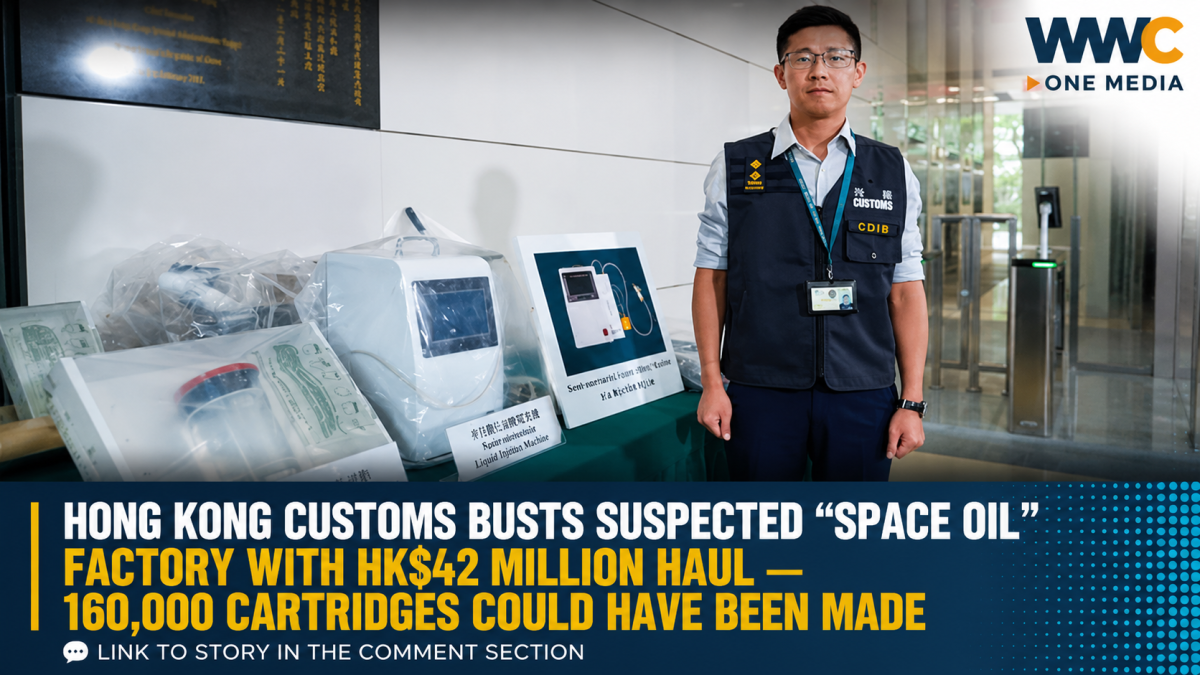
HONG KONG — Hong Kong Customs has uncovered what officials describe as a major suspected etomidate manufacturing operation, seizing drugs and production equipment worth an estimated HK$42 million (about US$5.3 million) and arresting a 61-year-old man.
The discovery is significant because investigators say they found a semi-automated production line capable of mass-producing etomidate cartridges — the drug commonly associated with the street name “space oil.”
According to Customs, the equipment and raw materials seized could have produced more than 160,000 cartridges in a short period if the operation had continued.
🚨 What Customs found
The operation took place on September 1 in Kam Tin, Yuen Long.
During an anti-narcotics operation, Customs officers intercepted a 61-year-old local man and escorted him to a nearby village house for a search.
Inside, officers found:
- More than 3,000 suspected etomidate cartridges
- About 13.4kg of suspected liquid etomidate
- About 3kg of suspected etomidate powder
- Drug-manufacturing equipment
- Packaging equipment
- A high-precision liquid-filling machine
Customs estimated the total value of the suspected etomidate at approximately HK$42 million.
🏭 A production line — not just a stash
What makes this case particularly significant is the equipment.
Hong Kong Customs said this was the first time it had uncovered a drug-trafficking syndicate using a high-precision liquid-filling machine and a semi-automated production line to mass-produce etomidate capsules.
Officials said the machinery could fill the drug into cartridges with precise quantities, substantially increasing the scale and consistency of production.
Based on the seized raw materials and machinery, Customs estimated that more than 160,000 cartridges could have been produced in a short period.
That means investigators weren’t simply dealing with someone allegedly storing a few cartridges.
They say they discovered what appeared to be an organized manufacturing setup.
What exactly is “space oil”?
“Space oil” is a street term used in Hong Kong for products containing etomidate, an anaesthetic drug that has increasingly been misused through electronic cigarettes and similar devices.
Etomidate has legitimate medical applications, but recreational use can pose serious health risks.
Hong Kong authorities have been escalating enforcement against the drug as its use has spread, particularly through vaping products.
In February 2025, etomidate became controlled under Hong Kong’s Dangerous Drugs Ordinance. Illegal possession or use can carry severe penalties, while trafficking and manufacturing offences carry even heavier penalties.
⚖️ The suspect now faces serious charges
The 61-year-old man has been charged with:
One count of manufacturing a dangerous drug
and
One count of trafficking in a dangerous drug.
He is scheduled to appear at the Tuen Mun Magistrates’ Courts on September 3.
Under Hong Kong’s Dangerous Drugs Ordinance, Customs says conviction for manufacturing or trafficking a dangerous drug can carry a maximum fine of HK$5 million and life imprisonment.
The charges are allegations at this stage; the suspect has not been convicted.
📈 Authorities have been fighting a growing “space oil” problem
The latest bust comes after Hong Kong authorities spent the past two years increasing enforcement against etomidate.
Hong Kong police reported 195 space-oil-related cases and 278 arrests in 2024, including 61 young people. Police also said nearly 10,000 suspected space-oil capsules, 1.7 litres of suspected liquid etomidate and 1.2kg of suspected etomidate powder were seized in a major 2024 operation.
Police also introduced rapid etomidate test kits in January 2025, allowing frontline officers to identify suspected etomidate more quickly.
The government subsequently strengthened legal controls, making illegal possession and trafficking substantially more serious offences.
🌏 The drug is becoming a wider Asian problem
Hong Kong isn’t the only place dealing with illicit etomidate use.
The drug has appeared under different street names across parts of Asia. In Singapore, for example, etomidate-containing vape products have been referred to as “Kpods.” Japan has also moved to prohibit illicit etomidate after concerns about its spread among young people.
That makes the Hong Kong seizure significant beyond the territory itself.
Authorities aren’t simply confronting individual users.
They are increasingly targeting the supply chain — including manufacturing, trafficking and online distribution.
The bigger concern: scale
The most alarming figure from the operation may not be the HK$42 million valuation.
It may be the 160,000 cartridges.
Customs said the seized production line and raw materials could have generated that quantity in a short period.
Had those products reached the illicit market, authorities said the consequences could have been severe.
The case therefore highlights how quickly the “space oil” problem can move from individual possession to industrial-scale production.
And Hong Kong Customs has now uncovered a suspected operation that appears designed to do exactly that.
WWC ONE MEDIA J.M.D
Leave a Reply