
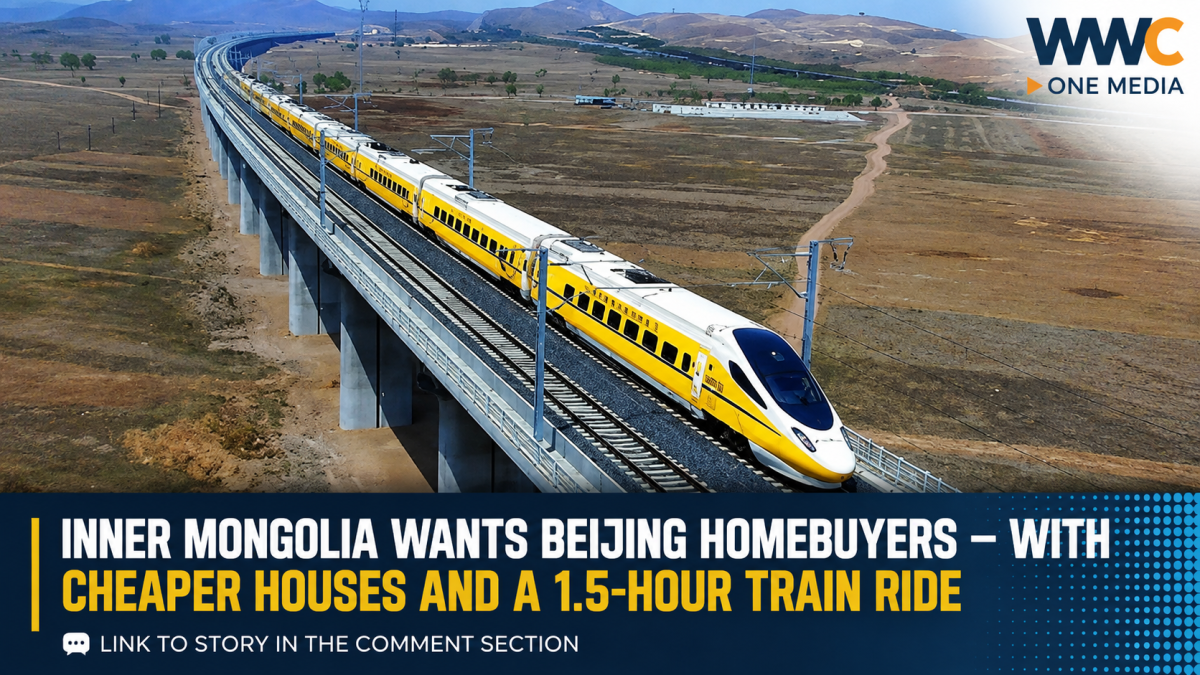
BEIJING — What if living hundreds of kilometres from Beijing did not necessarily mean giving up access to the capital?
That is the pitch coming from Inner Mongolia, where local governments are actively courting Beijing residents with a combination of lower home prices, high-speed rail connections and a growing technology economy.
The campaign is an unusually direct response to two problems at once: Beijing’s expensive housing market and Inner Mongolia’s struggling property sector.
Officials from Inner Mongolia recently brought nearly 20 residential and property projects to Beijing, presenting options ranging from ordinary homes to wellness communities and holiday apartments under the campaign “I Have a Home in the Grasslands.” The three-day promotion was organized by the Inner Mongolia regional housing authority together with governments from Hohhot, Chifeng, Ulanqab and Duolun County.
And their biggest selling point may be the train.
🚄 A home in Inner Mongolia, a commute to Beijing?
Ulanqab, in particular, is being marketed as part of a potential Beijing commuter lifestyle.
Officials say high-speed rail can connect Ulanqab with central Beijing in as little as 1.5 hours, making the city considerably more accessible to people who work or do business in the capital. Inner Mongolia says several cities in the region now have direct high-speed rail services to Beijing.
That changes the sales pitch.
Instead of asking Beijing residents to abandon the capital entirely, Inner Mongolia is promoting a “dual-city” lifestyle — live in a cheaper city while retaining relatively fast access to Beijing.
It’s a strategy increasingly made possible by China’s extensive high-speed rail network.
🏠 The price difference is the real hook
The numbers being promoted are striking.
Average commercial housing prices across Inner Mongolia were reported at around 5,800 yuan (about US$863) per square metre, while housing in Hohhot was described as costing roughly one-sixth of Beijing’s level.
But there is an important distinction: these are average commercial-housing figures, not a promise that every property in Inner Mongolia is available at those prices.
The promotion included different types of developments, from ordinary residential projects to retirement/wellness communities and holiday properties.
The affordability message is nevertheless clear:
For Beijing buyers priced out of the capital, Inner Mongolia wants to look like an alternative.
📉 Why is Inner Mongolia pushing so hard?
Because its own property market needs help.
Regional government data showed that during the first half of 2026, the sales value of commercial properties in Inner Mongolia fell 6.2% year on year, while the floor area sold declined 6%.
The region has also introduced measures aimed at stabilizing the housing market.
Inner Mongolia’s housing policies encourage local governments to provide home-purchase subsidies, while allowing adjustments to housing provident-fund lending limits and supporting measures for talent home purchases. The policy package also includes measures supporting residents who sell an existing home and buy another.
So the Beijing property roadshow isn’t happening in isolation.
It is part of a broader attempt to stimulate housing demand and attract people with money, skills and jobs into regional cities.
🤖 Then there’s the AI boom
Inner Mongolia’s pitch isn’t based entirely on cheap property.
Officials are also betting that the region’s economy can attract a new generation of workers through artificial intelligence and data centres.
Ulanqab has emerged as a major data-centre location because of its cool climate and access to renewable electricity, two factors that are particularly valuable as demand for computing power rises.
Under a three-year development plan running through 2028, Ulanqab plans to focus on green computing for training and operating large AI models while encouraging investment in areas such as liquid cooling, computing hardware, AI software and talent.
That creates an interesting economic combination:
cheap housing + fast rail + AI investment.
The hope is that the three reinforce one another.
🌾 Beijing’s housing problem could become Inner Mongolia’s opportunity
China’s property downturn has created a difficult environment for cities outside the country’s biggest economic centres.
But Inner Mongolia is trying to turn its geographic distance from Beijing into an advantage.
Its argument is essentially:
Why pay Beijing prices if you can live farther away, enjoy more space and still reach the capital relatively quickly?
The strategy also fits China’s broader push toward regional integration, where improved rail connections make it easier for workers and businesses to operate across city boundaries.
China Railway’s recent schedules show continued expansion of passenger services linking Inner Mongolia with Beijing and other major cities, including additional high-speed services during peak travel periods.
⚠️ But there’s a catch
A 1.5-hour train ride sounds attractive.
A daily commute is another question.
The actual experience depends on where someone lives, where they work in Beijing, train schedules, ticket availability, station access and the cost of making the journey regularly.
And there is an even bigger issue:
A cheaper home does not automatically mean a stronger local economy.
Inner Mongolia is trying to address that by pairing its housing campaign with industrial development, particularly in technology, energy and data centres.
If those industries generate well-paid jobs locally, residents may have less reason to commute to Beijing in the first place.
The bigger bet
This isn’t simply a real-estate promotion.
It is an experiment in whether high-speed rail can reshape China’s housing geography.
For years, Beijing’s enormous economic pull has helped drive housing demand and prices around the capital.
Now cities in neighbouring regions are effectively saying:
Come live with us instead.
Inner Mongolia has the land and lower housing costs. High-speed rail gives it a faster connection to Beijing. And the AI/data-centre boom offers a potential source of new jobs and investment.
Whether that combination is powerful enough to convince Beijing residents to relocate remains to be seen.
But one thing is already clear:
China’s high-speed rail network is no longer just moving people between cities — local governments are increasingly using it to sell an entirely different way of living.
WWC ONE MEDIA J.M.D


Leave a Reply